
Alabama LAMFTA Requirements: Hours, Exams & Step-by-Step Guide
Stop guessing if your categories match Alabama requirements. License Trail checks your direct, indirect, and supervision hours against LAMFTA requirements continuously and flags mismatches before you submit.
No credit card required · Free plan available
Quick Requirements Overview
- Authority/Status: Issued by the Alabama Board of Examiners in Marriage & Family Therapy; associate license for post-degree supervised practice toward LMFT
- Education: Master’s/doctoral in MFT (or allied field) from a regionally accredited school with Board-required MFT coursework
- Internship (time): ≥ 12 months
- Internship (hours): 500 direct client contact hours total; ≥ 250 must be couple/family sessions with clients physically present together
- Internship supervision: 100 supervision hours, concurrent, 1:5 (1 supervision per 5 direct hours); ≥ 50 individual (remainder may be group)
- Supervision/practice rules: Must practice only under a Board-approved supervision contract with an AAMFT/ABEMFT Approved Supervisor or Candidate
- Time limits & renewal: May hold LAMFTA max 5 years; renewal requires Board-required CEUs (preceding 24 months) + fees
- Path to LMFT while LAMFTA: ≥ 2 years post-degree experience, 1,000 post-degree direct hours (≥250 couple/family), supervision concurrent at 1:10; 200 total supervision hours (≥100 individual), with up to 100 internship supervision hours countable if properly structured
License Details
Procedures
Alabama’s Licensed Marriage And Family Therapy Associate (LAMFTA) credential is the state’s formal “associate” license for new marriage and family therapists. It is issued by the Alabama Board of Examiners in Marriage and Family Therapy and functions as the supervised, post‑degree license you hold while you finish the experience required for full LMFT licensure. (regulations.justia.com)
Below is a structured explanation of what Alabama law and Board rules require, with emphasis on the exact types and amounts of hours.
1. How Alabama defines a Marriage and Family Therapy Associate
The Alabama Code defines a “marriage and family therapy associate” as an individual who: (law.justia.com)
- Has graduated from a program that meets the Board’s course requirements.
- Has completed the required internship.
- Is continuing training in marriage and family therapy under a Board‑approved supervisory arrangement in order to complete a minimum two‑year post‑graduate supervision requirement before applying for the LMFT license.
In the Administrative Code, a Licensed Marriage And Family Therapy Associate (LAMFTA) is described as someone who has the qualifying master’s or doctoral degree, has met the Board’s course, clinical internship, and supervision requirements, and is practicing under a Board‑approved supervisory arrangement to complete that two‑year post‑graduate supervision. A person may remain licensed as an MFT Associate for a maximum of five (5) years. (law.cornell.edu)
2. Basic eligibility checklist for LAMFTA
To be licensed as a LAMFTA in Alabama, you must meet all of the following: (law.cornell.edu)
-
Application and fees
- Submit a completed application on Board‑prescribed forms.
- Pay the application and license fees set by the Board (see 536‑X‑5 Appendices 1 and 2).
-
Good moral character
- Provide evidence that you are of good moral character and have not engaged in conduct that would make you ineligible under the Marriage and Family Therapy Licensure Act.
-
Degree requirement
- Graduate from a regionally accredited institution with either:
- A master’s or doctoral degree in marriage and family therapy, or
- A degree in an allied field with graduate‑level course work in marriage and family therapy that meets the Board’s course requirements (Rule 536‑X‑5).
- Graduate from a regionally accredited institution with either:
-
Internship requirement
- Complete the Board‑specified internship (details in the next section).
-
Supervised practice status
- Practice only under approved supervision (specific supervisor types are defined by rule).
- Have a Board‑approved supervision contract on file (details below).
-
Continuing education for renewal
- For renewal, complete the required Continuing Education Units (CEUs) during the preceding 24 months as set out in Rule 536‑X‑6, and pay renewal fees. (law.cornell.edu)
3. Internship hours required to qualify for LAMFTA
The internship is where Alabama is very specific about both direct client contact hours and supervision hours. To qualify for LAMFTA, you must have completed an internship (during the degree or as a post‑degree experience) that meets all of these minimums: (law.cornell.edu)
3.1 Internship duration
- At least 12 months of internship.
- This is a minimum time requirement; the hours below must be accumulated over at least a year.
3.2 Direct client contact hours (internship)
- Minimum of 500 direct client contact hours during the internship.
- Of those 500 hours, at least 250 hours must be with couples or families physically present in the therapy room.
“Direct client contact hours” are the face‑to‑face clinical hours in which you are providing marriage and family therapy services to individuals, couples, or families (including relational work within a family system). Alabama emphasizes that at least half of these internship hours must be “relational” (couple/family) contacts with the clients physically present together. (law.cornell.edu)
3.3 Supervision hours during the internship
- Minimum of 100 supervision hours, with these conditions: (law.cornell.edu)
- Supervision must follow a ratio of 1 hour of supervision for every 5 hours of direct client contact, and must be concurrent with those client hours (you cannot retroactively match them).
- At least 50 of the 100 supervision hours must be individual supervision (one‑on‑one).
- The remaining supervision hours may be group supervision, which the Board “encourages.”
- A Board Approved Supervisor must provide the supervision; for ongoing practice as an associate, that supervisor must be an AAMFT Approved Supervisor, AAMFT Supervisor Candidate, ABEMFT Approved Supervisor, or ABEMFT Supervisor Candidate.
3.4 Concurrency requirement
- The rules explicitly state that it is the responsibility of both the candidate and the supervisor to make sure that supervision hours and direct client contact hours are concurrent, both: (law.cornell.edu)
- During the internship, and
- Later, during post‑degree experience.
In practice, that means you must receive supervision while you are doing the clinical work, at the required ratios, rather than receiving it long after the fact.
4. Supervision and practice requirements while you hold the LAMFTA
Once licensed as a LAMFTA, you are expected to be in continuous supervised practice:
-
Continuous supervision requirement
- LAMFTAs must practice under ongoing supervision by an:
- AAMFT Approved Supervisor,
- AAMFT Supervisor Candidate,
- ABEMFT Approved Supervisor, or
- ABEMFT Supervisor Candidate. (law.cornell.edu)
- LAMFTAs must practice under ongoing supervision by an:
-
Supervision contract
- You must submit a contract for supervision that is approved by the Board.
- This contract identifies your supervisor, practice setting, and how your supervision will meet Alabama’s hour and ratio requirements. (law.cornell.edu)
-
Time limit on associate status
- You may remain licensed as a LAMFTA (MFT Associate) for no more than five (5) years. After that, you are expected to have completed the requirements for LMFT or otherwise cease using the associate license. (law.cornell.edu)
-
Renewal and CEUs
- To renew your LAMFTA license, you must:
- Complete the Board‑required CEUs within the preceding 24 months, and
- Pay renewal fees.
- The specific number and content areas for CEUs are defined in Rule 536‑X‑6 (and may change), so the Board’s current CE instructions should be checked directly. (law.cornell.edu)
- To renew your LAMFTA license, you must:
5. Post‑degree experience you complete as a LAMFTA toward full LMFT licensure
Even though your question is about becoming a LAMFTA, Alabama’s rules explicitly tie the LAMFTA stage to what you must eventually complete for full LMFT licensure. The LAMFTA is the license you hold while accumulating these post‑degree hours. (regulations.justia.com)
To become a Licensed Marriage And Family Therapist (LMFT) in Alabama, after you already meet the LAMFTA requirements, you must complete all of the following while licensed as an associate and under approved supervision:
5.1 Post‑degree supervised work experience
- At least two (2) years of post‑degree MFT work experience, as a licensed MFT Associate, under a Board‑approved supervisor.
- The rule refers to a “minimum of two years post degree per week MFT work experience” under supervision as an MFT Associate. (regulations.justia.com)
5.2 Total supervision hours (graduate + post‑degree)
- Total required supervision: 200 hours, broken down as follows: (regulations.justia.com)
- 200 total supervision hours, at least 100 of which must be individual supervision.
- You may count up to 100 supervision hours earned during your graduate program/internship toward this 200, if:
- They were provided at the internship ratio of 1 supervision hour for every 5 client contact hours, and
- They were concurrent with those clinical hours.
- The remaining 100 supervision hours must be post‑degree, and at least 50 of those post‑degree hours must be individual supervision.
- If your graduate program did not include an internship that met Alabama’s requirements, or you are coming from an allied mental health field, you must complete the full 200 supervision hours post‑degree under an AAMFT/ABEMFT approved (or candidate) supervisor.
In effect, Alabama allows you to “carry forward” up to 100 of your 100 internship supervision hours (if properly structured) into the 200‑hour total required for full licensure, but you still must add at least 100 more post‑degree supervision hours as an associate.
5.3 Post‑degree direct client contact hours
- Minimum of 1,000 post‑degree direct client contact hours, with all of the following conditions: (regulations.justia.com)
- These are hours after you have earned your qualifying degree.
- They must be completed concurrently with supervision at a ratio of 1 supervision hour for every 10 client contact hours.
- At least 250 of these 1,000 hours must be with couples or families physically present in the therapy room (again emphasizing relational work).
- Group therapy may count toward total clinical hours but is considered “relational” only when the group members live in the same household (including residential treatment or multi‑family groups).
The Board also requires written verification from the Approved Supervisor or program director documenting any hours accumulated beyond the initial 500 internship hours and specifying the ratio of supervision to clinical contact for those additional hours. (regulations.justia.com)
5.4 Examination and other LMFT requirements
For completeness, to transition from LAMFTA to LMFT you must also: (regulations.justia.com)
- Pass the national marriage and family therapy examination approved by the Board (Rule 536‑X‑4‑.07).
- Submit the LMFT application and fees, show you have met all education, internship, supervision, and hour requirements listed above, and continue to satisfy good‑moral‑character and CEU requirements.
6. Putting it together: what the hours actually look like
If you follow the standard route (MFT master’s program with approved internship), the minimum experience profile Alabama expects, in terms of hours, looks like this:
Before / at the point of LAMFTA licensure (internship)
- 500 direct client contact hours (internship), at least 250 relational (couple/family) hours.
- 100 supervision hours during internship, at 1:5 supervision‑to‑contact ratio, at least 50 individual.
- Internship spans at least 12 months. (law.cornell.edu)
Once you have this plus the degree and other criteria, you may be licensed as LAMFTA and begin accruing post‑degree hours.
While practicing as a LAMFTA (post‑degree, on the way to LMFT)
- 1,000 post‑degree direct client contact hours, at least 250 relational hours.
- Post‑degree supervision so that your total supervision (internship + post‑degree) equals 200 hours:
- Up to 100 hours from the internship may count (if concurrent and at 1:5 ratio).
- At least 100 hours must be post‑degree, with at least 50 of those post‑degree hours in individual supervision.
- All of this completed over at least two years of supervised practice as a licensed associate, under Board‑approved supervision and within the five‑year maximum associate period. (law.cornell.edu)
In summary, Alabama does not use a single combined figure such as “1,500 direct hours and 1,500 supervised hours” for LAMFTA. Instead, it has a two‑stage structure:
- To become LAMFTA: 500 internship direct hours + 100 internship supervision hours (with strict ratios and relational‑hour requirements).
- As a LAMFTA, to qualify for LMFT: 1,000 additional post‑degree direct hours + enough post‑degree supervision hours to bring your lifetime supervision total to 200 hours, all under an approved supervisor and within a minimum of two years (and a maximum of five years) in associate status.
Track your LAMFTA hours with confidence
License Trail checks your direct, indirect, and supervision hours against Alabama LAMFTA requirements continuously and flags mismatches before you submit.
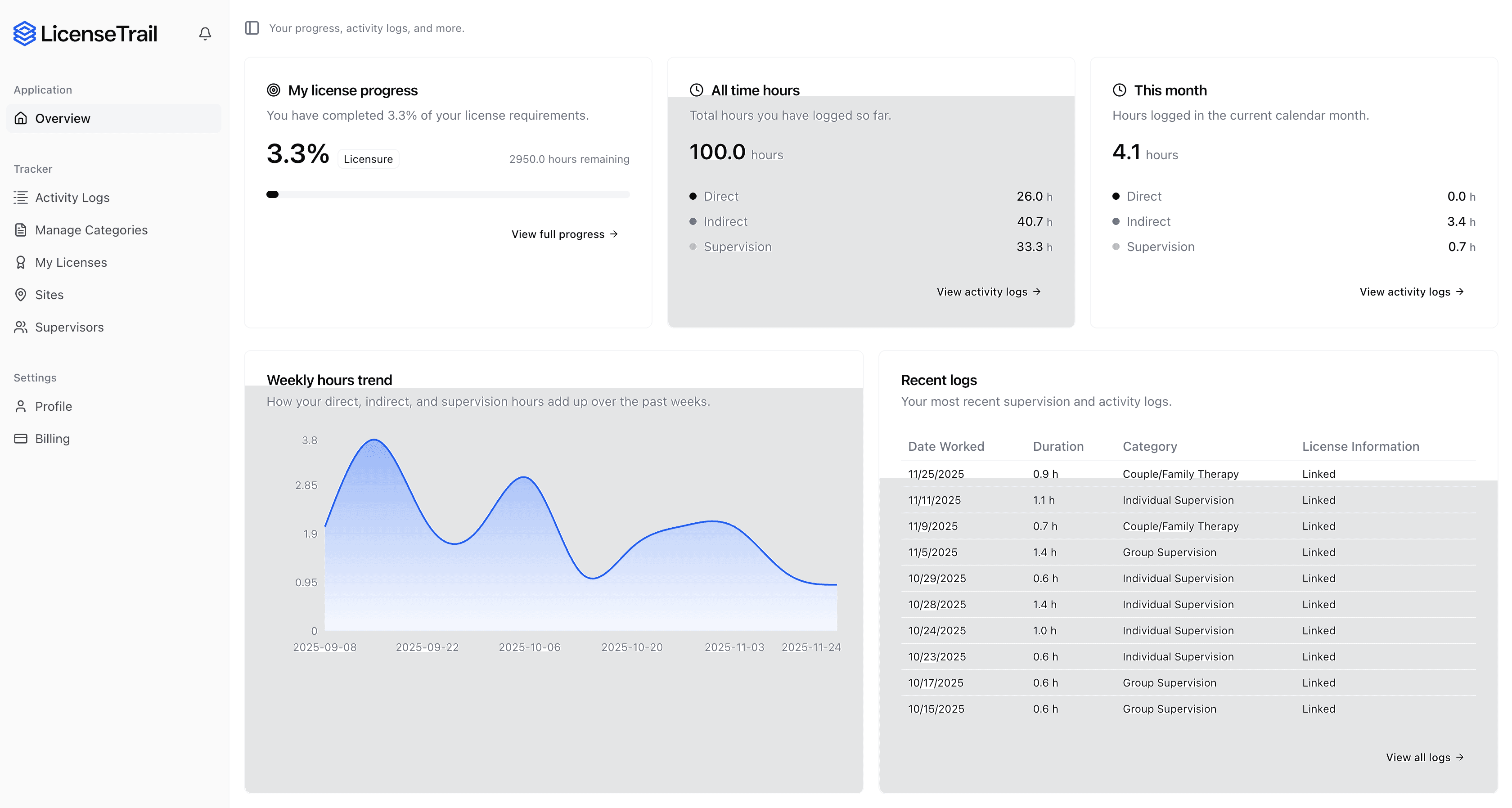 Start Tracking for Free
No credit card required · Free plan available
Related Licenses
Is your spreadsheet hiding Alabama LAMFTA risks?
Stop guessing if your categories match Alabama Board of Examiners in Marriage and Family Therapy requirements. License Trail checks your direct, indirect, and supervision hours continuously and flags mismatches before you submit.
Import or log
Bring your spreadsheet or start fresh
Upload your existing tracking spreadsheet and we'll map every hour into the right Alabama Board of Examiners in Marriage and Family Therapy categories automatically.
Verify against Alabama
Catch mismatches before the board does
License Trail checks your direct, indirect, and supervision hours against Alabama LAMFTA requirements continuously.
Export board-ready
One-click clean reports
Generate professional, board-ready reports for supervision meetings and Alabama Board of Examiners in Marriage and Family Therapy submissions in seconds.
No credit card required · Free plan available