
Alabama LPC Requirements: Hours, Exams & Step-by-Step Guide
Stop guessing if your categories match Alabama requirements. License Trail checks your direct, indirect, and supervision hours against LPC requirements continuously and flags mismatches before you submit.
No credit card required · Free plan available
Quick Requirements Overview
- Qualifying degree (effective 1/1/2024): Master’s in Counseling, CACREP/CORE or CACREP‑equivalent, 60 semester hrs (90 quarter hrs)
- Degree fieldwork: Practicum 100 hrs (≥40 direct; ≥80% counseling) + Internship 600 hrs (≥240 direct; ≥80% counseling); cannot count toward post‑degree hours
- Must obtain ALC first: No supervised‑experience hours count until ALC is issued; file ALC application + fee + Proposed Plan of Supervision with ABEC‑approved LPC‑S
- Supervision minimums (annual avg): 100 hrs/yr supervision total; ≥50 hrs/yr individual “Direct Supervision” (≥25 in‑person; up to 25 virtual if LPC‑S has tele‑supervision training) + 50 hrs/yr “Other Supervision”
- Post‑master’s experience for LPC: 3,000 hrs supervised experience = 2,250 direct counseling + 750 indirect (e.g., documentation/consultation/referrals), under the named LPC‑S
- Experience reduction option: Each 15 extra grad semester hrs (22.5 quarter) beyond the master’s may reduce experience by 1,000 hrs, but cannot go below 2,000 total (min 1,500 direct / 500 indirect)
- Exam: Pass NCE (timing allowed after education and/or after supervised experience per ABEC exam option)
- LPC application from ALC: Submit LPC application + fees + final supervision reports + CE as ALC (0.83 hrs/month since last renewal; incl. ≥2 ethics hrs) + required references/endorsements
License Details

Procedures
Becoming a Licensed Professional Counselor (LPC) in Alabama is a multi‑step process that runs through the Alabama Board of Examiners in Counseling (ABEC). The process revolves around three pillars:
- A qualifying graduate counseling degree
- A period of supervised practice as an Associate Licensed Counselor (ALC)
- A national counseling examination and a formal LPC application to ABEC
Below is a step‑by‑step outline with the specific hour requirements and the Board’s own terminology.
1. Educational foundation
Alabama ties both ALC and LPC eligibility to the same graduate education standards.
1.1 Required degree
Effective January 1, 2024, ABEC defines a qualifying degree as:
- A master’s degree in counseling that is:
- From a CACREP- or CORE‑accredited counseling program, or
- From a regionally accredited program with “CACREP‑equivalent” content,
- Consisting of at least 60 graduate semester hours (or 90 quarter hours), and
- Including specific core counseling content areas. (abec.alabama.gov)
ABEC states that “[a]ll applicants shall have a master’s degree in counseling from a CACREP…accredited program or CACREP equivalent.” (abec.alabama.gov)
1.2 Practicum and internship (pre‑degree)
Within that degree, the Board requires:
-
Practicum
- 100 clock hours total
- At least 40 hours of direct service work with clients
- At least 80% of those direct hours must be actual counseling sessions (no more than 20% may be assessment) (abec.alabama.gov)
-
Internship
- 600 clock hours total
- At least 240 hours of direct service work with clients
- Again, at least 80% of direct hours must be counseling sessions; no more than 20% may be assessment (abec.alabama.gov)
These practicum and internship hours cannot be counted toward the post‑degree supervised experience for LPC licensure; they are part of your degree, not your licensure experience. (abec.alabama.gov)
2. Step one after graduation: Become an Associate Licensed Counselor (ALC)
You cannot begin counting LPC supervision/experience hours until you hold an ALC license.
ABEC is explicit that “[n]o accrual of required supervised experience shall occur until the Associate Licensed Counselor license has been issued.” (abec.alabama.gov)
2.1 Apply for ALC
You must:
- Meet the education requirements noted above
- Submit the ALC Initial License Application and fee
- File a Proposed Plan of Supervision (PPoS) naming an ABEC‑approved Supervising Counselor (LPC‑S) (abec.alabama.gov)
Once ABEC approves your PPoS and issues your ALC license, you may begin accruing supervised experience hours toward LPC.
3. Supervision as an ALC: how the Board defines it
Supervision is separate from your client service hours, but it must occur alongside them and meet minimums.
3.1 Minimum annual supervision hours
Your Supervising Counselor must:
- “Personally provide to the ALC a minimum annual average of one hundred (100) hours” of supervision (abec.alabama.gov)
ABEC further breaks those 100 hours down as:
- At least 50 hours annually of “direct” one‑to‑one individual supervision, of which:
- 25 hours must be in‑person, one‑to‑one, real‑time, primarily focusing on client care
- The remaining 25 individual hours may be virtual if the LPC‑S has completed at least 2 hours of Board‑approved training in tele/virtual supervision (abec.alabama.gov)
- The other 50 hours annually can be met through “other supervision” methods (group supervision, additional virtual meetings, etc.) as allowed by ABEC law, codes, and rules. (abec.alabama.gov)
ABEC defines:
- “Direct Supervision” as individual, in‑person, one‑to‑one, real‑time supervision that primarily focuses on client care (virtual formats allowed if the LPC‑S has the required virtual supervision training). (abec.alabama.gov)
- “Other Supervision” as “other methods/techniques and hours of supervision” (i.e., any supervision that is not Direct Supervision). (abec.alabama.gov)
3.2 Only the named supervisor counts
Only counseling experience supervised by the Supervising Counselor identified on your ALC license may accrue toward the LPC experience requirement. Concurrent supervision for the same clients by another supervisor for another entity is prohibited. (abec.alabama.gov)
4. The heart of LPC licensure: 3,000 hours of supervised experience
Alabama focuses heavily on the type of post‑master’s experience you accumulate as an ALC.
4.1 Total hours and breakdown
ABEC states that LPC applicants “must have three thousand (3000) hours of supervised experience in professional counseling with Board approved supervision.” (abec.alabama.gov)
Those 3,000 supervised hours must include at minimum:
- 2,250 hours of “direct counseling service” with individuals, couples, families, or groups
- 750 hours of “indirect counseling services”, which ABEC describes as including, but not limited to, documentation, consultation, and referral development (abec.alabama.gov)
In other words, Alabama does not use a “1,500 direct / 1,500 supervised” model. Instead, the Board’s current rule is:
3,000 hours of supervised experience in professional counseling, including 2,250 hours of direct counseling service and 750 hours of indirect counseling services. (abec.alabama.gov)
4.2 What “direct” vs. “indirect” experience means
-
Direct counseling service
- Face‑to‑face (in‑person or via allowed telehealth) counseling and psychotherapy with clients (individuals, couples, families, groups).
- Alabama also expects that the majority of direct service, as in practicum and internship, be actual counseling sessions rather than testing or assessment. (abec.alabama.gov)
-
Indirect counseling services
- Non‑face‑to‑face professional activities directly associated with client care, including documentation, consultation, and referral development, among similar tasks. (abec.alabama.gov)
These 3,000 hours must be post‑master’s, accrued while you are licensed as an ALC, under Board‑approved supervision. You cannot count pre‑degree practicum/internship hours or work done after becoming fully licensed elsewhere.
5. Option to reduce supervised hours with extra graduate coursework
Alabama allows certain additional graduate coursework to substitute for part of the 3,000 hours—within strict limits.
5.1 How the reduction works
ABEC rule 255‑X‑3‑.01(3)(b)2 provides that an applicant:
- May subtract 1,000 hours of required professional experience for every:
- 15 graduate semester hours, or
- 22.5 quarter hours
- Obtained beyond the master’s degree,
- From a regionally accredited college or university,
- So long as those courses are:
- “Clearly related to the field of professional counseling,” and
- Focused on specified counseling areas (counseling theory and practice, human growth and development, social and multicultural foundations, helping relationships, group dynamics, lifestyle and career development, appraisal, research and evaluation, or professional orientation) (abec.alabama.gov)
However:
- You can never reduce below 1,000 hours of supervised experience. (abec.alabama.gov)
- Graduate coursework used for this reduction cannot also be used as continuing education for license renewal, and vice versa. (abec.alabama.gov)
5.2 How the Board allocates the reduced hours
If the Board grants a 1,000‑hour reduction, those hours are applied as:
- 750 hours subtracted from the direct counseling service requirement, and
- 250 hours subtracted from the indirect counseling service requirement. (abec.alabama.gov)
So, for example, if you qualify for a 1,000‑hour reduction, your minimum remaining required experience becomes:
- 1,500 direct counseling service hours
- 500 indirect counseling service hours
Total: 2,000 hours of supervised experience, rather than 3,000. (abec.alabama.gov)
6. Examination: National Counselor Examination (NCE)
Alabama requires that LPC applicants pass a professional counseling examination as required by statute. (abec.alabama.gov)
In practice, ABEC uses the National Counselor Examination (NCE), administered by NBCC:
- ABEC’s accommodations FAQ notes that “accommodation requests are directed towards the taking of the National Counselor Examination (NCE),” and the Board processes accommodation requests before notifying NBCC. (abec.alabama.gov)
- ABEC’s home page includes a link to request an NCE test letter, which you use to register for the exam. (abec.alabama.gov)
You may take the exam after meeting the educational requirements or after completing your supervised experience, per the ALC rule’s “Examination Option.” (abec.alabama.gov)
7. Transition from ALC to LPC
Once you have:
- Completed the required supervised experience hours (3,000 hours, or a reduced number if formally granted by the Board), and
- Passed the NCE,
you can apply for full LPC licensure.
7.1 Documentation you must provide
At LPC application, ABEC will expect:
- LPC (from ALC) Initial License Application and fees (abec.alabama.gov)
- Final supervision reports from your Supervising Counselor, documenting:
- Total supervised hours, and
- Direct vs. indirect counseling service hours that meet the 2,250/750 minimum (or adjusted minimum if you have an approved reduction). (abec.alabama.gov)
- Evidence of continuing education (CE) as an ALC since your last ALC renewal:
- ABEC requires ALCs seeking LPC licensure to show they have accrued 0.83 CE hours per month of ALC licensure since their last renewal, rounded up to the nearest whole hour. (abec.alabama.gov)
- These CE hours must include at least 2 clock hours in ethics (or, if you need just 1–2 hours total, they must both be ethics). (abec.alabama.gov)
- Any required references and endorsements demonstrating good character and professional integrity, as specified in the LPC rule and the application forms. (abec.alabama.gov)
After internal administrative, academic, and executive review, the application is sent to the Board for a vote on approval or denial. (abec.alabama.gov)
8. Quick reference: Alabama LPC hour requirements
Post‑master’s supervised experience (standard case)
- 3,000 hours of “supervised experience in professional counseling”, all:
- Completed after the ALC license is issued
- Under Board‑approved supervision by the LPC‑S named on the ALC license (abec.alabama.gov)
Breakdown within those 3,000 hours:
-
Direct counseling service
- 2,250 hours minimum
- Counseling services with individuals, couples, families, or groups (abec.alabama.gov)
-
Indirect counseling services
- 750 hours minimum
- Activities such as documentation, consultation, referral development, and related client‑care tasks (abec.alabama.gov)
Supervision hours (separate from the 3,000 experience hours)
Provided annually by your Supervising Counselor:
- 100 total hours of supervision per year, including at least:
- 50 hours of Direct Supervision, of which
- 25 hours must be in‑person, individual, one‑to‑one, real‑time, primarily focused on client care
- Up to 25 hours may be virtual if the LPC‑S has required tele‑supervision training
- 50 hours of Other Supervision (group and/or other approved modalities) (abec.alabama.gov)
- 50 hours of Direct Supervision, of which
With an approved reduction for extra graduate coursework:
- For each 15 extra semester / 22.5 quarter graduate hours (meeting Board criteria), you may subtract 1,000 hours of supervised experience, but you must still complete at least:
- 1,500 hours direct counseling service
- 500 hours indirect counseling services
- Total 2,000 hours at minimum, even with the reduction (abec.alabama.gov)
In sum, to be licensed as an LPC by the Alabama Board of Examiners in Counseling you must: complete a qualifying 60‑hour counseling master’s degree (with approved practicum and internship), obtain an ALC license and Board‑approved supervision, accumulate 3,000 supervised hours of professional counseling (2,250 direct / 750 indirect) under that ALC license (or a reduced but still substantial amount with extra graduate coursework), pass the NCE, maintain required CE as an ALC, and then successfully apply for LPC licensure with full documentation of your supervised experience and supervision.
Track your LPC hours with confidence
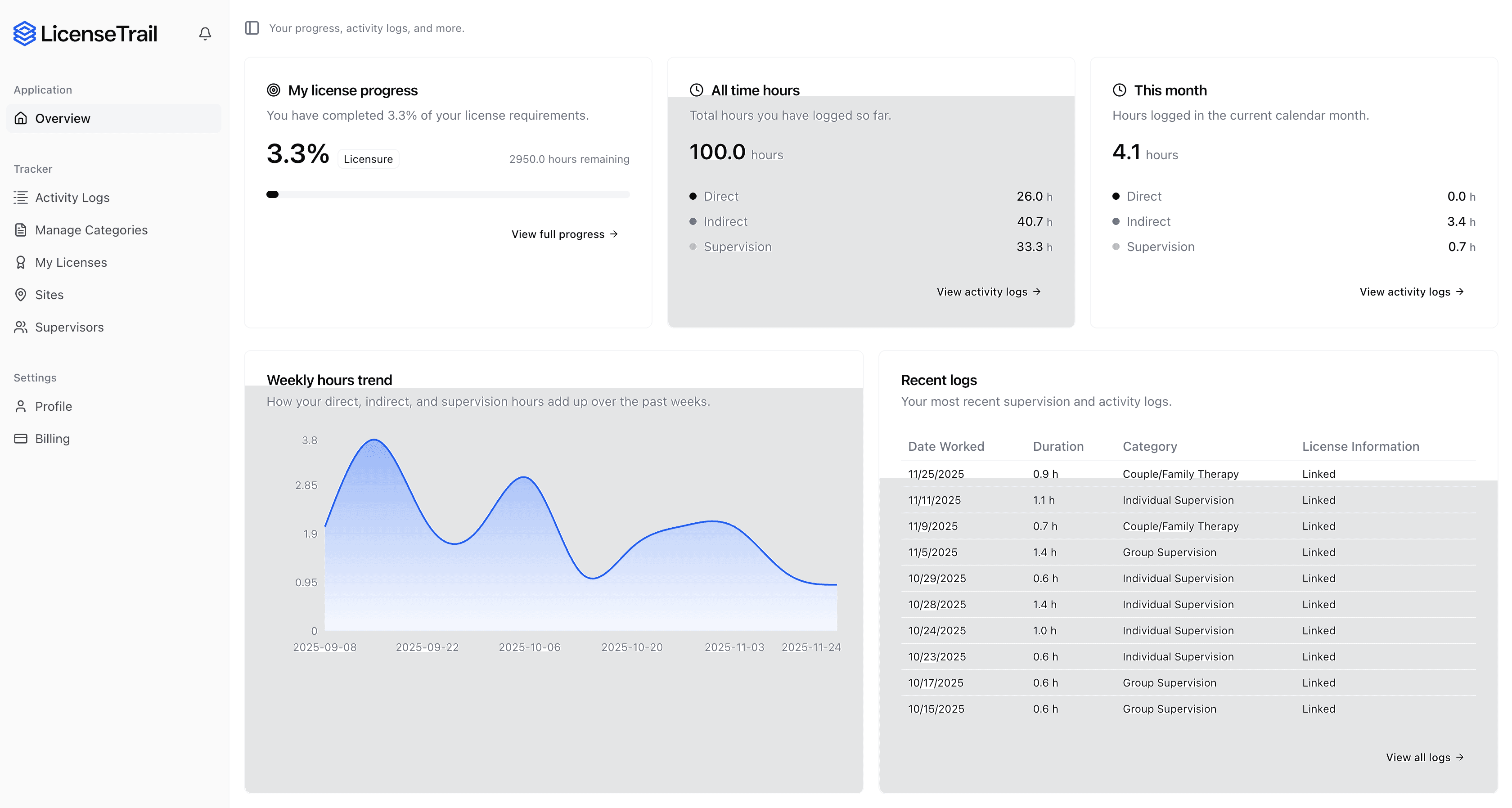
License Trail checks your direct, indirect, and supervision hours against Alabama LPC requirements continuously and flags mismatches before you submit.
 Start Tracking for Free
No credit card required · Free plan available
Is your spreadsheet hiding Alabama LPC risks?
Stop guessing if your categories match Alabama Board of Examiners in Counseling requirements. License Trail checks your direct, indirect, and supervision hours continuously and flags mismatches before you submit.
Import or log
Bring your spreadsheet or start fresh
Upload your existing tracking spreadsheet and we'll map every hour into the right Alabama Board of Examiners in Counseling categories automatically.
Verify against Alabama
Catch mismatches before the board does
License Trail checks your direct, indirect, and supervision hours against Alabama LPC requirements continuously.
Export board-ready
One-click clean reports
Generate professional, board-ready reports for supervision meetings and Alabama Board of Examiners in Counseling submissions in seconds.
No credit card required · Free plan available