
Alabama N/A Requirements: Hours, Exams & Step-by-Step Guide
Stop guessing if your categories match Alabama requirements. License Trail checks your direct, indirect, and supervision hours against N/A requirements continuously and flags mismatches before you submit.
No credit card required · Free plan available
Quick Requirements Overview
- Credential/Title: “Licensed Psychological Technician” only; may not use “psychologist.”
- Eligibility: ≥19 years old, good moral character, no unethical practice; must pass required exams; cannot have failed a Board exam within prior 6 months.
- Education: Master’s in psychology from a regionally accredited institution or master’s-equivalent from an APA-accredited doctoral program (Board-determined).
- Program minimums: At least 2 academic years; at least 1 academic year (30 semester hrs/45 quarter hrs) in residence at the degree-granting institution.
- Coursework: ≥45 semester hrs (68 quarter hrs) in standard psychology; ≥9 semester hrs across ≥3 basic substantive areas; plus 3-semester-hr assessment course and 3-semester-hr intervention techniques course (practicum and thesis each capped at 6 semester hrs).
- Practicum (pre-licensure hours): ≥500 supervised hours over ≥6 months; ≥50% direct client contact (≥250 hrs); supervision at least 1 face-to-face hour per 5 client-contact hours; ≥60% of supervision by a licensed psychologist.
- Application items: Board application (notarized), official transcripts sent by registrars, chronological work history, 4 references (incl. grad program, licensed psychologist/LPT, and practicum supervisor for post‑9/1/2000), fingerprints/background check via ALEA/FBI; application fee $260; submit by 1st day of odd-numbered months for next Board meeting.
- Exams & ongoing requirements: Pass EPPP (scaled 400 for technicians) and PSE (80%); post-licensure supervision required via Board-approved contract (levels tied to 3,000+ and 10,500+ supervised-practice hours); annual renewal/CE: 10 CE hours/year, renewal due Oct 15.
License Details
Procedures
Becoming a Licensed Psychological Technician in Alabama involves a very specific combination of graduate education, supervised practicum hours, examinations, and ongoing supervised practice under a licensed psychologist. The Alabama Board of Examiners in Psychology defines these requirements in statute (Title 34, Chapter 26, Code of Alabama) and in its Administrative Code (Title 750).
Below is a step‑by‑step outline grounded in that language, with emphasis on the exact types and amounts of hours the Board requires.
1. Understand the license and title
Alabama’s credential is “Licensed Psychological Technician.” The Board’s rules state that licensees must use the designation “Licensed Psychological Technician” on letterheads, professional cards, and other displays, and that psychological technicians may not use the title “psychologist.” (law.cornell.edu)
A psychological technician is a master’s‑level licensee who practices under defined limits and supervision, and may directly provide certain testing, screening, and psychoeducational services (with or without supervision, depending on the service) as specified in law and rule. (regulations.justia.com)
2. Meet basic eligibility requirements
Under Alabama Administrative Code r. 750‑X‑2A‑.01, a candidate for licensure as a psychological technician must provide evidence that they: (law.cornell.edu)
- Are at least 19 years of age.
- Are of good moral character.
- Hold a qualifying master’s degree in psychology (details in Section 3), or the equivalent of a master’s from an APA‑accredited doctoral program, as determined by the Board.
- Are “competent as a psychological technician” as shown by passing Board‑prescribed examinations (EPPP and PSE; see Section 6).
- Are not engaged in unethical practice, as defined by the APA Ethics Code.
- Have not failed a Board examination within the preceding six months.
There is no separate pre‑licensure work‑experience hour requirement like “1,500 hours of direct experience plus 1,500 hours of supervised experience” before you can sit for exams. Instead, Alabama embeds a 500‑hour supervised practicum inside the degree program (see Section 4) and then regulates hours of supervised practice after licensure (see Section 7).
3. Complete the required graduate education
3.1. Degree level and institutional accreditation
The training rule for psychological technicians (Ala. Admin. Code r. 750‑X‑2A‑.04) requires: (law.cornell.edu)
- A master’s degree in psychology from a regionally accredited institution, with the program publicly identified and clearly labeled as a psychology program, or
- Completion of the equivalent of a master’s degree from an APA‑accredited doctoral program in psychology, as determined by the Board.
3.2. Duration and residency
The program must: (regulations.justia.com)
- Encompass the equivalent of a minimum of two academic years.
- Include at least one academic year of full‑time graduate study in residence at the degree‑granting institution.
- Treat one year of residency as 30 semester hours or 45 quarter hours taken on a full‑ or part‑time basis at that institution.
3.3. Required coursework and credit hours
The Board specifies both content and quantity of graduate coursework: (law.cornell.edu)
- At least 9 graduate semester hours in basic substantive areas of psychology, representing at least three different substantive areas (e.g., ethics, experimental, developmental, tests and measurement, social, statistics, history and systems, personality theory, learning, physiological, abnormal, etc.).
- A minimum of 45 semester hours (or 68 quarter hours) of graduate study in standard psychology courses (e.g., social, experimental, physiological, developmental, history and systems, statistics and research design).
- A minimum 3‑semester‑hour graduate course in psychological assessment.
- A minimum 3‑semester‑hour graduate course in intervention techniques.
The Board also caps certain credits: no more than 6 semester (or 9 quarter) hours may be counted for practicum, and no more than 6 semester (or 9 quarter) hours for thesis. (law.cornell.edu)
4. Complete the required practicum / field experience hours
Alabama’s only explicit pre‑licensure hour requirement is in the required practicum or field experience within the degree program. The rule provides that the program must include practica or other field experience appropriate to psychological technician practice, and that: (law.cornell.edu)
- Duration: The training “shall last a minimum of six months”.
- Total hours: The training “shall… consist of at least 500 hours of supervised training.”
- Direct client contact: At least 50% of those hours must be in direct contact with patients or clients.
- In other words, you must complete at least 500 total practicum hours, of which a minimum of 250 hours must be direct service (e.g., assessment, intervention, interviewing) with clients.
- Nature of the experience: It must be a planned or directed program of training in psychology, integrated with your educational program and distinguished from on‑the‑job training. The training is planned by program faculty, not by the trainee.
- Training site supervision structure:
- The training site must designate a licensed psychologist responsible for the “integrity and quality” of the training program.
- The site must provide at least one hour of face‑to‑face, primarily individual supervision for every five hours of client contact.
- At least 60% of the supervision hours must be provided by a licensed psychologist (the remainder may come from psychiatrists, social workers, or other qualified professionals).
- Trainees must be clearly designated as “practicum student” or another title that clearly indicates training status. (law.cornell.edu)
This practicum is normally documented by your graduate program and later by your practicum supervisor’s reference (see Section 5.4).
5. Prepare and submit your licensure application
5.1. Timing and deadlines
Under Ala. Admin. Code r. 750‑X‑2A‑.02, the application process must be completed by the first day of odd‑numbered months (January, March, May, July, September, November) to be reviewed at the Board’s next regular meeting. (law.cornell.edu)
5.2. Application form and documentation
According to r. 750‑X‑2A‑.03: (law.cornell.edu)
- You must submit the Board’s psychological technician licensure application form, completed legibly and in detail.
- The application must include a complete list of job positions in chronological order.
- Official transcripts from each institution must be sent directly from the registrar to the Board.
- The degree‑granting institution must certify:
- The school/college that granted the degree;
- The exact name of the department;
- The exact title of the degree.
- The entire application form must be notarized.
- You must indicate whether you have ever previously applied for licensure in Alabama.
- You must include four references (see next subsection).
- You must include the licensure application fee or a fee‑waiver application, as allowed by the rules.
The Board’s fee schedule lists the Psychological Technician Application Fee as $260, due on submission. (psychology.alabama.gov)
5.3. Criminal background check
All applicants for licensure must complete a criminal history background check: (law.cornell.edu)
- Submit fingerprints on Board‑supplied cards and execute a criminal history information release.
- Provide the Board with the fingerprint cards and a cashier’s check or money order payable to the Alabama State Law Enforcement Agency (ALEA) in an amount sufficient to cover the background‑check cost.
- ALEA forwards fingerprints to the FBI for a national criminal history record check.
5.4. Required references
Rule 750‑X‑2A‑.05 requires four positive references, and it specifies the sources: (regulations.justia.com)
- At least one reference from your graduate program.
- At least one from a licensed psychologist or licensed psychological technician.
- For applications after September 1, 2000, one must be from your practicum supervisor.
If a particular required reference truly cannot be obtained, the Board may consider alternative references on a case‑by‑case basis.
6. Pass the required examinations (EPPP and PSE)
Alabama uses two examinations for psychological technicians: the national EPPP and a state‑specific ethics/law exam.
6.1. EPPP (Examination for Professional Practice in Psychology)
The Board’s examination rule (r. 750‑X‑3‑.01) states that the written examination includes the EPPP, developed by the Association of State and Provincial Psychology Boards, as a measure of professional competence in psychology. (regulations.justia.com)
For psychological technicians specifically, the rule sets a distinct passing score:
- The passing score for psychological technicians is an ASPPB scaled score of 400 on computer‑based administrations, or 60% correct on paper‑and‑pencil administrations. (regulations.justia.com)
Timing and re‑examination:
- Once admitted to the EPPP, you must take it within one year of the Board’s letter of admission, or you’ll need a new licensure application.
- After two EPPP failures, a new licensure application is required. (regulations.justia.com)
- Separate rule 750‑X‑3‑.03 provides that you must wait at least six months before retaking the EPPP or PSE; if you re‑take within one year of that six‑month wait, you do not need a new licensure application, but you must pay the exam fee again. (law.cornell.edu)
6.2. Professional Standards Examination (PSE)
In addition to the EPPP, the Board administers the Professional Standards Examination (PSE). The rule specifies that the PSE covers: (regulations.justia.com)
- The APA Ethical Principles of Psychologists and Code of Conduct, and
- Alabama psychology law.
Key points:
- A minimum score of 80% is required to pass.
- Failing the PSE does not require retaking the EPPP, but you must pass the PSE before any license is granted.
- As with the EPPP, you must take the PSE within one year of admission to the exam. (regulations.justia.com)
7. Understand supervised practice requirements after licensure
Alabama regulates how much ongoing supervision a Licensed Psychological Technician must receive from a licensed psychologist. These are not pre‑licensure experience hours; they are post‑licensure supervised practice requirements that continue throughout your career.
The supervision rule (r. 750‑X‑2A‑.07) divides supervision into three levels based on years and hours of supervised practice as a licensed psychological technician: (law.cornell.edu)
7.1. Level I supervision
Level I applies to a psychological technician who has less than two calendar years of supervised practice as a licensed psychological technician and whose supervised practice is described as “consisting of at least 3,000 hours of supervised practice.” (law.cornell.edu)
For Level I technicians, minimum monthly supervision is:
- 1–20 hours/month in activities requiring supervision → 2 hours of supervision/month.
- 21–30 hours/month → 3 hours of supervision/month.
- 31–40 hours/month → 4 hours of supervision/month.
- 41–60 hours/month → 5 hours of supervision/month.
- 61+ hours/month → 6 hours of supervision/month. (law.cornell.edu)
7.2. Level II supervision
Level II is for a psychological technician with a minimum of two calendar years of supervised practice as a licensed psychological technician, comprising at least 3,000 hours of supervised practice. (law.cornell.edu)
For Level II, minimum monthly supervision is:
- 1–20 hours/month requiring supervision → 1 hour of supervision/month.
- 21–60 hours/month → 2 hours of supervision/month.
- 61–100 hours/month → 3 hours of supervision/month.
- 101+ hours/month → 4 hours of supervision/month. (law.cornell.edu)
To be approved for Level II, the technician must: (law.cornell.edu)
- Apply to the Board on its application form.
- Have received at least one calendar year of supervision from the most recent supervisor.
- Provide a written recommendation from the most recent supervisor plus letters from all available previous supervisors.
7.3. Level III supervision
Level III is for a psychological technician with a minimum of seven calendar years of supervised practice as a licensed psychological technician, totaling at least 10,500 hours of supervised practice. (law.cornell.edu)
For Level III, minimum monthly supervision is:
- 1–50 hours/month → 1 hour of supervision/month.
- 51+ hours/month → 2 hours of supervision/month. (law.cornell.edu)
To be approved for Level III, the technician must again apply, have at least one calendar year of supervision from the most recent supervisor, and provide supporting recommendation letters. (law.cornell.edu)
7.4. Supervision contracts and duties
The rule also requires: (law.cornell.edu)
- A written supervision contract (on a Board‑adopted form) filed and accepted before any practice.
- Separate contracts for each work setting and, if necessary, for each supervisor.
- Supervisors must co‑sign appropriate documents, keep supervision records, report annually to the Board, and file a final supervision report when supervision ends.
- Supervision must be primarily face‑to‑face, one‑on‑one.
- The technician must attend supervision, disclose services provided, update the contract when conditions change, and obtain written client consent informing clients of the supervisory arrangement.
Failure to comply with supervisee duties is classified as a Class C misdemeanor. (law.cornell.edu)
8. Maintain licensure through continuing education and renewal
8.1. Annual continuing education (CE) hours
For Licensed Psychological Technicians, the continuing‑education rule (r. 750‑X‑3A‑.03) states: (regulations.justia.com)
- 10 hours of continuing education per year are required for license renewal.
- One CE hour is defined as at least 50 minutes of learning.
- CE credit is accrued annually from October 1 through September 30.
- Up to 3 hours earned in a given year may be carried over to the next year, and must be reported by the annual renewal date (October 15). Carryover is limited to one year.
The rule incorporates the APA’s concept of continuing professional education and allows credit for APA‑approved programs (including online and independent study) that meet specified criteria. (regulations.justia.com)
8.2. Renewal dates and lapse of license
The license‑renewal rule (r. 750‑X‑4‑.01) provides that: (law.cornell.edu)
- Licensees must pay an annual renewal fee and a continuing education fee, and demonstrate fulfillment of CE to renew.
- As a courtesy, the Board mails renewal notices on or about August 15 each year.
- October 15 is the official renewal date.
- Failure to complete all renewal requirements by October 15 results in a lapsed license, and you may not practice (unless working in an exempt setting) until reinstated.
The continuing‑education chapter further states that the Board reviews licensees for CE compliance no later than October 15 each year, and that failure to comply with CE requirements or CE fees results in a lapsed license that can be reinstated only after payment of all fees and submission of proof of CE. (regulations.justia.com)
9. How Alabama’s hours compare to “1,500 direct + 1,500 supervised” models
To address your example directly:
- Alabama does not require a pre‑licensure breakdown such as 1,500 hours of direct experience and 1,500 hours of supervised (indirect) experience.
- Instead, the only explicit pre‑licensure hour requirement is the 500 hours of supervised practicum, with at least half (≥250 hours) in direct client contact, conducted under structured supervision within a qualifying graduate psychology program. (law.cornell.edu)
- The larger hour thresholds—3,000 hours of supervised practice (for moving from Level I to Level II) and 10,500 hours of supervised practice (for Level III)—are post‑licensure practice hours that determine how much ongoing supervision you must receive, not a prerequisite to initial licensure. (law.cornell.edu)
This summary reflects Alabama law and Board rules current through the most recent updates available as of mid‑2025. Because licensing regulations can change, applicants should always confirm details directly with the Alabama Board of Examiners in Psychology (via its website or office) before relying on this information for application planning.
Track your N/A hours with confidence
License Trail checks your direct, indirect, and supervision hours against Alabama N/A requirements continuously and flags mismatches before you submit.
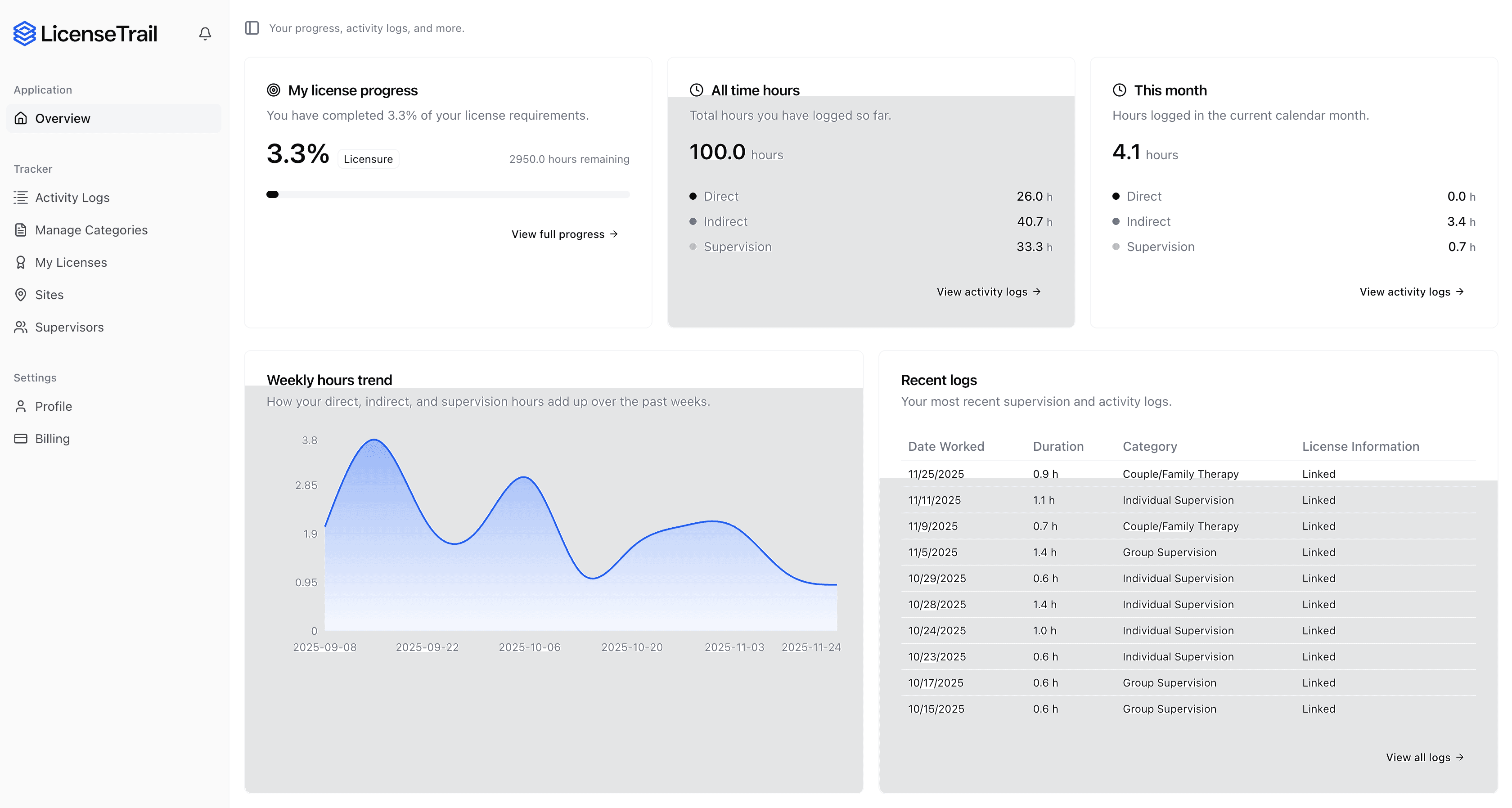 Start Tracking for Free
No credit card required · Free plan available
Related Licenses
Is your spreadsheet hiding Alabama N/A risks?
Stop guessing if your categories match Alabama Board of Examiners of Psychologists requirements. License Trail checks your direct, indirect, and supervision hours continuously and flags mismatches before you submit.
Import or log
Bring your spreadsheet or start fresh
Upload your existing tracking spreadsheet and we'll map every hour into the right Alabama Board of Examiners of Psychologists categories automatically.
Verify against Alabama
Catch mismatches before the board does
License Trail checks your direct, indirect, and supervision hours against Alabama N/A requirements continuously.
Export board-ready
One-click clean reports
Generate professional, board-ready reports for supervision meetings and Alabama Board of Examiners of Psychologists submissions in seconds.
No credit card required · Free plan available