
Alaska LPC Requirements: Hours, Exams & Step-by-Step Guide
Stop guessing if your categories match Alaska requirements. License Trail checks your direct, indirect, and supervision hours against LPC requirements continuously and flags mismatches before you submit.
No credit card required · Free plan available
Quick Requirements Overview
- Degree/Credits: Master’s or doctoral in counseling or related field from approved accredited institution; ≥60 graduate semester hours in counseling
- Exam: Pass NCE or NCMHCE; scores sent directly from NBCC; must be licensed within 3 years of passing or retake
- Post-degree Experience: 3,000 hours supervised professional counseling after degree, over ≥2 years
- Direct Client Hours: Within the 3,000, ≥1,000 hours direct counseling (individual/couple/family/group)
- Supervision Hours/Structure: ≥100 hours face-to-face direct supervision; ≥50 hours one-on-one; remaining 50 may be group/individual; ≥1 hour/month while accruing hours
- Supervisor Qualifications: Supervision must be by Board-approved supervisor (12 AAC 62.200) (e.g., LPC, LCSW, LMFT, psychologist, physician/psychiatrist, psych assoc., psych-mental health ANP)
- Supervision Modality: Face-to-face may be in-person or synchronous audio-video tele-supervision (both audio & video, real-time)
- Other application items: Background report (AK + out-of-state if applicable), official transcripts, supervision verification forms, license verifications; SSN/exemption; must meet fitness/discipline disclosure requirements
License Details

Procedures
Licensure as a Licensed Professional Counselor (LPC) in Alaska is governed by Alaska Statutes (AS 08.29) and the Board of Professional Counselors’ regulations (12 AAC 62). The Board also publishes detailed application instructions that effectively function as its working interpretation of those laws.(commerce.alaska.gov)
Below is a step‑by‑step outline focused on the hours and supervision structure, with wording and structure taken directly from the statute, regulations, and the Board’s own application materials.
1. Governing Law and Board
- Licensing authority: Alaska Board of Professional Counselors, within the Department of Commerce, Community, and Economic Development.(commerce.alaska.gov)
- Primary law: Alaska Statutes, Chapter 29 – Licensed Professional Counselors (AS 08.29).(commerce.alaska.gov)
- Primary regulations: 12 AAC 62 (especially 12 AAC 62.100–120, 62.200–220, 62.300–320).(commerce.alaska.gov)
When the Board reviews your application, it is checking that you meet AS 08.29.110 (qualifications for licensure) and the related regulations.(commerce.alaska.gov)
2. Educational Requirements
The Board will issue an LPC license only if you can show that you meet the education requirements in AS 08.29.110(a)(5) and the parallel requirements in the application. In practice, this means:(commerce.alaska.gov)
-
Graduate degree:
- Either:
- An earned doctoral degree in counseling or a related professional field, or
- An earned master’s degree in counseling or a related professional field.
- The degree must come from a regionally or nationally accredited institution approved by the Board.(commerce.alaska.gov)
- Either:
-
Minimum credit hours:
- You must document at least 60 graduate semester hours in counseling (during or after the master’s degree, if you are applying on a master’s).(commerce.alaska.gov)
-
“Related field” – Board definition:
- The regulations define a “related professional field” to include psychology, marital and family therapy, social work, and applied behavioral science.(commerce.alaska.gov)
If your degree title is in a related field rather than “counseling,” the Board requires you to submit an Educational Coursework Check Sheet demonstrating that your coursework meets the counseling content requirements.(commerce.alaska.gov)
3. Examination Requirement
Alaska uses a nationally recognized counseling exam as its licensure examination. The regulations and application instructions specify that:(commerce.alaska.gov)
- You must pass either:
- The National Counselor Examination for Licensure and Certification (NCE), or
- The National Clinical Mental Health Counseling Examination (NCMHCE),
both administered by the National Board for Certified Counselors (NBCC).(commerce.alaska.gov)
- Exam scores must be sent directly from NBCC to the Alaska licensing division, and if you are not issued an initial license within three years of passing, you must retake the exam.(commerce.alaska.gov)
4. Core Supervised Experience Requirement
(This is where the hour breakdown and terminology become very specific.)
4.1 Total hours and time frame
AS 08.29.110(a)(6) and the Board’s application instructions require that, after you earn your qualifying degree, you must complete either:(commerce.alaska.gov)
- A Board‑authorized associate counselor program (not widely in use yet), or
- At least 3,000 hours of supervised experience in the practice of professional counseling.
The statute and the Board’s instructions require that those 3,000 hours:(commerce.alaska.gov)
- Be performed over a period of at least two years, and
- Be completed after you have received your master’s or doctoral degree (pre‑degree practicum/internship does not count).
The Board’s current application instructions explicitly say that the supervised experience “must be completed after having received your degree” and that supervision hours only count after you earned the degree referenced in AS 08.29.110.(commerce.alaska.gov)
4.2 Required types of hours within the 3,000
Within those 3,000 hours of supervised experience in the practice of professional counseling, Alaska law further breaks down the types of hours:(commerce.alaska.gov)
-
Direct counseling hours (client contact):
- At least 1,000 hours must be “direct counseling with individuals, couples, families, or groups.”(commerce.alaska.gov)
- This is face‑to‑face clinical work (in person or via approved telehealth platforms) where you are actively providing counseling services as defined in the statute’s “practice of professional counseling” section (for example, assessment, diagnosis, and treatment of mental and emotional disorders; counseling individuals and groups; using counseling theories and methods).(commerce.alaska.gov)
-
Supervision hours:
- At least 100 hours of direct supervision are required as part of the 3,000. The statute calls for “at least 100 hours of direct supervision” by an approved supervisor.(commerce.alaska.gov)
- The regulations then specify that these 100 hours are face‑to‑face supervised experience and break down how they must be structured:(commerce.alaska.gov)
- At least 50 hours must be in a one‑on‑one setting with a Board‑approved counselor supervisor.
- The remaining 50 hours may be:
- One‑on‑one, or
- In a group supervision setting, as long as the supervisor is Board‑approved.
- You must have a minimum of one hour of supervision each month while you are accruing supervised experience.
-
The remaining hours (up to 1,900 hours):
- After you meet the minimum 1,000 direct counseling hours and 100 supervision hours, the balance (up to 1,900 hours) can be additional supervised counseling practice.
- Regulations require that supervised experience “include experience in those professional counseling skills included in the definition of ‘practice of professional counseling’” in the statute.(commerce.alaska.gov)
- In practical terms, these hours typically include:
- Additional direct counseling,
- Intake and assessment,
- Treatment planning and documentation,
- Case consultation and coordination,
- Other counseling tasks, all under the oversight of your approved supervisor.
Alaska does not split the 3,000 hours into “3,000 direct vs. 3,000 supervised” or “1,500 direct + 1,500 supervised” the way some states do. Instead, it requires a single block of 3,000 supervised counseling hours, inside which at least 1,000 must be direct client contact and at least 100 must be supervised hours with your supervisor.(commerce.alaska.gov)
4.3 Who can supervise and what “board‑approved” means
The statute and regulations require that your supervised experience be under the supervision of a board‑approved supervisor, and that the supervisor be certified before supervision begins.(commerce.alaska.gov)
The Board’s application instructions specify that your supervisor must hold a Board‑approved supervisor credential and be licensed as one of the following:(commerce.alaska.gov)
- Licensed Professional Counselor (LPC)
- Licensed Clinical Social Worker
- Licensed Marital and Family Therapist
- Licensed Psychologist
- Licensed Psychological Associate
- Licensed Physician or Psychiatrist
- Licensed Advanced Nurse Practitioner certified to provide psychiatric or mental health services
All supervisors must be approved by the Board under 12 AAC 62.200 before any of the supervised hours will count toward your 3,000.(commerce.alaska.gov)
4.4 What counts as “face‑to‑face” supervision (including telehealth)
The supervision regulations define both format and technology for “face‑to‑face” supervision:(commerce.alaska.gov)
- “Face‑to‑face” is defined as real‑time communication where the supervisor and applicant are able to communicate at the same time (synchronously).
- Supervision can be:
- In person, or
- By telephonic or electronic means using platforms such as Zoom, Microsoft Teams, or FaceTime, as long as:
- Audio and video are both active, and
- Supervisor and supervisee can see and hear each other in real time.
These remote sessions fully count toward the 100 required face‑to‑face supervision hours, provided the other conditions (Board‑approved supervisor, one‑on‑one vs. group distribution, minimum monthly hour) are met.(commerce.alaska.gov)
5. Additional Statutory Qualifications
In addition to the degree, exam, and supervised experience, AS 08.29.110(a) requires that an applicant:(commerce.alaska.gov)
- Be at least 18 years of age.
- Not be under current investigation in Alaska or another jurisdiction for actions that would violate the counseling statute.
- Not have had a license in counseling, psychology, marital and family therapy, or social work suspended, revoked, or surrendered in lieu of discipline, unless it has been fully reinstated.
The Board evaluates these issues through the application form and supporting documentation (professional fitness questions, explanations, and court records if applicable).(commerce.alaska.gov)
6. Application Packet and Documentation
The Board’s official “Professional Counselor License by Examination” packet (form #08‑4910, Rev. 07/01/2025) outlines what must be submitted before your application can be reviewed:(commerce.alaska.gov)
-
Application form
- Fully completed and signed application pages.
-
Fees
- As of July 2025:
- Application fee (non‑refundable): $200
- Initial license fee: $250
- Total due with application: $450.(commerce.alaska.gov)
- As of July 2025:
-
Official transcripts
- Sent directly from your graduate institution showing the qualifying degree and at least 60 graduate semester hours in counseling.(commerce.alaska.gov)
-
Educational coursework check sheet
- Required if your degree is in a related professional field rather than in counseling.(commerce.alaska.gov)
-
Verification of exam scores
- Official NCE or NCMHCE scores sent directly from NBCC.(commerce.alaska.gov)
-
Verification of supervised post‑degree experience
- A Board form (#08‑4910c) completed and signed by your approved supervisor(s), documenting:
- Total 3,000 hours of supervised experience,
- At least 1,000 hours of direct counseling with individuals, couples, families, or groups, and
- At least 100 hours of direct (face‑to‑face) supervision.(commerce.alaska.gov)
- A Board form (#08‑4910c) completed and signed by your approved supervisor(s), documenting:
-
Verification of any other licenses held
- License verifications from every jurisdiction where you have ever held a license in professional counseling, psychology, marital and family therapy, or social work.(commerce.alaska.gov)
-
Criminal justice / background checks
- A name‑based Alaska criminal justice report under AS 12.62, obtained from the Alaska State Troopers, issued no more than 90 days before the application.(commerce.alaska.gov)
- If your primary residence is outside Alaska, an equivalent criminal justice report from that state of residence is also required.
-
Social Security number and identification
- A U.S. Social Security number, or a Board‑approved exemption, must be on file before a license can be issued.(commerce.alaska.gov)
Applications are processed in order of receipt, and an application is considered abandoned if 12 months pass with no correspondence; at that point, the application is denied without prejudice and most fees are forfeited.(commerce.alaska.gov)
7. After You Are Licensed: Renewal and Continuing Education (Briefly)
While not part of initial licensure, the same statute and regulations immediately apply to you as a licensee.
Key points:(commerce.alaska.gov)
- License term: Two‑year cycle, expiring October 31 of odd‑numbered years, regardless of initial issuance date.
- Renewal requirement: Completion of continuing education (CE) in the 24 months before renewal:
- For periods beginning on or after November 1, 2023, each renewal requires:
- 40 contact hours of CE (under most circumstances),
- Including at least 3 hours in professional ethics,
- At least 3 hours in suicidality, and
- At least 3 hours in cultural competency,
- With at least 20 hours completed through synchronous (live) courses, seminars, or workshops.(commerce.alaska.gov)
- For periods beginning on or after November 1, 2023, each renewal requires:
8. Summary of Alaska LPC Hour Requirements in Plain Terms
Using the Board’s and statute’s own structure, the hour requirements to become an LPC in Alaska can be summarized as:
-
Total supervised experience:
- 3,000 hours of post‑degree, supervised experience in the practice of professional counseling, over at least two years.
-
Within that 3,000 hours:
- Minimum 1,000 hours of direct counseling with individuals, couples, families, or groups.
- Minimum 100 hours of direct (face‑to‑face) supervision with a Board‑approved supervisor, of which:
- At least 50 hours must be one‑on‑one supervision.
- Up to 50 hours may be in group or one‑on‑one formats.
- You must receive at least one hour of supervision each month.
-
Supervision format:
- Must be provided by a Board‑approved supervisor who holds one of the qualifying licenses.
- May occur in person or via real‑time audio‑video platforms (e.g., Zoom, Teams, FaceTime) as long as both audio and video are active and the interaction is synchronous.(commerce.alaska.gov)
These are the operative, Board‑defined requirements you must meet in order to be licensed as a Licensed Professional Counselor in Alaska.
Track your LPC hours with confidence
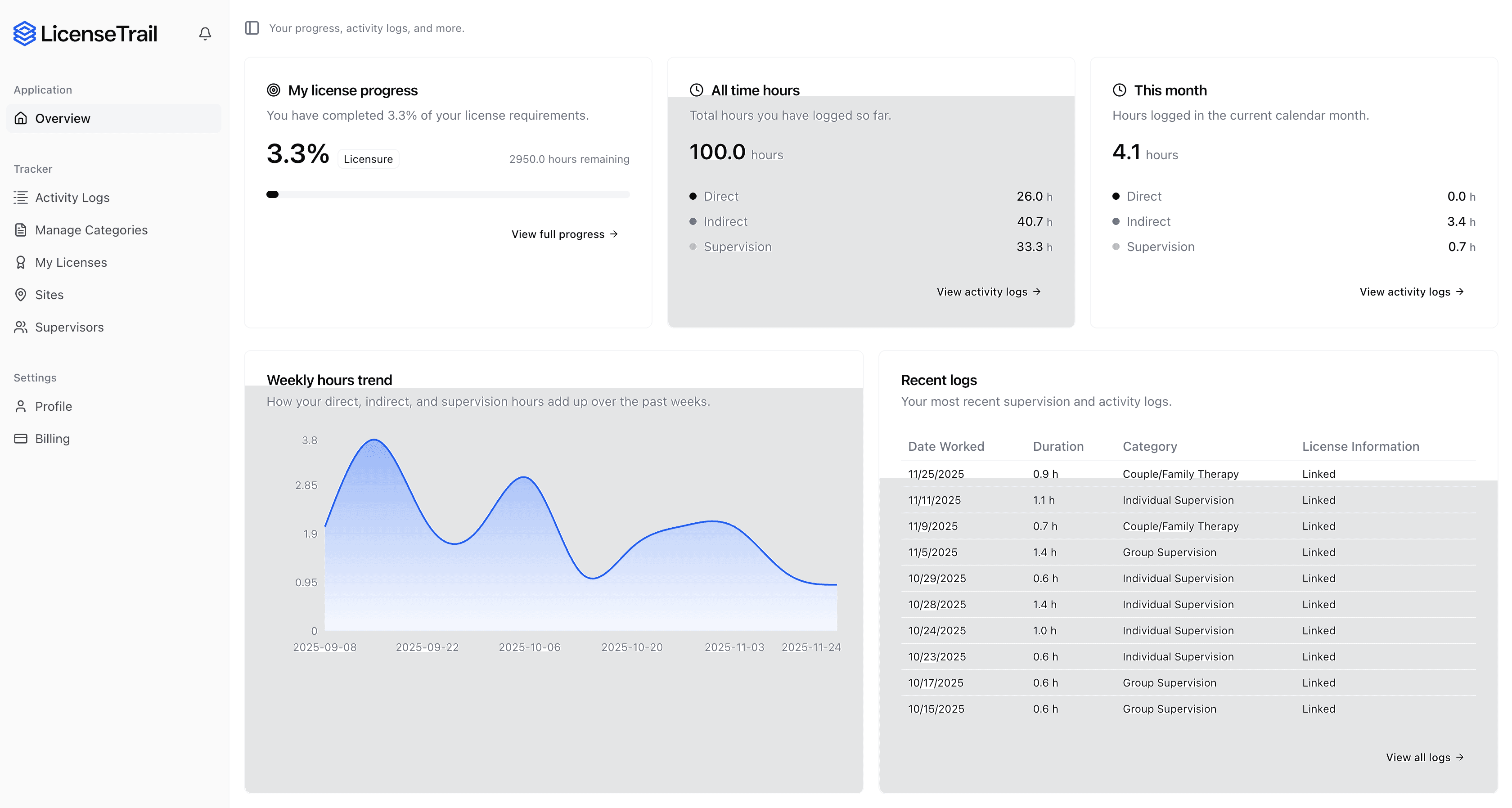
License Trail checks your direct, indirect, and supervision hours against Alaska LPC requirements continuously and flags mismatches before you submit.
 Start Tracking for Free
No credit card required · Free plan available
Is your spreadsheet hiding Alaska LPC risks?
Stop guessing if your categories match Alaska Board of Professional Counselors requirements. License Trail checks your direct, indirect, and supervision hours continuously and flags mismatches before you submit.
Import or log
Bring your spreadsheet or start fresh
Upload your existing tracking spreadsheet and we'll map every hour into the right Alaska Board of Professional Counselors categories automatically.
Verify against Alaska
Catch mismatches before the board does
License Trail checks your direct, indirect, and supervision hours against Alaska LPC requirements continuously.
Export board-ready
One-click clean reports
Generate professional, board-ready reports for supervision meetings and Alaska Board of Professional Counselors submissions in seconds.
No credit card required · Free plan available