
Alaska PSY-CR Requirements: Hours, Exams & Step-by-Step Guide
Stop guessing if your categories match Alaska requirements. License Trail checks your direct, indirect, and supervision hours against PSY-CR requirements continuously and flags mismatches before you submit.
No credit card required · Free plan available
Quick Requirements Overview
- Hold a current out-of-state psychologist license with standards essentially similar to or higher than Alaska’s (or be an ABPP diplomate in good standing); no Alaska exam retake (EPPP) required if approved via credentials
- Meet Alaska baseline education: earned doctoral degree with primary emphasis in psychology (clinical/counseling/educational or Board-equivalent)
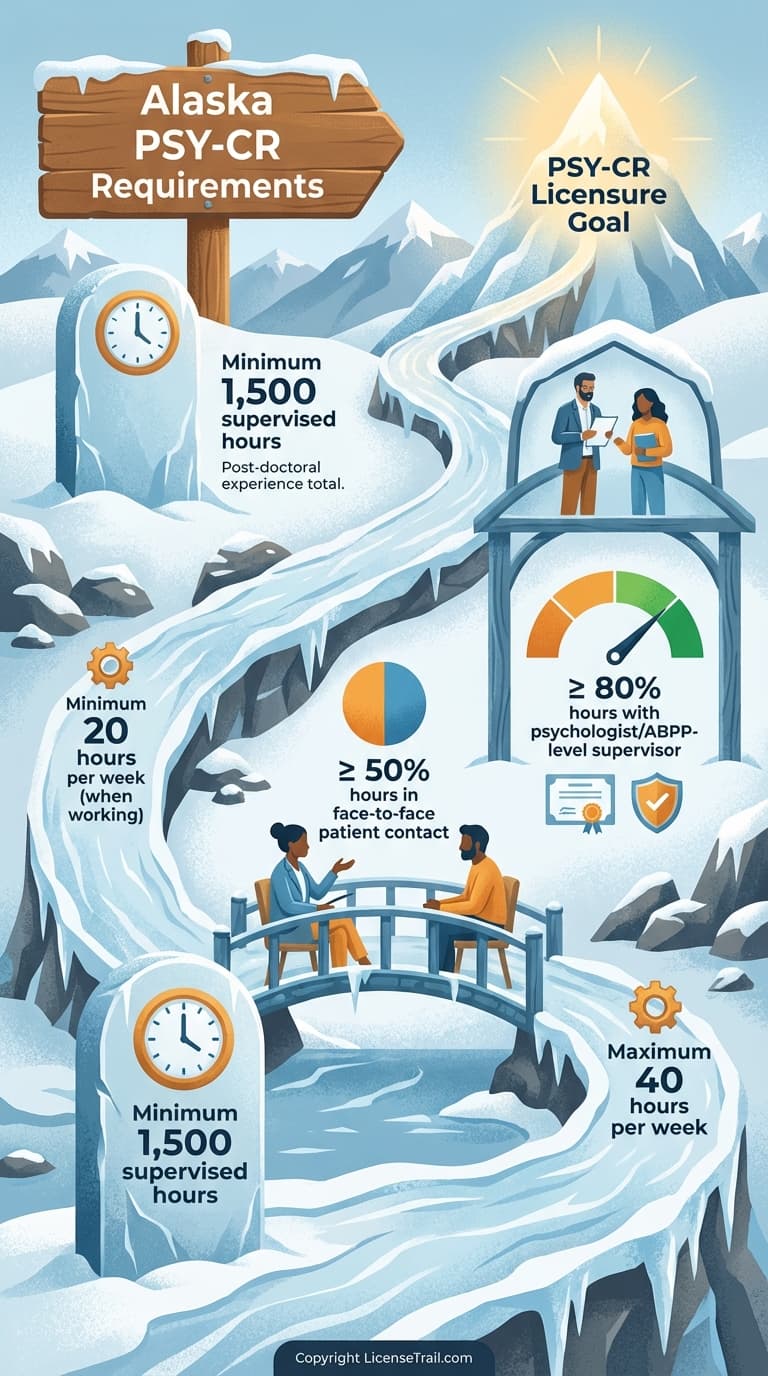
- Baseline supervised experience Alaska expects behind your original license: 1 year postdoctoral supervised experience (commonly applied as ≥1,500 hours over 10–24 consecutive months, 20–40 hrs/week)
- Experience mix commonly expected within the 1,500 hours: ≥50% direct services (~750 hrs); ≥25% total face-to-face patient contact (~375 hrs); ≥1 hr/week individual face-to-face supervision; ~2 hrs/week learning activities; ≥80% supervised by licensed psychologist/ABPP/Board-qualified
- Submit: application #08-4313 + fees (app $200 + credential review $100 + license $500; $800 total), CV (from high school to present), 5 references (3 psych/APA/ABPP + 2 others), fitness/SSN items
- Primary source verifications required: all licenses ever held (status/discipline); EPPP score verification (unless exempt due to era of initial licensure); ABPP verification if using ABPP route
- Temporary supervised license not issued for PSY‑CR applicants (can’t practice in AK while under review unless separately licensed)
- License maintenance: 2-year license cycle (expires June 30 odd-numbered years); 40 CE hours/2 years for renewal
License Details
Procedures
Alaska’s PSY‑CR (“Psychologist License by Credentials”) is designed for already‑licensed psychologists who want to obtain an Alaska license without retaking the national exam. The core of the process is (1) showing that your original license was issued under standards at least as strong as Alaska’s and (2) documenting that you meet Alaska’s baseline education and supervised‑experience requirements.
Below is a structured guide based on current Alaska statute, regulation, and the Board’s own application materials, with an emphasis on how supervised experience and hours are defined.
1. What “License by Credentials” (PSY‑CR) Means in Alaska
The legal authority for licensure by credentials is Alaska Statute 08.86.150 and regulation 12 AAC 60.030. Together they say that a person licensed or certified as a psychologist elsewhere can be licensed in Alaska without examination (i.e., without retaking the EPPP in Alaska) if the person:
- Applies on the proper form and pays the credential review fee.
- Submits proof of “continued competence” as required by Board regulation.
- And either:
- Holds a doctoral degree with primary emphasis on psychology that meets Alaska’s doctoral requirements, and the examination and qualification requirements for the out‑of‑state license were “essentially similar to or higher than” Alaska’s; or (law.justia.com)
- Is a diplomate in good standing of the American Board of Professional Psychology (ABPP). (commerce.alaska.gov)
Regulation 12 AAC 60.030 further specifies that an applicant for licensure by credentials as a psychologist will be licensed without examination if they: (regulations.justia.com)
- Comply with selected application requirements that also apply to exam‑route applicants (transcripts, CV, references, etc.).
- Have verification sent directly to the Board of:
- A current psychologist license from another jurisdiction, issued based on examination and qualifications “essentially similar to or higher than” Alaska’s.
- Their EPPP score (unless first licensed before that jurisdiction required the EPPP).
- The status of every psychology license they hold or have ever held.
- Or, for the ABPP path, verification that they are a diplomate in good standing.
Key implication: for PSY‑CR, you do not redo Alaska’s supervised experience, but the Board will look through your existing credentials to make sure that—at a minimum—you would have met Alaska’s education and supervised‑experience standards had you been licensed here.
2. Alaska’s Baseline Requirements for a Psychologist License
These are the standards your existing license must essentially match or exceed.
2.1 Education
Alaska statute requires that a psychologist licensee: (law.justia.com)
- Hold an earned doctoral degree in:
- Clinical psychology,
- Counseling psychology, or
- Education in a specialization the Board considers equivalent;
- From an academic institution whose program meets criteria set by regulation; and
- Have not engaged in dishonorable conduct related to counseling or psychometry.
2.2 Supervised Experience – Time Requirement
Under AS 08.86.130(a)(3) and 12 AAC 60.070(b), Alaska requires: (law.justia.com)
- “One year of postdoctoral supervised experience” in psychology,
- In a field of practice “the same or similar” to your academic training,
- Under the supervision of a licensed psychologist or ABPP diplomate.
The regulation itself defines this requirement in terms of a year of postdoctoral supervised experience, not a raw hour count.
However, in practice, the Board and state‑level guidance interpret that year as:
- At least 1,500 clock hours of supervised experience,
- Completed in no fewer than 10 months and no more than 24 consecutive months,
- With between 20 and 40 hours of supervised experience per week when you are working. (psychologydegree411.com)
These numeric thresholds are consistently described in Board‑focused guidance and in university and licensure resources that quote the Board’s supervision forms and policies. They are what the Board uses when reviewing supervision plans and Statements of Supervised Psychological Experience.
2.3 How Alaska Defines “Supervised Experience” and “Direct Services”
Alaska regulations do not split your time into “direct hours vs. supervision hours” the way some states do (e.g., “1,500 direct + 1,500 supervised”). Instead, they define the content of supervised experience:
-
“Supervised experience” is defined to include:
- Direct client contact and preparation for that contact,
- Staff meetings and case conferences,
- Report writing,
- Co‑therapy,
- In‑service training, and
- Psychodiagnostic assessment. (law.cornell.edu)
-
“Direct services” are defined as activities directly related to providing psychological services to a patient, such as:
- Individual or family psychotherapy,
- Psychological testing and interpretation,
- Report writing and studying test results,
- Case consultations,
- Reviewing literature relevant to the patient’s needs. (law.cornell.edu)
In other words:
- All of the above activities can count as supervised experience.
- The subset directly providing or supporting care for a specific patient counts as direct services.
2.4 Distribution of Hours Within the 1,500 Postdoctoral Hours
Board‑oriented summaries (which reflect the content of the Board’s own supervision forms) describe the expected mix of your 1,500 supervised hours as follows: (psychologydegree411.com)
-
Total supervised postdoctoral experience:
- At least 1,500 clock hours of supervised experience.
- Completed between 10 and 24 consecutive calendar months.
- Each week you work must include 20–40 hours of supervised experience.
-
Direct service portion:
- At least 50% of the 1,500 hours (≈ 750 hours) must be direct service activities (therapy, assessment, testing, etc.).
- At least half of those direct service hours (≈ 25% of the total, ≈ 375 hours) must be face‑to‑face patient contact (in person or live video).
-
Supervision and learning requirements within those hours:
- At least one hour of individual, face‑to‑face supervision per week, focused on your direct services.
- Additional required weekly “learning activities” (often described as about two hours per week) such as:
- Case conferences,
- Ethics discussions,
- Co‑therapy with discussion,
- Other structured training tasks assigned by the supervisor.
- At least 80% of your supervised experience (by hours) must be supervised by:
- A licensed psychologist,
- An ABPP diplomate, or
- A doctorate‑level psychologist the Board deems qualified.
These quantitative distributions are not laid out line‑by‑line in the statute, but are drawn from Board‑aligned summaries of Alaska’s supervision requirements and the Board’s own Statement of Supervised Psychological Experience form. (psychologydegree411.com)
For your purposes as a PSY‑CR applicant:
- Alaska expects that the supervised experience behind your current license was at least this robust—i.e., at least 1,500 postdoctoral hours with substantial, well‑supervised direct service.
3. Eligibility Routes for PSY‑CR
Under AS 08.86.150 and 12 AAC 60.030, there are two ways to qualify for licensure by credentials: (law.justia.com)
Route 1 – Equivalent (or Higher) Out‑of‑State License
You must show that:
- You hold a current psychologist license or certificate from another licensing jurisdiction; and
- That license was issued based on:
- A doctoral degree meeting Alaska’s education criteria, and
- Examination and qualification requirements that were “essentially similar to or higher than” Alaska’s requirements at the time. (law.justia.com)
This is where your supervised‑experience numbers matter. The Board will look at:
- Did your original state require at least a full year of postdoctoral supervised experience?
- Were those hours broadly comparable (e.g., 1,500+ postdoctoral hours, substantial direct service, structured supervision)?
Route 2 – ABPP Diplomate
Alternatively, you may qualify if you: (commerce.alaska.gov)
- Are a diplomate in good standing of the American Board of Professional Psychology, and
- Have that status verified directly to the Alaska Board.
In that scenario, the Board generally presumes your background meets or exceeds Alaska’s experience standards, but you still must satisfy the application and competence requirements described below.
4. Application Components for a PSY‑CR License
Alaska’s Psychologist License by Credentials application packet is Form #08‑4313 (revised February 13, 2025). The instructions and application require: (commerce.alaska.gov)
4.1 Application and Fees
- Application form #08‑4313 (4 pages), completed and signed.
- Fees (subject to change; amounts in the current form):
- Nonrefundable Application Fee: $200
- Credential Review Fee: $100
- License Fee: $500
- Total initially due: $800 (you may pay the license fee at application or after approval; the form notes license fees can change). (commerce.alaska.gov)
4.2 Proof of Education
- Official transcripts sent directly from all undergraduate and graduate institutions.
- If applying under the ABPP diplomate option (AS 08.86.150(2)), you may submit verification of ABPP diplomate status in good standing sent directly by ABPP instead of transcripts. (commerce.alaska.gov)
4.3 License Verifications
You must arrange for:
- Verification from every jurisdiction where you hold or have ever held a psychology license, including:
- License number,
- Status, and
- Any disciplinary history. (commerce.alaska.gov)
- Verification that at least one current license was issued based on examination and qualifications “essentially similar to or higher than” Alaska’s. Many boards include this in their standard verification; otherwise, Alaska may ask for supporting documents.
If you are applying under AS 08.86.150(1) (the “equivalent license” route), you must also provide:
- Verification of your EPPP score, sent either:
- From the jurisdiction that administered your EPPP, or
- Directly from ASPPB. (commerce.alaska.gov)
(Statute and regulation allow an exception if you were first licensed in a jurisdiction before it required the EPPP.)
4.4 Curriculum Vitae
- A complete vita covering from high school graduation to present, including dates and locations of residence and employment. (commerce.alaska.gov)
4.5 References
- Five reference letters on the Board’s reference form (#08‑4313c), with this required mix: (commerce.alaska.gov)
- Three from:
- Licensed psychologists, or
- Members of the American Psychological Association, or
- ABPP diplomates; and
- Two from other individuals not related to you.
- Three from:
4.6 Professional Fitness and Other Standard Items
- Responses (and documentation, if applicable) to the application’s professional fitness questions (discipline, criminal history, etc.). (commerce.alaska.gov)
- Social Security number (or an approved exemption form) as required by AS 08.01.060. (commerce.alaska.gov)
5. How Your Supervised Experience and Hours Are Evaluated for PSY‑CR
For PSY‑CR applicants there is no new hour requirement on top of your existing license. Instead, the Board checks that:
-
Your original psychologist license rested on:
- A qualifying doctoral degree, and
- At least one year of postdoctoral supervised experience comparable to Alaska’s (i.e., effectively ≥ 1,500 well‑supervised hours in 10–24 months, with substantial direct services and individual supervision). (law.justia.com)
-
Your current competence is still intact (proof of continued competence may include evidence of practice, CE, or credentialing).
If your original state required more than Alaska (for example, 2 years/3,000 postdoc hours with similar distributions), you will almost certainly meet the “essentially similar or higher” standard. If your state required less (e.g., only a predoctoral internship and no postdoc, or fewer than 1,500 postdoc hours), Alaska can conclude that your out‑of‑state qualifications are not essentially similar, and you could be directed to the examination route instead.
Important:
Alaska explicitly states that a temporary supervised license will not be issued to license‑by‑credentials applicants. (law.cornell.edu)
So you cannot begin practicing in Alaska while your PSY‑CR application is under review unless you independently qualify for, and obtain, a separate courtesy license.
6. Process Timeline and License Maintenance
- Processing: Once all documents and fees are received, your file is deemed complete and is sent to the Board for review at its next meeting. (commerce.alaska.gov)
- License term: Psychologist licenses are issued for two years and expire on June 30 of odd‑numbered years, regardless of original issue date. (commerce.alaska.gov)
- Continuing education: To maintain the license, Alaska currently requires 40 hours of CE every two years, with required ethics content and limits on non‑live activities. (onlinepsychologyprograms.org)
7. Summary of the Hour‑Related Requirements in Alaska’s System
While the PSY‑CR pathway itself does not add new clock‑hour obligations, it is built on Alaska’s baseline psychologist licensure standard, which expects:
- One year of postdoctoral supervised experience, defined by regulation as a year of supervised practice in a field similar to your training, under a licensed psychologist or ABPP diplomate. (regulations.justia.com)
- In practice, that year must include:
- ≥ 1,500 hours of supervised experience,
- Spread across 10–24 months,
- Between 20 and 40 hours/week while working. (psychologydegree411.com)
- Within those 1,500 hours:
- At least 50% (≈ 750 hours) as direct services,
- At least 25% of the total (≈ 375 hours) as face‑to‑face patient contact,
- Weekly individual, face‑to‑face supervision, and additional structured learning activities,
- ≥ 80% of supervision provided by a psychologist/ABPP/Board‑approved doctorate. (psychologydegree411.com)
The Board’s PSY‑CR decision is essentially: Does your existing license show that you met or exceeded this experience profile (plus Alaska’s doctoral and exam standards) at the time you were first licensed, and are you still competent now?
Track your PSY-CR hours with confidence
License Trail checks your direct, indirect, and supervision hours against Alaska PSY-CR requirements continuously and flags mismatches before you submit.
 Start Tracking for Free
No credit card required · Free plan available
Is your spreadsheet hiding Alaska PSY-CR risks?
Stop guessing if your categories match Alaska Board of Psychologist and Psychological Associate Examiners requirements. License Trail checks your direct, indirect, and supervision hours continuously and flags mismatches before you submit.
Import or log
Bring your spreadsheet or start fresh
Upload your existing tracking spreadsheet and we'll map every hour into the right Alaska Board of Psychologist and Psychological Associate Examiners categories automatically.
Verify against Alaska
Catch mismatches before the board does
License Trail checks your direct, indirect, and supervision hours against Alaska PSY-CR requirements continuously.
Export board-ready
One-click clean reports
Generate professional, board-ready reports for supervision meetings and Alaska Board of Psychologist and Psychological Associate Examiners submissions in seconds.
No credit card required · Free plan available