
Arizona BA Requirements: Hours, Exams & Step-by-Step Guide
Stop guessing if your categories match Arizona requirements. License Trail checks your direct, indirect, and supervision hours against BA requirements continuously and flags mismatches before you submit.
No credit card required · Free plan available
Quick Requirements Overview
- Governing body: AZ Board of Psychologist Examiners (A.R.S. § 32‑2091.03; AAC R4‑26‑404/.404.1/.404.2/.405)
- Education: Master’s or higher from an accredited institution; program met BACB requirements at time of graduation
- Coursework: 270 classroom hours graduate-level ABA instruction consistent with ABAI Verified Course Sequence (as in effect when taken)
- Exam: Must pass the BACB BCBA exam (no alternative exam accepted)
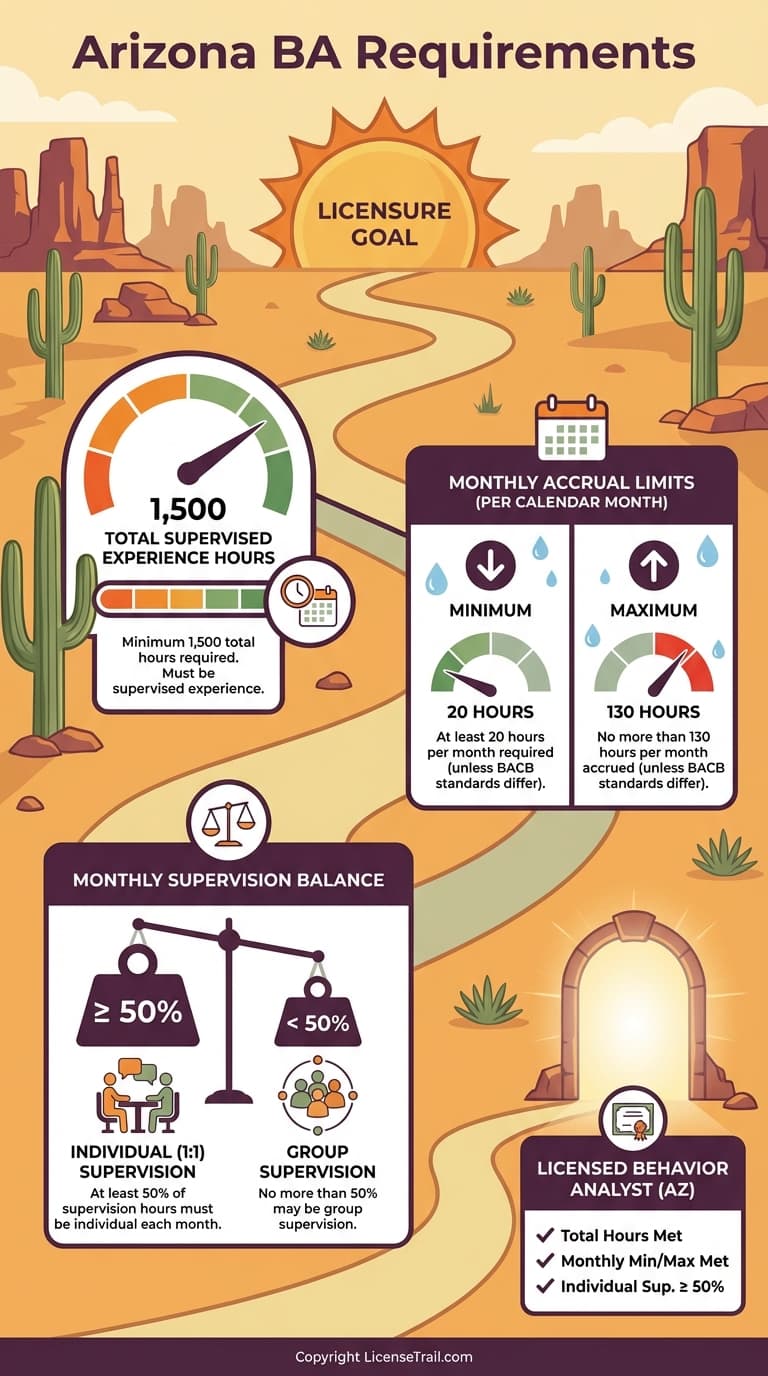
- Supervised experience: 1,500 clock hours (no BACB multiplier; “1 hour = 1 hour”); allowed types: independent fieldwork, practicum, intensive practicum (BACB-aligned; one category per supervisory period)
- Hour distribution: Per month 20–130 hours (incl. supervision) unless BACB standards at the time specify otherwise
- Supervisor rules (AZ-specific): Supervisor must be licensed in the state where services occurred (if that state licenses BAs); otherwise BACB-certified; AZ license required when supervising services delivered in AZ (supervision location = where client/services are)
- Supervision/admin: Written supervision plan required (incl. supervisor 8-hour BACB supervision training); group supervision max 50% per period; clients can’t be related/caretaking relationships; activities must cover required BA practice areas (assessment, program design/monitoring, oversight, training/systems, related BA tasks)
License Details
Procedures
Licensure as a behavior analyst in Arizona is governed by the Arizona Board of Psychologist Examiners under A.R.S. § 32‑2091.03 and Article 4 of the Arizona Administrative Code (R4‑26‑404, R4‑26‑404.1, R4‑26‑404.2, R4‑26‑405). The Board has aligned its standards with the BACB (BCBA) requirements, but with some important Arizona‑specific twists, especially around supervised hours and supervisor licensure.
Below is a structured guide focused on what you need to become a Licensed Behavior Analyst in Arizona, with emphasis on hours, types of experience, and the state’s own terminology.
1. Basic framework Arizona uses
By statute, an applicant:
- Must meet graduate‑level education and supervised experience requirements and pass a national examination. (law.justia.com)
- The Board must adopt standards “consistent with the standards set by a nationally recognized behavior analyst certification board” (i.e., BACB), except that:
- The supervised experience must be at least 1,500 hours of “supervised work experience or independent fieldwork, university practicum or intensive university practicum”. (law.justia.com)
- If the experience was obtained in a state that already licensed behavior analysts, the supervisor must be licensed in the state where the trainee provided services. (law.justia.com)
Arizona’s own rules then spell out, in detail, how those 1,500 hours must look.
2. Education requirement
Arizona’s rule on education (R4‑26‑404.1) states that, to be licensed as a behavior analyst, you must have:
- A master’s degree or higher, and
- The degree must be from an accredited institution of higher education,
- In a program that met the BACB’s requirements at the time of graduation. (law.cornell.edu)
In practice, this means a graduate degree that would qualify you for BCBA certification (or did so when you finished).
3. Coursework requirement
For applicants not “grandfathered” by older BACB standards, the coursework rule (R4‑26‑405) requires:
- A minimum of 270 classroom hours of graduate‑level instruction
- The content must be “consistent with the minimum verified course sequence of the Association for Behavior Analysis International in effect at the time the instruction is obtained.” (law.cornell.edu)
The Board accepts coursework completed:
- At an accredited institution of higher education, or
- In a program that is consistent with the then‑current ABAI Verified Course Sequence. (law.cornell.edu)
This is Arizona’s way of hard‑linking coursework to what BACB/ABAI considered acceptable when you took it.
4. National examination requirement
The examination rule (R4‑26‑404) is very straightforward:
- You must “take and pass the examination administered by the BACB for Board Certified Behavior Analysts” as part of its certification process. (law.cornell.edu)
The Board explicitly notes that:
- No other exam or certifying body is accepted for this purpose; BACB’s BCBA exam is the one recognized exam. (psychboard.az.gov)
5. Supervised experience / fieldwork: hours and types
5.1. Total number of hours
The core requirement is:
- 1,500 hours of supervised experience to be licensed as a behavior analyst in Arizona. (law.cornell.edu)
Arizona’s rules and guidance are explicit that:
- These must be literally 1,500 clock hours of supervised experience or fieldwork. The Board does not accept the BACB’s “intensive” or “concentrated fieldwork” multipliers; “one hour equals one hour” for Arizona licensure purposes. (psychboard.az.gov)
There is not a second, separate 1,500‑hour requirement (e.g., 1,500 “direct” plus 1,500 “supervised”). Instead, Arizona requires a single minimum of 1,500 hours of supervised experience, which can be composed of various types of supervised fieldwork, described below.
5.2. Categories of supervised experience
Rule R4‑26‑404.2 describes the types of supervised experience Arizona will accept for those 1,500 hours. The Board calls these “experience categories” and recognizes three BACB‑aligned categories: (law.cornell.edu)
-
Supervised independent fieldwork
- Supervision frequency must meet the BACB standards in effect at the time of supervision.
-
Practicum
The supervisee must:- Participate in a practicum in behavior analysis within a program approved by the BACB,
- Achieve a passing grade,
- Obtain graduate‑level academic credit, and
- Be supervised at a frequency that meets BACB standards at the time of supervision.
-
Intensive practicum
The supervisee must:- Participate in an intensive practicum in behavior analysis in a BACB‑approved program,
- Achieve a passing grade,
- Obtain graduate‑level academic credit, and
- Be supervised at the frequency specified by the BACB’s standards at that time.
Arizona allows you to:
- Accrue the 1,500 hours in one category or in any combination of two or three of these categories, but only one category per “supervisory period” (e.g., a given supervisory month cannot be split between “practicum” and “independent fieldwork” for Arizona’s counting). (law.cornell.edu)
5.3. How the hours must be distributed
R4‑26‑404.2 also sets a permissible monthly range of hours:
- In any month counted toward the 1,500 hours, the supervisee must accrue no fewer than 20 hours and no more than 130 hours, including supervision time. (law.cornell.edu)
- Alternatively, hours may be accrued at the rate that meets BACB standards in effect at the time of supervision, if those differ. (law.cornell.edu)
So, in practice:
- Your supervised experience must be spread across multiple months, with each month within the 20–130‑hour band (unless the applicable BACB standard at that time had a different but acceptable structure).
6. What counts as “appropriate” supervised experience hours
R4‑26‑404.2(C)(2) defines “appropriate activities” that can be counted toward the 1,500 hours. To be accepted, the hours must demonstrate participation with various populations, settings, and supervisors, and include all of the following activity areas: (law.cornell.edu)
- Conducting assessments related to behavioral intervention (e.g., functional behavior assessments, skills assessments).
- Designing, implementing, and monitoring skill‑acquisition and behavior‑reduction programs.
- Overseeing implementation of behavior‑analytic programs by others (e.g., supervising RBTs or direct‑care staff).
- Training, designing behavioral systems, and managing performance (this can include staff training, performance management, and system‑level behavior analytic work).
- Other activities directly related to behavior analysis, such as:
- Attending planning meetings about a behavior analytic program,
- Researching the literature relevant to the program,
- Discussing the program with other stakeholders.
Hours outside these activity types (e.g., purely administrative or non‑behavior analytic tasks) are not what the rule contemplates as “appropriate.”
6.1. Appropriate clients
The rule also constrains who you can work with for hours to count: (law.cornell.edu)
- An “appropriate client” is defined as one for whom behavior‑analytic services are suitable.
- A client is not appropriate if:
- The client is related to the supervisee,
- The client’s primary caretaker is related to the supervisee, or
- The supervisee is the client’s primary caretaker.
This is intended to avoid dual‑relationship situations and ensure professional boundaries during training hours.
7. Supervisor qualifications and supervision standards
Arizona adds several state‑specific requirements on who can supervise and how supervision must occur.
7.1. Supervisor licensure or certification
For supervised hours to count toward licensure, the supervisor must: (law.cornell.edu)
- Be licensed as a behavior analyst in the state where the supervision occurred during the period of supervised experience; or,
- If that state did not have licensure for behavior analysts at that time, be certified as a behavior analyst by the BACB; and
- Not be related to, subordinate to, or employed by the supervisee, except that being paid by the supervisee specifically for supervision is permitted.
Additionally, under A.R.S. § 32‑2091.03 and the Board’s application guidance:
- If your supervised experience took place in a state that requires licensure for behavior analysts, your supervisor must have been licensed in that same state for the entire supervised period, even for remote supervision. (psychboard.az.gov)
- For hours earned while delivering services to clients in Arizona, any supervisor (remote or in‑person) must themselves be licensed in Arizona if they are providing supervision to an Arizona‑located trainee or unlicensed individual. (psychboard.az.gov)
- Supervision is considered to occur in the state where the trainee delivers behavior analytic services, not where the supervisor sits. (psychboard.az.gov)
7.2. Nature and format of supervision
R4‑26‑404.2 describes “effective supervision” as supervision that improves and maintains the supervisee’s behavior‑analytic, professional, and ethical skills. It includes, among other things: (law.cornell.edu)
- Developing performance expectations,
- Observing the supervisee with clients and providing feedback (in‑person preferred, but synchronous or asynchronous video/telehealth observation is acceptable),
- Modeling technical, professional, and ethical behavior,
- Guiding case conceptualization and decision‑making,
- Reviewing written materials (programs, data sheets, reports),
- Evaluating both the supervisee’s service delivery and the effects of supervision itself.
Supervision may be:
- Individual for at least half of the supervised hours in each supervisory period, and
- Group (2–10 supervisees) for no more than half of the supervised hours in each supervisory period. (law.cornell.edu)
7.3. Supervision plan
Before hours can count, there must be a written supervision plan, executed by both supervisor and supervisee before the supervised experience begins. That plan must: (law.cornell.edu)
- State the responsibilities of supervisor and supervisee,
- Require the supervisor to complete 8 hours of supervision training provided by the BACB,
- Describe appropriate activities and instructional objectives,
- Specify measurable conditions under which the supervisor will complete the supervisee’s Experience Verification Form,
- Spell out consequences if either party fails to follow the plan,
- Require written permission from the employer/manager when applicable, and
- Require compliance with the ethical standards in R4‑26‑406.
8. Verification and linkage to BACB requirements
When you apply, R4‑26‑403 governs how supervised experience is verified:
- The Board will accept, as verification, BACB final experience verification forms submitted by your supervisors (or, in limited cases, copies submitted by you) provided the hours met BACB requirements at the time you were initially certified. (law.cornell.edu)
The Board’s own guidance explicitly notes that:
- To qualify under the general licensure pathway, your 1,500 hours of supervised fieldwork must meet all requirements in R4‑26‑404.2. (psychboard.az.gov)
- Arizona may not accept hours that BACB accepted if the supervisor lacked appropriate state licensure under Arizona’s rules (for states that already licensed behavior analysts). (psychboard.az.gov)
9. Practice without a license and telehealth
Statute and Board guidance emphasize that:
- It is a class 2 misdemeanor to practice behavior analysis, including providing supervision, in Arizona without a license, except for narrow statutory exceptions. (psychboard.az.gov)
- There is a Telehealth Registry option for out‑of‑state licensed behavior analysts, but that registry does not authorize providing supervision to trainees or unlicensed behavior technicians—it only covers direct telehealth services to Arizona clients. (psychboard.az.gov)
10. Putting it together in practical terms
To become a licensed behavior analyst under the Arizona Board of Psychologist Examiners (general pathway, not counting reciprocity/universal recognition), an applicant must:
- Earn a qualifying graduate degree (master’s or higher) from an accredited institution in a BACB‑compliant behavior analytic program. (law.cornell.edu)
- Complete the required ABA coursework (typically 270 graduate‑level classroom hours tied to an ABAI Verified Course Sequence, unless you fall under older grandfathering rules). (law.cornell.edu)
- Accrue at least 1,500 hours of supervised experience, consisting of:
- Supervised independent fieldwork, BACB‑approved practicum, BACB‑approved intensive practicum, or a combination of these,
- With 20–130 hours per month,
- Engaging in the defined “appropriate activities” and working with “appropriate clients,”
- Under supervisors who meet Arizona’s licensure/certification and relationship requirements, and
- Under a written supervision plan meeting all elements of R4‑26‑404.2. (law.cornell.edu)
- Take and pass the BACB BCBA examination. (law.cornell.edu)
- Submit a complete application to the Board, including transcripts, supervised experience verification (generally BACB experience verification forms), exam verification, a fingerprint clearance card, proof of lawful presence, and any required license verifications if you hold other licenses. (law.cornell.edu)
The key “numbers” Arizona uses are thus:
- 1 graduate degree (master’s or higher in a BACB‑qualifying program)
- 270 classroom hours of graduate ABA instruction (current rule; older applicants may follow earlier 225‑hour scheme)
- 1,500 hours of supervised experience/fieldwork, distributed within 20–130 hours per month, meeting the specific activity, client, supervisor, and supervision‑plan requirements.
Those are the controlling requirements, in the Board’s own language and structure, for becoming licensed as a behavior analyst in Arizona today.
Track your BA hours with confidence
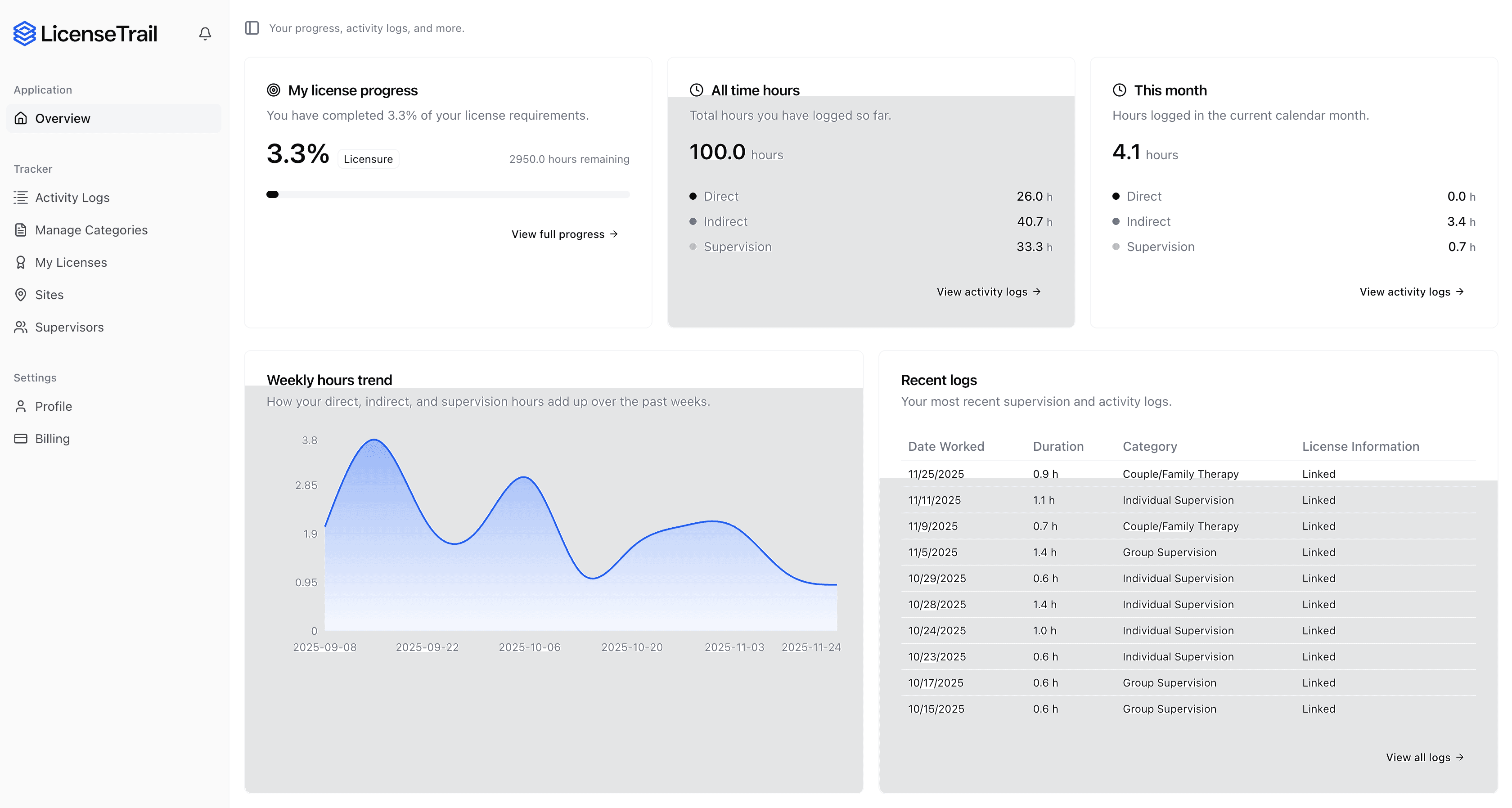
License Trail checks your direct, indirect, and supervision hours against Arizona BA requirements continuously and flags mismatches before you submit.
 Start Tracking for Free
No credit card required · Free plan available
Related Licenses
Is your spreadsheet hiding Arizona BA risks?
Stop guessing if your categories match Arizona Board of Psychologist Examiners requirements. License Trail checks your direct, indirect, and supervision hours continuously and flags mismatches before you submit.
Import or log
Bring your spreadsheet or start fresh
Upload your existing tracking spreadsheet and we'll map every hour into the right Arizona Board of Psychologist Examiners categories automatically.
Verify against Arizona
Catch mismatches before the board does
License Trail checks your direct, indirect, and supervision hours against Arizona BA requirements continuously.
Export board-ready
One-click clean reports
Generate professional, board-ready reports for supervision meetings and Arizona Board of Psychologist Examiners submissions in seconds.
No credit card required · Free plan available