
California PSY Requirements: Hours, Exams & Step-by-Step Guide
Stop guessing if your categories match California requirements. License Trail checks your direct, indirect, and supervision hours against PSY requirements continuously and flags mismatches before you submit.
No credit card required · Free plan available
Quick Requirements Overview
- Doctoral degree from a qualifying/accredited (or equivalent) program per BPC §2914
- Supervised Professional Experience (SPE): 3,000 hours total, with ≥1,500 hours postdoctoral (up to 1,500 predoctoral allowed)
- SPE timing limits: each 1,500-hour “year” within 30 consecutive months; if all 3,000 postdoc, within 60 consecutive months
- SPE weekly cap & supervision: count ≤44 hrs/week; supervision ≥10% of weekly hours incl. ≥1 hr/week individual face-to-face (or live A/V) with primary supervisor
- Predoc hour eligibility: only after 48 semester / 72 quarter units; must be via approved internship/exempt setting/registered psych associate/DMH waiver role
- Required pre-licensure coursework (6 areas): human sexuality; alcohol/chemical dependency; child abuse; partner/spousal abuse; aging/long-term care; suicide risk assessment/intervention
- Exams: EPPP + CPLEE
- Background check & documentation: DOJ/FBI fingerprints; written supervision agreement before hours, weekly logs (as applicable), and VOE from each placement (sealed/signed)
License Details

Procedures
Licensure as a psychologist (PSY) in California is governed by the California Board of Psychology (BOP) under the Business and Professions Code (BPC) §2914 and Title 16 of the California Code of Regulations (CCR), especially §1387 and §1387.3. The centerpiece of licensure is 3,000 hours of supervised professional experience (SPE), at least 1,500 hours of which must be postdoctoral. (psychology.ca.gov)
Below is a structured overview of the full requirements, with special focus on hours and how the Board defines them.
1. Core Eligibility Requirements
To qualify for initial licensure as a psychologist in California, the Board lists the following major requirements: (psychology.ca.gov)
-
Doctoral degree
- An earned doctoral degree in:
- Psychology (with a specialization such as clinical, counseling, school, consulting, forensic, industrial/organizational), or
- Education with a qualifying specialization (e.g., counseling or educational psychology), or
- Another field specifically designed to prepare graduates for the professional practice of psychology. (codes.findlaw.com)
- The program must meet accreditation or equivalency standards defined in BPC §2914(b).
- An earned doctoral degree in:
-
Supervised Professional Experience (SPE)
- Total of 3,000 hours of SPE, with at least 1,500 hours earned postdoctorally. (psychology.ca.gov)
-
Pre‑licensure coursework (six content areas)
- Human sexuality
- Alcohol/chemical dependency
- Child abuse assessment and reporting
- Partner/spousal abuse assessment
- Aging and long‑term care
- Suicide risk assessment and intervention (psychology.ca.gov)
-
Examinations
- Examination for Professional Practice in Psychology (EPPP)
- California Psychology Laws and Ethics Examination (CPLEE) (psychology.ca.gov)
-
Background check
- Fingerprints submitted to the California Department of Justice (DOJ) and the FBI for a criminal history check. (psychology.ca.gov)
2. How California Defines “Supervised Professional Experience” (SPE)
California does not split experience into “X hours direct client work + Y hours supervised experience” in the way some other states do. Instead, the law talks about “supervised professional experience” as a single category that includes both service and supervision time, with supervision making up at least 10% of weekly hours.
Key regulatory language from 16 CCR §1387 describes SPE as: (law.cornell.edu)
- An organized, planned, structured sequence of professionally supervised clinical training experiences.
- Designed to build skills and competencies stepwise to prepare for independent practice.
- Involves socialization into the profession, and can include mentoring, didactics, role‑modeling, observational learning, and consultative guidance.
- Counts only time spent in “psychological activities” that directly prepare you for independent practice.
- Does not include purely custodial/clerical tasks (e.g., filing, typing, transcription).
In other words, all counted hours are “supervised professional experience”; there is no separate bucket for “unsupervised” or “indirect” hours. Time in supervision is counted inside the 3,000-hour total, as long as it meets the supervision rules.
3. Required Amount and Timing of SPE
Under BPC §2914(c) and 16 CCR §1387 / §1387.3: (codes.findlaw.com)
-
Total amount
- Two years of qualifying SPE are required.
- One “year” is defined as 1,500 hours, so the Board requires:
- 3,000 hours of SPE total, and
- At least 1,500 hours must be postdoctoral.
-
Pre‑ vs. post‑doctoral split
- Up to 1,500 hours may be accrued pre‑doctorally.
- At least 1,500 hours must be accrued post‑doctorally (“postdoctoral” meaning after the date your institution certifies that you have met all requirements for the doctoral degree). (law.cornell.edu)
-
Time limits
- Each 1,500‑hour year of SPE must be completed within 30 consecutive months.
- If you complete all 3,000 hours postdoctorally, then the entire postdoc SPE must be completed within 60 consecutive months.
- The Board may modify these time limits for good cause. (law.cornell.edu)
-
Maximum weekly hours and required supervision percentage
- You may count up to 44 hours per week toward the SPE requirement.
- You must receive supervision equal to at least 10% of the total time worked each week.
- At least 1 hour per week must be direct, individual, face‑to‑face supervision with the primary supervisor (in person or in real‑time audiovisual, as allowed under law). (law.cornell.edu)
Practically, if you work the maximum 44 hours in a week, at least 4.4 of those hours must be documented supervision, and that supervision time is included within the 44 counted hours, not in addition to them.
4. Types of Settings and Roles That Can Provide SPE
4.1 Predoctoral SPE (up to 1,500 hours)
Predoctoral hours can only be counted after you have completed 48 semester/trimester units or 72 quarter units of graduate coursework in psychology (not including thesis, internship, dissertation). (law.cornell.edu)
You may accrue predoctoral SPE only in the following ways (16 CCR §1387(a)(1)): (law.cornell.edu)
- Formal internship placement that:
- Meets §2911 criteria and is accredited by APA, or
- Is a member of APPIC or the California Psychology Internship Council (CAPIC); or
- Employee in an exempt setting (BPC §2910) – certain governmental or institutional settings where Board registration is not required; or
- Registered Psychological Associate (BPC §2913) – you register with the Board and work under a qualified supervising psychologist; or
- Department of Mental Health Waiver position (W&I Code §5751.2), where Board registration is not required.
4.2 Postdoctoral SPE (at least 1,500 hours)
Postdoctoral hours (at least 1,500) may be accrued only as (16 CCR §1387(a)(2)): (law.cornell.edu)
- Formal postdoctoral training program meeting §2911 and accredited by APA or a member of APPIC or CAPIC; or
- Employee in an exempt setting (BPC §2910); or
- Registered Psychological Associate (BPC §2913), with registration prior to beginning work; or
- Department of Mental Health Waiver (no Board registration required).
5. What Counts as SPE “Hours” in Practice
California’s regulations emphasize functions, not just raw face‑to‑face therapy time. Under 16 CCR §1387, qualifying SPE hours must: (law.cornell.edu)
- Be spent in psychological activities that prepare you for independent practice, such as:
- Clinical interviewing and psychotherapy
- Psychological assessment and testing
- Diagnosis and treatment planning
- Crisis intervention
- Consultation, case conferences, and treatment team meetings
- Report writing and clinical documentation
- Didactic seminars and training activities that are part of the structured program
- Exclude clerical/custodial tasks, such as:
- Filing, scheduling, data entry, transcription, or other purely administrative duties.
Because the regulation explicitly states that SPE includes only time engaged in qualifying psychological activities and excludes clerical tasks, you and your supervisor must track hours by activity type and avoid counting non‑clinical administrative work.
6. Supervision Structure and Documentation
6.1 Supervision Agreement
Before any SPE hours can count, you and your primary supervisor must complete a written Supervision Agreement that: (law.cornell.edu)
- Is completed prior to the start of the experience.
- Outlines:
- Start and anticipated end dates
- Duties and training sequence
- Goals and objectives of the SPE
- Locations where services will be provided
- How socialization into the profession will occur
- How and when performance feedback will be given.
- Is submitted with applications where required (e.g., for psychological associate registration or later with the licensure application).
Hours accrued before this agreement is in place do not count toward licensure.
6.2 Weekly Logs
All psychological associates accruing SPE must maintain a written weekly log documenting all supervised hours toward licensure, consistent with 16 CCR §1387.5 (referenced in the Board’s FAQ). (psychology.ca.gov)
The log typically records:
- Total hours worked
- Nature of activities (e.g., assessment, therapy, supervision, didactic)
- Number of individual and group supervision hours
- Supervisor signatures/initials as required.
6.3 Verification of Experience (VOE)
At the end of each SPE placement:
- The primary supervisor provides:
- The signed original Supervision Agreement (if not previously submitted), and
- A completed Verification of Experience (VOE) form, sealed and signed across the envelope flap. (psychology.ca.gov)
- The VOE form certifies:
- Total hours completed
- Consistency with the Supervision Agreement
- That your performance met or exceeded the expected level of competence for your training level.
- If the SPE did not follow the agreement or your overall performance was below expected competence, those hours will not be credited toward licensure. (law.cornell.edu)
You submit these sealed VOE forms to the Board with your licensure application.
7. Alternate Plan for Non‑Mental‑Health Practice Areas
For trainees preparing for practice in non‑mental‑health areas of psychology (e.g., industrial‑organizational, certain applied research roles), 16 CCR §1387.3 allows an “alternate plan” for SPE: (law.cornell.edu)
- You must submit a supervision plan to the Board for approval before supervision begins.
- The plan must:
- Demonstrate appropriate preparation for non‑mental‑health practice in that setting.
- Describe supervisor qualifications and responsibilities.
- Explain how the quality of work and client protection will be assured.
- The same hours and timing rules apply:
- Two years of SPE = 3,000 hours
- 1,500 hours per “year”
- At least one 1,500‑hour year must be postdoctoral
- 30‑month limit per 1,500‑hour year; 60‑month limit if both years are postdoc.
Hours accrued before the Board approves the alternate plan do not count.
8. Examination and Application Sequence (In‑State, First‑Time Applicants)
The Board FAQ outlines a three‑step licensure process for applicants who have never been licensed at the doctoral level in California, a U.S. territory, or Canadian province: (psychology.ca.gov)
Step 1 – Apply and Qualify for the EPPP
To apply for licensure and be made eligible to sit for the EPPP, you must submit:
- Application for Licensure as a Psychologist plus fee.
- Verification of:
- A qualifying doctoral degree, and
- At least 1,500 hours of qualifying supervised professional experience (which may be pre‑ or post‑doctoral).
Step 2 – Qualify for and Take the CPLEE
After passing the EPPP, you request the CPLEE. To be approved:
- You must document a total of 3,000 hours of qualifying SPE.
- If 1,500 hours were already approved at Step 1, you submit evidence of the remaining 1,500 hours of postdoctoral SPE.
Step 3 – Initial Licensure
Once you have:
- Passed both EPPP and CPLEE,
- Documented 3,000 hours of SPE (with at least 1,500 postdoc),
- Completed the six required pre‑licensure courses, and
- Cleared the background check and paid fees,
the Board can issue your psychologist (PSY) license.
9. Summary of the Hour Requirements in Plain Terms
Putting the California Board’s requirements into the kind of breakdown you asked for:
-
Total experiential requirement:
- 3,000 hours of “supervised professional experience” (SPE)
- Defined as structured, supervised psychological training activities that prepare you for independent practice; excludes clerical tasks. (law.cornell.edu)
-
Distribution of hours:
- At least 1,500 hours must be postdoctoral.
- Up to 1,500 hours may be predoctoral, once you’ve finished the required amount of graduate coursework.
- The Board does not divide hours into “direct” vs. “supervised” categories; instead:
- All 3,000 count as SPE, which includes both service and supervision time.
- Within that, supervision must be at least 10% of your weekly total, with at least one hour per week in individual, face‑to‑face (or real‑time audiovisual) supervision with the primary supervisor. (law.cornell.edu)
-
Timing and rate limits:
- Each 1,500‑hour year of SPE must be finished within 30 months.
- If all 3,000 hours are postdoctoral, they must be completed within 60 months.
- You may count no more than 44 hours per week, including supervision hours. (law.cornell.edu)
Overall, California’s Board of Psychology frames experience in terms of a single, integrated, supervised professional experience requirement (3,000 hours of SPE) rather than separate “direct” vs. “supervised” hour buckets; the key distinctions are pre‑ vs. post‑doctoral hours, setting eligibility, supervision structure, and time limits.
Track your PSY hours with confidence
License Trail checks your direct, indirect, and supervision hours against California PSY requirements continuously and flags mismatches before you submit.
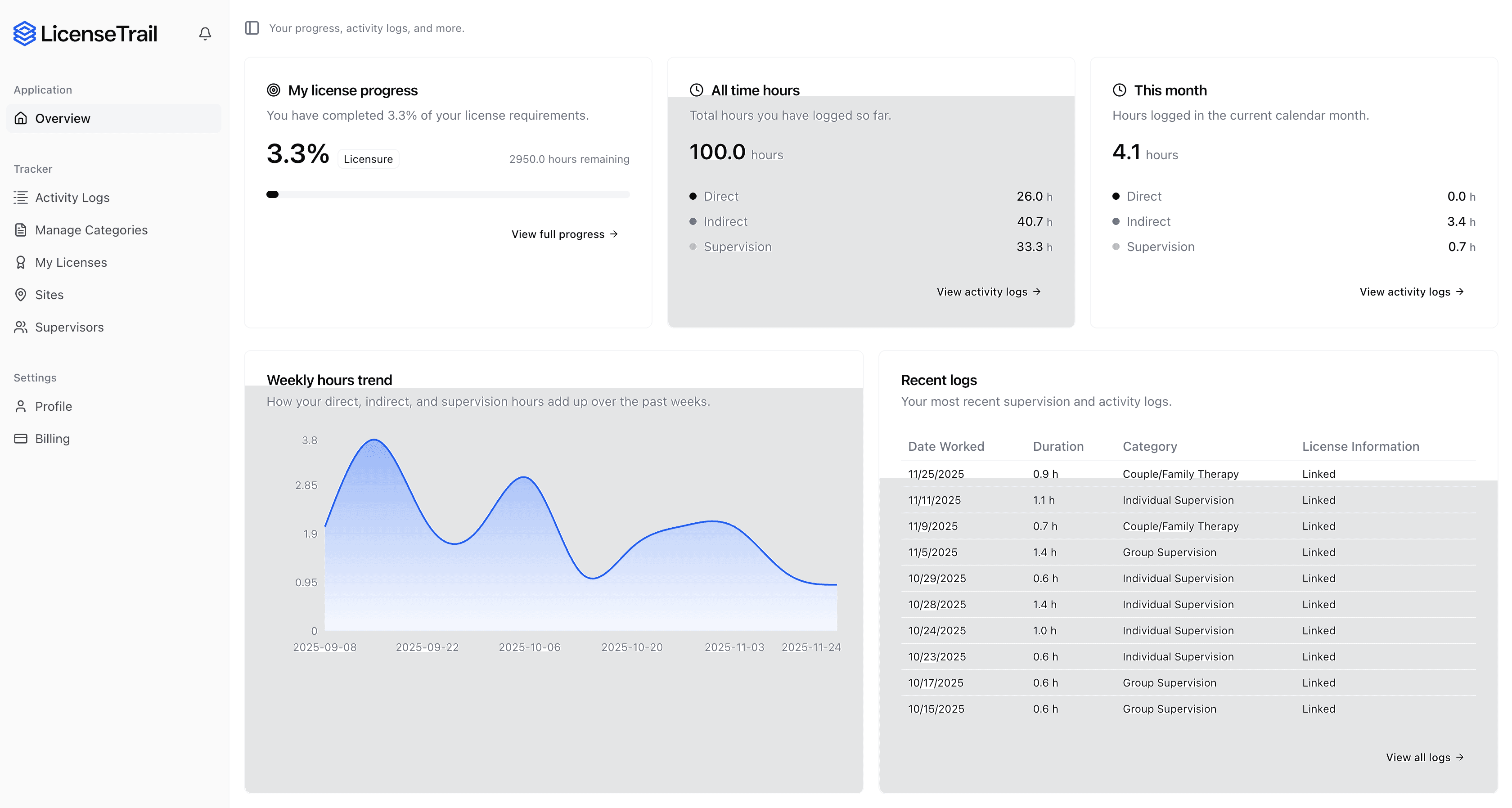 Start Tracking for Free
No credit card required · Free plan available
Is your spreadsheet hiding California PSY risks?
Stop guessing if your categories match California Board of Psychology requirements. License Trail checks your direct, indirect, and supervision hours continuously and flags mismatches before you submit.
Import or log
Bring your spreadsheet or start fresh
Upload your existing tracking spreadsheet and we'll map every hour into the right California Board of Psychology categories automatically.
Verify against California
Catch mismatches before the board does
License Trail checks your direct, indirect, and supervision hours against California PSY requirements continuously.
Export board-ready
One-click clean reports
Generate professional, board-ready reports for supervision meetings and California Board of Psychology submissions in seconds.
No credit card required · Free plan available