
Colorado LAC Requirements: Hours, Exams & Step-by-Step Guide
Stop guessing if your categories match Colorado requirements. License Trail checks your direct, indirect, and supervision hours against LAC requirements continuously and flags mismatches before you submit.
No credit card required · Free plan available
Quick Requirements Overview
- Age: 21+
- Degree: Master’s or doctorate in behavioral health sciences (accredited/equivalent)
- Exams: Pass NAADAC MAC (or equivalent) and CO jurisprudence exam
- Training: Complete BHA/Board-required addiction-specific clock hours (evidence-based tx, ethics, co-occurring disorders, clinical supervision, etc.)
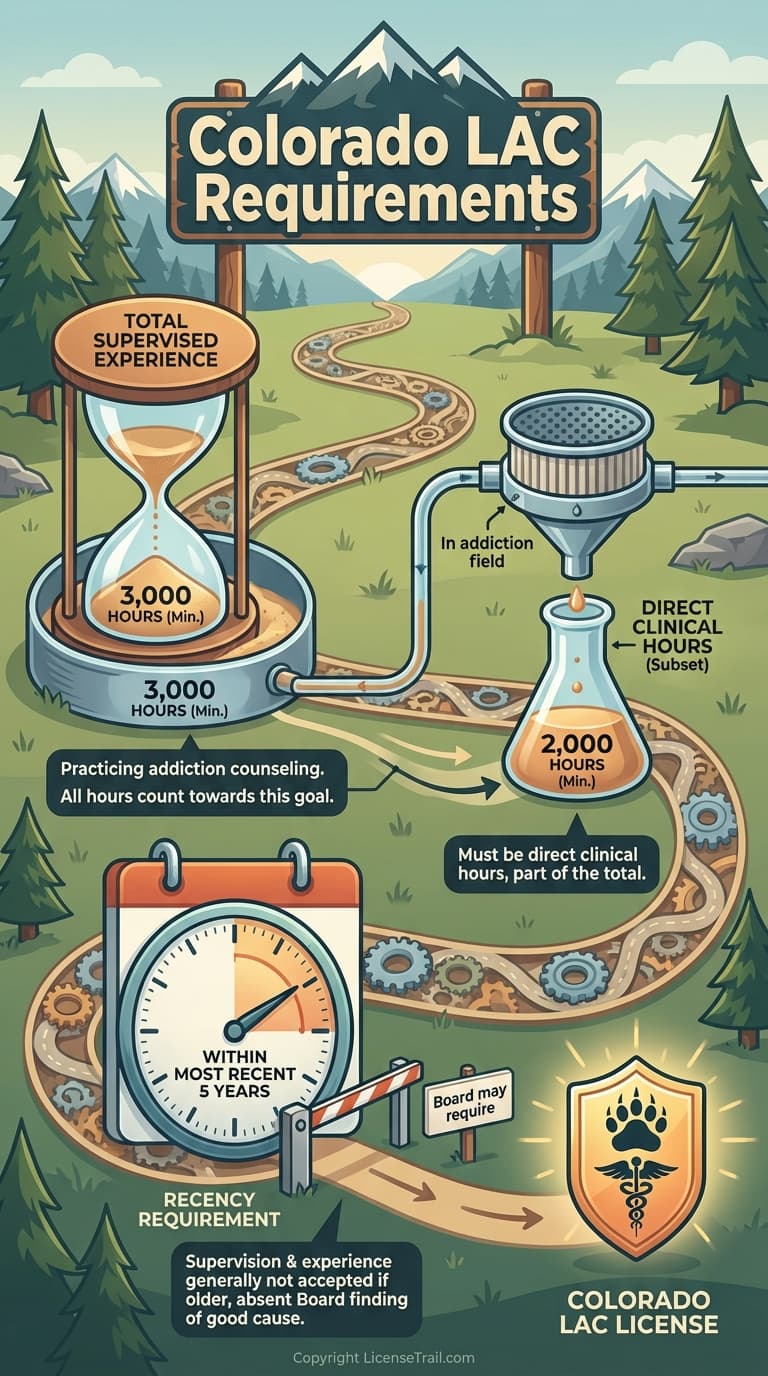
- Experience: 3,000 supervised addiction-counseling hours total, incl. 2,000 direct clinical hours
- Supervision/Docs: Hours must be under approved clinical supervision (typically LAC); supervisor verification + records retained 5 years
- Candidate status: Typically accrue required hours while registered as Addiction Counselor Candidate (ADDC)
- Post-licensure CPC: 40 PDH per 2-year renewal cycle
License Details
Procedures
Colorado’s Licensed Addiction Counselor (LAC) credential is regulated by the Colorado State Board of Addiction Counselor Examiners under the Mental Health Practice Act (C.R.S. 12‑245‑804) and implementing rules at 4 CCR 744‑1. The LAC is the highest-level addiction counseling credential in Colorado and is treated as a full behavioral health clinician license.
Below is a structured, article-style overview of what the Board currently requires, with emphasis on hours and how they are defined.
1. Core statutory requirements for LAC licensure
Under C.R.S. 12‑245‑804(1), as amended and effective in 2024, the Board may issue a LAC license only to an applicant who, among other things: (law.justia.com)
- Is at least 21 years of age.
- Holds a master’s or doctoral degree in the behavioral health sciences from an accredited school, or an equivalent program as determined by the Board.
- The Behavioral Health Administration (BHA) identifies typical qualifying degrees as community counseling, human services counseling, marriage and family therapy, clinical or counseling psychology, human psychology, clinical social work, psychiatric nursing/advanced practice nursing, addiction medicine, and related behavioral health sciences. (bha.colorado.gov)
- Demonstrates professional competence by passing both:
- The Master Addiction Counselor (MAC) examination (NAADAC) or an equivalent exam, and
- The Colorado jurisprudence examination. (law.justia.com)
- Meets Board‑approved education requirements established by the State Board of Human Services (BHA) for addiction counselor licensure. (colorado.public.law)
- Completes Board‑specified clock hours of addiction‑specific training, including content in:
- Evidence‑based treatment approaches
- Clinical supervision
- Ethics
- Co‑occurring disorders (colorado.public.law)
(The exact training-hour breakdown is detailed in the most current “Training Requirements for LAC” document issued by the BHA, which sits outside DORA’s rules but is incorporated by reference.)
- Completes a defined amount of clinically supervised work experience, including a minimum number of direct clinical hours in the addiction field (discussed in detail below).
2. Clinically supervised work experience: total hours and direct clinical hours
Two separate but coordinated authorities govern your experience hours:
- Statute (C.R.S. 12‑245‑804(1)(g)), and
- Board rule 4 CCR 744‑1.15(C) (“Licensure by Examination”). (law.justia.com)
2.1 Total supervised experience hours vs. direct clinical hours
Under current Board rule, LAC applicants must complete:
- 3,000 hours of supervised experience in addiction counseling,
- of which at least 2,000 hours must be “direct clinical” hours. (law.cornell.edu)
The rule states that applicants must complete “3000 hours of supervised experience in addiction counseling with a minimum of 2000 direct clinical hours.” (law.cornell.edu)
The statute, in parallel, requires “at least two thousand direct clinical hours of clinically supervised work experience in the addiction field” and allows this supervision to be either in-person or via telesupervision. (law.justia.com)
In other words, in Colorado’s own terms:
- “Supervised experience in addiction counseling” = your entire 3,000‑hour experience pool, accumulated under an approved supervisor.
- “Direct clinical hours” = a subset (at least 2,000 of those 3,000) consisting of direct clinical work with clients in the addiction field.
2.2 What counts as “direct clinical hours” vs. other supervised hours?
The current rules do not create a separate, one‑sentence definition of “direct clinical hours,” but they do define related terms:
- “Clinical supervision” is “personal direction and responsible direction” provided by a supervisor who meets Board criteria, in person or virtually. This includes sufficient knowledge of all clients, oversight of treatment plans, decisions on services provided, and review/correction of the supervisee’s work. (law.cornell.edu)
- “Clinically supervised work experience” (in the BHA rules) is defined as paid or unpaid addiction-specific counseling work under clinical supervision. (paperzz.com)
Putting those together:
- Direct clinical hours are the hours you spend delivering addiction counseling services directly to clients—typically individual, group, couple/family, or co‑occurring treatment modalities, whether in person or via synchronous telehealth—within the scope of addiction counseling.
- Other supervised hours (the remaining ~1,000 within the 3,000) can include:
- Case management and care coordination
- Treatment and recovery planning
- Documentation and clinical record-keeping
- Interdisciplinary team meetings and case consultation
- Certain program or service-related activities that are still part of “addiction counseling” practice, but not direct face‑to‑face client work
All 3,000 hours must occur under Board‑recognized clinical supervision; consultation alone (i.e., a voluntary peer relationship between professionals with roughly equal status) is not considered supervision and does not count toward the required supervised experience. (law.cornell.edu)
2.3 Supervisors, settings, and documentation
Under 4 CCR 744‑1.15(C): (law.cornell.edu)
- Acceptable supervisors include:
- A Licensed Addiction Counselor (LAC) licensed by the Board in the jurisdiction where services are performed; or
- In some cases, another licensed addiction professional at the highest level in another jurisdiction, or another professional with equivalent experience if approved by the Board.
- Supervisors must keep records that show:
- The exact number of hours of acceptable addiction counseling practice, and
- The exact number of supervision hours provided.
These records must be kept for at least five years from the date of supervision.
- Each applicant must file a verified statement from the supervisor(s) attesting to:
- Completion of the required work experience and supervision hours, and
- That the applicant met “generally accepted standards of practice” during supervised practice. (law.cornell.edu)
Clinically supervised work experience does not have to occur only in a state‑licensed substance use disorder program, but it must still meet the addiction‑specific and supervision criteria in the CDHS/BHA rules and DORA rules. (paperzz.com)
3. Addiction-specific education and training hours
While the statute refers generically to “the number of clock hours of addiction‑specific training” and assigns that figure to the Board’s rules, it does not set a single numeric figure in law. (colorado.public.law)
The specifics live in:
- The “Training Requirements for LAC” document and
- The CAC/LAC Handbook issued by the Behavioral Health Administration (BHA), referenced by CDPHE and DORA. (bha.colorado.gov)
Those documents (periodically updated, and currently referenced as June 2024 for LAC requirements) set out:
- The total number of clock hours of BHA‑approved addiction‑specific coursework required for LAC applicants.
- Topic domains such as:
- Principles of addiction treatment
- Addiction counseling skills
- Case conceptualization and documentation
- Ethics and jurisprudence
- Co‑occurring disorders
- Clinical supervision
- Cultural competence and trauma‑informed care, and so on. (bha.colorado.gov)
Because those training grids are housed in BHA/Google‑hosted PDFs that are locked behind access controls, the exact current hour counts and course list can’t be reliably reproduced here. The legal takeaway, however, is:
- The Board will not issue a LAC license unless you have completed all BHA‑specified addiction‑specific training clock hours, documented by official certificates/transcripts from BHA‑approved trainers or equivalent academic coursework evaluated under BHA rules. (paperzz.com)
4. Examinations required
Under C.R.S. 12‑245‑804(1)(d) and the Board’s rules: (law.justia.com)
- NAADAC Master Addiction Counselor (MAC) exam (or equivalent)
- You must pass the master addiction counselor examination administered by the National Association for Alcoholism and Drug Abuse Counselors (NAADAC) or an equivalent exam from a successor organization.
- Colorado jurisprudence exam
- You must pass a jurisprudence examination administered by the Division of Professions and Occupations covering:
- Relevant Colorado statutes and rules (Mental Health Practice Act, Board rules, confidentiality, prohibited conduct, etc.)
- Board standards and ethics.
- You must pass a jurisprudence examination administered by the Division of Professions and Occupations covering:
For lower credentials (CAT, CAS), the law also requires national addiction counselor exams (NCAC I and II), but for LAC the relevant exam is the MAC‑level examination specified in 12‑245‑804(1)(d)(I). (law.justia.com)
5. The role of “Addiction Counselor Candidate” status
Colorado now uses a candidate registration model (Addiction Counselor Candidate – ADDC) parallel to other mental health professions. SB 24‑115 and the Board’s materials explain that: (dpo.colorado.gov)
- You register as an addiction counselor candidate while accruing:
- Your clinically supervised work experience (the 3,000/2,000 hours), and
- Any remaining education and training requirements.
- Candidates must:
- Pass the jurisprudence exam for initial registration, and
- Maintain registration (including continuing professional development hours) if they do not complete all requirements within the initial registration period.
Candidate registration is therefore the status under which most people accrue their LAC supervised experience and direct clinical hours in Colorado.
6. Putting the hours together in practice
From the Board’s rules and statute, the current LAC hour picture in Colorado looks like this (as of 2025):
-
Clinically supervised work experience (practice hours)
- Total supervised experience in addiction counseling:
- 3,000 hours minimum.
- Direct clinical hours (within the 3,000):
- At least 2,000 hours of “direct clinical hours of clinically supervised work experience in the addiction field.” (law.cornell.edu)
- Other supervised hours (up to 1,000 of the 3,000):
- Addiction‑related activities that are not direct client contact but are part of practicing addiction counseling (documentation, case coordination, treatment planning meetings, etc.), still under clinical supervision.
- Total supervised experience in addiction counseling:
-
Supervision hours (time with your supervisor)
- The Board requires that the 3,000 hours be under clinical supervision by an “approved supervisor,” defines what supervision is, and requires specific documentation. (law.cornell.edu)
- Detailed monthly supervision‑hour ratios (e.g., minimum hours of supervision per month) are fleshed out in BHA rules for clinically supervised work experience (e.g., CAC/CAS supervised hours), which the Board relies on when evaluating LAC applications. (paperzz.com)
-
Training/education clock hours (coursework)
- A set of addiction-specific training clock hours must be completed in BHA‑approved content areas (evidence‑based practices, ethics, co‑occurring disorders, clinical supervision, etc.). (colorado.public.law)
- These are separate from your 3,000 practice hours: training hours are classroom/learning time, whereas supervised experience hours are on‑the‑job practice.
7. After licensure: continuing professional competency
Once licensed as a LAC, you must comply with the Board’s Continuing Professional Competency (CPC) program:
- For each two‑year LAC license period, you must complete at least 40 Professional Development Hours (PDH) through Board‑recognized activities.
- PDH are defined as clock hours of active learning, and multiple caps and distribution rules apply (e.g., no more than 20 PDH from a single activity category). (dpo.colorado.gov)
This requirement is separate from, and begins after, initial licensure.
8. Summary of the key hour requirements for a Colorado LAC
Focusing just on the hours, in the language that comes from the Colorado statute and Board rules:
- Clinically supervised work experience in the addiction field
- 3,000 hours of “supervised experience in addiction counseling”
- At least 2,000 of those hours must be “direct clinical hours” (direct clinical work with addiction clients under clinical supervision) (law.cornell.edu)
- Addiction‑specific training
- A Board‑specified number of clock hours of addiction‑specific training, including education in evidence‑based treatment, clinical supervision, ethics, and co‑occurring disorders, as set out in BHA’s current LAC training grid. (colorado.public.law)
- Supervision
- All practice hours must be under clinical supervision provided by an approved supervisor (typically a LAC), with formal documentation and record‑keeping as described in 4 CCR 744‑1.15(C). (law.cornell.edu)
These supervised and direct clinical hours, combined with the required degree, training clock hours, and examinations, are what the Colorado State Board of Addiction Counselor Examiners currently requires to issue a Licensed Addiction Counselor credential.
Track your LAC hours with confidence
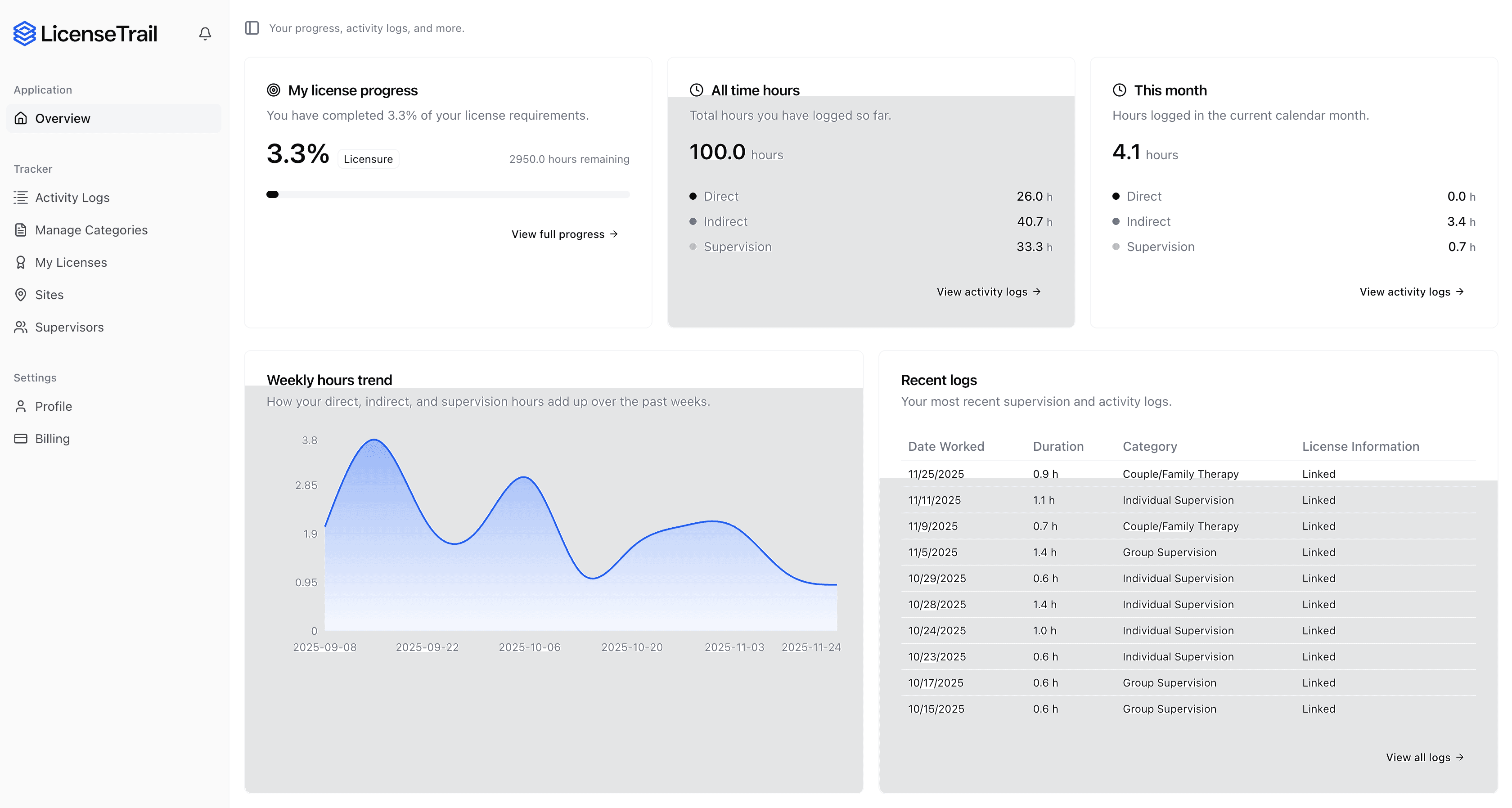
License Trail checks your direct, indirect, and supervision hours against Colorado LAC requirements continuously and flags mismatches before you submit.
 Start Tracking for Free
No credit card required · Free plan available
Is your spreadsheet hiding Colorado LAC risks?
Stop guessing if your categories match Colorado State Board of Addiction Counselor Examiners requirements. License Trail checks your direct, indirect, and supervision hours continuously and flags mismatches before you submit.
Import or log
Bring your spreadsheet or start fresh
Upload your existing tracking spreadsheet and we'll map every hour into the right Colorado State Board of Addiction Counselor Examiners categories automatically.
Verify against Colorado
Catch mismatches before the board does
License Trail checks your direct, indirect, and supervision hours against Colorado LAC requirements continuously.
Export board-ready
One-click clean reports
Generate professional, board-ready reports for supervision meetings and Colorado State Board of Addiction Counselor Examiners submissions in seconds.
No credit card required · Free plan available