
Colorado LCSW Requirements: Hours, Exams & Step-by-Step Guide
Stop guessing if your categories match Colorado requirements. License Trail checks your direct, indirect, and supervision hours against LCSW requirements continuously and flags mismatches before you submit.
No credit card required · Free plan available
Quick Requirements Overview
- Education: MSW (CSWE-accredited) or DSW within a CSWE-accredited social work program; foreign degrees require Board-accepted credential evaluation
- Pre-hour status: Hours count only if registered as Clinical Social Worker Candidate (SWC) (or otherwise authorized) before accruing experience/supervision
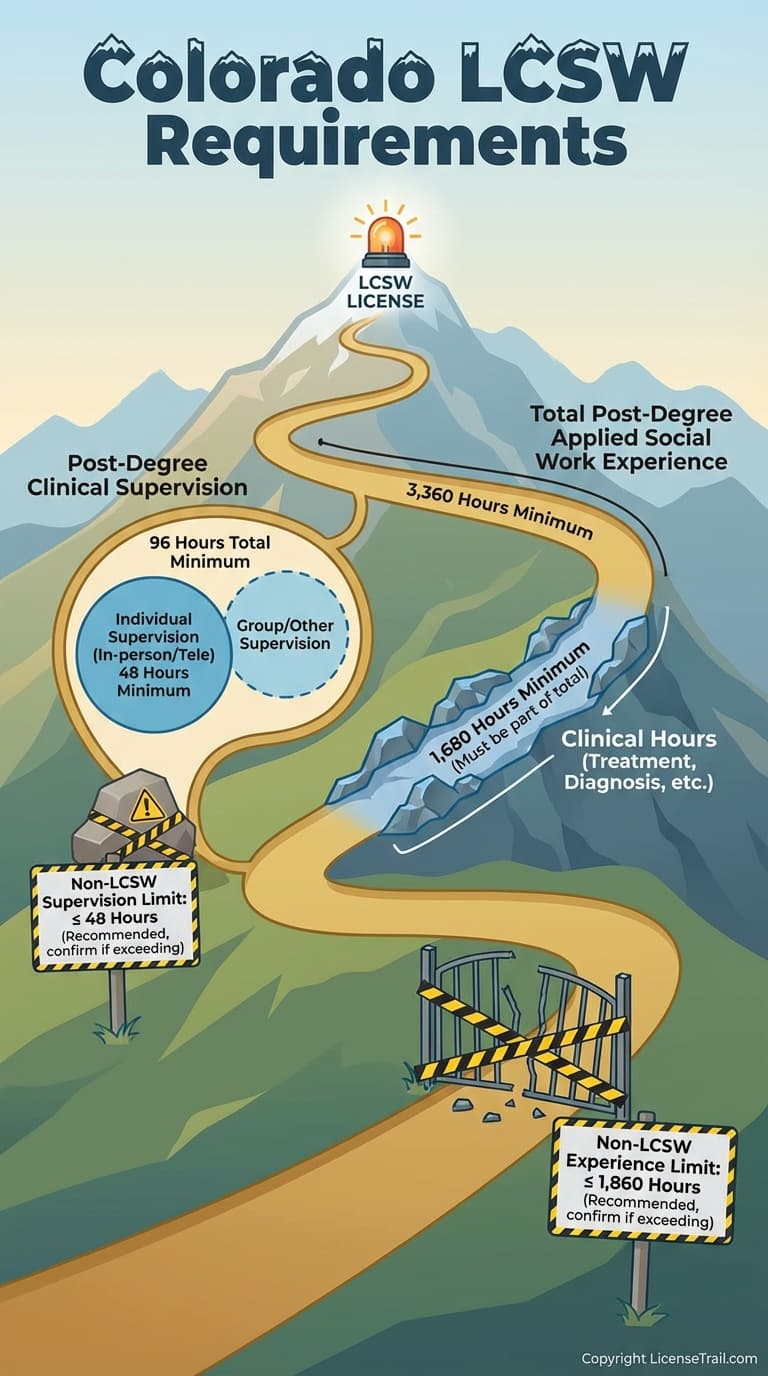
- Experience: 3,360 post-degree applied social work practice hours under supervision, over ≥24 months, reasonably uniformly distributed
- Clinical subset: ≥1,680 of the 3,360 must be clinical (treatment/diagnosis/testing/assessment/counseling); teaching doesn’t count toward clinical hours
- Supervision: 96 hours total, reasonably distributed; ≥48 must be individual (in-person or telesupervision); group supervision max 10 supervisees
- Supervisor: Typically LCSW; non-LCSW supervisors limited to ≤48 supervision hours and ≤1,860 of the 3,360 experience hours (with added documentation)
- Exams: Pass CO jurisprudence exam + ASWB Clinical (taken after completing required hours/supervision)
- Timing: Exam must be within 5 years of application; experience/supervision generally within 5 years (unless Board finds good cause); application active 1 year
License Details
Procedures
Licensure as a Licensed Clinical Social Worker (LCSW) in Colorado is governed by the Colorado State Board of Social Work Examiners through its rules in 4 CCR 726-1 and related statutes. The key areas are education, post-degree clinical experience, clinical supervision, exams, and application timing.
Below is an article-style guide that tracks closely to the Board’s own language and structure.
1. Educational foundation
The Board requires a graduate social work degree:
- You must have either:
- A master’s degree in social work from a program approved by the Council on Social Work Education (CSWE), or
- A doctoral degree in social work from a doctoral program within a CSWE-accredited social work education program. (law.cornell.edu)
Foreign-trained applicants must have their credentials evaluated by an agency used by the Board to determine CSWE equivalency. (law.cornell.edu)
2. Registration while you gain hours (Clinical Social Worker Candidate)
Colorado is strict about when hours “count” toward LCSW:
The Board states that the required post-degree work experience and supervision hours will only count if, while accruing them, you are one of the following: (law.cornell.edu)
- Registered as a Clinical Social Worker Candidate (SWC) pursuant to C.R.S. 12‑245‑404(4)(a); or
- Licensed, registered, or certified in another Colorado mental/behavioral health profession that is already authorized to perform those clinical activities; or
- Listed with the Colorado State Board of Unlicensed Psychotherapists; or
- Practicing in an exempt facility as allowed by statute.
The Social Work Applications and Forms page reiterates this: post-degree work experience and supervision “will only count towards licensure” if you are registered as a candidate or otherwise fall into those categories, and this status “must be met prior to accumulating” experience and supervision hours. (dpo.colorado.gov)
In practice, most people:
- Obtain the MSW/DSW.
- Apply for the Clinical Social Worker Candidate (SWC) registration through DPO’s online system. (dpo.colorado.gov)
- Begin accruing post-degree hours only after that registration (or another qualifying status) is in place.
3. Required post-degree clinical experience hours
Colorado’s rules do not split hours into “direct” vs “indirect” totals as some states do. Instead, they define:
3.1 Total post-degree applied practice hours
Rule 4 CCR 726‑1.14(C)(4) requires: (law.cornell.edu)
- At least 3,360 hours of applied social work practice
- These hours must be:
- Post-degree (after completion of the MSW/DSW),
- Under supervision, and
- Obtained over a minimum of 24 months (“cannot be completed in fewer than twenty‑four months”),
- “Reasonably uniformly distributed over a minimum of twenty‑four months” (you can’t compress them into a few short bursts).
The rules call this the “post-degree experience practicing social work under supervision” and specify that it is the two years of experience required by statute for licensure. (law.cornell.edu)
3.2 Clinical portion within those hours
For LCSW specifically, the Board carves out a clinical subset of those hours:
- At minimum, half of the work experience hours (1,680) of the 3,360 total
- Must “include a professional relationship that involves treatment, diagnosis, testing, assessment, or counseling.” (law.cornell.edu)
The rule then gives examples of the kinds of activities that qualify for these clinical hours. One or more of the following activities may be involved:
- Assisting individuals or groups to alleviate mental disorders
- Understanding unconscious or conscious motivation
- Resolving emotional, relationship, or attitudinal conflicts
- Modifying behaviors that interfere with effective emotional, biopsychosocial, or intellectual functioning (law.cornell.edu)
Those 1,680 hours are effectively your clinical practice hours within the larger 3,360-hour requirement.
3.3 What does “practice in social work” mean?
The rules define “practice in social work” broadly as all services within the statutory definition at C.R.S. 12‑245‑403. (law.cornell.edu)
In practical terms, the 3,360 hours will include:
- Clinical psychotherapy/counseling and assessment (which must make up at least 1,680 of those hours for LCSW purposes), and
- Other applied social work functions that fall under the statute’s definition, provided they occur under approved supervision.
Teaching hours do not count for the clinical subset: “Teaching hours are not acceptable for those hours accumulated” toward the clinical work experience requirement in Rule 1.14(C)(4)(c)(1). (law.cornell.edu)
4. Required clinical supervision hours
Separate from the 3,360 practice hours, the Board sets a minimum supervision-hour requirement.
4.1 Total supervision hours
Rule 4 CCR 726‑1.14(C)(5) requires: (law.cornell.edu)
- A minimum of 96 hours of supervision, and
- These supervision hours must be reasonably distributed over the period in which you are accumulating the 3,360 hours of supervised experience. The supervision must track the accrual of experience; it cannot all occur at the beginning or end.
4.2 Individual vs group supervision
Within the 96 hours:
- At least 48 hours must be individual supervision delivered in-person or via telesupervision. (law.cornell.edu)
The rules define:
- “Individual supervision” as supervision given to one supervisee at a time. (law.cornell.edu)
- “Group supervision” as supervision to no more than ten individuals at one time. (law.cornell.edu)
- “Telesupervision” as clinical supervision “conducted through audio/video technology such as videoconferencing or telephone.” (law.cornell.edu)
The remaining 48 hours (beyond the required 48 individual hours) may be a mix of individual and group supervision, as long as the overall minimums and distribution rules are met.
4.3 Who can be your supervisor?
The Board’s default requirement is that your supervisor be an LCSW:
- An approved supervisor is typically “a licensed clinical social worker (LCSW) who, at the time of supervision, was licensed by the Board in the jurisdiction in which the applicant’s services were performed.” (law.cornell.edu)
In limited circumstances, non-LCSW supervisors can be approved, with restrictions such as:
- Non‑LCSW supervisors can provide no more than half of the clinical work experience hours (1,860 of the 3,360), and
- No more than half (48) of the total 96 required supervision hours. (regulations.justia.com)
Additional documentation is required in those cases (competence in social work, supervision training, alignment with the Social Work Code of Ethics, etc.). (regulations.justia.com)
5. Examination requirements (including the ASWB Clinical exam)
The Board requires both a jurisprudence exam and a national exam.
5.1 Colorado jurisprudence examination
Under 4 CCR 726‑1.14(D): (law.cornell.edu)
- All applicants must pass a Board-developed jurisprudence examination.
- This is the Colorado mental health law/ethics exam referenced in the Social Work Applications and Forms page and the Jurisprudence Examination Guide. (dpo.colorado.gov)
5.2 National (ASWB) examination
The rules require a national examination appropriate to the level of licensure. For LCSW, Colorado uses the ASWB Clinical exam. (law.cornell.edu)
The Colorado NASW summary of the Board’s 2022 exam policy change states that for Licensed Clinical Social Worker applicants, the Board requires: (naswco.socialworkers.org)
- An MSW or DSW;
- Passing of the ASWB Clinical exam after completing all post-degree work experience and clinical supervision hours;
- 3,360 hours of supervised post-degree work experience over at least 2 years, with 96 hours of direct clinical supervisor contact acquired concurrently over at least 2 years;
- Passing the Colorado jurisprudence exam.
This aligns with and clarifies the Board’s regulatory text: you do not take the ASWB Clinical exam first; you complete the hours and supervision, then sit for the Clinical exam.
5.3 Recency of exam and experience
Rule 1.14 also sets “freshness” requirements: (law.cornell.edu)
- You must have passed the required examination no more than five (5) years prior to the date of application.
- Experience and supervision that predate the application by more than five years are not accepted absent good cause as determined by the Board.
6. Application and documentation to the Board
When you are ready to apply for LCSW:
- Submit a completed application for LCSW licensure by examination through DPO Online Services, with required fees and official transcripts. (dpo.colorado.gov)
- Provide verification of:
- Your qualifying post-degree practice hours (3,360 total, including at least 1,680 clinical), and
- Your supervision hours (96 total, at least 48 individual, in-person or telesupervision).
The Board requires that:
- Your approved supervisor(s) file a verified statement (on Board forms) under penalty of law attesting to:
- Your completion of the required post-degree work experience and supervision hours “as defined in Rule 1.14,” and
- Your having met “the generally accepted standards of practice during the supervised practice.” (law.cornell.edu)
Applications remain active for one year; if you are not licensed within that window, you must reapply and meet the requirements in effect at that later date. (law.cornell.edu)
7. Condensed checklist of Colorado LCSW requirements
Using the Board’s numbers and terminology, the path to LCSW in Colorado is:
-
Degree
- MSW or DSW from a CSWE-approved/accredited program (or foreign equivalent approved via credentialing). (law.cornell.edu)
-
Registration/Status while accruing hours
- Register as a Clinical Social Worker Candidate (SWC) or be otherwise authorized (licensed in another qualifying MH profession, listed as an Unlicensed Psychotherapist, or in an exempt facility) before you start counting post-degree hours. (law.cornell.edu)
-
Post-degree supervised practice
- 3,360 hours of applied social work practice under supervision,
- Accrued over at least 24 months, reasonably evenly distributed. (law.cornell.edu)
-
Clinical content within those hours
- At least 1,680 of those hours must involve a professional relationship that includes treatment, diagnosis, testing, assessment, or counseling, in the context of activities such as alleviating mental disorders, resolving emotional/relationship conflicts, or modifying dysfunctional behaviors. (law.cornell.edu)
-
Supervision hours
- At least 96 hours of clinical supervision total,
- At least 48 hours must be individual supervision delivered in-person or via telesupervision,
- Supervision hours must be reasonably distributed over the period in which you accrue the 3,360 practice hours. (law.cornell.edu)
-
Exams
- Colorado jurisprudence exam (Board-developed). (law.cornell.edu)
- ASWB Clinical exam, taken after all required post-degree work experience and supervision are completed, per the Board’s exam-use policy (implemented July 1, 2022). (naswco.socialworkers.org)
-
Application timing
- Exam passed within 5 years of application.
- Experience/supervision generally must be within 5 years of application, absent Board-approved good cause. (law.cornell.edu)
These are the primary Board-defined requirements and hour types for becoming an LCSW in Colorado, expressed using the Board’s own structure and terminology where possible.
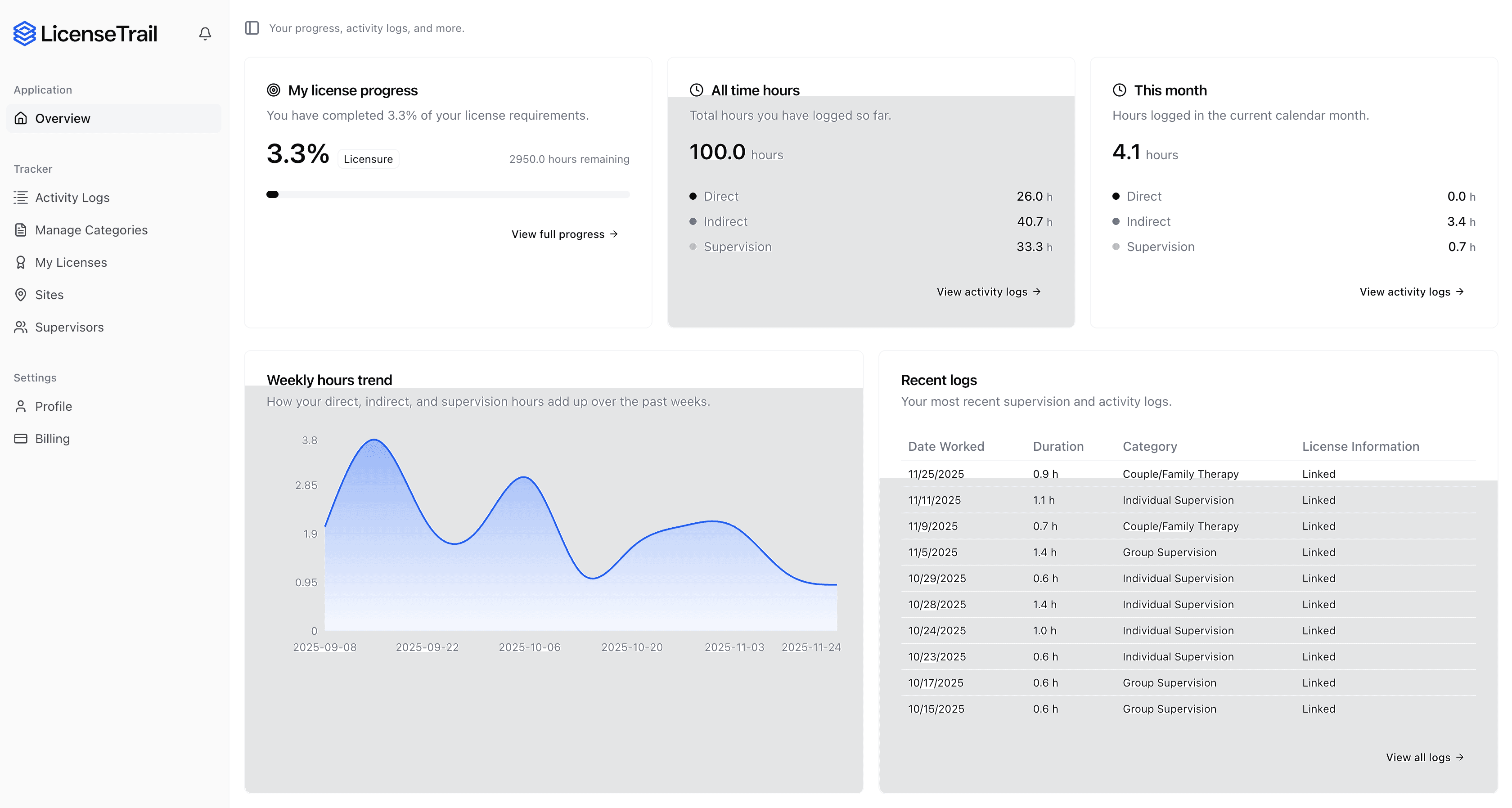
Track your LCSW hours with confidence
License Trail checks your direct, indirect, and supervision hours against Colorado LCSW requirements continuously and flags mismatches before you submit.
 Start Tracking for Free
No credit card required · Free plan available
Is your spreadsheet hiding Colorado LCSW risks?
Stop guessing if your categories match Colorado State Board of Social Work Examiners requirements. License Trail checks your direct, indirect, and supervision hours continuously and flags mismatches before you submit.
Import or log
Bring your spreadsheet or start fresh
Upload your existing tracking spreadsheet and we'll map every hour into the right Colorado State Board of Social Work Examiners categories automatically.
Verify against Colorado
Catch mismatches before the board does
License Trail checks your direct, indirect, and supervision hours against Colorado LCSW requirements continuously.
Export board-ready
One-click clean reports
Generate professional, board-ready reports for supervision meetings and Colorado State Board of Social Work Examiners submissions in seconds.
No credit card required · Free plan available