
Colorado LPC Requirements: Hours, Exams & Step-by-Step Guide
Stop guessing if your categories match Colorado requirements. License Trail checks your direct, indirect, and supervision hours against LPC requirements continuously and flags mismatches before you submit.
No credit card required · Free plan available
Quick Requirements Overview
- Eligibility: Age 21+; in good standing per CRS Title 12, Art. 245 and 4 CCR 737-1
- Education: Master’s or doctoral in professional counseling (or Board-equivalent) incl. practicum/internship; CACREP (post‑8/31/2014): 60 semester credits
- Candidate status required: Register as LPCC (or other allowed status) before post-degree hours count; requires app/fee + meeting eligibility + passing CO jurisprudence
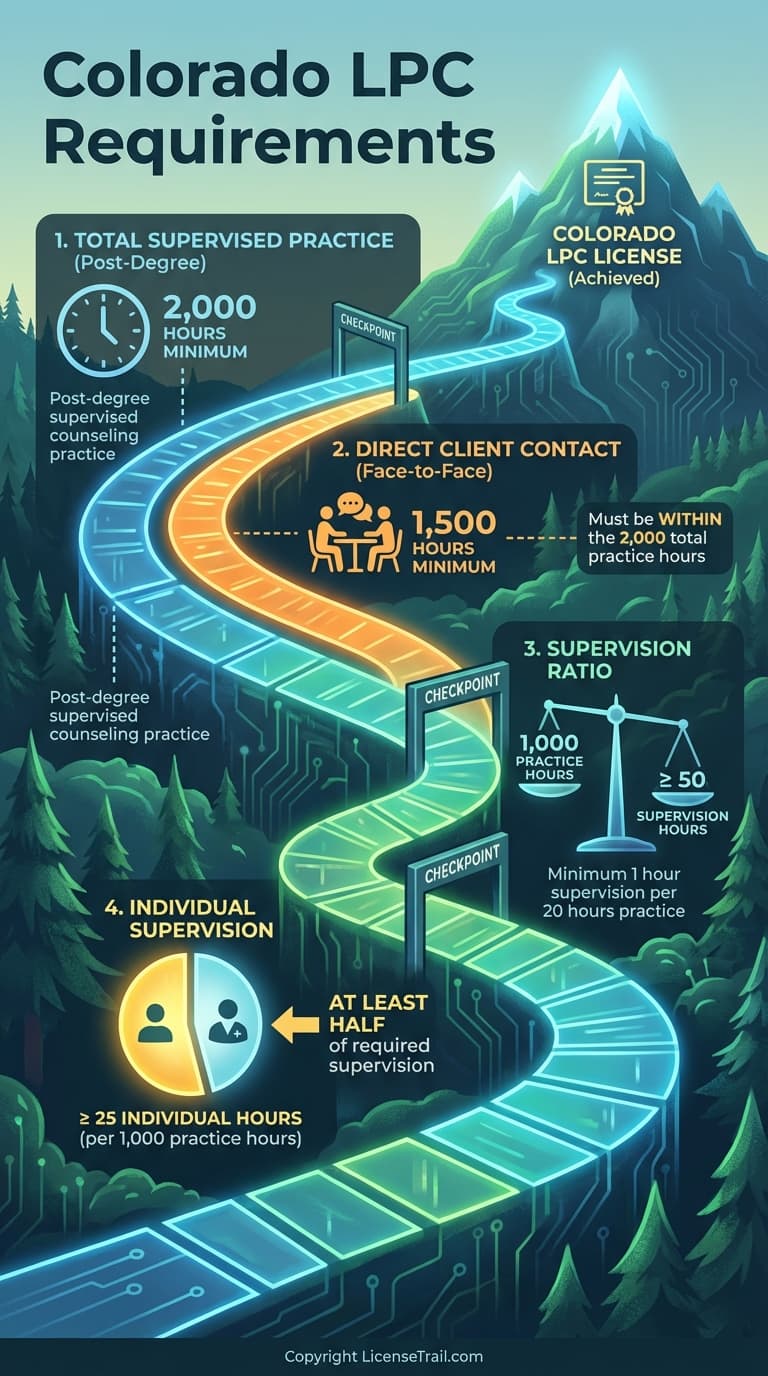
- Post-degree practice hours: 2,000 hours “practice in counseling,” incl. 1,500 face-to-face direct client contact
- Time minimum: 2,000 hours cannot be completed in <24 months (plan ≥2 years post-master’s)
- Supervision: 100 hours total (50 per 1,000); ≥50 individual; remainder triadic/group; max 1:10 supervisor:supervisees; no other supervision modes accepted
- Exams: NBCC national counseling exam (e.g., NCE) + Colorado mental health jurisprudence exam (generally valid 5 years)
- Apply for LPC: Submit application/fees, transcripts, supervision & hours verification, and exam scores to the CO Board
License Details
Procedures
In Colorado, the title “Licensed Professional Counselor” (LPC) and the path to earning it are set in statute (Title 12, Article 245 of the Colorado Revised Statutes) and in the State Board of Licensed Professional Counselor Examiners’ rules (4 CCR 737‑1). The process centers on a qualifying graduate degree, a defined period of supervised “practice in counseling,” and two examinations.
Below is a step‑by‑step outline with the specific hour types and the Board’s own terminology.
1. Basic eligibility
To qualify for LPC licensure, you must:
- Be at least 21 years old.
- Not be in violation of any provision of Article 245 (Mental Health) or any Board rule.
- Complete the education and supervised practice described below, and pass the required exams. (law.justia.com)
2. Complete a qualifying graduate degree
Degree level and content
Colorado requires either:
- A master’s or doctoral degree in professional counseling from an accredited school or college, or
- An equivalent program as determined by the Board.
In both cases, the degree must include a practicum or internship “in the principles and the practice of professional counseling.” (law.justia.com)
The Board’s rules add that:
- A CACREP‑approved program (if enrolled after August 31, 2014) must be at least 60 semester credit hours. (regulations.justia.com)
- Non‑CACREP programs must show educational equivalency, typically through a Board‑approved credentialing agency and coverage of eight core content areas (human growth and development, social and cultural foundations, helping relationships, groups, career development, appraisal, research and evaluation, professional orientation). (regulations.justia.com)
What “practice of licensed professional counseling” means
Colorado defines the “practice of licensed professional counseling” as applying mental health, psychological, or human development principles—using interventions such as evaluation, assessment, diagnosis, treatment, consultation, case management, psychotherapy, crisis intervention, and related services—to individuals, couples, families, or groups. (law.justia.com)
This definition matters because your post‑degree hours must be in this type of work.
3. Register as a Licensed Professional Counselor Candidate (LPCC)
Before any post‑degree hours can count toward LPC licensure, you must be properly credentialed while you are accumulating them.
Candidate registration requirement
By statute, the Board “shall register as a licensed professional counselor candidate” any person who: (law.justia.com)
- Files a candidate registration application and pays the required fee.
- Shows evidence that they meet the age, good‑standing, and education requirements (the same subsections (1)(a), (1)(b), and (1)(c) described above).
- (Under current law) has passed the Colorado mental health jurisprudence examination. (law.justia.com)
The Division of Professions and Occupations (DPO) further specifies that post‑degree work experience and supervision hours only count toward licensure if, while you are earning them, you are:
- Registered as a Licensed Professional Counselor Candidate (LPCC) or other mental health “candidate” status, or
- Registered as an Unlicensed Psychotherapist, or
- Practicing in an exempt facility as permitted. (dpo.colorado.gov)
If you begin working after graduation without one of these statuses, those hours generally do not count toward LPC requirements.
Candidate registration timeframe and renewals
Current statute provides that:
- If a candidate has not met the experience and exam requirements within three years, the registration becomes subject to regular renewal/expiration rules.
- Before a second or subsequent renewal, LPCCs must complete continuing professional competency (continuing professional development hours) to keep the registration. (law.justia.com)
4. Complete post‑graduate supervised practice
This is where the specific hour types and counts matter most.
The combination of statute and Board rule requires:
A. Minimum period of practice
You must have:
- At least two years of post‑master’s practice, or
- One year of post‑doctoral practice
in licensed professional counseling under clinical supervision. (law.justia.com)
The Board’s rules further state that the 2,000 required hours of practice (see below) “cannot be completed in fewer than twenty‑four months.” (regulations.justia.com)
In practice, this means you should plan on at least two years of supervised post‑degree practice, even if you hold a doctoral degree.
B. Total practice hours and direct client contact
Under section 12‑245‑604(1)(d) and Rule 4 CCR 737‑1.14(C): (law.justia.com)
You must complete:
- At least 2,000 hours of “practice in counseling” (i.e., practice in professional counseling/psychotherapy as defined in statute and rule), including:
- At least 1,500 hours of face‑to‑face direct client contact.
Key Board phrases:
- “Practice in professional counseling” includes the full range of counseling/psychotherapy activities defined in section 12‑245‑603 and the psychotherapy definition in section 12‑245‑202(14). (regulations.justia.com)
- “Face‑to‑face direct client contact” refers to in‑person or telehealth encounters where you are directly providing counseling or psychotherapy services to a client.
- The 2,000 hours may include some activities beyond direct sessions (e.g., documentation, case consultation), but at least 1,500 must be direct client counseling or psychotherapy.
The Board also allows some post‑doctoral teaching of the practice of professional counseling to count, up to 300 hours, if that teaching is itself supervised according to the rules. (regulations.justia.com)
C. Supervision hour requirements
Supervision is tracked separately from the 2,000 practice hours.
The rules state that for each 1,000 hours of supervised practice in professional counseling, you must receive: (regulations.justia.com)
- At least 50 hours of supervision, made up of:
- At least 25 hours of individual supervision (one supervisee at a time), which may be in person or telesupervision.
- Up to 25 hours of triadic or group supervision, with a maximum ratio of one supervisor to ten supervisees.
- “No other modes of supervision will be accepted.”
For the full 2,000 hours of practice, this translates to at least:
- 100 total hours of clinical supervision, of which:
- At least 50 hours must be individual, and
- Up to 50 may be triadic/group (within the 1:10 ratio).
The Board defines:
- “Individual supervision” as supervision provided to one individual at a time.
- “Group supervision” as supervision provided to no more than ten individuals at a time.
- “Supervision” as personal and responsible direction from a Board‑approved supervisor (LPC, LCSW, LMFT, psychologist, or licensed addiction counselor, properly licensed where the services were performed). (regulations.justia.com)
Supervisors must maintain records documenting:
- The exact number of hours of post‑master’s or post‑doctoral practice, and
- The exact number of supervision hours, in compliance with the rule. (regulations.justia.com)
5. Required examinations
Colorado requires demonstration of “professional competence” through examinations before LPC licensure.
A. National counseling examination
By rule, the Board’s professional counseling examination is the counselor certification exam administered by the National Board for Certified Counselors (NBCC) (e.g., the National Counselor Examination, NCE). (regulations.justia.com)
- You apply directly to NBCC (or any other testing service contracted by the Board).
- You may be allowed to take the exam in the final semester of a qualifying graduate program. (regulations.justia.com)
B. Colorado mental health jurisprudence examination
Both statute and rule require a jurisprudence examination covering Colorado mental health law and ethics: (law.justia.com)
- You must pass this:
- To register as an LPC candidate (under current version of section 12‑245‑604(4)), and
- To be licensed as an LPC.
Exam results are generally valid for up to five years for licensure purposes. (regulations.justia.com)
6. Apply for LPC licensure
Once you have:
- Met the age and good‑standing requirements,
- Completed a qualifying master’s or doctoral counseling degree with practicum/internship,
- Registered and practiced as an LPC candidate (or equivalent allowed status) while
- Completing at least 2,000 hours of “practice in counseling,” including at least 1,500 hours of face‑to‑face direct client contact,
- Obtained at least 100 hours of clinical supervision (50 individual, up to 50 triadic/group within a 1:10 ratio),
- Spent at least two years in post‑master’s (or one‑year postdoctoral, but note the 24‑month minimum for the 2,000 hours) supervised practice, and
- Passed both the NBCC counseling exam and the Colorado jurisprudence exam,
you submit a complete LPC application (form, fees, transcripts, supervision verification forms, exam scores) to the State Board of Licensed Professional Counselor Examiners. (law.justia.com)
The Board reviews your application against the requirements in statute and in Rule 4 CCR 737‑1.14. If everything is in order, the Board issues your Licensed Professional Counselor (LPC) license, which gives you the right to use the title “Licensed Professional Counselor” and the abbreviation “LPC” in Colorado. (colorado.public.law)
7. Summary of Colorado LPC supervised practice requirements (as of 2025)
Using the Board’s terminology:
- Total post‑degree practice required:
- 2,000 hours of “practice in counseling” / “practice in professional counseling.”
- Minimum 1,500 of those hours must be face‑to‑face direct client contact. (law.justia.com)
- Supervision required:
- 50 hours of clinical supervision per 1,000 practice hours,
- For 2,000 hours, at least 100 supervision hours total, with:
- Minimum 25 hours of individual supervision per 1,000 hours (so ≥ 50 individual for 2,000),
- Remaining supervision hours may be triadic or group (max 1 supervisor : 10 supervisees).
- “No other modes of supervision will be accepted.” (regulations.justia.com)
- Timeframe:
- At least two years of post‑master’s or one year of post‑doctoral supervised practice, and
- The 2,000 hours of practice “cannot be completed in fewer than twenty‑four months.” (law.justia.com)
Because statutes and rules can change, it is wise to double‑check the most recent Professional Counselor Licensing Guide and the current text of section 12‑245‑604 and Rule 4 CCR 737‑1 before planning your hour accumulation and application. (dpo.colorado.gov)
Track your LPC hours with confidence
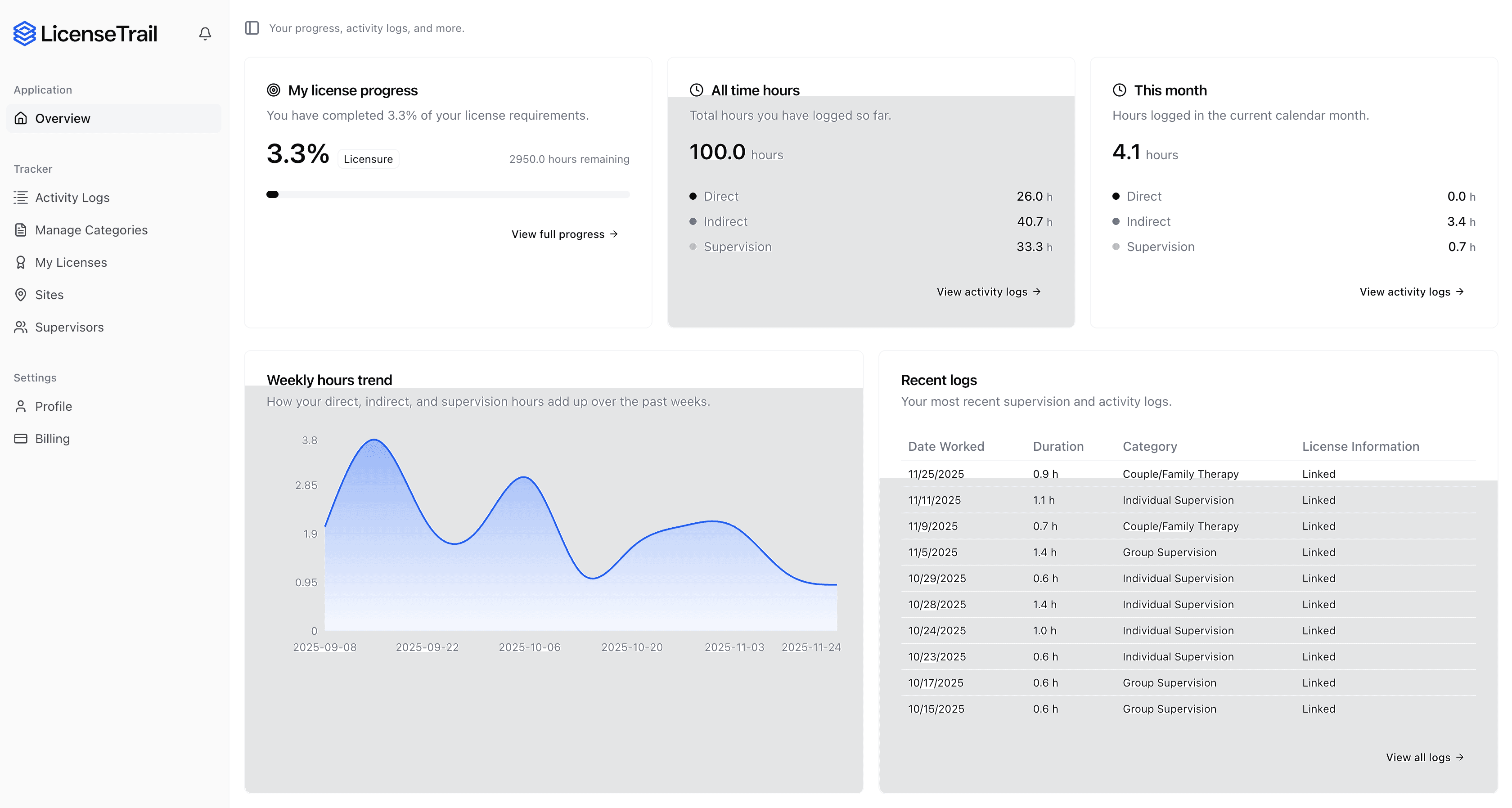
License Trail checks your direct, indirect, and supervision hours against Colorado LPC requirements continuously and flags mismatches before you submit.
 Start Tracking for Free
No credit card required · Free plan available
Is your spreadsheet hiding Colorado LPC risks?
Stop guessing if your categories match Colorado State Board of Licensed Professional Counselor Examiners requirements. License Trail checks your direct, indirect, and supervision hours continuously and flags mismatches before you submit.
Import or log
Bring your spreadsheet or start fresh
Upload your existing tracking spreadsheet and we'll map every hour into the right Colorado State Board of Licensed Professional Counselor Examiners categories automatically.
Verify against Colorado
Catch mismatches before the board does
License Trail checks your direct, indirect, and supervision hours against Colorado LPC requirements continuously.
Export board-ready
One-click clean reports
Generate professional, board-ready reports for supervision meetings and Colorado State Board of Licensed Professional Counselor Examiners submissions in seconds.
No credit card required · Free plan available