
Colorado LMFT Requirements: Hours, Exams & Step-by-Step Guide
Stop guessing if your categories match Colorado requirements. License Trail checks your direct, indirect, and supervision hours against LMFT requirements continuously and flags mismatches before you submit.
No credit card required · Free plan available
Quick Requirements Overview
- Governing body: CO DORA, State Board of Marriage and Family Therapist Examiners (rules: 4 CCR 736-1; statute: C.R.S. §12-245-504)
- Baseline eligibility: Age 21+; master’s/doctorate in MFT (or equivalent) incl. practicum/internship
- Pre-licensure status: Must be properly registered while accruing hours (typically MFTC; or Unlicensed Psychotherapist / exempt setting); otherwise hours may not count
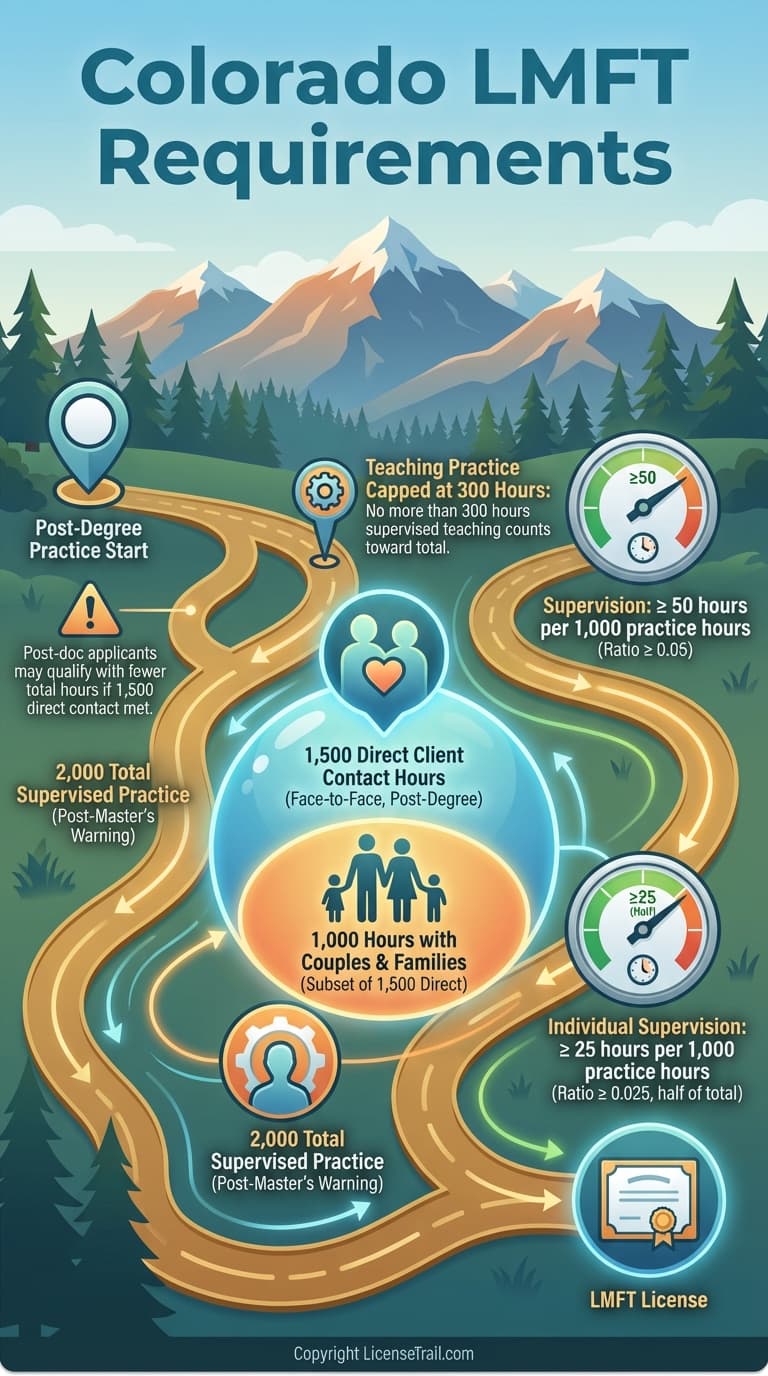
- Post-degree practice (master’s track): 2,000 supervised practice hours over ≥24 months, incl. 1,500 direct client contact; 1,000 of direct hours with couples/families
- Supervision (master’s track): 100 hours total (50 per 1,000 practice hrs); ≥50 individual; up to 50 group (≤10 supervisees); distributed over the experience period
- Doctoral track: ≥12 months; 1,500 direct client contact hrs incl. 1,000 couples/families; typically 75 supervision hrs
- Exams: CO Mental Health Jurisprudence Exam (now required for MFTC and LMFT) + AMFTRB National MFT Exam (scores valid up to 5 years)
- Timing limits: Experience/supervision generally must be within 5 years of application (unless good cause accepted)
License Details
Procedures
Licensure as a Licensed Marriage and Family Therapist (LMFT) in Colorado is governed by the State Board of Marriage and Family Therapist Examiners, within the Department of Regulatory Agencies (DORA), Division of Professions and Occupations. The requirements are defined in statute (primarily C.R.S. § 12‑245‑504) and in the Board’s rules at 4 CCR 736‑1, especially Rule 1.14 (Licensure by Examination). (codes.findlaw.com)
Below is a step‑by‑step outline, with the exact types and amounts of hours the Board requires.
1. License types and overall pathway
Colorado uses three related credentials under this Board: (dpo.colorado.gov)
- Marriage and Family Therapist Candidate (MFTC) – post‑degree trainee status; you must hold this (or another allowed status) for your post‑degree hours to count.
- Licensed Marriage and Family Therapist (LMFT) – full independent license.
- Provisional Marriage and Family Therapist (MFP) – a newer, limited license especially for practitioners who do not fully meet new statutory requirements but have substantial work experience.
For a new graduate, the standard path is:
Graduate MFT degree → register as MFTC → complete required supervised practice and supervision hours → pass required exams → apply for full LMFT.
2. Baseline eligibility for LMFT
The Board will issue an LMFT license to an applicant who (among other things): (codes.findlaw.com)
- Is at least 21 years old.
- Holds a master’s or doctoral degree in marriage and family therapy or its equivalent from a regionally accredited institution, including a practicum or internship in MFT.
- Has completed the post‑degree supervised practice and supervision requirements (detailed below).
- Has passed both the national MFT exam and the Colorado jurisprudence exam. (law.cornell.edu)
3. Candidate status (MFTC) and when hours “count”
The Board and DPO are very explicit that post‑degree hours only count if you are properly registered while you accrue them.
DORA’s Marriage and Family Therapy Applications page states that post‑degree work experience and supervision hours will only count toward licensure if the applicant is: (dpo.colorado.gov)
- registered as a candidate (e.g., MFTC),
- or registered as an Unlicensed Psychotherapist,
- or practicing in an exempt facility as allowed by law.
You must meet this requirement before accumulating post‑degree hours; hours gained while not properly registered typically will not be accepted. (dpo.colorado.gov)
Key points about MFTC registration
- Title: “Marriage and Family Therapist Candidate.”
- Supervision requirement while a candidate: the Mental Health Credentials Chart notes that MFTC must be supervised by an AAMFT‑approved supervisor or an LMFT in good standing; supervision by non‑LMFT mental health professionals must be approved by the Board to count. (scribd.com)
- Jurisprudence exam requirement: Under SB24‑115 and the 2025 rules, you must pass the Colorado Mental Health Jurisprudence Examination to obtain MFTC registration, not just for full licensure. (dpo.colorado.gov)
- Validity / expiration:
- MFTC registrations expire December 31 every three years. (dpo.colorado.gov)
- Candidates can now renew, and must complete continuing professional development hours before a second or later renewal. (dpo.colorado.gov)
4. Post‑degree supervised practice: hours and types
The detailed hour requirements are set out in 4 CCR 736‑1.14(C). (law.cornell.edu)
Colorado distinguishes between:
- Total supervised practice hours (your actual clinical and related work in “practice in individual and marriage and family therapy”), and
- Supervision hours (hours spent in formal supervision meetings).
These are not the same thing.
4.1 Master’s‑level pathway (most common)
For a master’s‑level applicant, the Board requires at least two years (24+ months) of post‑master’s practice under supervision. Within that, you must meet all of the following hour requirements: (law.cornell.edu)
-
Total supervised post‑master’s practice
- Minimum: 2,000 hours of “practice in individual and marriage and family therapy” under Board‑approved supervision.
- Minimum time frame: cannot be completed in fewer than 24 months. You may take longer.
-
Direct client contact requirement within those 2,000 hours
- At least 1,500 hours must be face‑to‑face direct client contact for purposes such as assessment and intervention.
- Of those direct hours, at least 1,000 hours must be with couples and families (for diagnosis, assessment and intervention). (law.cornell.edu)
-
What “couples and families” hours can include
- The rules clarify that sessions with individual members of a couple or family may count toward the “face‑to‑face direct client contact with couples and families” requirement when those sessions are part of, and further, ongoing work with that couple or family. (law.cornell.edu)
-
Distribution over time
- The 1,500 direct hours (including the 1,000 couples/families hours) must be “reasonably uniformly distributed” across at least 24 months; the Board does not want all hours compressed into a short stretch. (law.cornell.edu)
-
Teaching that may count
- Up to 300 hours of teaching the practice of individual and MFT may count toward the 2,000 practice hours.
- Up to 30 hours of supervision related to that teaching can count toward your supervision totals (see below), provided the teaching was itself supervised by a qualified supervisor. (law.cornell.edu)
In short for a master’s‑level candidate:
2,000 total supervised practice hours over at least 24 months
– including 1,500 hours of face‑to‑face direct client contact,
– of which 1,000 hours must be with couples and families.
4.2 Doctoral‑level pathway
If you have a qualifying doctoral degree, Colorado allows a shorter experience period, but with intensive client contact: (law.cornell.edu)
-
Total supervised post‑doctoral practice
- Must be completed in not fewer than 12 months.
-
Direct client contact hours
- At least 1,500 hours of face‑to‑face direct client contact in individual and MFT.
- Of that, at least 1,000 hours must be face‑to‑face direct client contact with couples and families for diagnosis, assessment and intervention, again reasonably uniformly distributed over at least 12 months. (law.cornell.edu)
-
Teaching that may count
- Up to 300 hours of teaching MFT may count toward post‑doctoral practice, with up to 15 supervision hours related to that teaching allowed. (law.cornell.edu)
-
Supervision‑hour total (see next section)
- Because supervision is required at a fixed ratio (50 hours per 1,000 practice hours), the doctoral track typically implies at least 75 supervision hours, and the DORA credentials chart explicitly lists 75 hours of supervision over a minimum of 12 months. (scribd.com)
5. Supervision: hours, format, and supervisors
5.1 Required supervision hours (distinct from practice hours)
The Board’s rules require supervision in proportion to your practice hours: (law.cornell.edu)
- Ratio: for each 1,000 hours of supervised practice, you must receive at least 50 hours of supervision.
- Of those 50 hours:
- At least 25 hours must be individual, face‑to‑face supervision (one supervisee at a time), which the Board allows to be in‑person or telesupervision.
- Up to 25 hours may be group supervision (no more than 10 supervisees at once), also in‑person or by telesupervision.
- Supervision hours must be “reasonably distributed” throughout each block of 1,000 hours of practice; you cannot “front‑load” or “back‑load” all supervision at the start or end. (law.cornell.edu)
Concretely, that means:
-
Master’s‑level (2,000 practice hours)
- Minimum supervision: 100 hours total, because 2 × (50 per 1,000)
- Of these, at least 50 hours must be individual face‑to‑face supervision, with up to 50 eligible to be group supervision. (law.cornell.edu)
-
Doctoral‑level (1,500 practice hours)
- At the same 50‑per‑1,000 ratio, this equates to a minimum of 75 supervision hours, and DORA’s credentials chart specifically lists 75 hours of supervision over at least 12 months. (scribd.com)
These supervision hours are in addition to your direct client contact and total practice hours; they are not double‑counted.
5.2 Who can serve as a supervisor
The Board’s Rule 1.14(C)(3) sets out who may be approved as a supervisor. Acceptable supervisors include: (law.cornell.edu)
- A licensed marriage and family therapist or other licensed mental health professional (e.g., professional counselor, psychologist, clinical social worker, licensed addiction counselor) in good standing, who has appropriate education, clinical experience, and supervisory experience in MFT.
- An AAMFT‑approved supervisor.
- A licensed MFT who was licensed at the highest level in another jurisdiction where your services were performed, with documentation of competence in MFT.
The Mental Health Credentials Chart further clarifies: (scribd.com)
- MFTC “must be supervised by [an] AAMFT‑approved supervisor or LMFT in good standing.”
- Supervision conducted by non‑MFT licensees must be approved by the Colorado Board of Marriage and Family Therapist Examiners for those hours to count.
Supervision must meet the Board’s definition: it is “personal direction and responsible direction” by an approved supervisor, not mere consultation, and may be provided in person or via telesupervision. (law.cornell.edu)
6. Examinations required
Colorado requires two examinations for LMFT licensure (and, now, for candidate registration as well): (law.cornell.edu)
-
Colorado Mental Health Jurisprudence Examination
- A Board‑developed exam covering Colorado mental health laws, rules, and ethical standards.
- As of SB24‑115 and current rules, this exam must be passed for both MFTC registration and LMFT licensure.
-
National MFT Licensing Examination
- The Board has adopted the Marriage and Family Therapy National Examination administered under contract with the Association of Marital and Family Therapy Regulatory Boards (AMFTRB) as the required national exam.
- Students in their last semester of a COAMFTE or non‑COAMFTE MFT graduate program may apply directly to AMFTRB to sit for the exam.
- Exam results are valid for up to five years for licensure purposes. (law.cornell.edu)
7. Applying for the LMFT license
Once you have:
- Completed the required post‑degree supervised practice hours,
- Completed the required supervision hours, and
- Passed both the Colorado jurisprudence exam and the national MFT exam,
you apply for licensure via DPO Online Services under “Marriage and Family Therapist – Initial License by Examination.” (dpo.colorado.gov)
Typical documentation includes:
- Verification of your graduate degree and practicum (often via your earlier MFTC “Certification of Education” form). (dpo.colorado.gov)
- A Post‑Degree Experience and Supervision Form, completed and signed by your supervisor(s), documenting:
- total practice hours,
- direct client contact hours, including couples/families hours, and
- supervision hours (individual and group). (dpo.colorado.gov)
- A Non‑MFT Supervisor Information Form if any of your supervision was by a non‑MFT who must be approved by the Board. (dpo.colorado.gov)
Time‑limit note: the Board’s rules state that experience and supervision more than five years before your application generally will not be accepted, unless you can show good cause and the Board agrees. (law.cornell.edu)
8. Provisional Marriage and Family Therapist (MFP) – special pathway
SB24‑115 created or broadened provisional licenses for mental health professionals, including MFT, mainly to address practitioners who do not meet the new candidate/supervision configurations. Key features of provisional licensure under that act include: (dpo.colorado.gov)
- Provisional licensees must show at least 4,000 hours of work experience and have completed a supervised period of at least one year.
- Provisional licenses are linked to new requirements for continuing education and supervision; all such licenses remain subject to Board discipline and rule‑making.
On DORA’s Marriage and Family Therapy page, Provisional MFTs have their own applications and “Verification of Employment” form. (dpo.colorado.gov)
For someone just beginning the profession in Colorado, the standard expectation is to go through the MFTC → LMFT route. The provisional LMFT path is primarily a transition mechanism for existing practitioners whose previous experience doesn’t neatly fit current candidate rules.
9. After licensure: renewal and continuing professional competency
9.1 Renewal cycles
DORA specifies that: (dpo.colorado.gov)
- All LMFT and Provisional LMFT licenses expire on August 31 of odd‑numbered years.
- All MFTC registrations expire on December 31 every three years.
9.2 Continuing Professional Competency (CPC)
For LMFTs, the Board requires participation in a Continuing Professional Development (CPD) program as a condition of renewal: (dpo.colorado.gov)
- Complete a Professional Survey and Self‑Assessment.
- Create a Learning Plan based on identified learning needs.
- Complete and document 40 Professional Development Hours (PDH) in line with that plan each renewal cycle (prorated if you are newly licensed mid‑cycle).
For MFTC candidates, effective May 22, 2024, the rules require 60 hours of continuing professional development and educational activities prior to a second or subsequent renewal of the candidate registration. (law.cornell.edu)
10. Numeric summary of Colorado LMFT hours
Putting the core quantitative requirements together:
Master’s‑level LMFT (standard route)
-
Post‑master’s supervised practice:
- 2,000 hours in “practice in individual and marriage and family therapy,”
- spread over at least 24 months. (law.cornell.edu)
-
Within those 2,000 hours:
- 1,500 hours must be face‑to‑face direct client contact;
- at least 1,000 of those direct hours must be with couples and families (individual sessions with family members can count if part of ongoing family/couple work). (law.cornell.edu)
-
Supervision hours (separate from practice):
- 100 hours total supervision (because it is 50 hours per 1,000 practice hours),
- at least 50 hours must be individual, face‑to‑face supervision (in‑person or telesupervision),
- up to 50 hours may be group supervision. (law.cornell.edu)
Doctoral‑level LMFT
-
Post‑doctoral supervised practice:
- At least 1,500 hours of face‑to‑face direct client contact,
- of which 1,000 hours must be with couples and families,
- completed in no fewer than 12 months. (law.cornell.edu)
-
Supervision:
- At least 75 hours of supervision (at the same 50‑per‑1,000 ratio; the DORA chart explicitly lists 75 hours over a minimum of 12 months), with at least half of those hours being individual, face‑to‑face supervision. (scribd.com)
Regulatory details are periodically updated—especially in light of SB24‑115—so before relying on this for an application, it is prudent to confirm against the current Colorado Marriage and Family Therapy Applications page and the latest version of 4 CCR 736‑1 on the state’s official sites. (dpo.colorado.gov)
Track your LMFT hours with confidence
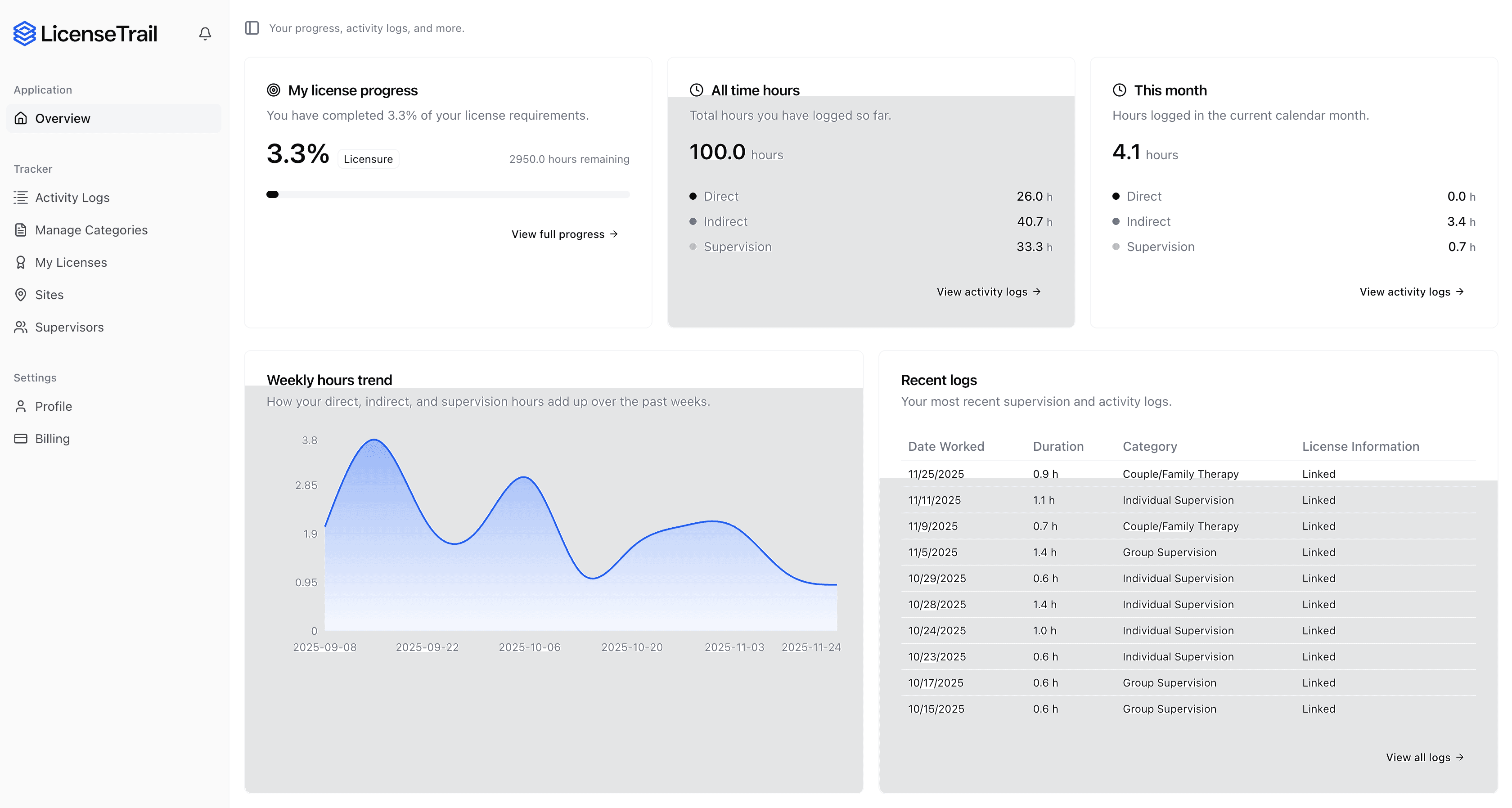
License Trail checks your direct, indirect, and supervision hours against Colorado LMFT requirements continuously and flags mismatches before you submit.
 Start Tracking for Free
No credit card required · Free plan available
Is your spreadsheet hiding Colorado LMFT risks?
Stop guessing if your categories match Colorado State Board of Marriage and Family Therapist Examiners requirements. License Trail checks your direct, indirect, and supervision hours continuously and flags mismatches before you submit.
Import or log
Bring your spreadsheet or start fresh
Upload your existing tracking spreadsheet and we'll map every hour into the right Colorado State Board of Marriage and Family Therapist Examiners categories automatically.
Verify against Colorado
Catch mismatches before the board does
License Trail checks your direct, indirect, and supervision hours against Colorado LMFT requirements continuously.
Export board-ready
One-click clean reports
Generate professional, board-ready reports for supervision meetings and Colorado State Board of Marriage and Family Therapist Examiners submissions in seconds.
No credit card required · Free plan available