
Colorado PSP Requirements: Hours, Exams & Step-by-Step Guide
Stop guessing if your categories match Colorado requirements. License Trail checks your direct, indirect, and supervision hours against PSP requirements continuously and flags mismatches before you submit.
No credit card required · Free plan available
Quick Requirements Overview
- Doctoral degree in psychology that meets CO psychologist education requirements (typically APA-accredited or Board-equivalent).
- Must be working in a licensed residential child care facility (RCF/RTC) in Colorado.
- Practice is limited to that facility and only under supervision of a licensee (supervisor name/contact/license # required).
- No specific experience-hour or supervision-hour minimums are required to obtain/hold the PSP (hours are tied to full PSY licensure, not PSP).
- License auto-terminates if employment or supervision ends and is not replaced within 30 days; changes must be reported within 30 days.
- Renewal/expiration aligns with psychology cycle: expires Aug 31 of odd-numbered years.
- “Provisional Psychologist” title is protected; cannot be used without PSP license.
License Details
Procedures
Colorado’s “Provisional Psychologist” (PSP) license is a very specific credential: it exists to let a doctoral‑level psychologist practice under supervision only in a residential child care facility, while they are otherwise meeting the full requirements for a psychologist license.
Below is a structured overview of what the Colorado State Board of Psychologist Examiners and the Mental Health Practice Act actually require, and how the supervised‑experience hour requirements fit in.
1. What the PSP Provisional Psychologist license is (and is not)
Under the Mental Health Practice Act, a “provisional license” is a special license the Board may issue to certain mental health professionals working in residential child care facilities under supervision. (law.justia.com)
For psychologists, this shows up as the Provisional Psychologist (PSP) license on DORA’s Psychology Applications and Forms page, alongside Psychologist (PSY) and Psychologist Candidate (PSYC). (dpo.colorado.gov)
Key points:
- The PSP:
- Is a provisional license issued by the State Board of Psychologist Examiners under C.R.S. 12‑245‑208. (law.justia.com)
- Allows you to practice only in a licensed residential child care facility (RCF/RTC) and only under the supervision of a licensee. (law.justia.com)
- It is not the same as:
- A full psychologist (PSY) license, or
- A Psychologist Candidate (PSYC) registration, which is the usual status used to log post‑doctoral hours for full licensure. (law.justia.com)
Because of that, the PSP itself does not come with its own “X hours of experience + Y hours of supervision” requirement. The detailed hour requirements you hear about (1,500 hours, 75 supervision hours, etc.) belong to full psychologist licensure, not to the PSP license itself.
2. Statutory requirements to qualify for a Provisional Psychologist (PSP) license
The general statutory authority for all provisional licenses in the mental health professions is C.R.S. 12‑245‑208. For psychologists, the Board has implemented this as the PSP license.
2.1 Education
To receive a provisional psychologist license, you must have completed a postgraduate degree that already meets the educational requirements for psychologist licensure under C.R.S. 12‑245‑304. (law.justia.com)
Practically, that means:
- A doctorate in psychology:
- “Has completed a doctorate degree with a major in psychology, or the equivalent … from an approved school.” (codes.findlaw.com)
- In practice, this normally means a doctoral program in psychology that is APA‑accredited or deemed equivalent by the Board. (ru.scribd.com)
There is no separate “hours” requirement in the statute to obtain the PSP, beyond having this qualifying doctoral degree.
2.2 Work setting: residential child care facility + supervision
C.R.S. 12‑245‑208(1)(a) says the Board may issue a provisional license to an applicant who:
- Has completed the qualifying postgraduate degree, and
- “is working in a residential child care facility … under the supervision of a licensee.” (law.justia.com)
The State’s mental‑health credentials chart, summarizing Board requirements, says for the PSP: Provisional Psychologist:
- Training: “Doctorate degree from APA‑approved program or equivalent”
- Must be “working under supervision of a licensed mental health professional in a residential childcare facility (RTC)” (ru.scribd.com)
So, concretely:
- You must be employed by a qualifying Colorado residential child care facility (RCF/RTC).
- You must be under the supervision of a licensee (e.g., a Colorado‑licensed psychologist or other appropriately licensed mental health professional, per Board rules and facility requirements).
2.3 Duration and automatic termination
By statute, a provisional license (which includes the PSP) ends automatically if you leave the facility or lose supervision and don’t promptly replace it. Specifically: (law.justia.com)
- It terminates at the earliest of:
- 30 days after you stop working for a qualifying residential child care facility, unless you submit proof of employment with another such facility; or
- 30 days after your supervision ends, unless you submit proof of new supervision by another licensee.
- You must notify the Board of any change in supervision within 30 days.
All provisional licenses (including PSP) share the same renewal/expiration schedule as psychologist licenses—they expire on August 31 of odd‑numbered years. (dpo.colorado.gov)
2.4 Application and Board paperwork
On the Colorado Psychology Applications and Forms page, the Board lists the specific PSP application mechanisms: (dpo.colorado.gov)
- Apply online (through DPO Online Services):
- Provisional Psychologist – Initial by Original Method
- Provisional Psychologist – Reinstatement of an Expired License
- Provisional Psychologist – Renewal
- Downloadable forms:
- Provisional Psychologist – Verification of Practice
- Model Mandatory Disclosure Statement
- Mental Health Credentials Chart
- Jurisprudence Examination Guide
Secondary sources summarizing these Board materials note that for PSP you must: (psychologydegree411.com)
- Hold an APA‑approved (or Board‑equivalent) doctoral degree in psychology.
- Apply through the online portal (application fee noted as approximately $70, but fees can change).
- Submit a Verification of Practice form documenting your work and supervision in the residential child care facility.
The statute also requires that an application for a provisional license identify “the name, contact information, and license number of the licensee providing supervision.” (law.justia.com)
2.5 Title use and protections
Under C.R.S. 12‑245‑218, no one may hold themselves out by the title “provisional psychologist” unless they are properly licensed under Article 245: (law.justia.com)
- The statute explicitly lists “psychologist” and “provisional psychologist” as protected titles.
- Using those titles without a license is considered unauthorized practice and can trigger enforcement.
3. Are there specific hour requirements tied to the PSP itself?
No specific hour minimums are attached to obtaining or holding the PSP license in the statute or in the Board’s summary materials.
The controlling statute (C.R.S. 12‑245‑208) focuses on: (law.justia.com)
- Completion of a qualifying postgraduate degree (for psychologists, the doctoral degree described in C.R.S. 12‑245‑304), and
- Current supervised employment in a residential child care facility.
It does not say, for example, “1,500 hours of supervised practice are required to get a PSP license.”
The detailed supervised‑experience hour requirements you’ve probably heard about—such as “1,500 hours” and “75 hours of supervision”—belong to full psychologist licensure (PSY) under C.R.S. 12‑245‑304 and the Board’s rules, not to the PSP credential itself. (codes.findlaw.com)
You can hold a PSP license and also be accruing hours toward full psychologist licensure, but those hours are governed by the full‑licensure rules, described next.
4. Post‑doctoral supervised experience requirements for full psychologist licensure (PSY)
Because most people seeking a PSP are either on the path to licensure or already qualify for licensure elsewhere, it’s important to separate:
- Requirements to hold a PSP, vs.
- Requirements for full psychologist licensure, which include a specific, quantified year of supervised experience.
Under C.R.S. 12‑245‑304 and the Board’s rules, to qualify for a psychologist (PSY) license, you must: (codes.findlaw.com)
- Be at least 21 years old.
- Not be in violation of the Mental Health Practice Act or Board rules.
- Have completed a doctorate degree in psychology (or Board‑determined equivalent) from an approved school.
- Have “at least one year of postdoctoral experience practicing psychology under supervision approved by the board.”
- Pass:
- The Examination for Professional Practice in Psychology (EPPP), and
- The Colorado Mental Health Jurisprudence Examination. (codes.findlaw.com)
The Board’s post‑degree rules and multiple licensure guides summarize that one year of post‑doctoral experience in Colorado as: (psychologydegree411.com)
- 1,500 hours of post‑doctoral supervised experience, completed over no fewer than 12 months.
- Within that 1,500 hours, you must have at least:
- 75 hours of supervision, of which
- At least 50 hours must be individual, face‑to‑face supervision.
- The majority of your supervised hours must be under a Colorado‑licensed psychologist; however:
- Up to 375 of the 1,500 hours may be supervised by a Board‑certified psychiatrist (with up to about 17.75 hours of supervision from that psychiatrist).
- You may count up to:
- 500 hours of supervised teaching, and
- 500 hours of supervised research
toward the 1,500 hours, if those activities are properly supervised and aligned with Board rules.
- At least 50 hours of your work and 3 hours of supervision must address race and ethnicity in psychology, though some graduate coursework may be allowed to fulfill this requirement per Board guidance.
The Board’s Applications & Forms page also emphasizes that post‑degree work experience and supervision hours “will only count” toward licensure if you are properly registered (for psychologists, typically as a Psychologist Candidate [PSYC]) or are practicing in an exempt facility: (dpo.colorado.gov)
“…the required post-degree work experience and supervision hours will only count towards licensure if the applicant is registered as a candidate … or is currently registered as an Unlicensed Psychotherapist or practicing in an exempt facility as permitted.”
That means:
- To have your hours recognized toward full psychologist licensure, you generally must:
- Hold a Psychologist Candidate (PSYC) registration, or
- Be practicing in a qualifying exempt facility under the statute and rules.
- SB 24‑115 has recently added a requirement that aspiring PSYC candidates pass the Colorado Mental Health Jurisprudence Examination in order to obtain the PSYC registration; rulemaking is underway to align Board rules with this statute. (leg.colorado.gov)
5. Putting it together: practical pathway to PSP and, if desired, full licensure
Step 1 – Complete the qualifying doctoral degree in psychology
- Earn a doctoral degree (Ph.D., Psy.D., or Ed.D. with a psychology major) from an APA‑accredited or Board‑equivalent program so that you meet C.R.S. 12‑245‑304(1)(c). (codes.findlaw.com)
Step 2 – Obtain supervised employment in a Colorado residential child care facility
- Secure a position in a residential child care facility/RTC that is recognized under Colorado law.
- Arrange supervision by a Colorado‑licensed mental health professional (for psychologists, ordinarily a licensed psychologist), whose license information will be listed on your application. (law.justia.com)
Step 3 – Apply for the PSP (Provisional Psychologist) license
Through DPO Online Services, complete: (dpo.colorado.gov)
- Provisional Psychologist – Initial by Original Method application.
- Pay the applicable fee (commonly reported around $70, but confirm current fees).
- Submit:
- Official transcripts or other proof of your qualifying doctoral degree.
- Verification of Practice form documenting:
- Employment at a residential child care facility, and
- Your supervising licensee (name, contact, license number).
You must maintain your employment and supervision to keep the PSP active; if you lose either and do not replace it within 30 days (and notify the Board), the provisional license terminates automatically. (law.justia.com)
Step 4 – If your goal is full psychologist licensure (PSY), separately satisfy the hour requirements
Holding a PSP license alone does not fulfill the supervised‑experience requirements for full psychologist licensure. To become a fully licensed psychologist you must: (codes.findlaw.com)
- Accrue 1,500 hours of supervised post‑doctoral experience over at least 12 months, respecting:
- 75 hours of total supervision
- 50 hours minimum individual face‑to‑face supervision
- The permitted proportions of psychologist vs. psychiatrist supervision
- Limits on counting teaching and research hours
- Race/ethnicity‑focused hour requirements
- Make sure your hours are being logged in a status that the Board will credit (usually as a Psychologist Candidate [PSYC] or in an exempt facility as defined in statute and rule). (dpo.colorado.gov)
- After completing the hours, pass:
- The EPPP; and
- The Colorado Mental Health Jurisprudence Examination. (codes.findlaw.com)
Only after that process will the Board issue you a full Psychologist (PSY) license.
6. Summary of “hours” in plain terms
-
For the PSP Provisional Psychologist license itself
- Statute and Board summaries do not specify a numeric experience‑hour or supervision‑hour requirement.
- The controlling criteria are:
- Completion of a qualifying doctoral degree, and
- Being employed and supervised in a residential child care facility. (law.justia.com)
-
For full psychologist licensure (PSY)
- Colorado requires 1,500 hours of post‑doctoral supervised experience over at least 12 months, including:
- 75 hours of supervision, with
- 50 hours of individual, face‑to‑face supervision. (psychologydegree411.com)
- Those hours must be earned while in a recognized status (e.g., PSYC) or exempt facility so they “count” toward licensure, and they are separate from any minimums to simply hold the PSP license. (dpo.colorado.gov)
- Colorado requires 1,500 hours of post‑doctoral supervised experience over at least 12 months, including:
In other words: Colorado does not require something like “1,500 hours of direct experience plus 1,500 hours of supervised experience” for the PSP. The quantified hours you see in Board‑aligned sources (1,500 total hours with 75 hours of supervision) are the one‑year post‑doctoral requirement for full psychologist licensure, not a condition of obtaining or renewing the PSP Provisional Psychologist license itself.
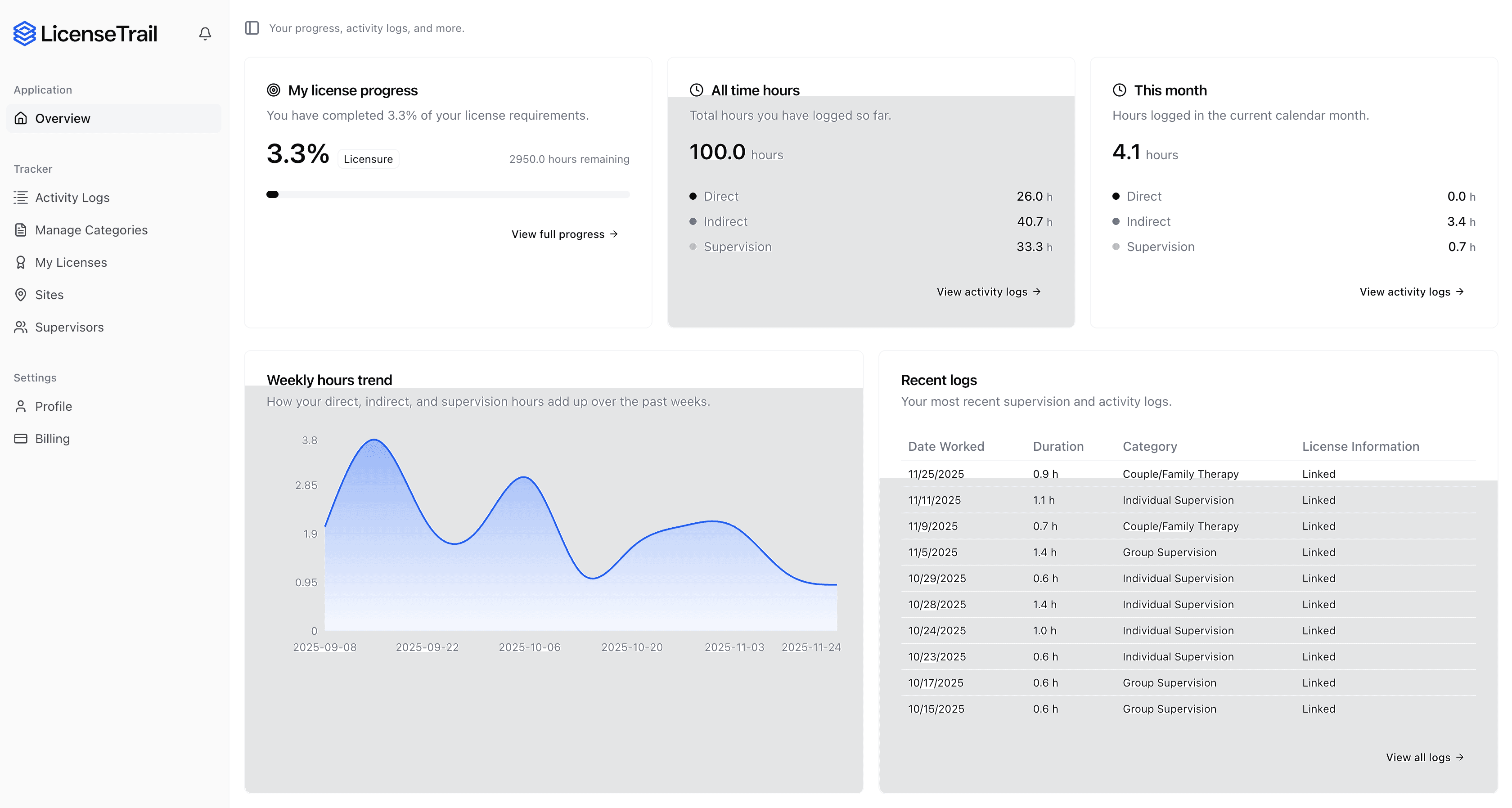
Track your PSP hours with confidence
License Trail checks your direct, indirect, and supervision hours against Colorado PSP requirements continuously and flags mismatches before you submit.
 Start Tracking for Free
No credit card required · Free plan available
Related Licenses
Is your spreadsheet hiding Colorado PSP risks?
Stop guessing if your categories match Colorado State Board of Psychologist Examiners requirements. License Trail checks your direct, indirect, and supervision hours continuously and flags mismatches before you submit.
Import or log
Bring your spreadsheet or start fresh
Upload your existing tracking spreadsheet and we'll map every hour into the right Colorado State Board of Psychologist Examiners categories automatically.
Verify against Colorado
Catch mismatches before the board does
License Trail checks your direct, indirect, and supervision hours against Colorado PSP requirements continuously.
Export board-ready
One-click clean reports
Generate professional, board-ready reports for supervision meetings and Colorado State Board of Psychologist Examiners submissions in seconds.
No credit card required · Free plan available