
Colorado PSYC Requirements: Hours, Exams & Step-by-Step Guide
Stop guessing if your categories match Colorado requirements. License Trail checks your direct, indirect, and supervision hours against PSYC requirements continuously and flags mismatches before you submit.
No credit card required · Free plan available
Quick Requirements Overview
- PSYC registration required to have postdoctoral hours count toward CO psychologist licensure (unless registered as Unlicensed Psychotherapist or working in an exempt facility).
- PSYC eligibility: age 21+, qualifying doctoral degree (major/equivalent in psychology from approved school), no violations, apply/pay fee, must pass CO Mental Health Jurisprudence Exam, and cannot have been previously registered as PSYC.
- Postdoc requirement while PSYC: 1,500 clock hours of psychology practice under Board-approved supervision, over ≥12 months (cannot be completed in <12 months; reasonably uniformly distributed).
- Supervision minimums: 75 supervision hours total, including ≥50 hours individual face-to-face; remainder may be group (≤10 supervisees); other supervision modes not accepted.
- Content requirement: ≥50 hours training in racial/ethnic bases of behavior plus ≥3 supervision hours in that area (or documented grad coursework substitution).
- Allowable caps within the 1,500 hours: teaching ≤500 hrs, research ≤500 hrs, psychiatrist-supervised experience ≤375 hrs (psychologist must supervise psychological testing).
- PSYC term/renewal: if postdoc + exams not completed within 3 years, registration subject to renewal/reinstatement/delinquency provisions; continuing professional development/education required before 2nd+ renewals.
- Full licensure also requires passing a national psychology exam (EPPP or successor; exam scores typically must be ≤5 years old) in addition to the CO jurisprudence exam.
License Details
Procedures
In Colorado, the Psychologist Candidate (PSYC) registration is the credential you must hold while completing your postdoctoral supervised experience on the way to full psychologist licensure. The State Board of Psychologist Examiners defines in statute and rule exactly what education, exams, and types of hours are required, and it ties those hours to your PSYC status.
Below is a step‑by‑step guide, with emphasis on the specific hour and supervision requirements and the Board’s own terminology.
1. Big picture: PSYC within the Colorado licensure pathway
Colorado law says the Board issues a psychologist license only to applicants who:
- Are at least 21 years old;
- Are not in violation of the mental health practice act or Board rules;
- Have completed a doctoral degree with a major in psychology, or an equivalent major, from an approved school;
- Have completed at least one year of postdoctoral experience practicing psychology under supervision approved by the Board; and
- Have passed both a national written examination in psychology and a Colorado jurisprudence examination. (colorado.public.law)
The psychologist candidate (PSYC) registration is the status you hold while you work on the last two bullets: the postdoctoral supervised experience and the exams. (colorado.public.law)
2. Eligibility to register as a Psychologist Candidate (PSYC)
2.1 Statutory eligibility requirements
Colorado Revised Statutes § 12‑245‑304(3)(a) provides that the Board “shall register as a psychologist candidate” a person who:
- Files an application for registration, accompanied by the required fee; and
- Submits evidence satisfactory to the Board that the person has met the following three requirements for full licensure (incorporating § 12‑245‑304(1)(a)–(c)): (colorado.public.law)
- (1)(a) Is at least twenty‑one years of age;
- (1)(b) Is not in violation of Article 245 or any Board rules;
- (1)(c) Has completed a doctorate degree with a major in psychology, or the equivalent as determined by the Board, from an approved school.
In addition, the statute requires that the person:
- Has not been previously registered as a psychologist candidate by the Board; and
- Has passed a Colorado jurisprudence examination administered by the Division (this requirement was added by 2024 legislation and written into § 12‑245‑304(3)(a)(III)). (law.justia.com)
So, in plain terms, you must:
- Hold an acceptable doctoral degree in psychology;
- Be at least 21 with a record acceptable to the Board;
- Pass the Colorado Mental Health Jurisprudence Examination; and
- Apply and pay the fee, without having held a PSYC registration in the past.
2.2 Where and how you apply
The Colorado Division of Professions and Occupations (DPO) lists “Psychologist Candidate – Initial by Original Method” as an online application. (dpo.colorado.gov)
The Board’s psychology applications page indicates that, through DPO Online Services, you can:
- Apply for an initial Psychologist Candidate registration;
- Reinstate an expired candidate registration; and
- Renew a candidate registration. (dpo.colorado.gov)
You’ll typically need:
- Official doctoral transcript or a “Psychologist Candidate – Certification of Doctorate Education” form completed by your program; (dpo.colorado.gov)
- Documentation of any professional licensure history or discipline;
- Results of the Colorado Mental Health Jurisprudence Examination;
- Application fee (amount set by the Division, not in statute).
3. How long the PSYC registration lasts and renewal rules
Colorado law ties the duration and renewal of PSYC registration to your progress toward full licensure.
Under the current version of § 12‑245‑304 as amended in 2024: (law.justia.com)
- A psychologist candidate is under the jurisdiction of the Board.
- If the candidate has not completed:
- (1)(d) the required postdoctoral supervised experience, and
- (1)(e) the required national psychology examination plus jurisprudence exam,
within three years, the candidate registration becomes subject to renewal, reinstatement, and delinquency fee provisions under § 12‑20‑202.
- Before a second or subsequent renewal of a PSYC registration, the candidate must complete continuing professional development and educational hours to maintain the registration.
Colorado DPO’s summary of SB24‑115 confirms the recent change: to obtain a PSYC registration you must pass the Colorado jurisprudence exam, and PSYC registrations can be renewed if you cannot complete all licensure requirements within the three‑year window, with continuing education obligations for subsequent renewals. (dpo.colorado.gov)
In practice:
- Expect your initial PSYC registration to be issued for a three‑year term.
- If you have not finished the 1,500 postdoctoral hours and passed the national exam by then, you may renew — but you’ll have to follow whatever continuing‑education requirements the Board implements in rule.
Because SB24‑115 directed the Board to align its rules with these statutory changes by December 31, 2024, always verify the current renewal details in the Board’s rules or with DPO when you are actually applying. (law.justia.com)
4. Hours that must be completed while you are a PSYC
Colorado links post‑degree work experience to holding an appropriate candidate registration (or a limited set of alternatives). The psychology licensing information states that:
Post‑degree work experience and supervision hours will only count towards licensure if the applicant is registered as a candidate (including PSYC) or is registered as an unlicensed psychotherapist or practicing in an exempt facility. (dpo.colorado.gov)
So, if you want your postdoctoral hours to count:
- You must be registered as a Psychologist Candidate (PSYC),
or - Be registered as an Unlicensed Psychotherapist or employed in an exempt facility (e.g., certain governmental or institutional settings) as permitted by law.
For most applicants pursuing independent practice licensure, the ordinary path is to register as a PSYC and accrue the postdoctoral hours in that status.
5. Exact postdoctoral hour and supervision requirements
These requirements are what you must satisfy while holding PSYC (or equivalent) status to qualify later for full psychologist licensure. They are defined in both statute and the Board’s rule 3 CCR 721‑1.14.
5.1 Statutory minimum: one year of postdoctoral supervised experience
The statute requires:
- “At least one year of postdoctoral experience practicing psychology under supervision approved by the Board.” (colorado.public.law)
The rule tells you what “one year” means quantitatively and what counts as “practicing psychology under supervision.”
5.2 Total number of postdoctoral hours
Under 3 CCR 721‑1.14(C)(4): (law.cornell.edu)
- The postdoctoral experience practicing psychology under supervision:
- Cannot be completed in fewer than 12 months; and
- Must include at least 1,500 clock hours.
- Those 1,500 hours must be “reasonably uniformly distributed” over a minimum of twelve months.
So the core requirement is:
1,500 clock hours of postdoctoral experience practicing psychology under supervision, over at least 12 months.
This is not 1,500 hours of direct client work plus a separate 1,500 hours of supervised experience; the 1,500 hours are the total postdoc practice hours, all under supervision.
5.3 Required supervision hours within those 1,500 hours
The Board separates practice hours from supervision hours and specifies the supervision minimums:
- You must receive at least 75 clock hours of postdoctoral supervision;
- Of those, at least 50 hours must be face‑to‑face individual supervision;
- The remaining supervision up to 75 hours may be group supervision;
- No other modes of supervision (e.g., purely consultative relationships) will be accepted. (law.cornell.edu)
In other words:
- Practice requirement: minimum 1,500 hours of postdoctoral practice in psychology under supervision.
- Supervision requirement (within or in parallel to that practice): minimum 75 hours of supervision, of which:
- ≥ 50 hours are individual, face‑to‑face;
- ≤ 25 hours may be group (up to ten supervisees at a time).
5.4 What counts toward the 1,500 hours (types of postdoctoral experience)
The rule defines, and caps, several types of experience that may be counted toward the 1,500 hours. (law.cornell.edu)
Within the 1,500 postdoctoral hours, you may include:
-
Teaching of psychology
- May count for up to 500 hours of postdoctoral experience;
- May also account for up to 25 hours of supervision, if the teaching is in courses in the same or similar field and is supervised by an approved supervisor.
-
Research experience
- May count for up to 500 hours of postdoctoral experience;
- May also account for up to 25 hours of supervision, if performed in the same or similar field and supervised by an approved supervisor.
-
Experience under a board‑certified psychiatrist
- May count for up to 375 hours of postdoctoral experience;
- May count for up to 17.75 hours of supervision;
- A licensed psychologist must supervise psychological testing even when the primary supervisor is a psychiatrist.
-
Training in racial/ethnic bases of behavior
- At least 50 hours of your postdoctoral practice must be in this subject area;
- At least 3 hours of supervision must be focused on this area;
- The Board allows substitution of clearly documented graduate coursework equal to three semester or five quarter hours for this training requirement.
The rule also defines:
- “Post‑doctoral experience” as experience under approved supervision after the doctoral degree requirements are certified as complete;
- “Practice in ‘psychology’” as services within the statutory definition of psychotherapy and the more specific definition of psychological services;
- “Individual supervision” as supervision of one supervisee at a time, and “group supervision” as supervision of no more than ten supervisees at one time. (law.cornell.edu)
All hours must be documented and verified by your approved supervisor(s) on Board forms attesting to satisfactory completion of the postdoctoral practice and adherence to generally accepted standards of practice. (law.cornell.edu)
6. Supervision: who can supervise and how it must be structured
The Board’s rule specifies who qualifies as a supervisor and how supervision is to be provided. (law.cornell.edu)
6.1 Approved supervisors
Acceptable supervisors include:
- A licensed psychologist in the jurisdiction where the services are performed;
- A psychiatrist who is:
- Certified by the American Board of Psychiatry and Neurology;
- Licensed as a physician in that jurisdiction;
- Completed psychiatric residency; and
- Competent in the same practice area;
- (But a psychologist must supervise psychological testing in this scenario);
- A psychologist licensed at the highest possible level in another jurisdiction deemed competent in the relevant field.
Supervision must meet the Board’s definitions of personal direction and responsible direction, which require the supervisor to know the clients sufficiently, review treatment plans, oversee the supervisee’s work, and collaborate on decisions requiring a psychologist’s skill set. (law.cornell.edu)
6.2 Record‑keeping
Approved supervisors must keep records sufficient to:
- Train and evaluate the candidate;
- Credit the candidate with the exact number of hours of acceptable postdoctoral practice and supervision. (law.cornell.edu)
These records support the Post‑Degree Experience and Supervision Form the Board requires in your eventual psychologist license application. (dpo.colorado.gov)
7. Pre‑degree practicum and internship hours (education requirements)
Although your question focuses on the PSYC and postdoctoral stage, Colorado’s rules also specify minimum practicum and internship hours within the doctoral program. These help clarify what “direct” vs. supervised hours look like earlier in training.
Under 3 CCR 721‑1.14(B)(2)(g): (law.cornell.edu)
-
Practicum
- Minimum 400 hours of practicum, of which:
- At least 150 hours must be direct service experience;
- At least 75 hours must be formally scheduled supervision.
- Minimum 400 hours of practicum, of which:
-
Internship
- For clinical, school, or counseling psychology internships, the experience must:
- Be at least one full‑time calendar year or two half‑time years; and
- Encompass at least 1,500 experience hours;
- Be APA‑accredited or substantially equivalent.
- For clinical, school, or counseling psychology internships, the experience must:
These requirements are part of determining whether your doctoral program qualifies as a major in psychology or equivalent for licensure. They are separate from, and in addition to, the postdoctoral 1,500 supervised hours you complete as a PSYC.
8. Exams associated with the PSYC and full licensure
8.1 Colorado Mental Health Jurisprudence Examination
- Required to obtain a PSYC registration as of SB24‑115 and § 12‑245‑304(3)(a)(III). (law.justia.com)
- Also required for full psychologist licensure under § 12‑245‑304(1)(e). (colorado.public.law)
DPO provides a Jurisprudence Examination Guide and administers the exam online. (dpo.colorado.gov)
8.2 National psychology exam (EPPP or successor)
For full licensure (but not necessarily to obtain PSYC), you must pass a national written examination in psychology covering: (colorado.public.law)
- General psychology;
- Clinical and counseling psychology;
- Application of clinical and counseling psychology, including statutes and ethics.
The Board contracts with the Examination for Professional Practice in Psychology (EPPP) and requires that exam results be no more than five years old at the time of licensure application. (law.cornell.edu)
9. Putting it all together: what “becoming a PSYC” really entails
To summarize the core requirements and hour structure, using the Board’s own terminology:
-
Before PSYC registration
- Complete a qualifying doctoral degree in psychology with required practicum (400 hours, including 150 direct service and 75 supervision) and internship (1,500 hours). (law.cornell.edu)
- Be at least 21 and in compliance with law and rules. (colorado.public.law)
- Pass the Colorado Mental Health Jurisprudence Examination. (law.justia.com)
-
Obtain PSYC (Psychologist Candidate) registration
- Apply online for “Psychologist Candidate – Initial by Original Method”, submit fees and proof of doctoral education and jurisprudence exam, and attest you have not previously been a PSYC. (dpo.colorado.gov)
-
While registered as a PSYC (or equivalent status)
-
Complete at least one year of postdoctoral experience practicing psychology under supervision, which the Board defines as: (colorado.public.law)
- Minimum 1,500 clock hours of postdoctoral practice in psychology under supervision, spread over ≥ 12 months;
- Minimum 75 hours of postdoctoral supervision, including at least 50 hours of individual, face‑to‑face supervision, with the remainder allowed as group supervision;
- Optional but capped credit for teaching (≤ 500 hours), research (≤ 500 hours), and psychiatrist‑supervised experience (≤ 375 hours and 17.75 supervision hours);
- At least 50 hours of postdoctoral experience and 3 hours of supervision focusing on racial/ethnic bases of behavior (or equivalent coursework).
-
Ensure you are properly registered (PSYC, unlicensed psychotherapist, or exempt facility) so that your post‑degree work experience and supervision hours will count toward licensure, as the Board’s licensing materials require. (dpo.colorado.gov)
-
-
Toward full licensure
- Pass the national psychology exam (EPPP or successor) within the allowed timeframe; (law.cornell.edu)
- Apply for licensure by examination once education, postdoctoral experience, and exams are all complete.
This is the structure the Colorado State Board of Psychologist Examiners uses to define the Psychologist Candidate (PSYC) pathway, and these are the specific hour requirements and terms you are expected to meet and document.
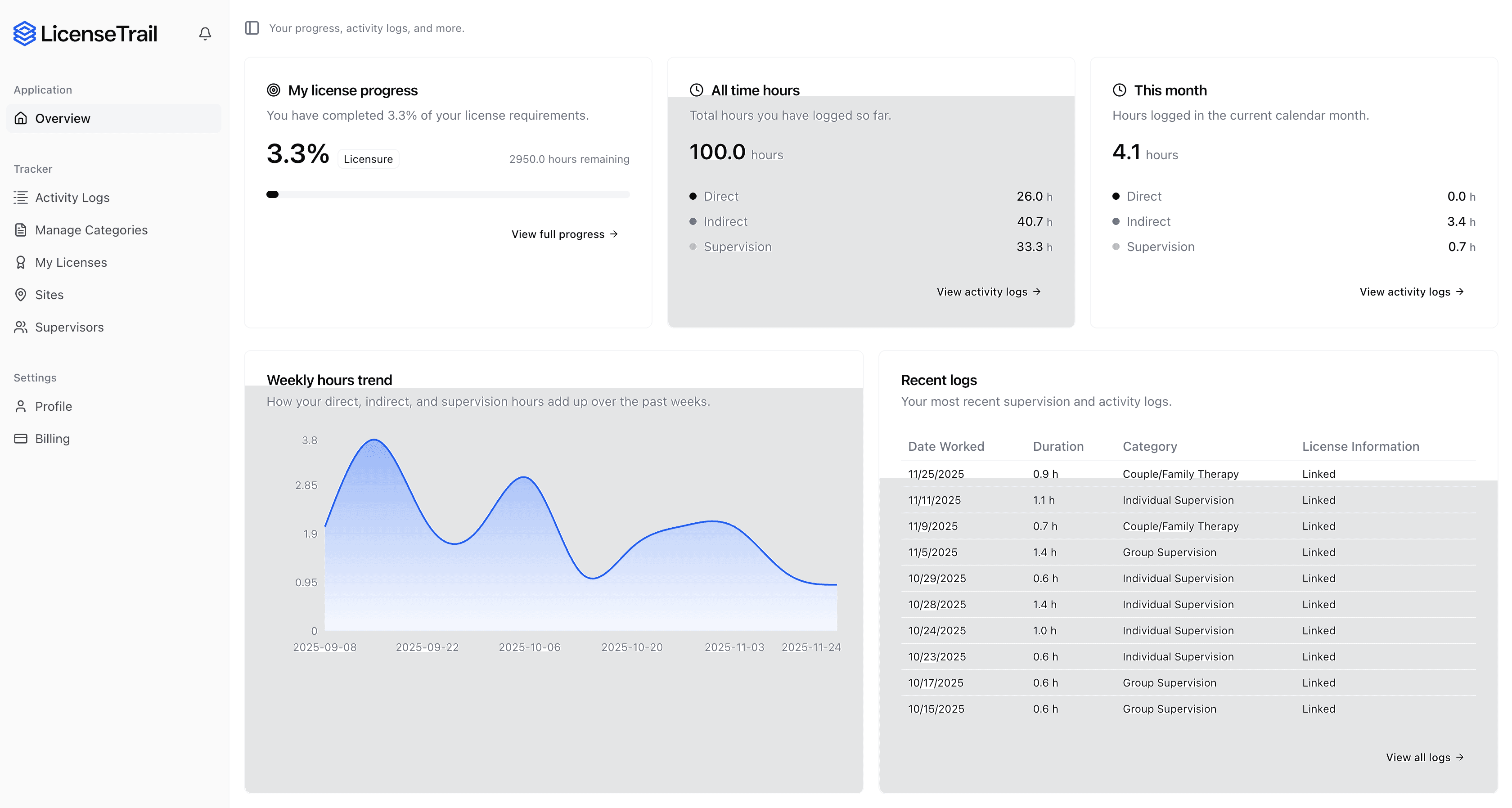
Track your PSYC hours with confidence
License Trail checks your direct, indirect, and supervision hours against Colorado PSYC requirements continuously and flags mismatches before you submit.
 Start Tracking for Free
No credit card required · Free plan available
Related Licenses
Is your spreadsheet hiding Colorado PSYC risks?
Stop guessing if your categories match Colorado State Board of Psychologist Examiners requirements. License Trail checks your direct, indirect, and supervision hours continuously and flags mismatches before you submit.
Import or log
Bring your spreadsheet or start fresh
Upload your existing tracking spreadsheet and we'll map every hour into the right Colorado State Board of Psychologist Examiners categories automatically.
Verify against Colorado
Catch mismatches before the board does
License Trail checks your direct, indirect, and supervision hours against Colorado PSYC requirements continuously.
Export board-ready
One-click clean reports
Generate professional, board-ready reports for supervision meetings and Colorado State Board of Psychologist Examiners submissions in seconds.
No credit card required · Free plan available