
Connecticut LCSW Requirements: Hours, Exams & Step-by-Step Guide
Stop guessing if your categories match Connecticut requirements. License Trail checks your direct, indirect, and supervision hours against LCSW requirements continuously and flags mismatches before you submit.
No credit card required · Free plan available
Quick Requirements Overview
- Education: MSW/DSW/PhD in Social Work from CSWE-accredited program (or CSWE-equivalent foreign education)
- CT in-state hours rule: Post‑master’s hours earned in CT on/after 10/1/2011 must be while licensed as an LMSW
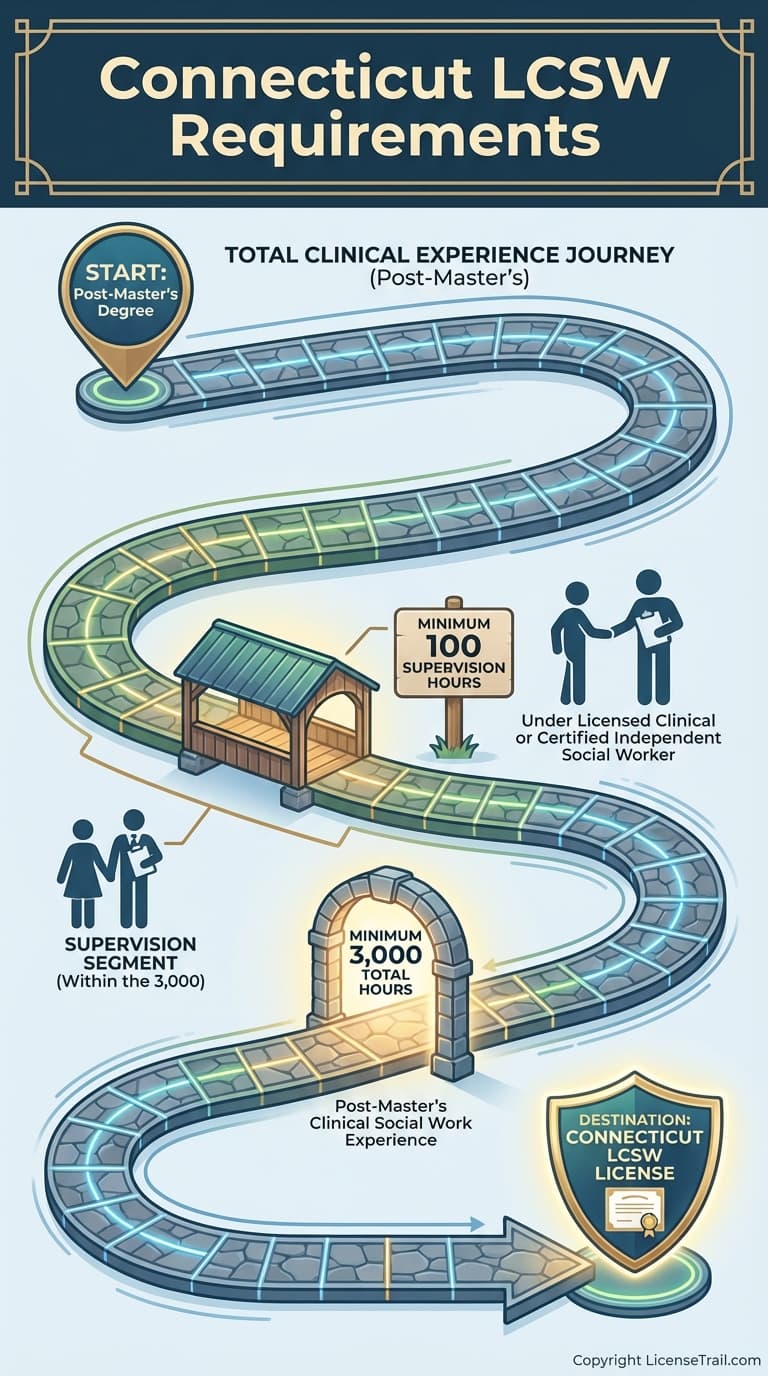
- Experience: 3,000 hours of post‑master’s social work experience
- Supervision (within the 3,000): Minimum 100 hours of professional supervision by an LCSW or certified independent social worker
- Exam: Pass ASWB Clinical exam (DPH authorizes exam after eligibility review)
- Application: Online-only via CT DPH; $200 fee
- Documentation: Official transcript sent to DPH; employment + supervision verification forms sent directly by employer/supervisor; out-of-state license verifications if applicable
- Alternate for out-of-state practice: May substitute 3 years of licensed clinical social work in another state (with required employer/authority letter) in lieu of CT’s 3,000/100 hour documentation
License Details
Procedures
Licensure as a Licensed Clinical Social Worker (LCSW) in Connecticut is regulated by the Connecticut Department of Public Health (DPH) under Chapter 383b of the Connecticut General Statutes and related DPH policies. What follows is a step‑by‑step, detail‑oriented overview of the requirements, with attention to the exact types of hours and statutory language that matter for applicants.
1. Role and Scope of an LCSW in Connecticut
Under Connecticut law, a “licensed clinical social worker” is a person licensed as a clinical social worker pursuant to Chapter 383b. (cga.ct.gov)
“Clinical social work” is defined as the application of principles of psychosocial development, behavior, psychopathology, unconscious motivation, interpersonal relationships and environmental stress to the evaluation, assessment, diagnosis and treatment of biopsychosocial dysfunction, disability and impairment (including mental, emotional, behavioral, developmental and addictive disorders) in individuals, couples, families, or groups. Clinical social work explicitly includes counseling, psychotherapy, behavior modification and mental health consultation. (cga.ct.gov)
An LCSW in Connecticut:
- May perform all functions of a licensed master social worker (LMSW), and
- “may engage in independent practice” of clinical social work. (cga.ct.gov)
By contrast, a licensed master social worker “may not engage in independent practice.” (cga.ct.gov)
2. Core Requirements for Initial LCSW Licensure (By Examination)
The primary, up‑to‑date requirements are laid out both in statute (Conn. Gen. Stat. §20‑195n(c)) and on the DPH’s “LCSW Licensing Requirements” page. (portal.ct.gov)
To qualify for licensure as a clinical social worker in Connecticut by examination, an applicant must:
- Hold a qualifying social work degree
- Complete specified post‑master’s work experience and supervision
- Pass the ASWB Clinical level examination
- Submit required documentation and fees to DPH
Each element is described in more detail below.
3. Educational Requirement
The education requirement is:
- A master’s or doctoral degree in social work from a program accredited by the Council on Social Work Education (CSWE), or
- For foreign‑educated applicants, completion of an educational program deemed equivalent by CSWE. (portal.ct.gov)
DPH policy also notes a temporary provision for graduates of a Connecticut school in CSWE candidate status between specified semesters, but the enduring baseline is CSWE accreditation or its CSWE‑recognized equivalent. (portal.ct.gov)
4. Post‑Master’s Experience and Supervision Requirements
This is the heart of the LCSW path and where specific hour counts matter.
4.1. Total Post‑Master’s Hours
Connecticut requires:
- “Three thousand hours post‑master’s social work experience”. (portal.ct.gov)
The statute and DPH guidance treat this as a single pool of 3,000 hours of post‑master’s social work experience, not as separate categories of “3,000 direct hours plus 3,000 supervised hours.” In other words:
- Required total = 3,000 hours of post‑master’s social work experience, and
- Within those 3,000 hours, at least 100 hours must be under specified supervision (described below).
4.2. Supervision Requirement Within the 3,000 Hours
Within the 3,000 hours, state law requires that the experience:
- “Shall include not less than one hundred hours of work under professional supervision by a licensed clinical or certified independent social worker.” (cga.ct.gov)
DPH’s licensure page mirrors this statutory language, stating that the required 3,000 hours must include “not less than one hundred (100) hours of work experience under professional supervision by a licensed clinical or certified independent social worker.” (portal.ct.gov)
Key points about these 100 hours:
- They are part of the 3,000 hours; Connecticut does not list them as an additional 100 hours on top of 3,000.
- Supervision must be delivered by a licensed clinical social worker or certified independent social worker (the latter category exists historically; currently, LCSW is the active licensure type). (cga.ct.gov)
- The statute references “professional supervision,” and the Board has historically interpreted this as structured supervisory contact focused on clinical work (e.g., case discussion, diagnosis, treatment planning, ethics), though DPH does not impose an explicit breakdown of individual vs. group supervision hours in the statutory text.
4.3. Requirement That CT Hours Be Earned as an LMSW
A crucial point for anyone accruing hours in Connecticut is the licensure status during the supervised period.
The statute states that, “on and after October 1, 2011, such hours completed in this state shall be as a licensed master social worker.” (cga.ct.gov)
In practical terms, that means:
- If you are accruing your 3,000 post‑master’s hours in Connecticut on or after October 1, 2011, you are expected to be licensed as a Master Social Worker (LMSW) while doing so.
- Hours obtained in other states or earlier transitional periods may be handled differently under endorsement or historical provisions (discussed below), but contemporary in‑state hours must be as an LMSW.
4.4. Types of Experience That Count
While the statute and DPH guidance do not list every permissible job title, they specify that what is required is post‑master’s social work experience, including the supervised clinical component. (portal.ct.gov)
Practically, the Board expects the 3,000 hours to consist primarily of:
- Direct clinical services to individuals, couples, families, or groups (assessment, diagnosis, psychotherapy, counseling, treatment planning)
- Related clinical tasks such as documentation, interdisciplinary case conferences, and collateral contacts that are part of treatment
- Activities occurring in settings where clinical social work is being practiced (e.g., hospitals, community mental health, clinics, private practices under supervision, residential programs, etc.)
Because the DPH requires employers and supervisors to verify this experience via dedicated forms (see below), they assess whether the role was appropriately clinical and under proper supervision.
5. Examination Requirement
To be licensed as an LCSW in Connecticut, the applicant must:
- “Successfully complete the Clinical Level Examination of the Association of Social Work Boards (ASWB)” (or any other exam prescribed by the commissioner, but ASWB Clinical is the standard). (portal.ct.gov)
DPH procedures:
- You submit your application and all documentation to DPH.
- Once your materials are reviewed and you are found eligible, DPH notifies you and authorizes you to register for the ASWB Clinical exam. (portal.ct.gov)
- Exam logistics, fees, and accommodations (including ESL accommodations) are handled through ASWB, guided by the ASWB Candidate Handbook. (portal.ct.gov)
6. Documentation and Application Process
The Connecticut DPH “LCSW Licensing Requirements” page lays out what must be submitted. (portal.ct.gov)
6.1. Application and Fee
- Complete the online application for LCSW licensure through DPH’s system (applications are accepted only online).
- Pay the application fee of $200. (portal.ct.gov)
6.2. Official Transcript
Arrange for your official transcript to be sent directly from your school to DPH, documenting:
- Award of a master’s or doctoral degree in social work from a CSWE‑accredited program (or CSWE‑recognized equivalent for international education). (portal.ct.gov)
6.3. License Verifications (If Applicable)
If you hold or have ever held any social work license in another state, you must:
- Request official license verification from each state licensing authority, sent directly to Connecticut DPH. (portal.ct.gov)
States often charge a fee for this verification.
6.4. Experience Verification
To document the 3,000 hours of post‑master’s work experience, Connecticut requires:
- A “Verification of employment form documenting completion of 3,000 hours post‑master’s work experience”, and
- A “Verification of supervision form documenting completion of 100 hours of work experience under professional supervision by a licensed clinical or certified independent social worker.” (portal.ct.gov)
These forms must be sent directly from the employer/supervisor to DPH. The forms confirm:
- The total number of hours of social work employment
- The nature of duties (to establish clinical content)
- The number of hours under qualifying supervision and the supervisor’s credential (LCSW or certified independent social worker)
6.5. Substitution of Out‑of‑State Clinical Experience
Connecticut law and DPH policy allow for a substitution pathway:
- “An applicant may substitute three (3) years of licensed work experience in the practice of clinical social work in another state in lieu of the work experience and supervision requirements as outlined above.” (portal.ct.gov)
To use this substitution, you must arrange for:
- A letter from the appropriate authority at the organization where the work occurred, sent directly to DPH, indicating:
- That you were employed as a clinical social worker, and
- The dates of employment. (portal.ct.gov)
This path is essentially for experienced clinicians licensed elsewhere who can demonstrate at least three years of licensed clinical practice rather than documenting the 3,000‑hour/100‑hour breakdown.
7. Licensure by Endorsement (Out‑of‑State Licensees)
Connecticut provides for license by endorsement under certain conditions.
Under Conn. Gen. Stat. §20‑195n(d)–(e), the commissioner may grant a license by endorsement to an applicant who: (cga.ct.gov)
For master social worker or clinical social worker endorsement (subsection d):
- Is licensed or certified as a master social worker or clinical social worker in good standing in another state or jurisdiction whose requirements are substantially similar to or higher than Connecticut’s; and
- Has successfully completed the master’s‑level ASWB exam (for master social worker endorsement).
For clinical social worker endorsement (subsection e):
- Is licensed or certified as a clinical social worker in good standing in another jurisdiction with substantially similar or greater requirements; and
- Has successfully completed the ASWB Clinical examination (or an exam the commissioner accepts as equivalent).
No endorsement license will be issued if:
- Professional disciplinary action is pending, or
- The applicant is the subject of an unresolved complaint. (cga.ct.gov)
Endorsement applicants still apply through DPH, pay the fee, and arrange for verification of current/previous licenses and exam completion.
8. Summary of the Key Hour Requirements in Connecticut Language
To summarize the exact hour‑related requirements, using the state’s own framing:
- Connecticut requires “three thousand (3000) hours of post‑master’s social work experience”.
- Those 3,000 hours “shall include not less than one hundred (100) hours of work experience under professional supervision by a licensed clinical or certified independent social worker.” (portal.ct.gov)
- For hours completed in Connecticut on or after October 1, 2011, the law requires that “such hours completed in this state shall be as a licensed master social worker.” (cga.ct.gov)
Critically, Connecticut does not say, for example, “1,500 hours of direct experience and 1,500 hours of supervised experience” as separate categories. Instead, it defines:
- One unified requirement of 3,000 post‑master’s social work hours,
- Within which there must be at least 100 hours of qualifying professional supervision by an LCSW or certified independent social worker.
9. Practical Checklist for an Aspiring LCSW in Connecticut
While the user asked for an article rather than a bullet‑only guide, a concise checklist is useful to ensure that nothing is missed:
- Earn your MSW or DSW/PhD in Social Work from a CSWE‑accredited (or CSWE‑equivalent) program. (portal.ct.gov)
- Obtain Connecticut LMSW licensure (if you will be accruing post‑master’s hours in Connecticut after October 1, 2011). (cga.ct.gov)
- Accrue 3,000 hours of post‑master’s social work experience, ensuring that:
- At least 100 hours are under professional supervision by an LCSW or certified independent social worker. (portal.ct.gov)
- Confirm that your duties and setting are clinical, aligned with the statutory definition of clinical social work (evaluation, diagnosis, treatment, psychotherapy, etc.). (cga.ct.gov)
- Arrange for:
- Official transcripts sent from your school
- Verification of employment documenting 3,000 hours
- Verification of supervision documenting 100 hours with an LCSW/certified independent social worker
- Any required license verifications from other states (portal.ct.gov)
- Submit the online application to DPH and pay the $200 fee for LCSW licensure. (portal.ct.gov)
- Once declared eligible, register for and pass the ASWB Clinical exam. (portal.ct.gov)
For experienced out‑of‑state clinicians, consider:
- Endorsement if your existing license and exam meet Connecticut’s similarity and exam standards; or
- Using the three‑years‑licensed‑clinical‑work substitution route in lieu of documenting the 3,000/100‑hour breakdown. (portal.ct.gov)
This structure reflects the precise statutory and DPH language governing LCSW licensure in Connecticut as of late 2025.
Track your LCSW hours with confidence
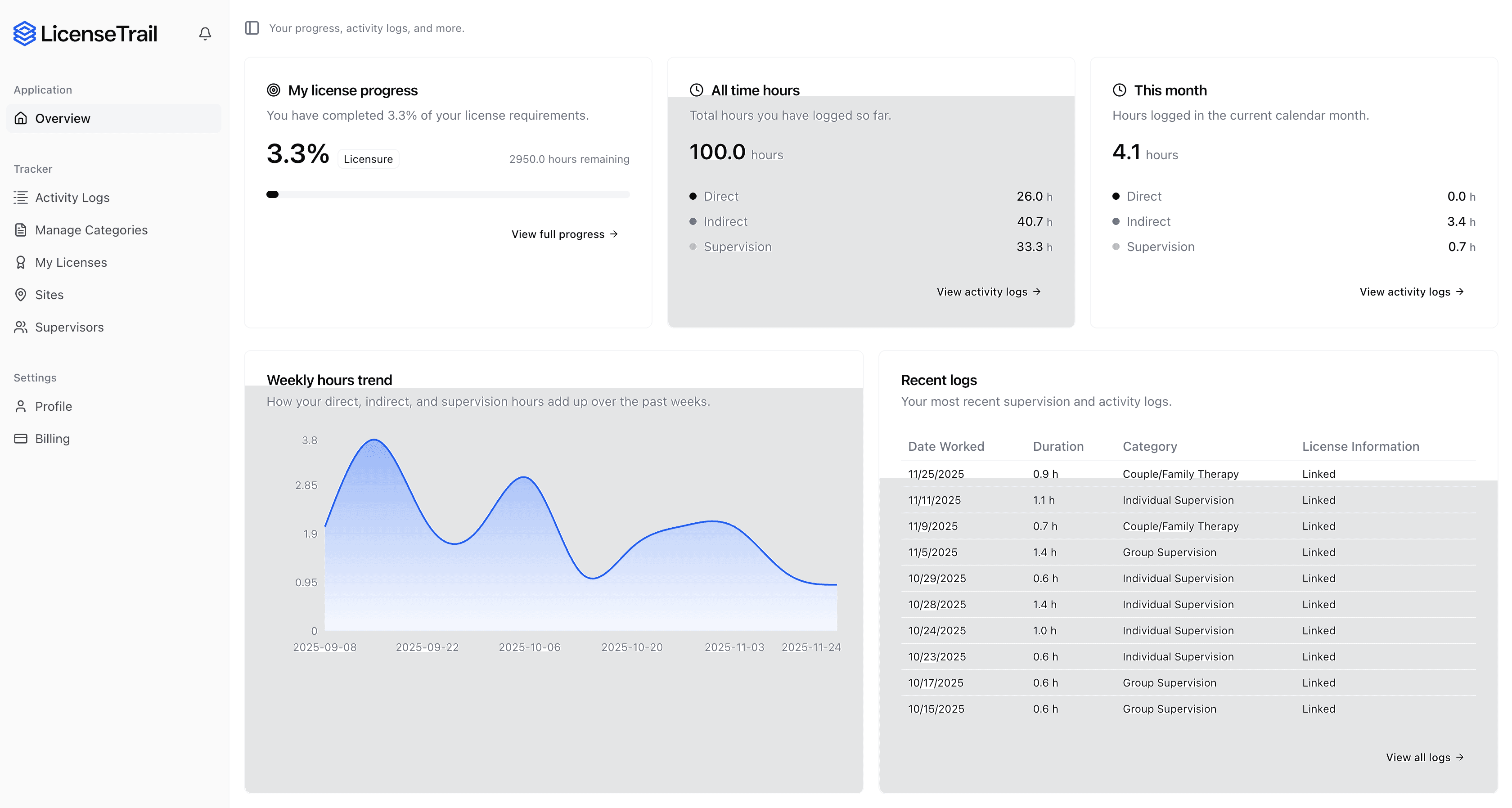
License Trail checks your direct, indirect, and supervision hours against Connecticut LCSW requirements continuously and flags mismatches before you submit.
 Start Tracking for Free
No credit card required · Free plan available
Is your spreadsheet hiding Connecticut LCSW risks?
Stop guessing if your categories match Connecticut Department of Public Health (Social Work Licensure) requirements. License Trail checks your direct, indirect, and supervision hours continuously and flags mismatches before you submit.
Import or log
Bring your spreadsheet or start fresh
Upload your existing tracking spreadsheet and we'll map every hour into the right Connecticut Department of Public Health (Social Work Licensure) categories automatically.
Verify against Connecticut
Catch mismatches before the board does
License Trail checks your direct, indirect, and supervision hours against Connecticut LCSW requirements continuously.
Export board-ready
One-click clean reports
Generate professional, board-ready reports for supervision meetings and Connecticut Department of Public Health (Social Work Licensure) submissions in seconds.
No credit card required · Free plan available