
Connecticut LMFT Requirements: Hours, Exams & Step-by-Step Guide
Stop guessing if your categories match Connecticut requirements. License Trail checks your direct, indirect, and supervision hours against LMFT requirements continuously and flags mismatches before you submit.
No credit card required · Free plan available
Quick Requirements Overview
- Regulator: Connecticut Department of Public Health (DPH) — LMFT (“marital and family therapist”)
- Education: Master’s (or higher) specializing in MFT; COAMFTE-accredited or CT-regulation equivalent
- Degree practicum/internship: ≥500 face-to-face direct clinical hours + ≥100 clinical supervision hours
- Postdegree supervised experience: ≥24 months
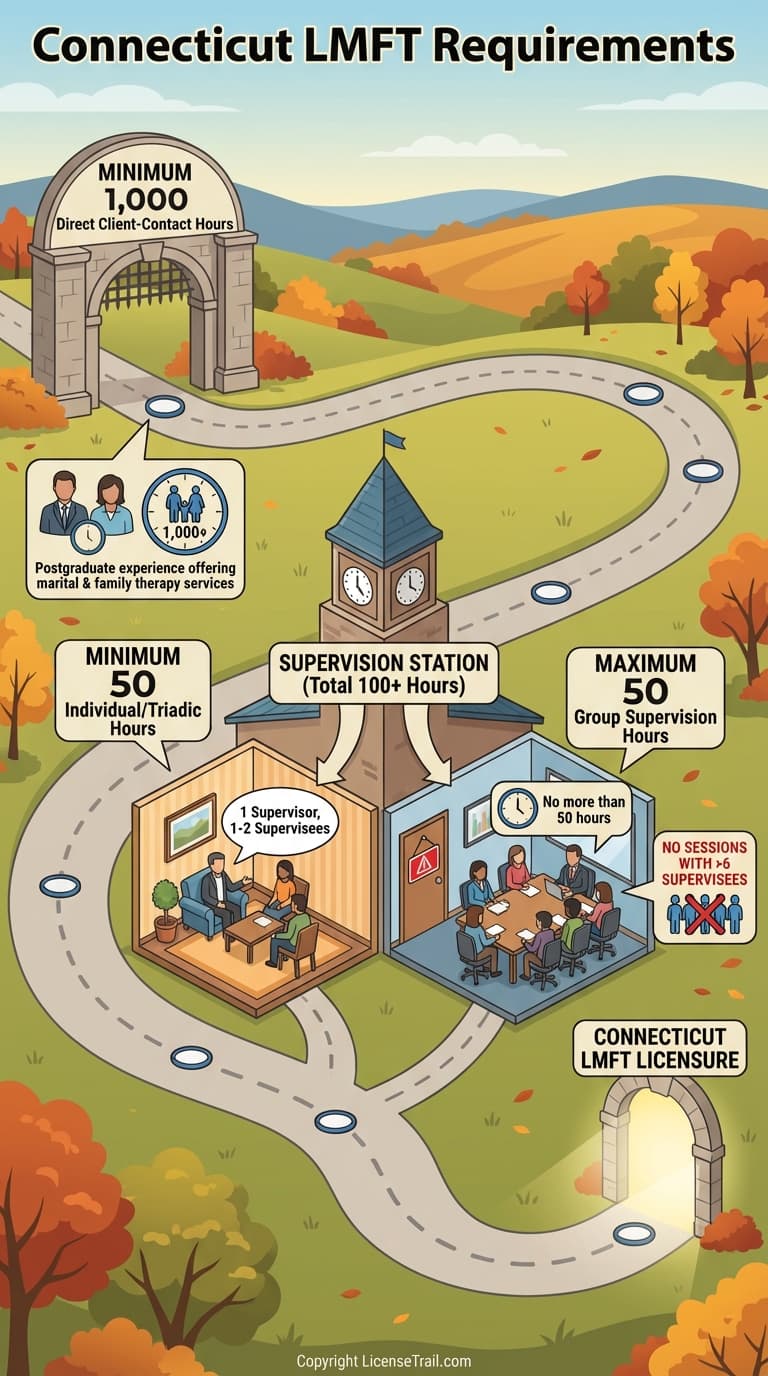
- Postdegree hours: ≥1,000 direct client-contact MFT hours + ≥100 supervision hours by a CT-licensed LMFT (≥50 individual; remainder may be group)
- Exam: Pass AMFTRB Examination in Marital & Family Therapy
- Application: Online via eLicense; $200 fee; primary-source verifications (transcript, hours/supervision, exam score, any out-of-state licenses)
License Details
Procedures
Licensure as a Licensed Marital and Family Therapist (LMFT) in Connecticut is governed by the Connecticut Department of Public Health (DPH) under the title “Marital and Family Therapist Licensure.” As of November 23, 2025, DPH specifies detailed education, practicum, supervised experience, and examination requirements, including exact categories and numbers of hours. (portal.ct.gov)
1. Governing agency and license type
- License title: Licensed Marital and Family Therapist (LMFT) – legally referred to as “marital and family therapist.”
- Agency: Connecticut Department of Public Health (DPH), Practitioner Licensing and Investigations Section. (portal.ct.gov)
- Primary authority: Connecticut General Statutes §§ 20‑195a–20‑195c and implementing regulations, plus DPH policy pages. (cga.ct.gov)
2. Educational requirement
DPH requires:
-
Graduate degree
- Completion of a graduate degree program specializing in marital and family therapy (master’s or higher).
- The program must either:
- Be accredited by the Commission on Accreditation for Marriage and Family Therapy Education (COAMFTE), or
- Meet the curricular standards in Connecticut’s regulations (Section 20‑195a‑2) at a regionally accredited institution. (portal.ct.gov)
-
Supervised practicum or internship (pre‑degree)
- The degree must include a “supervised practicum or internship with an emphasis in marital and family therapy”, supervised either by:
- The program granting the degree; or
- An accredited postgraduate clinical training program approved by COAMFTE. (portal.ct.gov)
- The degree must include a “supervised practicum or internship with an emphasis in marital and family therapy”, supervised either by:
Connecticut law and DPH policy further quantify this practicum/internship:
- At least 500 hours of direct, face‑to‑face clinical client contact in marital and family therapy, and
- At least 100 hours of clinical supervision tied to that practicum/internship. (portal.ct.gov)
In DPH’s own wording, the practicum is described as providing a minimum of “500 direct clinical hours” that include “100 hours of clinical supervision.” (portal.ct.gov)
3. Pre‑degree hours: what “counts”
During the graduate practicum/internship, hours are counted as follows:
-
Direct clinical / direct client contact hours (pre‑degree)
- Minimum: 500 hours.
- Type: face‑to‑face clinical work providing marital and family therapy services (individuals, couples, families) within a relational/family systems framework. (portal.ct.gov)
-
Clinical supervision hours (pre‑degree)
- Minimum: 100 hours of clinical supervision associated with those practicum hours.
- Supervisors: faculty or supervisors in COAMFTE‑approved programs or other supervisors meeting the regulatory standard (e.g., in COAMFTE‑approved postgraduate training). (portal.ct.gov)
These pre‑degree hours are embedded in the education requirement; they do not substitute for the required postgraduate supervised experience.
Running total by the time you graduate:
- Direct client/clinical hours (pre‑degree): 500
- Supervision hours (pre‑degree): 100
4. Postgraduate supervised experience (after the degree)
After completing the qualifying degree, DPH requires supervised postgraduate work experience before you can be licensed as an LMFT by examination.
4.1 Required duration
- You must complete twenty‑four (24) months of supervised postgraduate work experience in marital and family therapy. (portal.ct.gov)
DPH further clarifies in its documentation section that the required direct client contact must be accumulated in “not less than 24 months of postgraduate work experience.” (portal.ct.gov)
4.2 Required types and numbers of hours
Within those 24 months, the experience must include all of the following:
-
Direct client contact hours (postgraduate)
- Minimum: 1,000 hours of direct client contact
- Verbatim DPH category: “direct client contact offering marital and family therapy services.” (portal.ct.gov)
- These hours are typically therapy sessions with individuals, couples, and families where you are functioning as a marital and family therapist.
-
Postgraduate clinical supervision hours
- Minimum: 100 hours of post‑graduate clinical supervision
- The supervision must be “provided by a licensed marital and family therapist.” (portal.ct.gov)
-
Distribution of supervision: individual vs. group
- Of the 100 supervision hours:
- At least 50 hours must be “individual supervision”; and
- The remaining hours may be “group supervision as defined in the Regulations of Connecticut State Agencies.” (portal.ct.gov)
- Of the 100 supervision hours:
In practice:
- Individual supervision means you (alone, or sometimes with only one other supervisee, depending on regulatory definition) meet directly with an LMFT supervisor.
- Group supervision means supervised meetings with an LMFT supervisor and multiple supervisees (the regulations cap group size).
DPH’s licensure page explicitly uses the terms:
- “postgraduate work experience,”
- “direct client contact,”
- “post‑graduate clinical supervision,”
- “individual supervision,” and
- “group supervision.” (portal.ct.gov)
Running total for the postgraduate phase:
- Direct client contact (post‑degree): 1,000 hours
- Clinical supervision (post‑degree): 100 hours (≥50 individual; up to 50 group)
- Time frame: At least 24 months of supervised work experience
5. Overall hour totals before LMFT licensure
Putting the pre‑degree and post‑degree requirements together, Connecticut’s structure effectively looks like this:
5.1 Direct client/clinical hours
- 500 hours – supervised practicum/internship direct clinical / face‑to‑face client contact (pre‑degree). (portal.ct.gov)
- 1,000 hours – direct client contact offering marital and family therapy services during postgraduate supervised work experience (minimum 24 months). (portal.ct.gov)
Total direct client / clinical hours required across training:
1,500 hours of direct client contact in marital and family therapy roles.
5.2 Supervision hours
- 100 hours – clinical supervision during the graduate practicum/internship. (portal.ct.gov)
- 100 hours – post‑graduate clinical supervision by a licensed marital and family therapist, with at least 50 hours of individual supervision and the remainder permitted as group supervision. (portal.ct.gov)
Total formal supervision hours required across training:
200 hours of clinical supervision, of which at least 50 hours (and, in practice, often more) must be individual in the post‑degree phase.
A commonly used summary in secondary guidance on Connecticut licensure matches this breakdown: 500 practicum client hours + 1,000 post‑degree client hours, and 100 + 100 supervision hours. (careersinpsychology.org)
6. National licensing examination
Connecticut requires successful completion of the Examination in Marital and Family Therapy administered by the Association of Marital and Family Therapy Regulatory Boards (AMFTRB). (portal.ct.gov)
- DPH’s licensure page states that applicants must complete this examination as part of LMFT licensure.
- When applying to sit for the exam as a Connecticut candidate, DPH requires at least:
- An online application and fee, and
- An official transcript verifying award of a qualifying master’s degree in marital and family therapy. (portal.ct.gov)
7. Application, documentation, and fees
7.1 Application and fee
- Application method: Applications are submitted online through the Connecticut eLicense system.
- Initial application fee (standard LMFT licensure): $200, as listed on the DPH marital and family therapist licensure pages. (portal.ct.gov)
7.2 Required documentation (standard examination route)
DPH’s Marital and Family Therapist Licensure page specifies that applicants must arrange for the following to be sent directly to DPH from the source: (portal.ct.gov)
-
Official graduate transcript
- Showing completion of the marital and family therapy degree.
- If the program was AAMFT/COAMFTE‑approved after 1979, no additional curriculum documentation is normally required; otherwise, you may need a Verification of Course of Study form.
-
Verification of direct client contact hours (postgraduate)
- Form(s) documenting at least 1,000 hours of direct client contact in not less than 24 months of post‑degree work experience.
- Each employer must complete a separate verification form if you worked at multiple sites.
-
Verification of postgraduate clinical supervision hours
- Form(s) documenting 100 hours of postgraduate clinical supervision by a licensed marital and family therapist, with at least 50 hours of individual supervision (remainder may be group).
-
Verification of exam passage
- Official verification of a passing score on the AMFTRB Marital and Family Therapy exam.
-
Out‑of‑state license verifications (if applicable)
- If you have ever held a counseling/therapy license in another jurisdiction, DPH requires official license verification from that jurisdiction.
-
Documentation of licensed experience for exempt applicants (if applicable)
- If you are already licensed as a marital and family therapist in another state and can document at least 3 years of licensed work experience, you may be exempt from documenting the practicum and 24‑month supervised work experience, depending on DPH’s evaluation. (portal.ct.gov)
All supporting documentation must be sent directly from the issuing institutions/supervisors to DPH at the address listed on the licensure page. (portal.ct.gov)
8. Licensure by waiver of examination (experienced out‑of‑state LMFTs)
Connecticut has a “Marital and Family Therapist Licensure by Waiver of the Examination” route for currently practicing LMFTs licensed in other states whose standards DPH judges to be similar or higher than Connecticut’s. (portal.ct.gov)
DPH requires, in brief:
- A qualifying MFT graduate degree (AAMFT/COAMFTE‑approved or equivalent); (portal.ct.gov)
- A supervised practicum/internship with at least 500 direct clinical hours and 100 hours of clinical supervision; (portal.ct.gov)
- At least 1,000 hours of direct client contact in not less than 12 months of postgraduate work experience; (portal.ct.gov)
- 100 hours of postgraduate supervision by a licensed marital and family therapist; and
- Evidence of current licensure and competent practice in another state. (portal.ct.gov)
The waiver route modifies the time frame (allowing the 1,000 hours of post‑degree direct client contact in 12 months rather than 24) but keeps the same core hour counts and categories (500 + 1,000 direct, 100 + 100 supervision) as the standard pathway.
9. Snapshot checklist of Connecticut LMFT requirements
Education and practicum
- Graduate degree in marital and family therapy (COAMFTE or equivalent).
- Practicum/internship emphasizing marital and family therapy that includes:
- ≥500 hours direct, face‑to‑face clinical client contact
- ≥100 hours clinical supervision (portal.ct.gov)
Postgraduate supervised experience
- 24 months of supervised postgraduate work experience.
- Within those 24 months:
- ≥1,000 hours “direct client contact offering marital and family therapy services.”
- ≥100 hours post‑graduate clinical supervision by a licensed MFT, including:
- ≥50 hours individual supervision
- Up to 50 hours group supervision (as defined in regulations). (portal.ct.gov)
Examination
- Passing the AMFTRB Examination in Marital and Family Therapy. (portal.ct.gov)
Application
- Online application via eLicense.
- $200 initial application fee (LMFT licensure). (portal.ct.gov)
- Official transcripts, verification of practicum (if requested), verification of 1,000 post‑degree direct client contact hours over ≥24 months, verification of 100 supervision hours, exam score, and any out‑of‑state license verifications sent directly to DPH.
In sum, Connecticut’s LMFT pathway is built around:
- 1,500 hours of direct client contact in marital and family therapy (500 pre‑degree + 1,000 post‑degree), and
- 200 hours of clinical supervision (100 pre‑degree + 100 post‑degree),
layered on top of a specialized MFT graduate degree, a 24‑month supervised post‑degree period, and successful completion of the AMFTRB national examination, all under the terminology and categories defined by the Connecticut Department of Public Health.
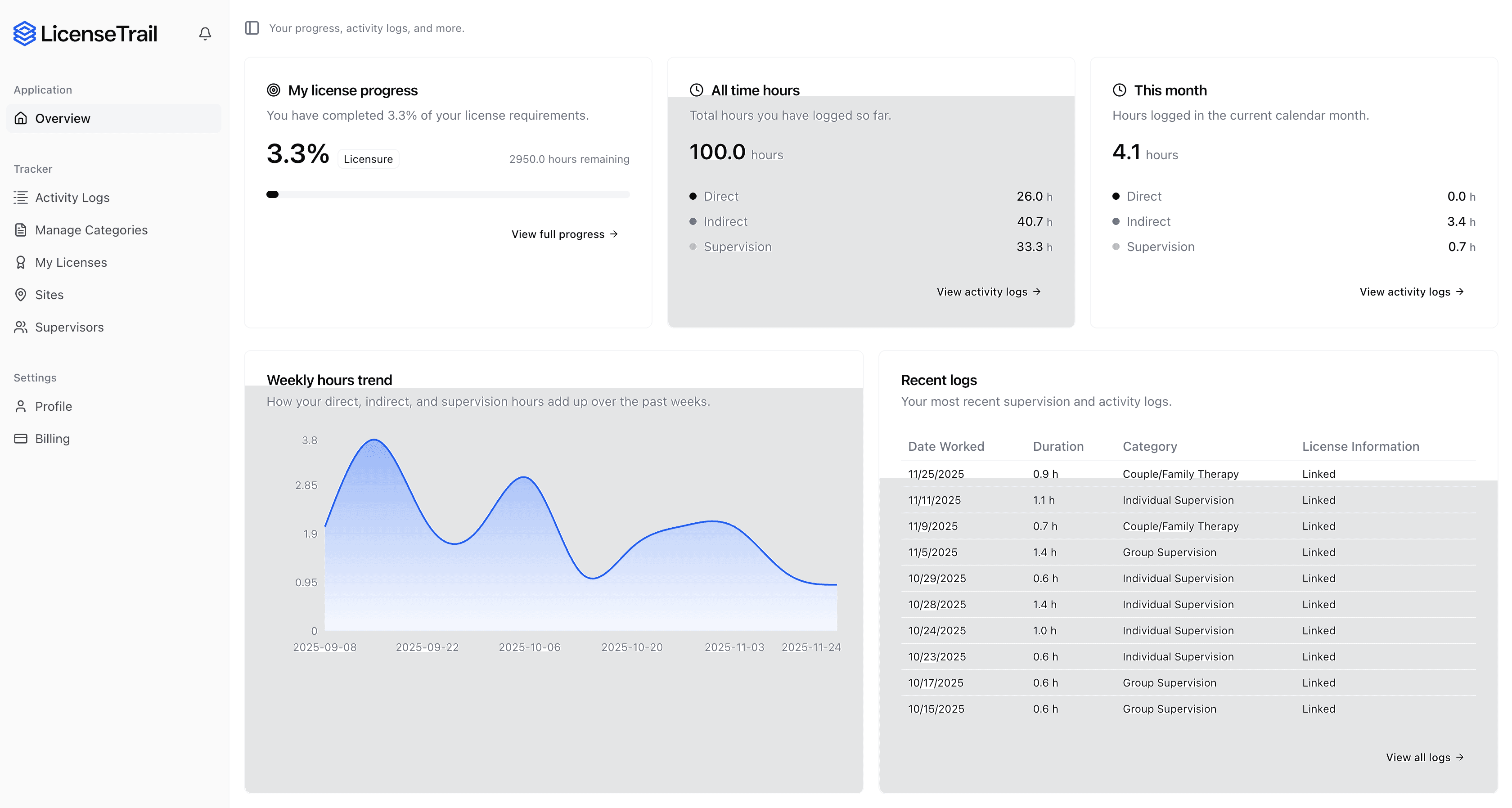
Track your LMFT hours with confidence
License Trail checks your direct, indirect, and supervision hours against Connecticut LMFT requirements continuously and flags mismatches before you submit.
 Start Tracking for Free
No credit card required · Free plan available
Is your spreadsheet hiding Connecticut LMFT risks?
Stop guessing if your categories match Connecticut Department of Public Health (Marital and Family Therapist Licensure) requirements. License Trail checks your direct, indirect, and supervision hours continuously and flags mismatches before you submit.
Import or log
Bring your spreadsheet or start fresh
Upload your existing tracking spreadsheet and we'll map every hour into the right Connecticut Department of Public Health (Marital and Family Therapist Licensure) categories automatically.
Verify against Connecticut
Catch mismatches before the board does
License Trail checks your direct, indirect, and supervision hours against Connecticut LMFT requirements continuously.
Export board-ready
One-click clean reports
Generate professional, board-ready reports for supervision meetings and Connecticut Department of Public Health (Marital and Family Therapist Licensure) submissions in seconds.
No credit card required · Free plan available