
Connecticut LPC Requirements: Hours, Exams & Step-by-Step Guide
Stop guessing if your categories match Connecticut requirements. License Trail checks your direct, indirect, and supervision hours against LPC requirements continuously and flags mismatches before you submit.
No credit card required · Free plan available
Quick Requirements Overview
- DPH licenses LPCs in CT; requirements vary by matriculation date (before vs. on/after 7/1/2017) or endorsement route
- Pre-degree (matriculated on/after 7/1/2017): 100-hour practicum + 600-hour clinical mental health counseling internship (part of graduate program)
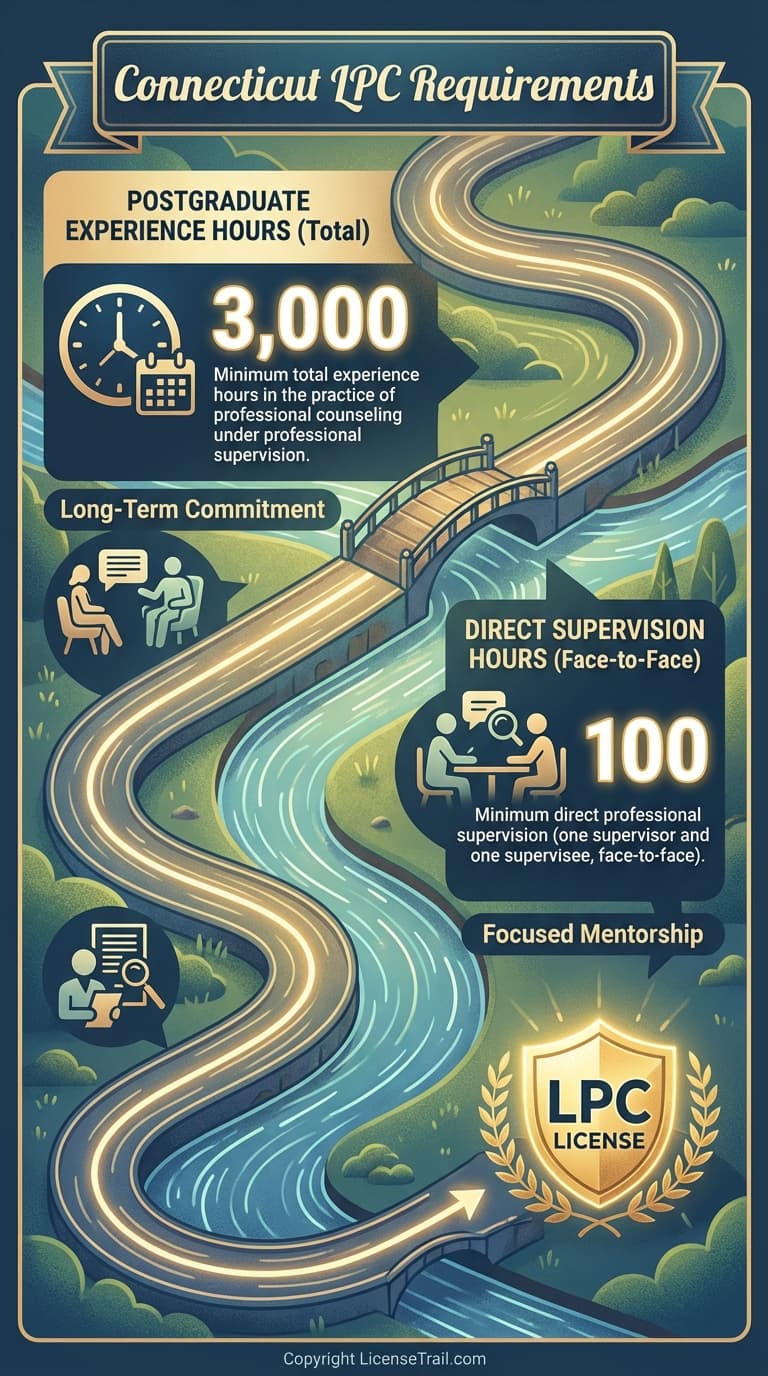
- Post-degree: 3,000 hours of postgraduate professional counseling experience under professional supervision
- Supervision minimum: within the 3,000 hours, ≥100 hours of direct professional supervision (face-to-face, at least monthly, with written evaluation)
- Timeframe: post-2019 rule requires ≥2 years to complete the 3,000 hours (legacy rule allowed ≥1 year)
- Who can supervise: LPC, psychiatrist (MD), psych APRN (PMH CNS/NP), psychologist, LMFT, or LCSW
- Exam: pass NCE or NCMHCE
- Endorsement option: if already licensed elsewhere, 3 years of licensed practice may substitute for the 3,000 supervised hours (with employer verification)
License Details
Procedures
In Connecticut, the Department of Public Health (DPH) regulates licensure as a Licensed Professional Counselor (LPC) through its Professional Counselor Licensure program. The central requirement, regardless of educational track, is substantial supervised postgraduate counseling experience, plus specific practicum and internship hours for most recent graduates.
Below is a structured overview focused on hours and supervision, using the state’s own terms.
1. Decide which rule set applies to you
Connecticut currently distinguishes applicants by when they entered (matriculated into) their counseling-related graduate program:
-
Applicants matriculating on or after July 1, 2017
- Must meet the newer educational standards (including specific practicum/internship hours) and the post‑2019 supervised‑experience rules. (portal.ct.gov)
-
Applicants matriculating before July 1, 2017
- Follow an older set of education rules, but still must complete 3,000 hours of supervised postgraduate counseling experience. (portal.ct.gov)
-
Applicants already licensed as a professional counselor in another state
- May substitute three years of licensed practice in lieu of the 3,000 supervised hours (licensure by endorsement pathway). (portal.ct.gov)
The actual hour numbers are very similar across tracks; the main differences are in education details and the minimum time span over which experience is completed.
2. Summary of required hours (typical current applicant)
For a typical new applicant (matriculated on/after July 1, 2017 and applying under the post‑2019 rules):
During your degree (pre‑licensure clinical training) (portal.ct.gov)
- 100 hours: Practicum in counseling
- 600 hours: Clinical mental health counseling internship
After your degree (postgraduate supervised experience) (portal.ct.gov)
- 3,000 hours of postgraduate experience in the practice of professional counseling
- These 3,000 hours must:
- Be “under professional supervision” (see definition below)
- Include at least 100 hours of direct professional supervision
- Be completed over a minimum of two years
Connecticut does not break the 3,000 hours into “X hours of direct client contact” plus “Y hours of other activities” in the way some states do. The only numerical breakdown is:
- 3,000 total postgraduate professional counseling hours, and
- Within those, 100 hours of direct professional supervision.
3. Pre‑degree clinical hours: practicum and internship
For applicants who matriculated on or after July 1, 2017, the DPH’s “Applicants Matriculating After July 1, 2017” criteria require both a practicum and an internship as part of your graduate program: (portal.ct.gov)
-
Practicum
- At least a “one-hundred-hour practicum in counseling”
- Must be taught by a faculty member who is licensed or certified as a professional counselor (or equivalent in another state).
-
Internship
- At least a “six-hundred-hour clinical mental health counseling internship”
- Also taught by a faculty member who is licensed or certified as a professional counselor (or equivalent).
These hours are part of your graduate education, not part of the 3,000 postgraduate hours. The 3,000 hours start after your qualifying graduate degree has been conferred.
4. Postgraduate supervised experience: the 3,000‑hour requirement
4.1. Total hours and time frame
For current applicants (post‑2019 rules), DPH states that you must have: (portal.ct.gov)
- “three thousand hours of postgraduate experience under professional supervision”, and
- This must include a minimum of one hundred hours of direct professional supervision,
- All “performed over a period of not less than two years.”
Key points:
- Postgraduate means after your qualifying counseling-related graduate degree is awarded.
- The 3,000 hours must be in the “practice of professional counseling” (not general human services work with no counseling component).
- The experience can be accumulated at one or more sites, as long as:
- Each site meets the supervision requirements, and
- Your total hours and supervision are properly documented on the DPH verification form. (portal.ct.gov)
4.2. “Under professional supervision”: who can supervise?
DPH defines “under professional supervision” for LPC licensure as practicing professional counseling under the supervision of one of the following licensed professionals: (portal.ct.gov)
- A Licensed Professional Counselor (LPC)
- A licensed physician who is board‑certified in psychiatry
- An advanced practice registered nurse (APRN) who is certified as a psychiatric and mental health clinical nurse specialist or nurse practitioner
- A licensed psychologist
- A licensed marital and family therapist (LMFT)
- A licensed clinical social worker (LCSW)
Your supervisor must hold one of these licenses. Supervision by other professions (e.g., school counselors, LMHCs from other jurisdictions) does not count unless they also hold one of the above Connecticut licenses (or a substantially equivalent license in another state when the hours are obtained outside CT).
4.3. “Direct professional supervision”: what the 100 hours must look like
The 3,000 hours must include at least 100 hours of “direct professional supervision.” DPH defines this as: (portal.ct.gov)
- Face‑to‑face consultation between the supervisor and the supervisee (one‑on‑one),
- Occurring at least monthly,
- Including a written evaluation and assessment by the supervisor of your counseling practice.
In practice, that means:
- Your 100 hours of supervision must be scheduled face‑to‑face (in person or, if accepted by DPH policy, real‑time video) with your qualifying supervisor.
- Group supervision does not satisfy the “direct professional supervision” requirement unless DPH explicitly allows it (the statutory definition is framed around one supervisor and one supervisee).
- You should expect written supervisory evaluations—DPH’s language explicitly mentions a written review and assessment.
Most applicants will receive considerably more than 100 hours of supervision if they are working regularly in clinical settings; however, only 100 hours are mandated as a minimum.
5. How Connecticut treats the hours (no 1,500/1,500 split)
Many states specify something like:
- X hours of direct client contact, and
- Y hours of indirect or other professional activities.
Connecticut’s LPC statute and DPH guidance do not currently break the 3,000 hours down this way. Instead, they require: (portal.ct.gov)
- 3,000 hours of postgraduate experience in the practice of professional counseling,
- Under a qualifying supervisor (“under professional supervision”),
- With at least 100 of those hours spent in direct professional supervision sessions.
So you will not see a requirement such as “1,500 direct client hours and 1,500 indirect hours” in Connecticut’s LPC rules. The only specific numeric subdivision is the 100 hours of direct supervision.
6. Legacy applicants: matriculated before July 1, 2017
If you entered your counseling-related graduate program before July 1, 2017, DPH’s legacy “Professional Counselor License Requirements” page applies. In that case you must have: (portal.ct.gov)
- A qualifying master’s or doctoral degree (in social work, marriage and family therapy, counseling, or psychology),
- At least 60 graduate semester hours in or related to counseling, with specific required coursework areas, and
- “three thousand (3000) hours of postgraduate supervised experience in professional counseling”,
- Performed over not less than one year,
- Including at least 100 hours of direct supervision by a qualifying mental health professional (same types of supervisors as listed above).
The hour totals (3,000 + 100 supervised) are essentially the same as for newer applicants; the principal differences are:
- The minimum time frame (older rule allows completion over “not less than one year,” while the post‑2019 rule clearly states two years), and
- Some differences in educational/coursework structure.
7. Licensure by endorsement (already licensed elsewhere)
If you are currently licensed or certified as a professional counselor (or equivalent) in another state, Connecticut allows you to substitute experience instead of documenting 3,000 supervised hours: (portal.ct.gov)
- You may use three years of licensed or certified work experience in professional counseling in lieu of the 3,000 hours of supervised postgraduate experience.
- DPH requires a letter from the employer or appropriate authority verifying:
- That you were employed as a professional counselor, and
- The dates of employment.
You still must meet exam and other licensure requirements.
8. Examination requirement
Across both old and new pathways, applicants must pass one of the following NBCC examinations: (portal.ct.gov)
- National Counselor Examination (NCE), or
- National Clinical Mental Health Counseling Examination (NCMHCE).
If you have not already passed one of these, you must register through NBCC specifically for Connecticut licensure.
9. Documentation of hours and supervision
For all routes that rely on supervised experience, DPH requires that your hours be documented on its official verification form, submitted directly from the supervising authority to DPH. The form must show: (portal.ct.gov)
- The total 3,000 hours of postgraduate supervised experience, and
- The 100 hours of postgraduate-degree supervision (direct professional supervision).
Because the state is precise about supervisor type and about the “direct professional supervision” definition, it is important while you are accruing hours to:
- Confirm each supervisor’s license type and status,
- Keep your own detailed log (dates, hours, setting, supervisor, activities), and
- Make sure supervisors are prepared to complete the DPH form accurately when you finish.
In sum, Connecticut’s LPC license hinges on three quantitative clinical elements:
- 100‑hour practicum and 600‑hour internship during your graduate program (for post‑2017 matriculants).
- 3,000 hours of postgraduate professional counseling experience, under a qualifying supervisor.
- Within those 3,000 hours, at least 100 hours of direct, face‑to‑face professional supervision with written evaluation.
Everything else—education details, examination, and paperwork—frames and documents these core hour requirements.
Track your LPC hours with confidence
License Trail checks your direct, indirect, and supervision hours against Connecticut LPC requirements continuously and flags mismatches before you submit.
 Start Tracking for Free
No credit card required · Free plan available
Is your spreadsheet hiding Connecticut LPC risks?
Stop guessing if your categories match Connecticut Department of Public Health (Professional Counselor Licensure) requirements. License Trail checks your direct, indirect, and supervision hours continuously and flags mismatches before you submit.
Import or log
Bring your spreadsheet or start fresh
Upload your existing tracking spreadsheet and we'll map every hour into the right Connecticut Department of Public Health (Professional Counselor Licensure) categories automatically.
Verify against Connecticut
Catch mismatches before the board does
License Trail checks your direct, indirect, and supervision hours against Connecticut LPC requirements continuously.
Export board-ready
One-click clean reports
Generate professional, board-ready reports for supervision meetings and Connecticut Department of Public Health (Professional Counselor Licensure) submissions in seconds.
No credit card required · Free plan available