
Connecticut LP Requirements: Hours, Exams & Step-by-Step Guide
Stop guessing if your categories match Connecticut requirements. License Trail checks your direct, indirect, and supervision hours against LP requirements continuously and flags mismatches before you submit.
No credit card required · Free plan available
Quick Requirements Overview
- Doctoral degree in psychology from an approved program (APA-accredited during attendance qualifies; non-APA reviewed; some applicants need APA-applied respecialization).
- Supervised work experience: 1 year pre- or postdoc; doctoral internship hours do not count toward this year.
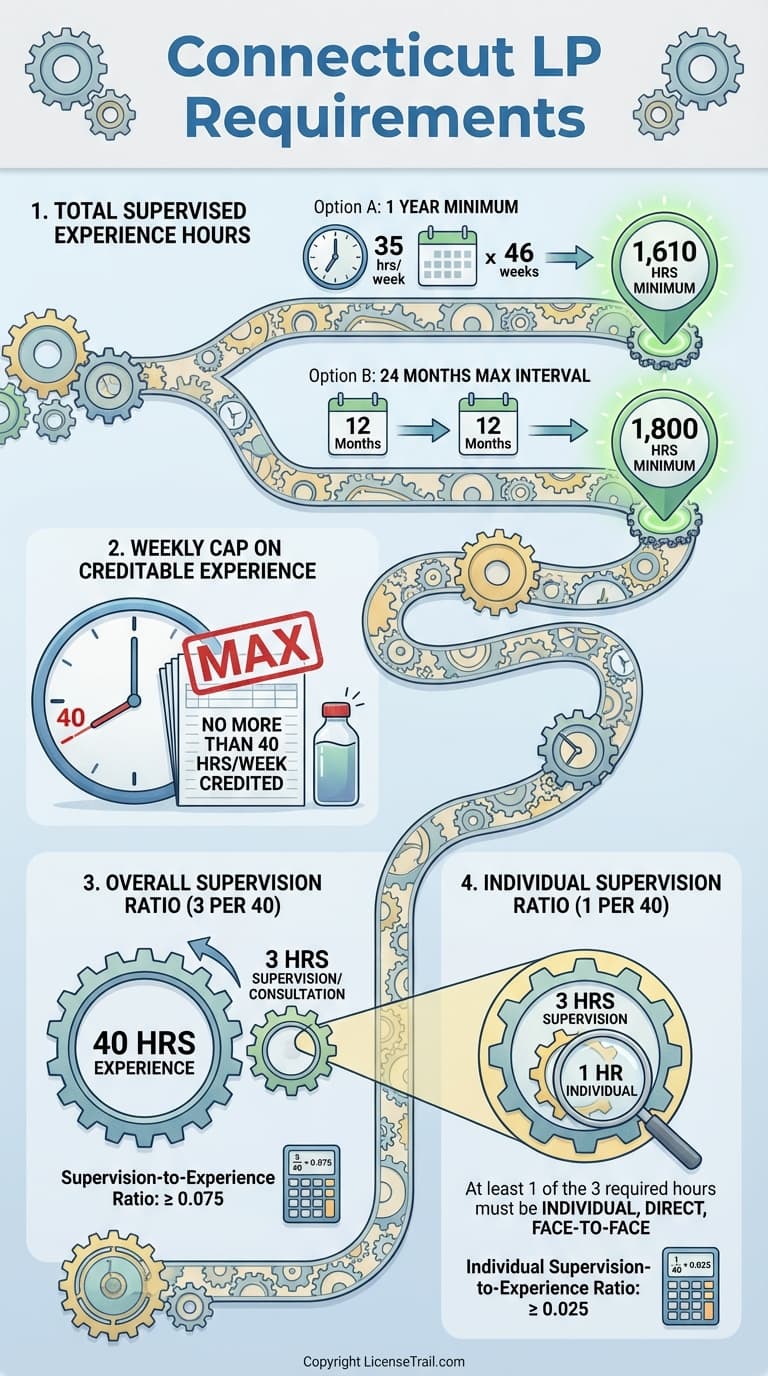
- Experience hour pattern: 35 hrs/wk for 46 wks within 12 consecutive months (max 40 hrs/wk credit) OR 1,800 hrs within 24 consecutive months (max 40 hrs/wk credit).
- Supervision: doctoral-level psychologist licensed where experience occurs, direct face-to-face; ≥3 hrs supervision per 40 work hrs, incl. ≥1 hr individual face-to-face.
- Supervisor limits/setting: supervisor may oversee no more than 3 trainees at once; setting must provide appropriate oversight, breadth, and admin control/responsibility by the licensed psychologist.
- Prohibited arrangements: no independent practice for the supervised year; no direct client fees/fee-based (variable) compensation for the experience.
- Exams: pass EPPP (500 scaled for exams since Apr 2001; 70% prior) + CT law/jurisprudence requirement.
- Option/notes: may substitute 2 years of licensed work experience for the 1-year supervised requirement; in-state trainees may use title “psychology resident” while completing supervised experience.
License Details
Procedures
In Connecticut, licensure as a psychologist is regulated by the Department of Public Health (DPH) with the advice and consent of the Board of Examiners of Psychologists under Chapter 383 of the Connecticut General Statutes and the associated regulations (notably Conn. Agencies Regs. § 20‑188‑2 and § 20‑188‑3). (cga.ct.gov)
What follows is an organized guide to what the Board/DPH actually requires, with emphasis on hours, supervision, and the exact types of experience they recognize.
1. Governing framework and terminology
-
Legal authority: Conn. Gen. Stat. § 20‑188 requires that, before granting a license, the DPH must ensure the applicant:
- Has a qualifying doctoral degree in psychology from an approved program, and
- Has completed “at least one year’s experience that meets the requirements established in regulations” (i.e., the supervised work experience in § 20‑188‑3). (cga.ct.gov)
-
Licensing agency vs. board:
- The Department of Public Health issues the license and sets procedures. (portal.ct.gov)
- The Board of Examiners of Psychologists advises DPH on standards, examinations, and discipline. (cga.ct.gov)
-
Title: Connecticut uses the title “licensed psychologist”; there is no separate “LP” credential.
2. Educational requirement
The DPH/Board require:
- Doctoral degree in psychology from an “approved program in psychology.”
- Programs that were APA‑accredited during your attendance automatically qualify as approved. (portal.ct.gov)
- Non‑APA programs are reviewed individually under Regs. § 20‑188‑2. (portal.ct.gov)
Applicants from non‑applied or non‑clinical doctoral areas must complete a respecialization program in an applied APA‑accredited psychology program to meet the educational requirement. (portal.ct.gov)
3. Supervised work experience: hours and structure
3.1 What Connecticut requires (big picture)
Connecticut requires “at least 1 year of supervised work experience at the pre or post‑doctoral level.” Internship hours required for the doctoral degree do not count toward this one‑year licensure experience. (portal.ct.gov)
This is not expressed as “1,500 hours of direct experience and 1,500 hours of supervised experience.” Instead, the regulations define:
- A one‑year block of supervised work experience
- With specific weekly hours and time‑frame patterns, and
- Minimum supervision ratios and setting requirements.
3.2 Allowed hour patterns
Both the DPH licensure page and Conn. Agencies Regs. § 20‑188‑3 define the year of supervised work experience as follows: (portal.ct.gov)
You must complete one of these patterns:
-
“No less than 35 hours per week for no less than 46 weeks within 12 consecutive months”
- This is effectively a full‑time year.
- Numerically, 35 hours/week × 46 weeks = 1,610 hours minimum.
- The regulations also cap creditable hours at no more than 40 hours per week.
-
“No less than 1,800 hours within 24 consecutive months”
- This is a more flexible, part‑time option, as long as the total is at least 1,800 hours within a continuous 24‑month window.
- Again, you may not count more than 40 hours per week toward the total.
There is no separate statutory requirement that a specific number of those hours be “direct client contact” vs. “indirect” work. Instead, the focus is on:
- Total hours in the defined time frame, and
- The nature and setting of the experience aligning with your doctoral training and intended area of practice. (law.cornell.edu)
3.3 What counts as “supervision”
Connecticut gives a precise definition. On the DPH site:
- “Supervision is defined as direct, face‑to‑face supervision provided by a doctoral‑level psychologist who is licensed in the state where the experience was conducted.” (portal.ct.gov)
The regulations specify the supervision ratio:
- For each 40 hours of work experience, supervision or consultation must consist of at least 3 hours, “of which no less than one hour shall be individual, direct, face‑to‑face supervision or consultation.” (law.cornell.edu)
- The supervisor may not supervise more than three individuals completing work experience at the same time. (portal.ct.gov)
- The supervisor must be a doctoral‑level psychologist, licensed in the state where the experience occurs. (portal.ct.gov)
In other words:
- Every block of 40 work hours must include:
- ≥ 3 hours total supervision, and
- Within those 3, ≥ 1 hour of one‑to‑one, face‑to‑face supervision.
3.4 Nature of duties and acceptable settings
The regulations emphasize that the supervised year must be consistent with your training:
- Your duties must be “within an area for which the applicant is qualified” by doctoral education. (law.cornell.edu)
- You must have completed a “directly related sequence of graduate coursework” and a supervised pre‑doctoral internship/practicum/field or lab training relevant to the work you perform in the supervised year. (law.cornell.edu)
An acceptable employment setting must: (law.cornell.edu)
- Employ or contract with a doctoral‑level licensed psychologist in your area of practice,
- Provide opportunities for:
- Regular professional interaction and collaboration with other disciplines,
- Use of a variety of psychological techniques and interventions, and
- Work with a range of populations and conditions, and
- Ensure that the licensed psychologist has administrative control and full professional responsibility for your activities and certifies your completion of the experience.
The regulations explicitly exclude certain arrangements from meeting the requirement:
- The work experience cannot be completed in your own independent practice setting.
- You cannot receive direct client fees or variable compensation based on fees generated for this experience. (law.cornell.edu)
3.5 Title and exemption while completing hours
For supervised work experience in Connecticut, the DPH/Board provide two key points: (portal.ct.gov)
- While completing this supervised work in‑state under an approved plan, you may use the description “psychology resident” solely for that employment.
- You are exempt from the psychologist licensure requirement while completing the supervised experience, but this exemption ends two years after completion if you have not passed the EPPP.
4. Substituting licensed experience instead of supervised work
Connecticut allows a substitution in some circumstances:
- The statutes and DPH page state that an applicant “may substitute two (2) years of licensed work experience in lieu of this [one‑year supervised work experience] requirement.” (portal.ct.gov)
This is particularly relevant for psychologists already licensed and practicing elsewhere who are seeking licensure in Connecticut but do not proceed under pure licensure‑by‑endorsement.
Separately, licensure by endorsement (reciprocity) exists for those licensed in another state with “substantially similar or higher” standards or holding an ASPPB Certificate of Professional Qualification in Psychology. (cga.ct.gov)
5. Examinations
To be licensed, the DPH/Board require you to pass:
-
Examination for Professional Practice in Psychology (EPPP)
- Administered by ASPPB. (portal.ct.gov)
- For exams before April 2001, the required score is 70%.
- For exams on or after April 2001, the passing score is 500 (scaled EPPP score). (portal.ct.gov)
-
Connecticut jurisprudence/law requirement
- Statute § 20‑190 allows the department to require evidence that an applicant “understands Connecticut laws and regulations relating to the practice of psychology,” and the DPH currently implements this via a jurisprudence exam or equivalent process. (cga.ct.gov)
6. Application process and documentation
The DPH outlines a straightforward process: (portal.ct.gov)
-
Online application and fee
- Complete the application through the Connecticut eLicense system.
- Pay the $565 application fee.
-
Official doctoral transcript
- Sent directly from the institution.
- If the program was not APA‑accredited, a Verification of Doctoral Education Program form must also be submitted from the program.
-
Verification of supervised work experience
- Submitted directly by your supervisor, on the DPH’s work‑experience verification form.
- If you are substituting licensed work experience, DPH instead requires a letter from your employer (or, for private practice, from a practitioner who had a referral relationship with you) confirming that you worked as a licensed psychologist and providing dates of employment.
-
EPPP score verification
- Sent directly via the EPPP Score Transfer Service (ASPPB).
-
License verifications
- Official verification of all psychology licenses ever held in any U.S. state or territory, sent directly from those licensing bodies.
All supporting documentation must be sent directly from the source to the DPH Psychologist Licensure office in Hartford. (portal.ct.gov)
7. How Connecticut’s requirements compare to a “3,000‑hour” model
Using your example language:
-
Connecticut does not formally split the requirement into something like “1,500 hours of direct experience and 1,500 hours of supervised experience.”
-
Instead, the Board/DPH framework is:
- One year of supervised work experience,
- Structured as:
- ≥ 35 hours/week for ≥ 46 weeks in 12 consecutive months (≈ 1,610 hours), or
- ≥ 1,800 hours in 24 consecutive months,
- With at least 3 supervision hours per 40 work hours, including ≥ 1 hour individual, face‑to‑face supervision,
- Under a doctoral‑level licensed psychologist,
- In an approved employment setting that is not your independent practice and does not pay you directly out of client fees.
These are the specific types of hours and supervisory conditions that the Connecticut Board of Examiners of Psychologists, through DPH regulations, recognizes as meeting the experience requirement for licensure. (portal.ct.gov)
Track your LP hours with confidence
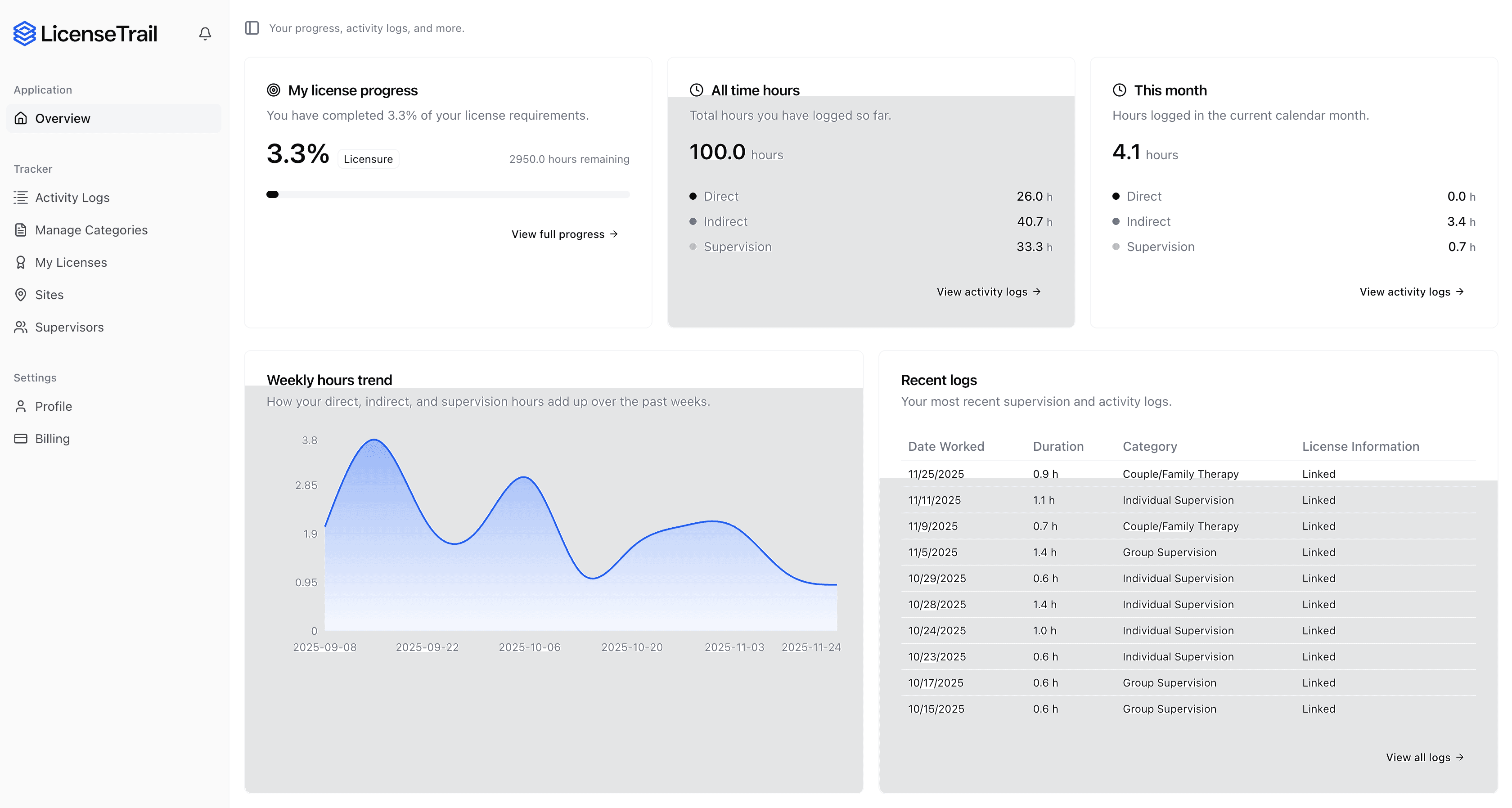
License Trail checks your direct, indirect, and supervision hours against Connecticut LP requirements continuously and flags mismatches before you submit.
 Start Tracking for Free
No credit card required · Free plan available
Is your spreadsheet hiding Connecticut LP risks?
Stop guessing if your categories match Connecticut Board of Examiners of Psychologists requirements. License Trail checks your direct, indirect, and supervision hours continuously and flags mismatches before you submit.
Import or log
Bring your spreadsheet or start fresh
Upload your existing tracking spreadsheet and we'll map every hour into the right Connecticut Board of Examiners of Psychologists categories automatically.
Verify against Connecticut
Catch mismatches before the board does
License Trail checks your direct, indirect, and supervision hours against Connecticut LP requirements continuously.
Export board-ready
One-click clean reports
Generate professional, board-ready reports for supervision meetings and Connecticut Board of Examiners of Psychologists submissions in seconds.
No credit card required · Free plan available