
Delaware LCSW Requirements: Hours, Exams & Step-by-Step Guide
Stop guessing if your categories match Delaware requirements. License Trail checks your direct, indirect, and supervision hours against LCSW requirements continuously and flags mismatches before you submit.
No credit card required · Free plan available
Quick Requirements Overview
- CSWE-accredited MSW/DSW/PhD (or CSWE-approved international credential evaluation) required
- Pass Board-designated exam (ASWB Clinical); official score verification sent directly to Board; if not yet passed, 2 years from application date to pass or reapply
- Complete 3,200 hours post-degree supervised clinical social work experience in 2–5 years (all hours under supervision acceptable to the Board)
- Within the 3,200 hours: 1,600 clinical experience hours under direct professional supervision
- Within the 1,600 hours: 100 hours 1:1 supervision (in-person or live video; no phone/email for required 1:1)
- Supervisor: typically an LCSW; if unavailable, psychologist/psychiatrist may supervise with Board-approved justification and required attestations/CE; max 7 supervisees; no reciprocal co-supervision
- LMSW supervisor only via grandfathering (supervision started/completed by 9/26/2024; LMSW continuation only until 3/25/2025)
- Other core requirements/documentation: state + FBI background check, Child Protection Registry checks/consent, official transcripts, and Supervisory Reference Form (logs may be requested)
License Details

Procedures
Becoming a Licensed Clinical Social Worker (LCSW) in Delaware involves meeting detailed statutory and regulatory requirements for education, examination, and—most notably—post‑degree supervised clinical experience hours. The licensing authority is now titled the Delaware Board of Social Work Examiners (not “Board of Clinical Social Work Examiners”), but it oversees LCSW licensure under Title 24, Chapter 39 of the Delaware Code and 24 Del. Admin. Code 3900. (delcode.delaware.gov)
Below is a structured guide focused on the exact hour requirements and the key Board language around supervision.
1. Basic eligibility for LCSW licensure in Delaware
1.1. Education
To apply as an LCSW, you must:
- Hold a master’s or doctoral degree in social work from a program accredited by the Council on Social Work Education (CSWE) or a doctoral program the Board has approved. (delcode.delaware.gov)
- If educated outside the U.S., you must obtain a CSWE‑approved credential evaluation (via ISWDRES) showing equivalence to a CSWE‑accredited program. (dpr.delaware.gov)
1.2. Examination
Delaware requires that an LCSW applicant:
- “Has successfully passed an examination that the Board designated” (Title 24 § 3907(b)(3)). In practice, this is the ASWB Clinical examination. (delcode.delaware.gov)
- The Board’s site specifies an official ASWB score verification must be sent directly to the Board for the clinical level exam. (dpr.delaware.gov)
If you have not yet passed the exam, the Board approves you to sit for it after reviewing your application. You then have two years from the date of application to pass, or you must reapply. (dpr.delaware.gov)
1.3. Character and background checks (for all social work licenses)
All applicants for licensure under § 3907(a) must, among other things: (delcode.delaware.gov)
- Undergo a state and FBI criminal background check (via IdentoGO, using a Board service code).
- Submit a Child Protection Registry Consent Form and associated registry checks from Delaware and any other state in which they have lived, worked, or been licensed as an adult.
- Attest that they do not have disqualifying criminal convictions and do not have impairments (e.g., related to substance use) that would make practice unsafe.
The Board’s licensing page lays out these requirements under “Requirements – All Applicants.” (dpr.delaware.gov)
2. Core experience requirement: hours and timeframe
Delaware is very specific about the type and amount of clinical experience required for LCSW licensure, and the regulations use particular terms you’ll see on the forms.
2.1. Total post‑degree clinical social work hours
Regulations at 24 Del. Admin. Code § 3900‑3.0 require: (law.cornell.edu)
- 3,200 hours of “post-degree supervised clinical social work experience”
- These hours must be:
- Post‑degree (after your qualifying MSW/DSW/PhD in social work)
- Completed in no less than 2 years and no more than 5 years
- Carried out under professional supervision acceptable to the Board
The regulation states that the entire 3,200 hours of total experience must be completed under the professional supervision of someone who meets the Board’s supervisor criteria in subsection 3.2. (law.cornell.edu)
In other words, Delaware does not split the 3,200 hours into “supervised vs. unsupervised” experience: all 3,200 hours are supervised, but there is a more intensively supervised clinical subset (see below).
2.2. Clinical subset: 1,600 “clinical experience hours” under direct supervision
Within the 3,200-hour total, the Board requires a more focused block of clinical work: (law.cornell.edu)
- 1,600 of the 3,200 hours must be “clinical experience hours” completed under “direct professional supervision.”
- “Direct professional supervision” is defined in the regulation as supervision that oversees your application of clinical social work principles, methods, or procedures, supporting your development of clinical knowledge, skills, and abilities.
The Board’s own Supervisory Reference Form instructions also highlight that the form must document at least 1,600 hours under professional supervision acceptable to the Board, and it must be signed by your direct clinical supervisor(s). (dpr.delaware.gov)
2.2.1. Required 1‑to‑1 supervision within the 1,600 hours
The 1,600 clinical experience hours must include a specified amount of individual supervision: (law.cornell.edu)
- At least 100 hours of 1‑to‑1 supervision provided by an approved supervisor.
- The 1‑to‑1 contact must be either face‑to‑face or via live video conferencing.
- Up to 100% of the 1‑to‑1 supervision may be conducted by live video, at the supervisor’s discretion.
- Supervision by telephone or e‑mail is expressly not permitted for these required contacts.
These provisions are all part of § 3900‑3.1.2.1 of the regulations.
2.3. What the Board expects you to be doing in those hours
Your supervised experience must be within the scope of “licensed clinical social work” as defined in Title 24 § 3902(17)–(18): that is, specialized clinical practice involving assessment, diagnosis, prevention, and treatment of biopsychosocial dysfunction and mental disorders, including individual, couple, family, and group therapy. (delcode.delaware.gov)
The regulations also specify the skills you must demonstrate during the 1,600 clinical hours under direct professional supervision, documented on the Supervisory Reference Form. You must show you can, at a minimum (paraphrased from § 3900‑3.1.5): (law.cornell.edu)
- Conduct adequate clinical diagnoses and biopsychosocial assessments
- Provide short‑term and/or long‑term interventions
- Develop treatment plans with measurable goals
- Adjust interventions to maximize client responsiveness
- Demonstrate competence in risk assessment and intervention
- Recognize when personal issues affect objectivity and stay within practice limits
- Seek consultation when indicated and make appropriate referrals
- Practice within ethical and legal parameters
The Board has discretion to request supervisory logs if the Supervisory Reference Form(s) are absent or need clarification. (law.cornell.edu)
3. How Delaware defines and structures supervision
3.1. Definition of “supervision”
The Delaware Code defines “supervision” as the professional relationship between a clinical supervisor and a social worker that provides evaluation, direction, and promotes the continued development of the social worker’s competence and ethical practice. (delcode.delaware.gov)
The regulations mirror this definition and state that “supervision acceptable to the Board” is this professional relationship, emphasizing evaluation and direction over your services and your development as a competent social worker. (law.cornell.edu)
3.2. Who may supervise your hours
Under the current law and regulations (as updated through March 1, 2025):
-
The standard supervisor is a Licensed Clinical Social Worker (LCSW) in any U.S. state or territory. (law.cornell.edu)
-
If supervision by an LCSW is not available, an applicant may be supervised by a:
- Licensed psychologist, or
- Licensed psychiatrist
In these non‑LCSW cases: (law.cornell.edu)
- You must demonstrate to the Board that an LCSW was not available for supervision.
- You must submit a notarized statement, on a Board form, explaining your efforts to obtain LCSW supervision and a compelling clinical reason for using a non‑LCSW supervisor.
- The Board has discretion to accept or reject your explanation.
-
For supervisors who are not Delaware‑licensed LCSWs (e.g., a psychologist or psychiatrist), the regulations require that the supervisor attest that they: (law.cornell.edu)
- Have read and are familiar with Delaware’s licensure requirements and Board rules and regulations
- Have the necessary training to provide clinical supervision
Additionally, all supervisors for LCSW applicants must attest that they: (law.cornell.edu)
- Have been in practice at least 3 years post‑licensure with no disciplinary action
- Have completed, within the 4 years prior to the application:
- At least 3 hours of continuing education (CE) in clinical supervision
- At least 3 hours of CE in cultural competency and/or diversity
- At least 6 hours of CE in ethics
- Have no more than 7 supervisees at any given time
Professional supervision is not acceptable if applicants have simultaneously supervised one another. (law.cornell.edu)
3.3. Grandfathering of LMSW supervisors (important if your supervision spans 2024–2025)
Recent statutory and regulatory changes phase out the use of licensed master’s social workers (LMSWs) as supervisors for LCSW applicants, with a limited grandfather period:
- Under Title 24 § 3907C(a), an applicant (or LCSW) who started or completed supervision by a master’s social worker on or before September 26, 2024 can still meet the supervision requirement, provided all other supervision rules are met. (delcode.delaware.gov)
- However, if you will not complete the 2‑year supervised experience by March 25, 2025, you must continue any remaining supervision under a licensed clinical social worker, licensed psychologist, or licensed psychiatrist. (delcode.delaware.gov)
- An LMSW who was already supervising an applicant as of September 26, 2024 may continue until March 25, 2025, but not beyond. (delcode.delaware.gov)
The regulations echo these dates and conditions in § 3900‑3.2.2.1–3.2.2.2. (law.cornell.edu)
Given you are looking at this in late 2025, most new or ongoing supervision must now be provided by an LCSW, psychologist, or psychiatrist; LMSW supervision is effectively a closed grandfather category.
4. Application process: how you actually move from hours to license
Once you meet the education, exam, and experience requirements, you apply through DELPROS, Delaware’s online licensing portal. (dpr.delaware.gov)
4.1. Choose the correct application type
For clinical social work, you may apply: (dpr.delaware.gov)
-
By Examination – if:
- You are seeking Board approval to take the ASWB Clinical exam; or
- You have passed the exam but do not hold a current clinical license elsewhere.
-
By Reciprocity – if:
- You have already passed the ASWB exam, and
- You hold a current clinical social work license in another jurisdiction.
-
By Upgrade – if:
- You currently hold a Delaware LBSW or LMSW license (obtained by examination or grandfathering), and
- You now meet all the LCSW education, experience, and exam requirements.
4.2. Create your DELPROS account and submit application
In DELPROS you will: (dpr.delaware.gov)
- Create a user account and start the Clinical Social Worker application.
- Upload or arrange to send:
- Criminal background check results (State of Delaware + FBI, ordered for this specific purpose).
- Child Protection Registry Consent Form.
- Official transcripts (sent directly from your CSWE‑accredited program or credential evaluation agency).
- Official ASWB Clinical exam score verification, sent directly from ASWB.
- A completed Supervisory Reference Form, signed by your direct clinical supervisor(s), documenting at least 1,600 hours under professional supervision acceptable to the Board and showing the required practice skills. (dpr.delaware.gov)
You have six months from starting the application in DELPROS to submit it, or you must restart. (dpr.delaware.gov)
5. Snapshot of the Delaware LCSW hour requirements (by the Board’s wording)
Putting the key elements together using the Board’s own terms:
-
Total experience:
- At least 3,200 hours of “post-degree supervised clinical social work experience”, all “under professional supervision acceptable to the Board,” completed in not less than 2 years and not more than 5 years. (law.cornell.edu)
-
Clinical subset within that total:
- 1,600 of the 3,200 hours must be “clinical experience hours” completed under “direct professional supervision” of an approved supervisor.
- Within those 1,600 hours, at least 100 hours must be 1‑to‑1 supervision, face‑to‑face or by live video conferencing; telephone and e‑mail contacts do not count toward required 1‑to‑1 supervision. (law.cornell.edu)
-
Supervisors:
- Normally an LCSW; when an LCSW is truly not available, a licensed psychologist or psychiatrist may supervise if the Board approves and the supervisor meets training and CE requirements.
- LMSW supervision is only recognized if supervision began on or before September 26, 2024, and is completed by March 25, 2025, or continued thereafter under an LCSW/psychologist/psychiatrist as described in § 3907C and § 3900‑3.2.2.1. (delcode.delaware.gov)
-
Documentation:
- Supervision must be evidenced by a Supervisory Reference Form completed by the supervisor(s), demonstrating the Board‑specified practice skills and confirming the required hours and supervision structure. (law.cornell.edu)
This framework—3,200 total post‑degree supervised clinical hours (within 2–5 years), including 1,600 directly supervised clinical hours with at least 100 hours of 1‑to‑1 supervision, all under approved supervisors—captures the hour structure and terminology that the Delaware Board uses for LCSW licensure.
Track your LCSW hours with confidence
License Trail checks your direct, indirect, and supervision hours against Delaware LCSW requirements continuously and flags mismatches before you submit.
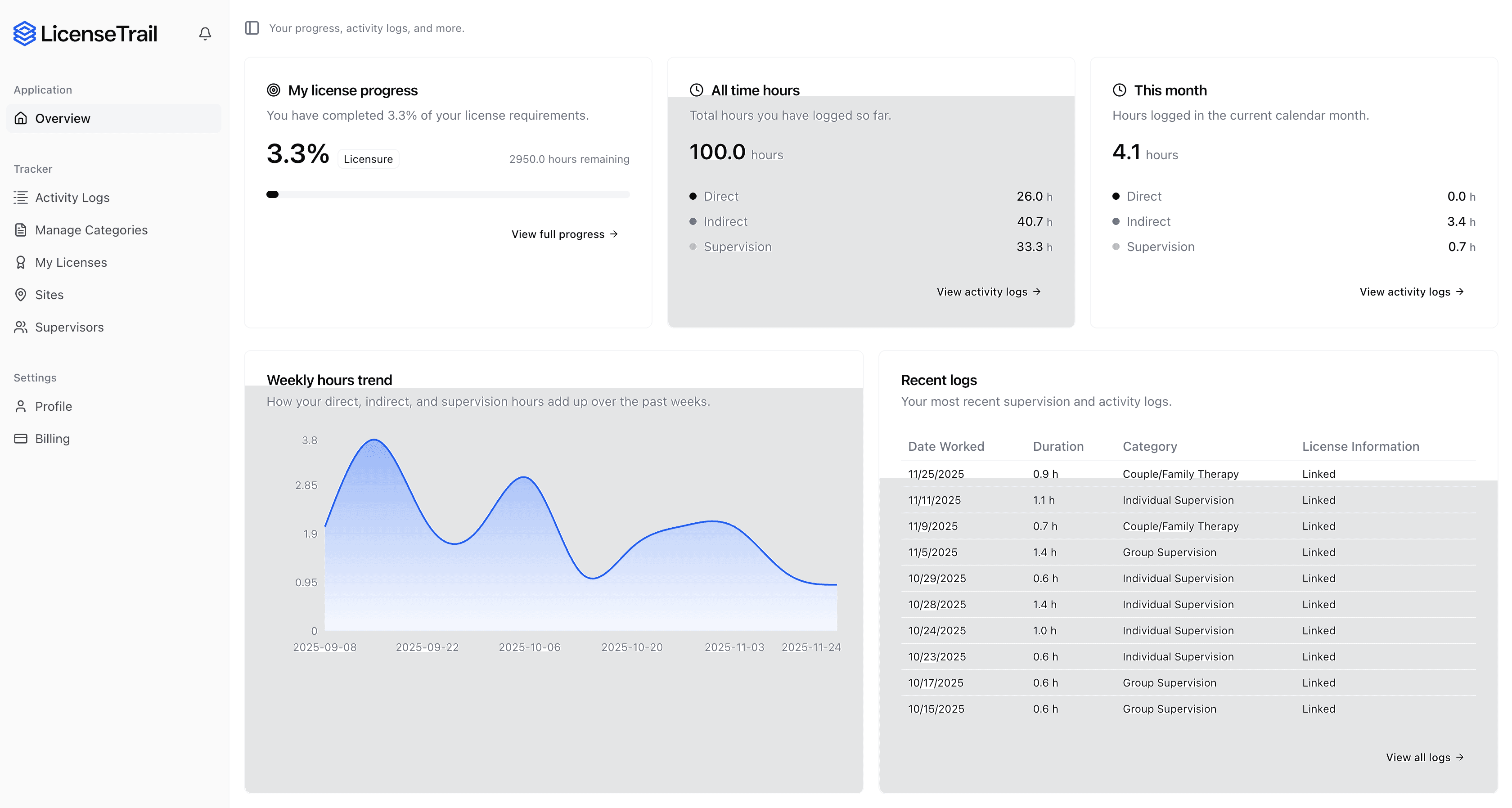 Start Tracking for Free
No credit card required · Free plan available
Is your spreadsheet hiding Delaware LCSW risks?
Stop guessing if your categories match Delaware Board of Clinical Social Work Examiners requirements. License Trail checks your direct, indirect, and supervision hours continuously and flags mismatches before you submit.
Import or log
Bring your spreadsheet or start fresh
Upload your existing tracking spreadsheet and we'll map every hour into the right Delaware Board of Clinical Social Work Examiners categories automatically.
Verify against Delaware
Catch mismatches before the board does
License Trail checks your direct, indirect, and supervision hours against Delaware LCSW requirements continuously.
Export board-ready
One-click clean reports
Generate professional, board-ready reports for supervision meetings and Delaware Board of Clinical Social Work Examiners submissions in seconds.
No credit card required · Free plan available