
Delaware Psychological Assistant Registration Requirements: Hours, Exams & Step-by-Step Guide
Stop guessing if your categories match Delaware requirements. License Trail checks your direct, indirect, and supervision hours against Psychological Assistant Registration requirements continuously and flags mismatches before you submit.
No credit card required · Free plan available
Quick Requirements Overview
- Registration required: Must be Board-registered as a Psychological Assistant before performing psychological work/postdoc accrual; practice is only under supervision.
- Education: Completion of a doctoral degree in psychology (APA/PCSAS or Board-approved equivalent) with official transcript submitted.
- Predoctoral internship (per rules): 1,500 hours over 48–104 weeks; ≥50% clinical services; ≥25% face-to-face client contact (in person or live video); ≤25% research.
- Postdoctoral supervised experience (for psychologist licensure): 1,500 hours in 1–3 years; ≥25% (375 hrs) direct service in area of training.
- Supervision minimums: At least 1 hour face-to-face supervision per 10 hours of clinical work; weekly 1:1 face-to-face case review required; supervision documented and reported at renewal/termination.
- Supervisor eligibility/obligations: DE-licensed psychologist, 2 years post-licensure, no discipline; employed/contracted at setting; 24/7 availability/coverage plan; assumes legal/ethical responsibility.
- Application essentials (DELPROS): DE+FBI background checks; supervisor form + detailed job description (role limits, supervision plan/ratio, emergency & backup coverage); EPPP score report or degree-conferred letter for approval to test.
- Renewal/CE: Expires July 31 odd-numbered years; 20 CE hours/2 years incl. 3 ethics + 3 cultural inclusion/equity/diversity.
License Details
Procedures
Delaware’s Board of Examiners of Psychologists treats “Psychological Assistant” as a formal registration that allows a doctoral‑level psychologist-in-training to practice only under supervision while accruing postdoctoral hours toward full psychologist licensure. The Board’s statute, regulations, and web guidance spell out precise hour counts and supervision ratios.
Below is a structured summary of what Delaware actually requires and how it describes the various types of hours.
1. What a Psychological Assistant Is in Delaware
Under the Board’s regulations, a psychological assistant is:
- A person registered with the Board to perform certain functions within the practice of psychology,
- Only under the direct supervision of a supervising psychologist, and
- Authorized by the Board to use the title “psychological assistant.” (law.cornell.edu)
Psychological assistants are “supervised, directed, and evaluated” by a Delaware‑licensed psychologist who assumes professional and legal responsibility for the services provided. (law.cornell.edu)
By statute, you may not act as a psychological assistant at all unless you are registered by the Board. (delcode.delaware.gov)
2. Baseline Education and Internship Requirements
To be registered as a psychological assistant, the supervising psychologist submits the application, but the applicant must meet specific education and internship criteria.
2.1 Doctoral degree requirement
The Delaware Code requires that the person being registered as a psychological assistant:
- Has completed all requirements for a doctoral degree in psychology from an APA‑accredited, PCSAS‑accredited, or Board‑approved equivalent program (with special grandfathering for assistants registered before July 17, 2010). (delcode.delaware.gov)
The Board’s Psychological Assistant Registration page echoes this by requiring an official transcript showing a doctoral degree from a psychological studies program specifically designed to train and prepare psychologists, citing APA or PCSAS accreditation as examples. (dpr.delaware.gov)
2.2 Predoctoral internship requirement and hour definitions
Statutorily, a psychological assistant must have “successfully completed a predoctoral internship which complies with the Board’s rules and regulations.” (delcode.delaware.gov)
In the Board’s regulations, that predoctoral internship is defined as follows:
- Minimum hours: The internship “consists of a minimum of 1,500 hours of actual work experience.”
- Time frame: Those 1,500 hours must be completed in not less than 48 weeks and not more than 104 weeks.
- Type of hours:
- At least 50% of the supervised experience must be in clinical services, explicitly including treatment, consultation, assessment, and report writing.
- At least 25% of the total time must be devoted to face‑to‑face direct patient or client contact.
- No more than 25% of the time may be allocated for research.
- “Face‑to‑face” is defined as either in‑person or live video conferencing. (law.cornell.edu)
The Board’s own FAQ, however, currently summarizes the entry‑level requirement for the psychological assistant license as a “doctoral degree and 450‑hour internship but no experience.” (dpr.delaware.gov)
Legally, the controlling documents are the statute and regulations, which tie the psychological assistant registration to a “predoctoral internship” that must comply with Section 7.2’s 1,500‑hour standard. The FAQ’s 450‑hour figure is a simplified summary; when planning, use the 1,500‑hour predoctoral internship definition in the rules unless the Board specifically advises otherwise.
3. Postdoctoral Supervised Experience While Registered
Registration as a psychological assistant is required before you can accrue supervised postdoctoral professional experience in Delaware:
The unlicensed practice of psychology is prohibited; therefore, individuals accruing supervised postdoctoral professional experience in psychological work in Delaware must obtain a psychological assistant registration before commencing such supervision. (law.cornell.edu)
3.1 Total postdoctoral hours and how they must be structured
For eventual psychologist licensure, the Board requires:
- 1,500 hours of supervised postdoctoral experience, described as “actual work experience” under the supervision of a licensed psychologist.
- Time frame: These 1,500 hours must be completed in not less than one calendar year and not more than three calendar years.
- Direct service requirement: At least 25% of the 1,500 hours must be “direct service” in the area of the applicant’s academic training.
- “Direct service” is defined as any activity that falls under the practice of psychology, or supervision of graduate students who are themselves engaging in such practice.
- Supervision ratio: There must be at least one hour of face‑to‑face supervision for every 10 hours of clinical work.
- Group supervision option: Group supervision is allowed if
- No more than five postdoctoral applicants meet with the supervisor at one time, and
- There are two hours of group supervision in place of every one hour of individual supervision. (law.cornell.edu)
Functionally, if you are accruing your Delaware postdoctoral year in psychological work, you:
- Must be registered as a psychological assistant during that time, and
- Must complete 1,500 hours of postdoctoral actual work experience, of which at least 375 hours (25%) are direct service, with the 1:10 supervision ratio above.
The Board does not split these 1,500 postdoctoral hours into two separate 1,500‑hour buckets (such as “1,500 direct” plus “1,500 supervised”). Instead, it is 1,500 total hours with minimum proportions and supervision requirements built in.
4. Supervision Requirements Specific to Psychological Assistants
Delaware has a separate regulatory section devoted to psychological assistants (24 DE Admin. Code § 3500‑9.0) and cross‑references it in the supervised experience rule (Section 7.0).
4.1 Who can supervise you
The supervising psychologist must:
- Have been in practice for two years post‑licensure in Delaware or another jurisdiction without disciplinary action. (law.cornell.edu)
- Hold a current, active Delaware psychologist license. (dpr.delaware.gov)
- Be employed or under contract in the setting where clinical services occur, and the supervision must occur within that setting. (law.cornell.edu)
- Provide 24‑hour availability to you and your clients, or arrange adequate alternative coverage when unavailable. (law.cornell.edu)
- Assume full professional, legal, and ethical responsibility for services you provide as a registered psychological assistant. (dpr.delaware.gov)
4.2 Required supervision ratios and “type of hours”
The regulations impose two overlapping supervision standards:
-
Global ratio for psychological assistants
- Supervision of psychological assistants is required at a frequency of one hour of face‑to‑face supervision for every 1–10 hours of clinical work performed by the assistant, and must comply with Section 9.0. (law.cornell.edu)
-
Detailed supervision structure in Section 9.0 (law.cornell.edu)
- Supervision must be a regular and formal process.
- The supervising psychologist and psychological assistant must have weekly, one‑on‑one, face‑to‑face supervision that includes review of each case served by the assistant.
- The regulation requires one hour of supervision for every ten hours (or fraction thereof) of direct clinical work:
- If you provide 8 hours of direct clinical service in a week, you need at least 1 hour of supervision.
- If you have 15 hours of direct clinical contact, you need at least 2 hours of supervision.
- This supervision must be documented in writing in the patient records.
- The supervising psychologist must submit supervision reports at renewal and at termination of the supervision relationship, documenting dates and amounts of supervision, unscheduled supervisory contacts, and a brief evaluation of your functioning.
-
Group supervision possibility (law.cornell.edu)
- The Board may approve substitution of group supervision for some of the one‑to‑one requirement, on a petition showing good cause.
- If approved:
- No more than five psychological assistants may meet with the supervisor at once.
- There must be two hours of group supervision for each one hour of individual supervision being replaced.
- Every psychological assistant must still receive at least one hour of individual supervision per week.
- The Board can withdraw permission for group supervision at any time.
In this context, the Board uses terms like:
- “Direct clinical work” / “direct clinical service” – your actual clinical contact and intervention with clients.
- “Face‑to‑face” – either in person or through live video conferencing. (law.cornell.edu)
5. Application Components and Process
Delaware processes all applications through its DELPROS online system. For a Psychological Assistant Registration, you must:
5.1 Set up DELPROS and start the correct application
- Create or log into a DELPROS account.
- Select the Psychological Assistant application.
- You have six months from starting the application to submit it; otherwise you must restart the application. (dpr.delaware.gov)
You should apply when you:
- Are in the process of obtaining post‑doctoral hours under a supervising psychologist’s supervision, and
- Intend to apply for full psychologist licensure after completing those postdoctoral hours. (dpr.delaware.gov)
5.2 Required documents and Board‑defined content
In addition to the online application and fee, you must provide: (dpr.delaware.gov)
-
Criminal background checks
- A Delaware state and FBI criminal background check, using the Board’s specified service code and fingerprinting process.
- Background checks obtained for other purposes (e.g., employment, other state licensure) do not satisfy this requirement.
-
Education verification
- An official doctoral transcript sent directly from your college/university to the Board, showing you earned a doctoral degree from a psychological studies program designed to train and prepare psychologists (APA/PCSAS accredited or equivalent).
- If your program is not APA or PCSAS accredited, you must also submit:
- An Evaluation of Coursework form, and
- Course descriptions (e.g., catalog entries) to demonstrate that your program meets detailed criteria in the Board’s Rules and Regulations.
-
EPPP status
- If you have already passed the EPPP, your score report must be sent directly from ASPPB to the Board.
- If you have not passed the EPPP, you must have your program send a signed letter stating the date your doctoral degree was conferred; the Board will review your file for approval to test.
-
Psychological Assistant Report of Initial or New Supervisor
- A Board form completed and signed by your chosen supervising psychologist.
- This must be accompanied by a detailed job description (see below).
- No psychological assistant may begin work until the Board has reviewed and approved this supervisory arrangement. (dpr.delaware.gov)
5.3 Content required in the job description
The Board requires a written job description, signed by both you and your supervisor, that must: (dpr.delaware.gov)
- Define your specific role in the supervising psychologist’s practice.
- Describe the range and type of duties assigned, including explicit limitations on independent action and decision‑making.
- Describe the strategy and format of supervision, including the ratio of clinical hours to supervisory hours.
- Lay out an emergency and contingency plan, describing:
- How you are to act in a time of clinical crisis, and
- Prearranged emergency consultation arrangements and how you will obtain such consultations.
- Describe a backup plan for anticipated or unanticipated unavailability of the licensed psychologist, ensuring competent and continuous clinical coverage.
The supervising psychologist must also maintain a current written job description and supervisory plan over time. (dpr.delaware.gov)
6. Ongoing Status, Renewal, and Continuing Education
6.1 Renewal cycle
- Psychological Assistant registrations and psychologist licenses expire on July 31 of odd‑numbered years (e.g., 2023, 2025). (dpr.delaware.gov)
- Renewal is done through DELPROS; at renewal you must:
- Pay the renewal fee,
- Attest to meeting continuing education requirements, and
- Address any changes in supervisors (uploading the Report of Releasing Supervisor and/or Report of New Supervisor as required). (dpr.delaware.gov)
6.2 Continuing education for psychological assistants
Under Section 10.0 of the regulations:
- Psychological assistants must complete 20 hours of continuing education every two‑year licensing cycle.
- Within those 20 hours, you must include:
- 3 hours in ethics, and
- 3 hours in cultural inclusion, equity, and diversity. (regulations.justia.com)
Failure to maintain required CE or to renew on time can jeopardize your ability to continue working as a psychological assistant.
7. Scope and Limits of Practice as a Psychological Assistant
By statute, psychological assistants: (delcode.delaware.gov)
- Perform only the specific functions delineated in the supervising psychologist’s statement to the Board.
- Do not practice independently; they must practice only under the supervision of a licensed psychologist.
- Do not represent themselves as licensed psychologists.
They are employed by, or working in the office/agency of, the supervising psychologist, “so as to have regular and continued supervision,” and supervision must be face‑to‑face (with contingency arrangements if the supervisor is unavailable). (law.cornell.edu)
8. Putting the Hour Requirements in Perspective
For clarity, the key hour‑based requirements tied to Psychological Assistant Registration and eventual licensure in Delaware are:
-
Predoctoral internship (before or as part of eligibility to register)
- At least 1,500 hours of actual work experience over 48–104 weeks, with:
- ≥50% in clinical services (treatment, consultation, assessment, report writing),
- ≥25% of total time in face‑to‑face direct client contact, and
- ≤25% in research. (law.cornell.edu)
- At least 1,500 hours of actual work experience over 48–104 weeks, with:
-
Postdoctoral supervised experience (usually while registered as a psychological assistant)
- 1,500 hours of actual work experience, completed in 1–3 years, with:
- At least 25% (≥375 hours) in direct service (practice of psychology or supervision of graduate students practicing),
- 1 hour of face‑to‑face supervision per 10 hours of clinical work, with specific group‑supervision allowances. (law.cornell.edu)
- 1,500 hours of actual work experience, completed in 1–3 years, with:
-
Ongoing supervision as a psychological assistant (regardless of where you are in that 1,500‑hour postdoc)
- One hour of face‑to‑face supervision for every 1–10 hours of clinical work,
- Weekly one‑on‑one, face‑to‑face supervision reviewing every case, and
- Documented supervision and periodic supervision reports to the Board. (law.cornell.edu)
These are the central Board‑defined hour and supervision structures that govern Psychological Assistant Registration in Delaware and the pathway from doctoral graduation through postdoctoral training to independent psychologist licensure.
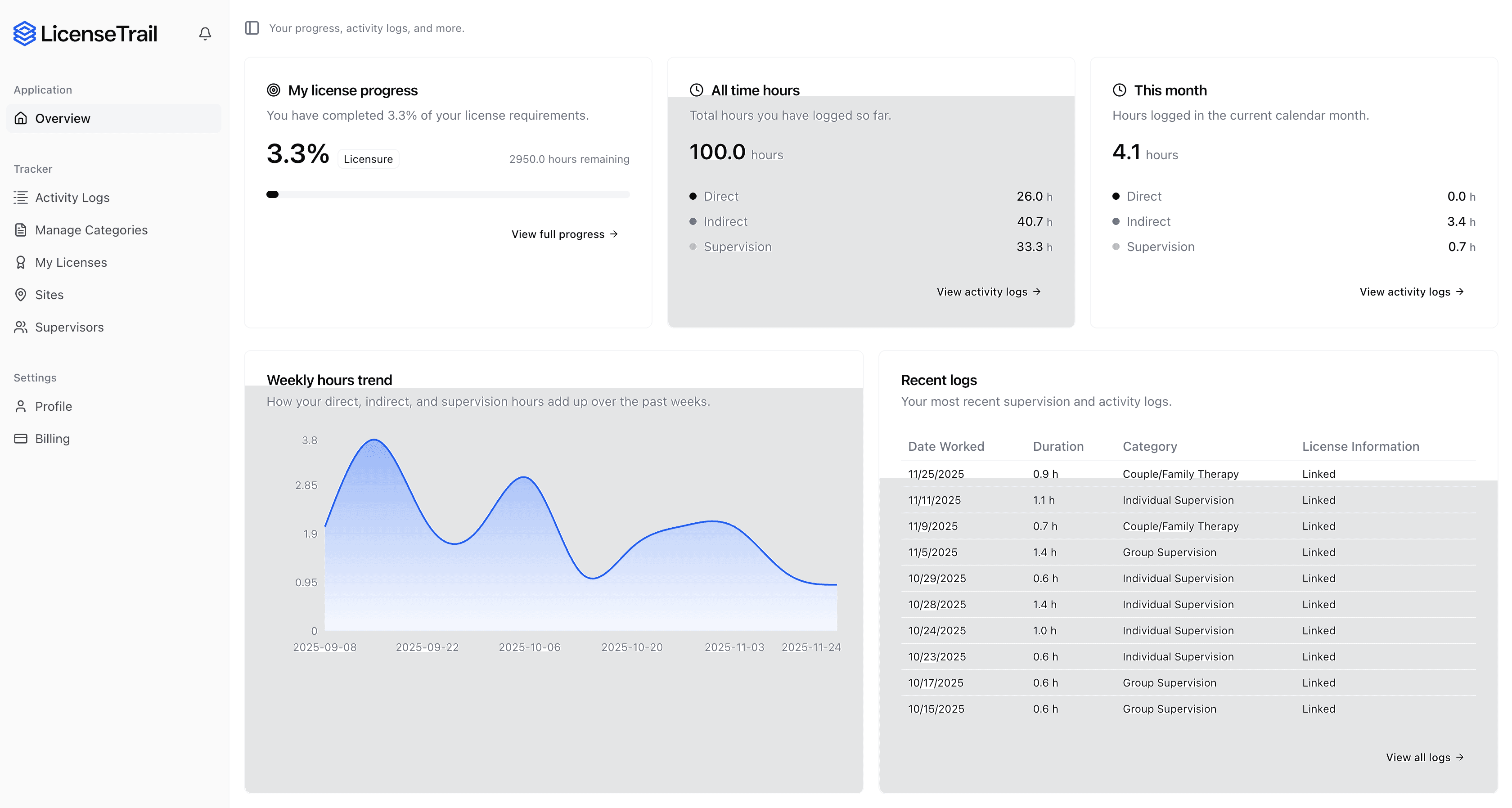
Track your Psychological Assistant Registration hours with confidence
License Trail checks your direct, indirect, and supervision hours against Delaware Psychological Assistant Registration requirements continuously and flags mismatches before you submit.
 Start Tracking for Free
No credit card required · Free plan available
Is your spreadsheet hiding Delaware Psychological Assistant Registration risks?
Stop guessing if your categories match Delaware Board of Examiners of Psychologists requirements. License Trail checks your direct, indirect, and supervision hours continuously and flags mismatches before you submit.
Import or log
Bring your spreadsheet or start fresh
Upload your existing tracking spreadsheet and we'll map every hour into the right Delaware Board of Examiners of Psychologists categories automatically.
Verify against Delaware
Catch mismatches before the board does
License Trail checks your direct, indirect, and supervision hours against Delaware Psychological Assistant Registration requirements continuously.
Export board-ready
One-click clean reports
Generate professional, board-ready reports for supervision meetings and Delaware Board of Examiners of Psychologists submissions in seconds.
No credit card required · Free plan available