
Delaware Psychologist License by Reciprocity Requirements: Hours, Exams & Step-by-Step Guide
Stop guessing if your categories match Delaware requirements. License Trail checks your direct, indirect, and supervision hours against Psychologist License by Reciprocity requirements continuously and flags mismatches before you submit.
No credit card required · Free plan available
Quick Requirements Overview
- Must hold a current doctoral-level psychologist license in another U.S. jurisdiction.
- Reciprocity eligibility: 2 years continuous practice or CPQ or NRHSPP (otherwise apply by examination).
- Must show EPPP passing score (verification from ASPPB unless accepted via CPQ/NRHSPP; ABPP may affect documentation).
- Must document doctoral degree in psychology (APA/PCSAS programs generally accepted; non-APA/PCSAS may need coursework evaluation).
- License verifications required from all jurisdictions ever licensed; Board checks for no pending discipline/complaints.
- Must complete Delaware + FBI criminal background check via required IdentoGO process.
- Delaware underlying training standard (comparability basis): 3,000 supervised hours = 1,500-hr predoctoral internship + 1,500-hr postdoc (postdoc in 1–3 years; specific supervision/direct-service rules).
License Details
Procedures
Licensure as a Psychologist by Reciprocity in Delaware is governed by both the Delaware Board of Examiners of Psychologists’ rules and by statute (24 Del. C. § 3511). The reciprocity pathway assumes you are already a licensed doctoral‑level psychologist elsewhere and focuses on verifying your existing license, practice history, education, and examination record rather than re‑documenting all of your supervised hours. However, Delaware’s rules do define the supervised hours and types of experience that underlie its psychologist license, and those standards are relevant to determining whether another state’s license is considered comparable.
Below is a structured guide, with emphasis on the required hours and how Delaware defines them.
1. Who is supposed to use the “Licensure by Reciprocity” route?
You use this pathway only if:
- You already hold a current psychologist license in another U.S. jurisdiction (state, D.C., or U.S. territory), and
- At least one of the following is true:
- You have practiced continuously for at least two years, or
- You hold a Certificate of Professional Qualification in Psychology (CPQ), or
- You are credentialed by the National Registry of Health Service Providers in Psychology (NRHSPP). (dpr.delaware.gov)
If you are licensed elsewhere but do not meet any of these three conditions, Delaware directs you to apply for licensure by examination, not reciprocity. (dpr.delaware.gov)
2. Core legal standard for reciprocity (what the law requires)
Delaware’s reciprocity statute, 24 Del. C. § 3511, lays out the baseline requirements:
If you are already licensed or certified as a doctoral‑level psychologist in another jurisdiction and have practiced continually for 2 years, the Board requires: (law.justia.com)
-
Proof of current license
- “A certificate or other evidence that the applicant is currently licensed or certified.” (law.justia.com)
-
Proof of continuous practice for two years
- “Evidence that the psychologist has practiced continually for 2 years.” (law.justia.com)
- The law does not convert this into a particular number of hours (e.g., 4,000 practice hours); the standard is framed in years of continuous practice, not a specific hour total.
-
EPPP examination requirement
- “Evidence that the psychologist has achieved the passing score set by the Board on the written standardized Examination for Professional Practice of Psychology (EPPP).” (law.justia.com)
-
Doctoral degree requirement
- Evidence of a doctoral degree in psychology from a recognized educational institution, or a closely‑allied doctoral degree if the Board finds the training substantially similar or otherwise equivalent. (law.justia.com)
-
Disciplinary check across jurisdictions
- The Board contacts every jurisdiction where you’ve been licensed to verify that there are no pending disciplinary proceedings or unresolved complaints before granting a Delaware license. (law.justia.com)
-
Alternative via credentialing organization
- Instead of individually providing the documentation in (a) and (b), you may submit a CPQ (or similar credential) from a Board‑approved credential bank, and the Board may require supplemental information as needed. (law.justia.com)
Note: The statute does not restate the exact number of supervised hours for reciprocity applicants; it assumes you already met your original state’s licensing standards and focuses on two years of active practice plus EPPP, education, and clean disciplinary record.
3. How many supervised hours does Delaware require for its own licenses?
Even though reciprocity applicants are not usually asked to re‑document all their supervised hours, Delaware law and Board rules define the supervised experience required for initial licensure as a psychologist. These definitions are important because they show what Delaware considers an acceptable training background.
3.1 Overall supervised‑experience framework
Delaware’s rules distinguish three types of supervision related to psychologist licensure and psychological assistants: (archive.regulations.delaware.gov)
- Predoctoral internship supervision
- Supervised postdoctoral experience (required for initial psychologist licensure)
- Supervision of psychological assistants
For licensure as a psychologist, the key pieces are:
- A predoctoral internship of at least 1,500 hours of actual work experience. (archive.regulations.delaware.gov)
- A postdoctoral supervised experience of 1,500 hours of actual work experience, completed in 1–3 years (with a limited exception up to 6 years for certain cases under § 3519(e)). (archive.regulations.delaware.gov)
Together, this comes to 3,000 hours of supervised training (1,500 predoctoral + 1,500 postdoctoral) to meet Delaware’s full psychologist training standard, even though reciprocity applicants aren’t typically asked to re‑submit all of this hour‑by‑hour documentation.
3.2 Predoctoral internship – how Delaware defines these hours
Delaware’s rules describe predoctoral internship supervision as follows: (archive.regulations.delaware.gov)
- The predoctoral internship “consists of a minimum of 1,500 hours of actual work experience” completed in not less than 48 weeks, nor more than 104 weeks.
- At least 50% of the predoctoral supervised experience must be in clinical services such as treatment, consultation, assessment, and report writing.
- At least 25% of that time must be devoted to face‑to‑face direct patient/client contact (i.e., direct clinical work).
- No more than 25% of total internship time may be allocated to research.
So, for Delaware’s own licensure pathway, the internship requirement is:
1,500 hours total, with at least 750 hours in clinical services and at least 375 hours in face‑to‑face direct client contact; research can be no more than 375 hours.
These numbers are implied by the percentages in the rule (50% clinical; 25% face‑to‑face; ≤25% research), not restated explicitly as exact hour counts.
3.3 Postdoctoral supervised experience – how Delaware defines these hours
Delaware also requires postdoctoral supervised experience after the doctoral degree. The rules state: (archive.regulations.delaware.gov)
- “Supervised postdoctoral experience is required for initial licensure.”
- Postdoctoral experience must consist of 1,500 hours of actual work experience.
- It must be completed in not less than one calendar year and not more than three calendar years (with a specific six‑year extension only for individuals covered under 24 Del. C. § 3519(e)).
The content of those 1,500 hours is defined as:
- At least 25% of the 1,500 hours must be devoted to direct service in the area of your academic training.
- “Direct service” is defined as any activity that:
- Is part of the practice of psychology, or
- Involves supervision of graduate students engaging in practice‑of‑psychology activities. (archive.regulations.delaware.gov)
Supervision requirements during postdoc:
- One hour of face‑to‑face supervision for every 1–10 hours of clinical work.
- The Board may allow some group supervision in place of individual supervision, but:
- No more than five postdoctoral applicants may meet with the supervisor at one time, and
- You need two hours of group supervision to substitute for one hour of individual supervision.
- Every postdoctoral applicant must receive at least one hour of individual supervision per week.
- No more than 25% of the supervision can be provided by other licensed mental health professionals (i.e., at least 75% of supervision must be by a licensed psychologist). (archive.regulations.delaware.gov)
Purpose and structure:
- The rules emphasize that postdoctoral supervision is intended “to train psychologists to practice at an independent level,” and it should be an organized educational and training program with explicit goals and regular written evaluations. (archive.regulations.delaware.gov)
Thus, Delaware’s base expectation for a fully trained psychologist is:
- 1,500 hours predoctoral internship (with specified clinical and face‑to‑face proportions), plus
- 1,500 hours postdoctoral supervised work (with at least 375 hours of direct service and specific supervision ratios).
These hour requirements are part of the underlying standard, even though the reciprocity path itself focuses on your current licensure and two years of practice rather than re‑verifying all 3,000 hours.
4. Additional requirements specifically for reciprocity applicants
From the Delaware Division of Professional Regulation’s “Psychologist Licensure by Reciprocity” page, the documentation requirements differ slightly if you do or do not hold CPQ/NRHSPP credentials. (dpr.delaware.gov)
4.1 For all reciprocity applicants (general process)
Everyone applying by reciprocity must:
- Create a DELPROS account and submit the Psychologist Licensure by Reciprocity application online (including paying the required fee). (dpr.delaware.gov)
- Request license verifications
- Have each jurisdiction where you have ever held a license send official licensure verification directly to the Delaware Board. (dpr.delaware.gov)
- Undergo State of Delaware and FBI criminal background checks
- These are done through the specified Service Code and IdentoGO process; background checks done for other purposes (like employment) will not satisfy this requirement. (dpr.delaware.gov)
4.2 Applicants without CPQ / NRHSPP credentials
If you do not currently hold a CPQ or NRHSPP credential, you must also submit: (dpr.delaware.gov)
-
Official doctoral transcript
- Showing that you earned a doctoral degree from a psychological studies program specifically designed to train and prepare psychologists.
- A doctoral degree from an APA‑accredited or PCSAS‑accredited program automatically meets this requirement.
-
Course descriptions + Evaluation of Coursework form
- Required only if your program is not APA‑ or PCSAS‑accredited, to show that it meets the detailed criteria in the Board’s Rules (Sections 6.1.1.2.1–6.1.1.2.10.4). (archive.regulations.delaware.gov)
-
EPPP verification
- If you do not hold a Diploma of the American Board of Examiners in Professional Psychology (ABPP), you must have your EPPP score report sent directly from ASPPB to the Delaware Board. (dpr.delaware.gov)
Notably, for reciprocity applicants, the Board’s public reciprocity checklist does not list a separate Supervisory Reference Form the way the “by examination” pathway does; instead, the combination of your existing license, two years of continuous practice (or CPQ/NRHSPP), EPPP passage, and doctoral training is used to satisfy Delaware’s underlying licensure standards. (dpr.delaware.gov)
4.3 Applicants with CPQ or NRHSPP credentials
If you currently hold a CPQ or are credentialed by NRHSPP: (dpr.delaware.gov)
- You submit:
- The DELPROS reciprocity application and fee, and
- Your CPQ or NRHSPP verification (whichever applies).
- The Board uses that credential to confirm your education, supervised experience, and exam history, in place of you submitting transcripts and EPPP scores separately.
5. Relationship between reciprocity and supervised‑hour requirements
Putting this together:
-
Delaware’s baseline psychologist training standard (for someone licensed initially in Delaware) involves:
- A predoctoral internship of at least 1,500 hours, with defined proportions of clinical and face‑to‑face work; and
- 1,500 hours of supervised postdoctoral experience completed over 1–3 years, with at least 25% direct service and specific supervision ratios. (archive.regulations.delaware.gov)
-
For reciprocity applicants, the Board does not usually demand that you re‑document every one of these hours. Instead, you must:
- Show two years of continuous practice as a licensed doctoral‑level psychologist or hold CPQ/NRHSPP;
- Prove you passed the EPPP at a Board‑acceptable level;
- Demonstrate an acceptable doctoral psychology education (or equivalent); and
- Clear disciplinary and criminal background checks. (law.justia.com)
In effect, Delaware assumes that if you have been licensed and practicing continuously at the doctoral level for at least two years in another jurisdiction — or have been vetted by CPQ/NRHSPP — your original licensing state’s supervised‑experience requirements, when combined with your subsequent practice, are sufficiently comparable to Delaware’s own supervised‑hour framework.
6. Practical step‑by‑step summary for an out‑of‑state psychologist
-
Confirm eligibility for the reciprocity route
- Make sure you have a current psychologist license elsewhere and either:
- Two years of continuous practice, or
- Current CPQ, or
- Current NRHSPP credential. (dpr.delaware.gov)
- Make sure you have a current psychologist license elsewhere and either:
-
Create a DELPROS account and select “Psychologist Licensure by Reciprocity”
- Fill out the online application; pay the fee. (dpr.delaware.gov)
-
Request supporting documents
- License verifications from all jurisdictions where you hold or ever held a license.
- EPPP score report sent directly from ASPPB (unless you hold ABPP Diplomate status that exempts this requirement).
- Doctoral transcript (and, if needed, course descriptions and the Evaluation of Coursework form) unless you qualify through CPQ/NRHSPP and the Board accepts those credentials in lieu of full academic documentation. (dpr.delaware.gov)
-
Complete the Delaware & FBI criminal background check
- Use the specific Service Code from the Board’s Criminal Background Check Process page and follow the IdentoGO instructions. (dpr.delaware.gov)
-
Monitor your application status in DELPROS
- The system allows you to check progress and respond if the Board requests any additional information.
-
Maintain practice records
- While the Board does not normally ask reciprocity applicants to itemize their 3,000 supervised hours, it is wise to maintain documentation of:
- Your internship hours and duties, and
- Your postdoctoral supervised hours and supervision schedule, in case the Board ever needs further confirmation that your original licensure is comparable to Delaware’s training model.
- While the Board does not normally ask reciprocity applicants to itemize their 3,000 supervised hours, it is wise to maintain documentation of:
In summary, Delaware’s reciprocity route centers on verification of: (1) a current doctoral‑level psychologist license, (2) two years of continuous practice or CPQ/NRHSPP, (3) EPPP passage, and (4) a qualifying doctoral degree, plus clean disciplinary and criminal records. The explicit hour requirements—a 1,500‑hour predoctoral internship and 1,500 hours of supervised postdoctoral experience with defined “direct service” and supervision standards—exist in the Board’s rules as the foundation of what Delaware considers adequate preparation for independent practice, even though those hours are not re‑documented in detail for most reciprocity applicants.
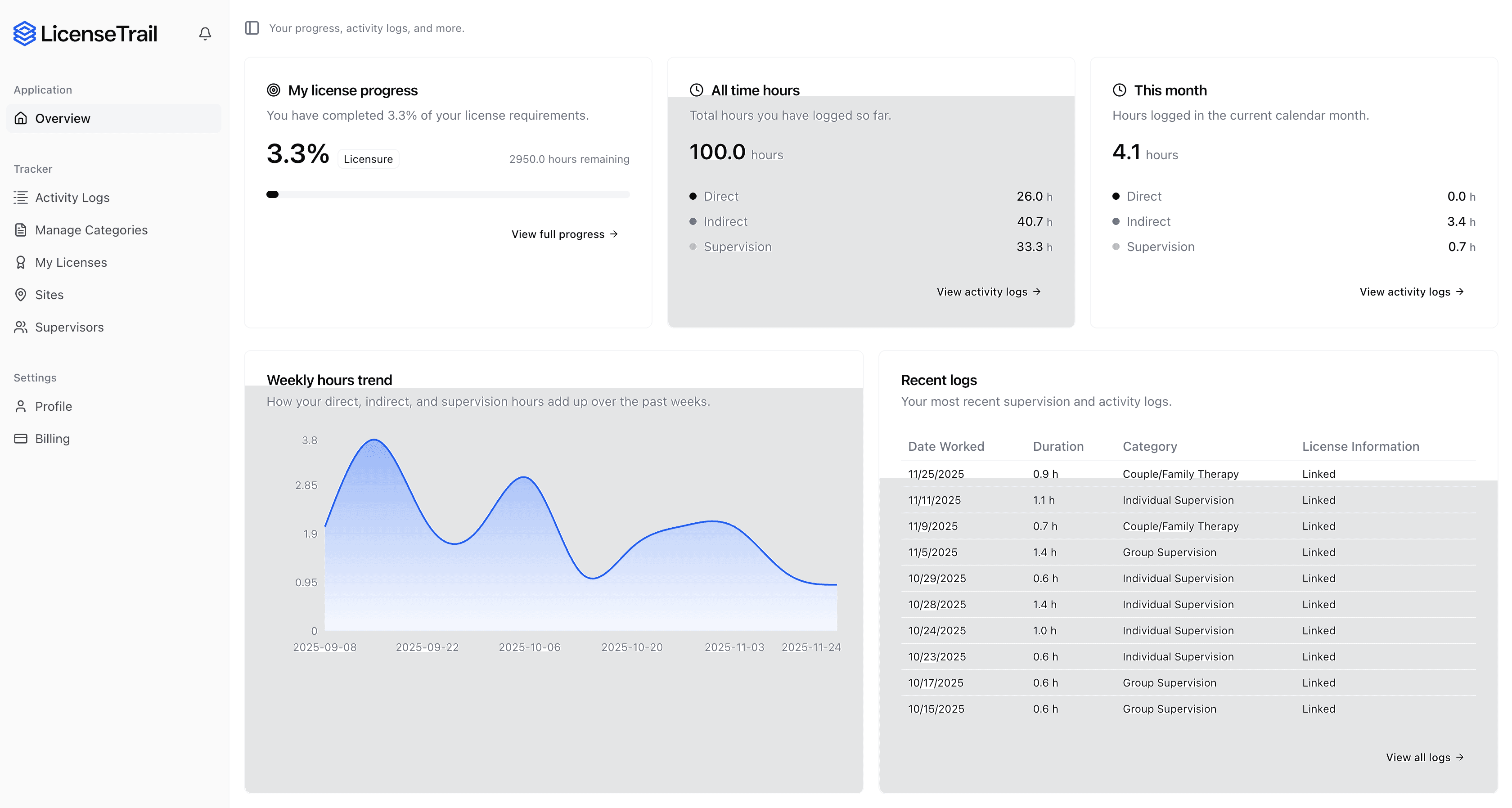
Track your Psychologist License by Reciprocity hours with confidence
License Trail checks your direct, indirect, and supervision hours against Delaware Psychologist License by Reciprocity requirements continuously and flags mismatches before you submit.
 Start Tracking for Free
No credit card required · Free plan available
Is your spreadsheet hiding Delaware Psychologist License by Reciprocity risks?
Stop guessing if your categories match Delaware Board of Examiners of Psychologists requirements. License Trail checks your direct, indirect, and supervision hours continuously and flags mismatches before you submit.
Import or log
Bring your spreadsheet or start fresh
Upload your existing tracking spreadsheet and we'll map every hour into the right Delaware Board of Examiners of Psychologists categories automatically.
Verify against Delaware
Catch mismatches before the board does
License Trail checks your direct, indirect, and supervision hours against Delaware Psychologist License by Reciprocity requirements continuously.
Export board-ready
One-click clean reports
Generate professional, board-ready reports for supervision meetings and Delaware Board of Examiners of Psychologists submissions in seconds.
No credit card required · Free plan available