
Florida PY Requirements: Hours, Exams & Step-by-Step Guide
Stop guessing if your categories match Florida requirements. License Trail checks your direct, indirect, and supervision hours against PY requirements continuously and flags mismatches before you submit.
No credit card required · Free plan available
Quick Requirements Overview
- Doctoral education: Ph.D./Psy.D./Ed.D. in psychology from an APA-accredited program; foreign grads need credentials eval + APA comparability letter.
- Total supervised experience: 4,000 hours / 2 years under supervision of a licensed psychologist (no independent private practice without on-site psychologist services).
- Internship: 2,000 hours satisfied by a qualifying doctoral psychology internship.
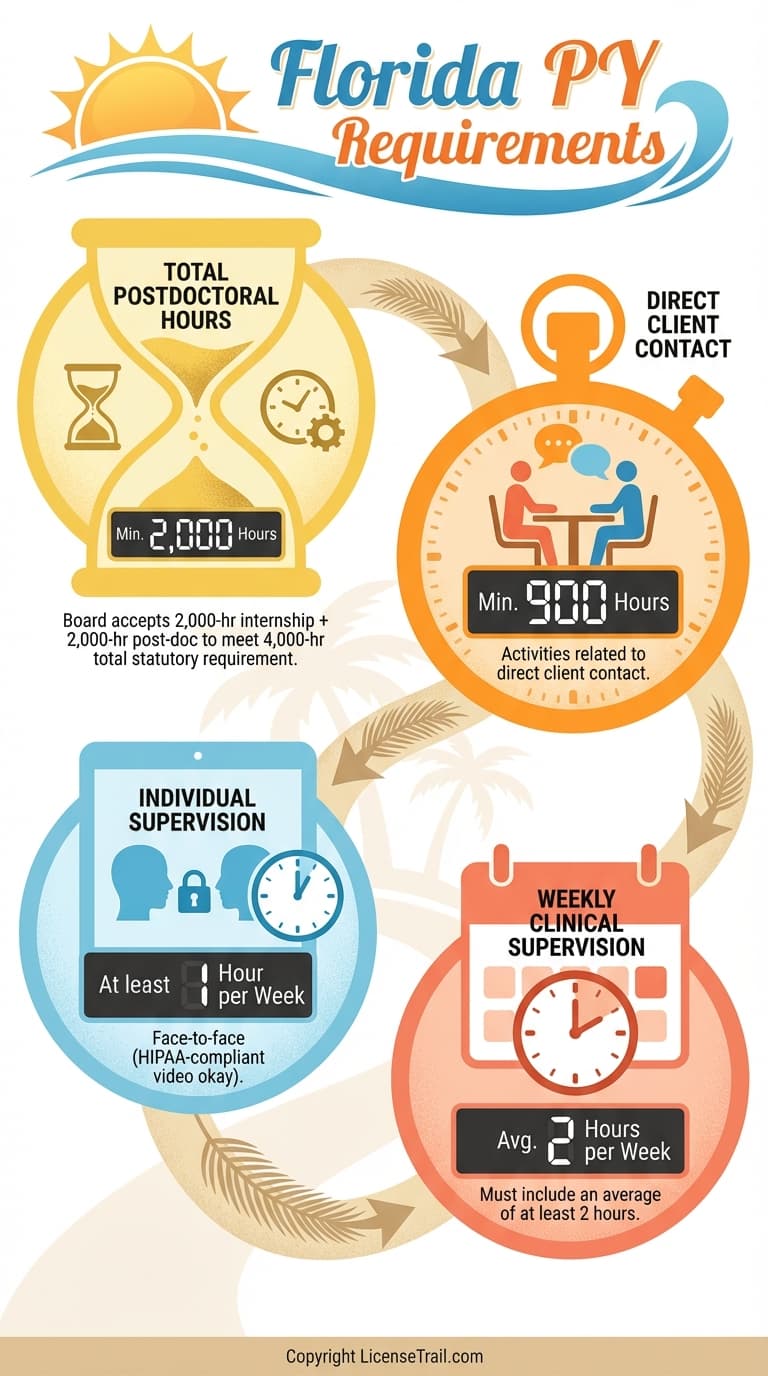
- Postdoc: Remaining 2,000 hours per Rule 64B19-11.005; completed as 40 hrs/wk for 1 year or 20 hrs/wk for 2 years.
- Direct client contact (postdoc): ≥900 hours in activities related to direct client contact; asynchronous tech cannot count toward these hours.
- Supervision (postdoc): Avg ≥2 hrs/week clinical supervision, including ≥1 hr/week individual face-to-face (in person or HIPAA-compliant video).
- Exams: Pass EPPP + Florida Laws & Rules exam (Ch. 456/490, Rule 64B19).
- Admin: Submit application/docs/fees + complete electronic fingerprinting/background screening before approval.
License Details
Procedures
In Florida, the standard psychologist license (license prefix “PY”) is issued by the Florida Board of Psychology under Chapter 490, Florida Statutes. To qualify, an applicant must satisfy detailed requirements in three broad areas: education, supervised experience (internship + postdoctoral), and examinations, along with background screening and an application review.
Below is a step‑by‑step guide that tracks the Board’s own wording and structure, with special attention to exact hour requirements and how they are defined.
1. Confirm the license type: PY Psychologist
The PY license is the full, independent practice license for psychologists in Florida. It is typically obtained:
- By Examination – for applicants whose education and supervised experience are complete at the time of application. (floridaspsychology.gov)
- Other routes (endorsement, “mobile endorsement,” limited license, etc.) exist, but the underlying education and experience benchmarks are anchored in the same statute and rule set.
The guide below focuses on the Licensure by Examination path, which is the standard route into a PY license.
2. Educational requirement
2.1 U.S.-trained applicants
Florida requires a doctoral degree in psychology (Ph.D., Psy.D. or Ed.D.) from a program accredited by the American Psychological Association (APA), which is presently the only “programmatic” accrediting agency approved by the U.S. Department of Education for doctoral psychology programs. (floridaspsychology.gov)
In Board language, you must submit:
- An official doctoral-level transcript in psychology showing graduation from an APA‑accredited program. (floridaspsychology.gov)
2.2 Internationally educated applicants
If your degree is from outside the U.S.:
- You must provide a credentials evaluation report showing that you hold a doctoral degree in psychology from an institution recognized by that country’s government and documenting pre‑doctoral internship equivalence.
- You must provide a “Letter of APA Comparability” from a director of an APA‑accredited doctoral psychology program stating that your program is equivalent to an APA‑accredited program and listing the documents reviewed. (floridaspsychology.gov)
These are the education prerequisites. Meeting them places you in the pool of applicants eligible to count supervised experience hours toward licensure.
3. Supervised experience requirement: total hours and structure
3.1 Statutory baseline: 4,000 hours of supervised experience
Chapter 490.005(1)(c), Florida Statutes, requires that the applicant has completed “at least 2 years or 4,000 hours of experience in the field of psychology in association with or under the supervision of a licensed psychologist.” (flsenate.gov)
The statute allows this experience to be on or off the supervisor’s premises, but it may not take the form of independent private practice without a psychologist actually providing services at the site. (flsenate.gov)
3.2 How the Board counts those 4,000 hours
The Board operationalizes the statutory requirement this way:
- Total required experience: “A total of 4000 hours of supervised experience.”
- Internship portion: The Board “accepts the doctoral level psychology internship in satisfaction of the first 2000 hours of the required experience.”
- Postdoctoral portion: Applicants “must complete the remaining 2000 hours as post‑doctoral supervised experience” in accordance with Rule 64B19‑11.005, Florida Administrative Code. (floridaspsychology.gov)
In other words, Florida does not split the requirement into something like “X hours direct” + “Y hours supervised non‑direct” at the global level. Instead, it requires:
- 4,000 hours of supervised experience total, composed of:
- 2,000 hours in a qualifying doctoral psychology internship, plus
- 2,000 hours of postdoctoral supervised experience that must meet detailed structural criteria, including minimum direct client contact and weekly supervision.
4. Detailed postdoctoral hour requirements (Rule 64B19‑11.005)
Rule 64B19‑11.005, F.A.C., is the core supervision rule for the postdoctoral year. As of its most recent amendment (effective October 31, 2024), it states that:
- The law requires “2 years or 4,000 hours of supervised experience” for licensure by examination. The internship counts for 1 year/2,000 hours; the rule “concerns the remaining 1 year or 2,000 hours.” (flrules.elaws.us)
The rule then defines what those 2,000 postdoctoral hours must look like.
4.1 Training status and titles
Within this rule:
- A “psychology resident or post‑doctoral fellow” is defined as a person who has met Florida’s educational requirements and is using this experience to satisfy the post‑internship supervised hours. (law.cornell.edu)
- All applicants for licensure must use the title “psychology resident” or “post‑doctoral fellow” until licensed as a psychologist. (law.cornell.edu)
- The resident/fellow must inform all service users of their supervised status and must provide the name of the supervising psychologist. Consultation reports and summaries must be co‑signed by the supervising psychologist (progress notes may be co‑signed at the supervisor’s discretion). (law.cornell.edu)
4.2 Required structure of the 2,000 postdoctoral hours
Rule 64B19‑11.005(2)(c) provides a specific structure for the postdoctoral year: (flrules.elaws.us)
-
Overall time pattern
- The postdoctoral training must average at least 20 hours per week for two years (part‑time)
or - 40 hours per week for one year (full‑time).
This is how the 2,000 hours must be distributed in practice.
- The postdoctoral training must average at least 20 hours per week for two years (part‑time)
-
Direct client contact requirement
- The rule requires “at least 900 hours in activities related to direct client contact.”
These 900 hours are a subset of the 2,000 postdoctoral hours and must involve direct psychological services (assessment, psychotherapy, etc.) delivered to clients, not just documentation, training, or administrative tasks.
-
Weekly clinical supervision requirement
- The rule requires an average of at least two (2) hours of clinical supervision each week, broken down as:
- At least one (1) hour of individual, face‑to‑face supervision, which may be conducted via HIPAA‑compliant video.
- The remaining one hour may consist of additional individual supervision, group supervision, or case presentations, and may also be conducted via HIPAA‑compliant video.
- The rule requires an average of at least two (2) hours of clinical supervision each week, broken down as:
-
Use of telecommunication technology
- A resident/fellow may complete postdoctoral requirements through synchronous or asynchronous telecommunications technology if done under the authority and supervision of a qualified supervisor under this rule.
- However, the rule explicitly provides that asynchronous telecommunications technology may not be used for accumulating the 900 hours of direct client contact; direct hours must involve real‑time clinical contact. (flrules.elaws.us)
4.3 Supervisory relationship and responsibilities
The rule also defines supervisor and sets out strict conditions: (law.cornell.edu)
- A supervisor must be:
- A Florida licensed psychologist in good standing, or
- A doctoral‑level psychologist licensed and in good standing in another U.S. state/territory or in Canada, when appropriate (with additional provisions for armed services, VA, federal prisons, and telehealth/E‑Passport scenarios).
- There must be no conflict of interest and no other relationship between supervisor and resident beyond the supervisory association.
- The supervisor must:
- Enter into a written agreement describing the applicant’s obligations/remuneration and the supervisor’s responsibilities.
- Maintain professional responsibility for the resident’s work.
- Provide and certify that the required supervision was delivered (2 hours per week; at least 1 hour individual).
- Inform the Board if there are complaints or concerns regarding the resident’s ethics, professionalism, or qualifications.
An applicant may have multiple supervisors at multiple sites, but each supervisor must provide supervision in a manner consistent with the rule.
5. Internship hours: how they fit into Florida’s scheme
Florida’s Board treats a qualifying doctoral-level psychology internship as automatically satisfying the first 2,000 of the 4,000 required supervised hours. (floridaspsychology.gov)
Key points:
- The internship must be at the doctoral level in psychology and meet the Board’s training standards (organized training program, appropriate supervision, range of clinical activities, etc.). Those criteria are embedded in the Board’s licensure rules and in the APA accreditation standards the Board relies on.
- The Board does not separately re‑specify internship “direct” vs “indirect” contact hour minimums on its general licensure pages; instead, it assumes that a compliant internship is a cohesive, supervised training experience of 2,000 hours that meets APA/Board standards.
Functionally:
- Internship = 2,000 supervised hours (year 1)
- Postdoctoral residency/fellowship = 2,000 supervised hours (year 2), including at least 900 direct client contact hours and specific weekly supervision
Together, these make up the statutory “2 years or 4,000 hours” of supervised experience under a licensed psychologist or equivalent. (flsenate.gov)
6. Examinations
Florida requires both a national exam and a state‑specific laws and rules exam:
-
EPPP (Examination for Professional Practice in Psychology)
- Administered by the Association of State and Provincial Psychology Boards (ASPPB).
- Applicants must obtain a passing score acceptable to Florida. (floridaspsychology.gov)
-
Florida Laws and Rules Examination
- A separate exam focused on:
- Chapter 456, F.S. (Health Professions and Occupations: General Provisions),
- Chapter 490, F.S. (Psychological Services), and
- Rule Chapter 64B19, F.A.C. (Board of Psychology rules). (floridaspsychology.gov)
- A separate exam focused on:
For Licensure by Examination, both exams must be passed before full licensure is granted. “Examination with Waiver” is available if you have already passed the EPPP with a score acceptable to Florida and are only taking the Florida laws and rules exam. (floridaspsychology.gov)
7. Application, fingerprinting, and fees
7.1 Application process
For licensure by examination (U.S.-trained), the Board’s process generally requires: (floridaspsychology.gov)
- Completed application form for Psychologist Licensure by Examination
- Application and initial licensure fees
- Official transcripts sent directly from the school or approved clearinghouse
- Documentation of internship and postdoctoral supervised experience (Board forms for internship/postdoc verification)
- Passing EPPP and Florida Laws & Rules exam scores
7.2 Fingerprinting and background screening
Following 2024 legislation (House Bill 975), Florida requires electronic fingerprinting/background screening for psychology licensure. The Board specifies that “Your application cannot be approved until this requirement, along with all other licensure criteria, has been met.” (floridaspsychology.gov)
7.3 Fees (as shown on current Board pages)
Current fees for a psychologist application by examination are typically listed as: (floridaspsychology.gov)
- Application fee: non‑refundable
- Initial licensure fee
- Unlicensed activity fee
(Exact dollar amounts can be checked on the Board’s site, as they may be adjusted by rule over time.)
8. Summary of Florida’s hour requirements in practical terms
Putting it all together for a PY psychologist license in Florida:
-
Education
- Doctoral degree in psychology (Ph.D./Psy.D./Ed.D.) from an APA‑accredited program (or foreign program demonstrated to be APA‑comparable). (floridaspsychology.gov)
-
Supervised experience – total
- 4,000 hours of supervised experience in psychology, equivalent to 2 full‑time years, in association with or under supervision of a licensed psychologist. (flsenate.gov)
-
Breakdown of those 4,000 hours
- 2,000 hours satisfied by a qualifying doctoral‑level psychology internship.
- 2,000 hours of postdoctoral supervised experience, which must:
- Average 40 hrs/week for 1 year or 20 hrs/week for 2 years,
- Include at least 900 hours in activities related to direct client contact,
- Include an average of at least 2 hours of clinical supervision each week, with:
- ≥1 hour/week being individual face‑to‑face supervision (in person or HIPAA‑compliant video), and
- The remaining supervision in additional individual, group, or case‑presentation formats, in person or via secure video,
- Be conducted under a qualified psychologist supervisor with no conflicting relationships, documented in a written supervision agreement. (flrules.elaws.us)
-
Exams
- Pass the EPPP (national examination).
- Pass the Florida Laws and Rules Examination. (floridaspsychology.gov)
-
Administrative steps
- Submit a complete application with fees and supporting documents.
- Complete electronic fingerprinting/background screening before approval. (floridaspsychology.gov)
Florida’s structure is thus: 4,000 total supervised hours, fully supervised, with 900 of the postdoctoral hours explicitly defined as direct client contact and tightly specified weekly supervision, rather than a simple “X direct + Y supervised” split.
Track your PY hours with confidence
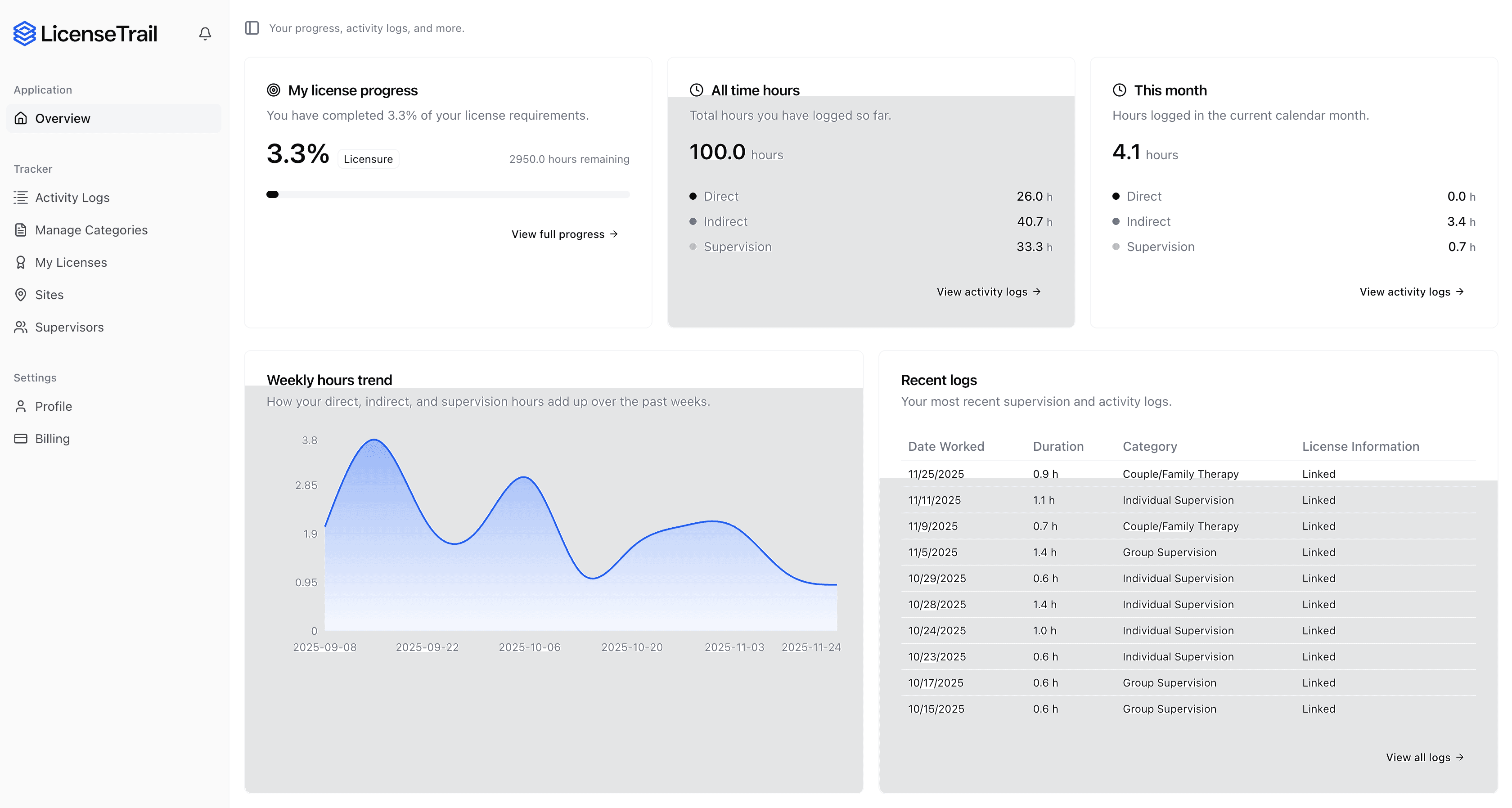
License Trail checks your direct, indirect, and supervision hours against Florida PY requirements continuously and flags mismatches before you submit.
 Start Tracking for Free
No credit card required · Free plan available
Related Licenses
Is your spreadsheet hiding Florida PY risks?
Stop guessing if your categories match Florida Board of Psychology requirements. License Trail checks your direct, indirect, and supervision hours continuously and flags mismatches before you submit.
Import or log
Bring your spreadsheet or start fresh
Upload your existing tracking spreadsheet and we'll map every hour into the right Florida Board of Psychology categories automatically.
Verify against Florida
Catch mismatches before the board does
License Trail checks your direct, indirect, and supervision hours against Florida PY requirements continuously.
Export board-ready
One-click clean reports
Generate professional, board-ready reports for supervision meetings and Florida Board of Psychology submissions in seconds.
No credit card required · Free plan available