
Hawaii LCSW Requirements: Hours, Exams & Step-by-Step Guide
Stop guessing if your categories match Hawaii requirements. License Trail checks your direct, indirect, and supervision hours against LCSW requirements continuously and flags mismatches before you submit.
No credit card required · Free plan available
Quick Requirements Overview
- Authority: HI DCCA PVL (Social Worker Program); governed by HRS Ch. 467E
- Education: CSWE-accredited (or equivalent) MSW or regionally accredited DSW/PhD in Social Work
- Exam: Pass ASWB Clinical (official score transfer sent directly to DCCA)
- Experience: 3,000 hours post-degree supervised clinical SW in an agency setting, completed in 2–5 years
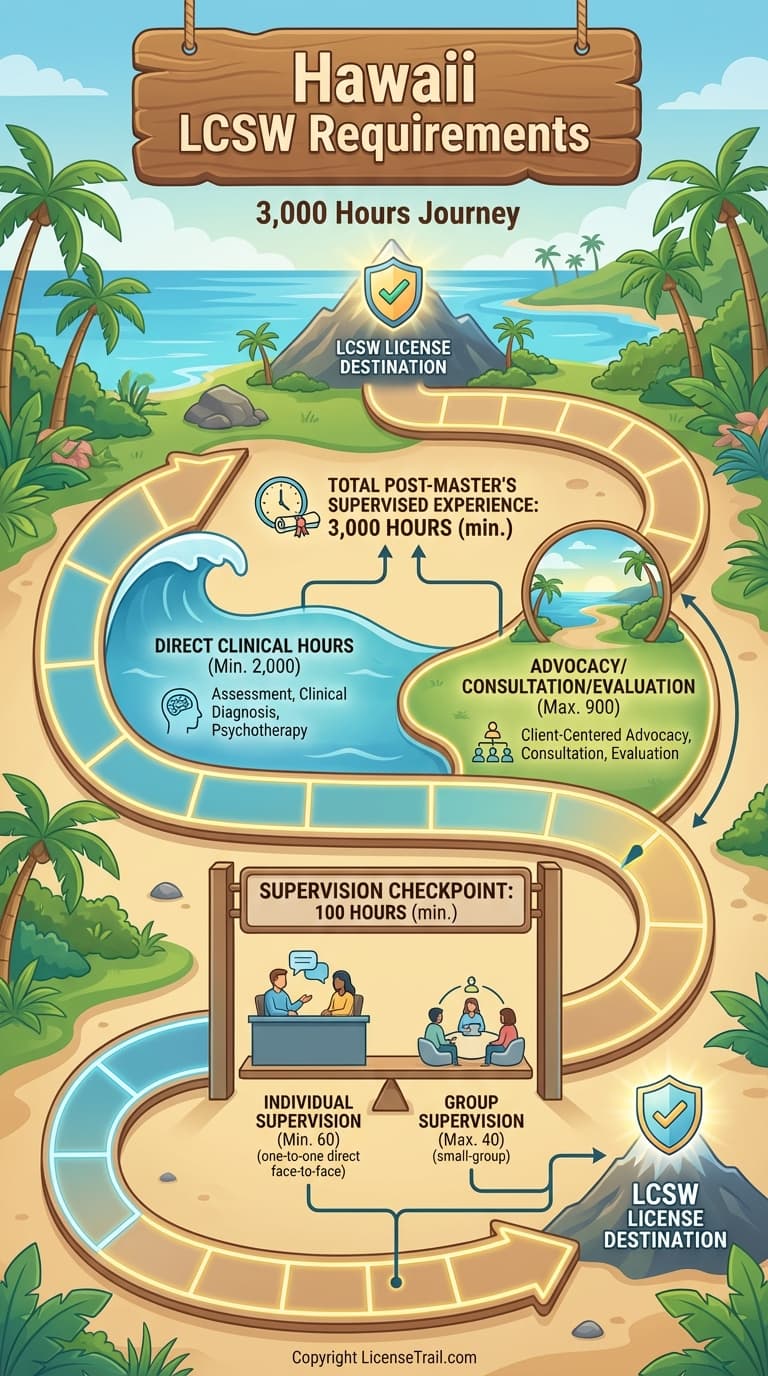
- Hour breakdown: ≥2,000 hrs assessment/clinical diagnosis/psychotherapy; ≤900 hrs client-centered advocacy/consultation/evaluation; ≥100 hrs supervision (within the 3,000)
- Supervision structure: ≥60 hrs individual face-to-face; ≤40 hrs small-group (max 6 supervisees); may be HIPAA-compliant video
- Supervisor qualifies: Must be HI LCSW with ≥4,500 post-MSW clinical hours (verified/notarized on DCCA form)
- Alt pathway: Experience requirement may be deemed met with NASW QCSW/DCSW or ABE BCD (primary-source verification sent to DCCA)
License Details
Procedures
Licensure as a Licensed Clinical Social Worker (LCSW) in Hawaiʻi is administered by the Department of Commerce and Consumer Affairs (DCCA), Professional & Vocational Licensing Division – Social Worker Program. The controlling requirements are in Hawaiʻi Revised Statutes (HRS) Chapter 467E and the DCCA “Requirements & Instructions – Licensed Clinical Social Worker Application (LCSW)” packet. (cca.hawaii.gov)
Below is a step‑by‑step guide with the exact hour types and structure required.
1. License type and authority
Hawaiʻi recognizes three social work licenses:
- Licensed Bachelor Social Worker (LBSW)
- Licensed Social Worker (LSW)
- Licensed Clinical Social Worker (LCSW) (cca.hawaii.gov)
The LCSW is the independent clinical license. You do not have to hold an LSW first, but you must meet the specific education, examination, and supervised clinical experience requirements below. (law.justia.com)
2. Education requirement
To qualify for LCSW, Hawaiʻi requires that you:
- Hold either
- a master’s degree in social work from a program accredited (or deemed equivalent) by the Council on Social Work Education (CSWE), or
- a doctoral degree in social work from a program accredited by the Western Association of Schools and Colleges or another comparable regional accreditor. (law.justia.com)
This is identical to the educational requirement for the LSW level; the difference at the LCSW level is the clinical exam plus post‑graduate clinical experience.
3. National exam requirement
You must pass the Association of Social Work Boards (ASWB) Clinical examination (or the historical “Level C” clinical exam taken before 1990). (law.justia.com)
- If you already passed the ASWB Clinical exam for another jurisdiction, you must arrange for ASWB to send an official score transfer directly to DCCA; copies from you are not accepted. (cca.hawaii.gov)
4. Post‑graduate supervised clinical experience
4.1 Total hours and time frame
Hawaiʻi law and the DCCA application both require at least 3,000 hours of post‑master’s supervised clinical social work experience:
- The experience must be post‑graduate (after the MSW or qualifying doctoral degree). (law.justia.com)
- It must be completed in no fewer than 2 years and no more than 5 years. (law.justia.com)
- The DCCA application specifies that the 3,000 hours must be in “an agency setting.” (cca.hawaii.gov)
The 3,000 hours are not all treated the same; Hawaiʻi breaks them into specific categories of work and supervision.
4.2 Required breakdown of the 3,000 hours
HRS §467E‑7(3)(C) and the DCCA LCSW application require that your 3,000 post‑graduate clinical hours include all of the following: (law.justia.com)
-
At least 2,000 hours of:
- “assessment, clinical diagnosis, and psychotherapy.”
These are your core, direct clinical practice hours—face‑to‑face clinical work where you are assessing clients, formulating clinical diagnoses, and providing psychotherapy.
- “assessment, clinical diagnosis, and psychotherapy.”
-
No more than 900 hours of:
- “client-centered advocacy, consultation, and evaluation.”
These are related but more indirect clinical services (e.g., collateral contacts, case consultation, advocacy directly tied to a client’s treatment, outcomes evaluation). You can have fewer than 900 hours in this category; you simply cannot exceed 900 of the 3,000 hours here.
- “client-centered advocacy, consultation, and evaluation.”
-
At least 100 hours of supervision:
- These are hours spent in formal supervision with your clinical supervisor, not additional client contact hours.
- Statute and the application require “at least 100 hours of [direct] face‑to‑face supervision” within the 3,000 hours. (law.justia.com)
In practical terms, Hawaiʻi’s structure looks like this:
- 3,000 total post‑graduate supervised clinical hours, all in an agency setting
- ≥ 2,000 hours: direct clinical practice (assessment, diagnosis, psychotherapy)
- ≤ 900 hours: client‑centered advocacy/consultation/evaluation
- ≥ 100 hours: supervision with your qualified supervisor (counted within that 3,000)
The Verification of Supervised Clinical Social Work Experience form that your supervisor completes mirrors this breakdown: they must attest separately to the number of hours in each category and certify you had no more than 900 hours of client‑centered advocacy/consultation/evaluation and the required supervision. (cca.hawaii.gov)
5. Supervision hour structure and tele‑supervision
5.1 How the 100 supervision hours must be structured
State law specifies how the minimum 100 supervision hours must be composed: (law.justia.com)
- At least 60 hours must be individual, direct face‑to‑face supervision (one‑on‑one with your supervisor).
- Up to 40 hours may be small‑group supervision, with no more than six supervisees in the group.
The NASW Hawaiʻi summary restates this succinctly: MSW graduates must complete 3,000 supervised clinical hours post‑MSW, including 100 hours of supervision (60 individual, 40 group) under a qualified LCSW supervisor, within the required 2–5 year window. (naswhi.socialworkers.org)
5.2 Who can supervise (qualifications of the supervisor)
For your hours to count toward LCSW licensure, your supervisor must meet the statutory requirements: (law.justia.com)
- The supervisor must be a licensed clinical social worker (LCSW), and
- Must have at least 4,500 hours of post‑master’s clinical social work experience.
Older provisions allowed non‑LCSW supervisors (e.g., certain psychiatrists, psychologists, or MSWs with 4,500 clinical hours) for the first five years after July 1, 2004 only; this transition period has long since expired and does not apply to current applicants. (law.justia.com)
The verification form requires the supervisor to certify they personally have at least 4,500 hours of post‑master’s clinical social work experience. (cca.hawaii.gov)
5.3 Tele‑supervision
A 2016 amendment to HRS §467E‑7 explicitly allows some or all supervision to occur by secure videoconference: (law.justia.com)
- Supervision may be conducted face‑to‑face in person or through a HIPAA‑compliant video conference service, as long as it meets all federal and state privacy and confidentiality laws.
- The law cautions that applicants should check other states’ rules, because relying heavily on electronic supervision could affect future licensure by endorsement elsewhere. (law.justia.com)
NASW Hawaiʻi echoes this, noting that supervision can be provided via tele‑supervision and that the supervision form must be notarized. (naswhi.socialworkers.org)
6. Alternative way to satisfy the experience requirement (national clinical credentials)
Instead of documenting 3,000 hours and 100 supervision hours directly, Hawaiʻi allows certain national clinical credentials to substitute for the supervised experience requirement:
If you hold one of the following and arrange for official primary‑source verification to be sent directly to DCCA, you are “deemed to have satisfied” the LCSW experience requirement: (law.justia.com)
- Qualified Clinical Social Worker (QCSW) or Diplomate in Clinical Social Work (DCSW) issued by the National Association of Social Workers (NASW), or
- Board Certified Diplomate (BCD) issued by the American Board of Examiners in Clinical Social Work (ABE).
If you pursue this route, DCCA must receive an official letter directly from NASW or ABE; copies or certificates you send yourself are not accepted. (cca.hawaii.gov)
7. Step‑by‑step application process with DCCA
Once you’ve met education, exam, and experience requirements, the formal licensure process with the Hawaiʻi DCCA Social Worker Program typically looks like this: (cca.hawaii.gov)
-
Obtain and complete the LCSW application packet
- Download the “Requirements & Instructions – Licensed Clinical Social Worker Application (LCSW)” from the DCCA Social Worker Program site under “Application Forms & Publications – Licensed Clinical Social Worker.” (cca.hawaii.gov)
-
Arrange for official transcripts
- Have your school’s Registrar send an official transcript directly to DCCA showing the degree, major (social work), and date conferred. (cca.hawaii.gov)
-
Arrange exam verification
- If you have already passed the ASWB Clinical exam, instruct ASWB to send an official score transfer directly to the Hawaiʻi board via ASWB’s score transfer process. (cca.hawaii.gov)
- If you have not yet taken the exam, you apply to DCCA to be authorized, then register with ASWB/Pearson VUE once you receive your eligibility letter. (cca.hawaii.gov)
-
Document supervised clinical experience
- Have your supervisor complete the “Verification of Supervised Clinical Social Work Experience” form, detailing:
- total hours of psychotherapy, assessment, and clinical diagnosis;
- total hours of client‑centered advocacy, consultation, and evaluation (with an explicit note that this cannot exceed 900);
- total hours of direct face‑to‑face (and, if applicable, tele‑) supervision;
- the number of supervisees in any group supervision;
- their own license type and number; and
- certification that they possess at least 4,500 hours of post‑master’s clinical social work experience. (cca.hawaii.gov)
- The supervisor must sign this form in the presence of a notary public; the notarized original is submitted with your application. (cca.hawaii.gov)
- Have your supervisor complete the “Verification of Supervised Clinical Social Work Experience” form, detailing:
-
Submit the application and fees
- File the completed application (online via MyPVL or by mail/in‑person, depending on current DCCA options), with the required non‑refundable application fee and initial licensing fees corresponding to the current license triennium. (cca.hawaii.gov)
- Fee amounts and breakdowns are listed in the current LCSW application packet; they vary depending on which year of the 3‑year cycle you apply in.
-
Respond to any additional information requests
- If you have any criminal convictions or disciplinary actions in any jurisdiction, DCCA requires detailed court documents and explanatory statements; these are spelled out in the application instructions. (cca.hawaii.gov)
-
License issuance
- Once all requirements are met (education, exam, supervised experience or qualifying credential, fees, and any background documentation), the DCCA Social Worker Program issues your Hawaiʻi LCSW license under HRS Chapter 467E. (cca.hawaii.gov)
8. After you’re licensed: renewal and continuing education (briefly)
For completeness, once you are licensed as an LCSW:
- License term: All social worker licenses (LBSW, LSW, LCSW) are renewed on a triennial cycle, with renewal by June 30 of each renewal year (e.g., 2025, 2028, 2031). (cca.hawaii.gov)
- Continuing education: Active LCSWs must complete at least 45 hours of CE every 3 years, including 3 hours in ethics, using courses approved by NASW or ASWB. (cca.hawaii.gov)
Failure to renew on time results in license forfeiture, and practice without an active license is prohibited.
Summary of the key hour requirements for Hawaiʻi LCSW
To become a Hawaiʻi LCSW under the DCCA Social Worker Licensing Program, you must complete:
- 3,000 hours of post‑graduate, supervised clinical social work experience in an agency setting, over 2–5 years, including: (law.justia.com)
- At least 2,000 hours of assessment, clinical diagnosis, and psychotherapy;
- No more than 900 hours of client-centered advocacy, consultation, and evaluation; and
- At least 100 hours of supervision, of which
- ≥ 60 hours must be individual, direct face‑to‑face supervision, and
- ≤ 40 hours may be small‑group supervision (up to six supervisees), which may be in person or via HIPAA‑compliant video.
Along with the required MSW/DSW, ASWB Clinical exam, and a properly qualified supervisor (LCSW with ≥4,500 post‑master’s clinical hours), meeting this structured 3,000‑hour requirement is the core experiential prerequisite to Hawaiʻi LCSW licensure. (law.justia.com)
Track your LCSW hours with confidence
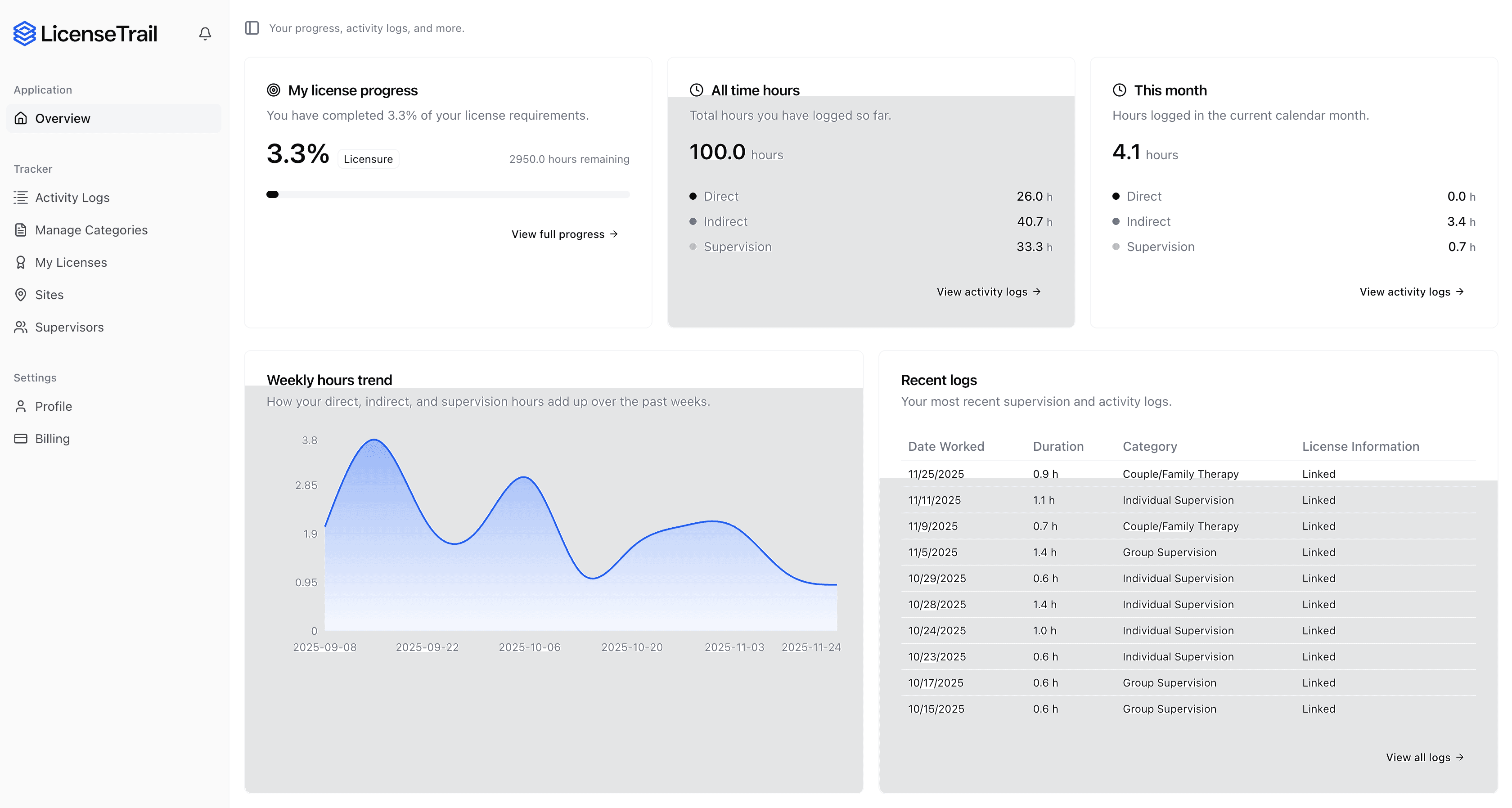
License Trail checks your direct, indirect, and supervision hours against Hawaii LCSW requirements continuously and flags mismatches before you submit.
 Start Tracking for Free
No credit card required · Free plan available
Is your spreadsheet hiding Hawaii LCSW risks?
Stop guessing if your categories match Hawaii Department of Commerce and Consumer Affairs (Social Worker Licensing Program) requirements. License Trail checks your direct, indirect, and supervision hours continuously and flags mismatches before you submit.
Import or log
Bring your spreadsheet or start fresh
Upload your existing tracking spreadsheet and we'll map every hour into the right Hawaii Department of Commerce and Consumer Affairs (Social Worker Licensing Program) categories automatically.
Verify against Hawaii
Catch mismatches before the board does
License Trail checks your direct, indirect, and supervision hours against Hawaii LCSW requirements continuously.
Export board-ready
One-click clean reports
Generate professional, board-ready reports for supervision meetings and Hawaii Department of Commerce and Consumer Affairs (Social Worker Licensing Program) submissions in seconds.
No credit card required · Free plan available