
Hawaii LMFT Requirements: Hours, Exams & Step-by-Step Guide
Stop guessing if your categories match Hawaii requirements. License Trail checks your direct, indirect, and supervision hours against LMFT requirements continuously and flags mismatches before you submit.
No credit card required · Free plan available
Quick Requirements Overview
- Regulator: HI DCCA/PVL (Marriage & Family Therapist Licensing Program); authority: HRS Ch. 451J
- Degree: Master’s or doctoral in MFT or allied mental health field (accredited)
- Coursework: 33 semester / 44 quarter hours total (MFT studies 9/12; MFT therapy 9/12; human development 9/12; ethics 3/4; research 3/4) + Training Outline (MFT-03)
- Practicum: 1-year practicum within graduate program with 300+ supervised client contact hours (verify via MFT-04)
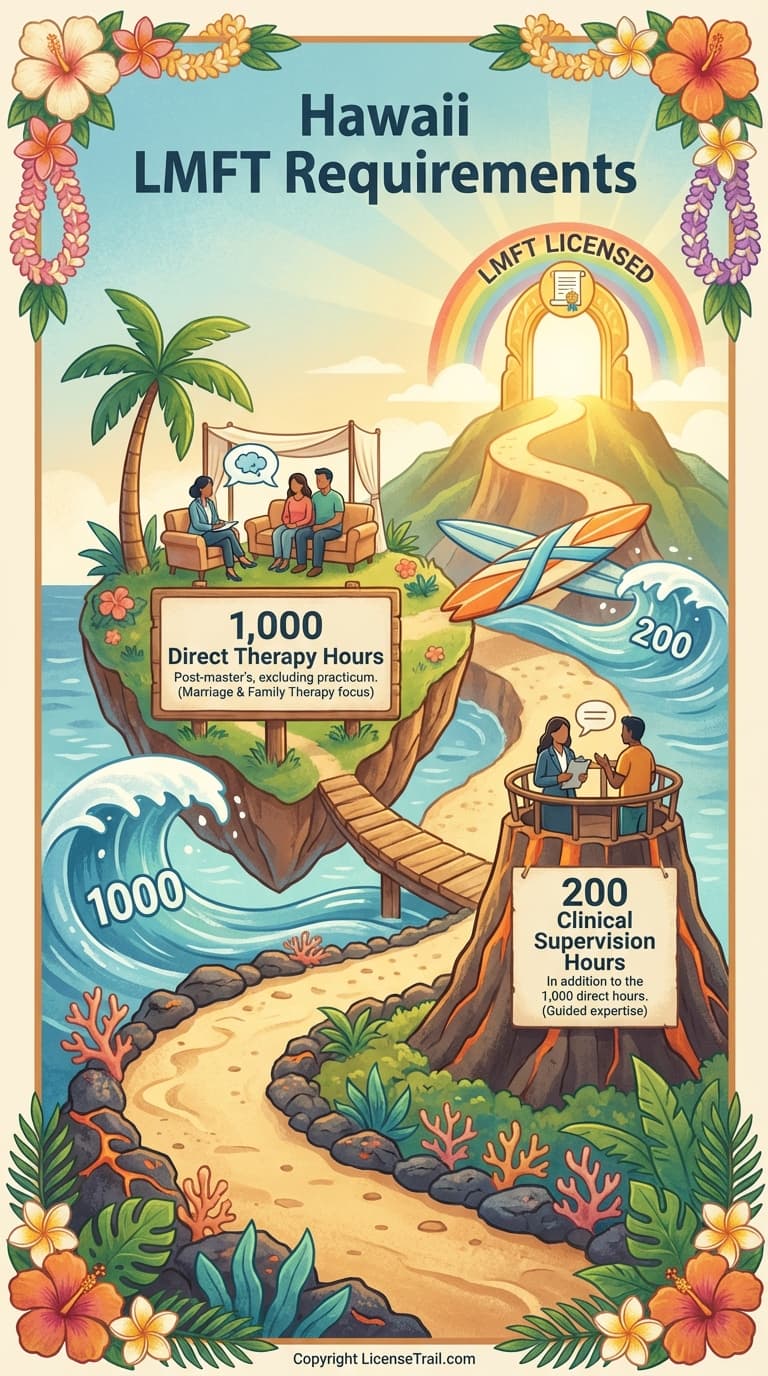
- Post-degree hours: 1,000 hours direct marriage & family therapy + 200 hours clinical supervision, completed in not less than 24 months (verify via MFT-05)
- Supervisor: LMFT in good standing (licensed ≥2 years) OR other licensed MH professional + AAMFT clinical member in good standing (≥2 years); supervision up to 6 supervisees
- Exam: Pass National Marital & Family Therapy Examination (state approval required to register; score transfer accepted)
- Alternate pathway: AAMFT Clinical Fellow deemed to meet education/practicum/post-master’s experience (exam + fees still required)
License Details
Procedures
Licensure for marriage and family therapists in Hawaii is regulated by the Department of Commerce and Consumer Affairs (DCCA), Professional & Vocational Licensing Division (PVL), under the Marriage and Family Therapist Licensing Program. The legal standards come primarily from Hawaii Revised Statutes (HRS) Chapter 451J and the DCCA’s official “Requirements & Instructions – Marriage and Family Therapist License” packet and forms. (cca.hawaii.gov)
Below is a structured guide focused on the specific hours and terminology the State uses.
1. Basic pathway to a Hawaii LMFT
To become a licensed marriage and family therapist (LMFT) in Hawaii you must:
- Complete an approved master’s or doctoral degree with specific coursework.
- Complete a one‑year practicum with at least 300 supervised client contact hours.
- After the degree, complete 1,000 hours of direct marriage and family therapy plus 200 hours of clinical supervision, over not less than 24 months.
- Pass the National Marriage and Family Therapy Examination.
- Apply to DCCA/PVL with the required forms, documentation, and fees. (cca.hawaii.gov)
The sections below unpack what each of those requirements means in the State’s own terms.
2. Educational requirements
Degree
You must have a master’s or doctoral degree from an accredited institution in:
- Marriage and family therapy, or
- An allied field related to the practice of mental health counseling,
and the degree must include or be supplemented by specific graduate‑level coursework. (cca.hawaii.gov)
Required coursework (Hawaii’s wording & numbers)
Both the statute and the DCCA application packet require a minimum of 33 semester hours or 44 quarter hours in these areas: (cca.hawaii.gov)
- Marriage and family studies – at least 9 semester / 12 quarter hours
- Marriage and family therapy studies – at least 9 semester / 12 quarter hours
- Human development – at least 9 semester / 12 quarter hours
- Ethical and professional studies – at least 3 semester / 4 quarter hours
- Research – at least 3 semester / 4 quarter hours
The DCCA requires a “Training Outline” (Form MFT‑03) listing courses in each category, and those courses must appear on your official graduate transcript. (cca.hawaii.gov)
3. Practicum requirement (pre‑degree clinical hours)
Hawaii distinguishes practicum hours (completed within the degree) from post‑master’s experience hours.
Required practicum hours
The law and DCCA packet both require: (cca.hawaii.gov)
- A one‑year practicum within the master’s or doctoral program,
- Including at least 300 hours of supervised client contact.
On the Practicum Verification Form (MFT‑04), the Board restates the requirement as:
“One year practicum within the graduate program, with at least 300 supervised client contact hours.”
The supervisor must verify these hours and complete Form MFT‑04, which you submit with your application. (cca.hawaii.gov)
Type of practicum hours:
The State’s phrase is “supervised client contact hours.” These are hours when you are providing clinical services to clients as part of your graduate practicum, under supervision, not just observing.
All practicum requirements must be completed before you file your licensure application. (cca.hawaii.gov)
4. Post‑master’s supervised clinical experience
This is where Hawaii specifies detailed hour requirements and clearly distinguishes direct therapy from supervision.
Statutory requirement (HRS §451J‑7)
The statute states that, in addition to the education and practicum, an applicant must: (law.justia.com)
- “Complete one thousand hours of direct marriage and family therapy, and two hundred hours clinical supervision in not less than twenty‑four months.”
DCCA application requirement (MFT‑05)
The DCCA’s Post‑Master’s Experience Verification Form (MFT‑05) restates the same requirement:
- 1,000 hours of direct marriage and family therapy experience, and
- 200 hours of clinical supervision,
- In not less than 24 months (post‑master’s).
The form explicitly labels two separate categories for the supervisor to report:
- “Marriage & Family Therapy Hours” (your direct client work), and
- “Total Clinical Supervised Hours” (your supervision hours). (cca.hawaii.gov)
How Hawaii uses these terms
Hawaii law defines “clinical supervision” and “marriage and family therapy practice” in HRS §451J‑1:
-
“Clinical supervision” is supervision of up to six supervisees at once, provided by a qualified supervisor (see next section). It includes case consultation about assessment/diagnosis, treatment planning, and evaluating the course of treatment, and may include direct observation of your therapy. (law.justia.com)
-
“Marriage and family therapy practice” is defined as applying psychotherapeutic and family systems theories and techniques to individuals, couples, or families to diagnose and treat mental, emotional, and nervous disorders within the context of relationships. It includes assessing problems, developing treatment plans, and implementing treatment to improve relational and psychological functioning. (law.justia.com)
In practice:
- Your 1,000 direct hours should be time spent actually providing marriage and family therapy services (as that practice is defined above) to individuals, couples, or families.
- Your 200 supervision hours are time spent with your supervisor (individually or in a small group of supervisees) discussing and reviewing your clinical work, treatment planning, diagnosis, progress, and possibly receiving live or video‑based observation and feedback.
Hawaii does not re‑label these into “general supervised experience hours”; the State consistently uses:
- “direct marriage and family therapy experience” (1,000 hours), and
- “clinical supervision” (200 hours),
- with a 24‑month minimum time frame after the degree. (law.justia.com)
5. Who qualifies as a supervisor
The DCCA packet and HRS definitions give parallel requirements for supervisors:
Your practicum and post‑master’s experience must be supervised by someone who is either: (cca.hawaii.gov)
-
A licensed marriage and family therapist
- Licensed in good standing in any U.S. state,
- Whose license has been in good standing for at least two years immediately before supervision begins and throughout the supervision period; or
-
Another licensed mental health professional (e.g., psychologist, clinical social worker, etc.)
- Licensed in good standing in any U.S. state, and
- A clinical member in good standing of the American Association for Marriage and Family Therapy (AAMFT) for at least two years before supervision begins and throughout the supervision period.
The statutory definition adds that clinical supervision:
- Is limited to no more than six supervisees at one time, and
- Includes consultation on assessment, diagnosis, treatment planning, and evaluation, and may involve direct observation. (law.justia.com)
These conditions apply to both your 300‑hour practicum supervision and your post‑master’s 1,000/200 hours.
6. Examination requirement
After your education, practicum, and post‑master’s hours are completed and approved, you must: (cca.hawaii.gov)
- Pass the National Marital and Family Therapy Examination (sometimes referred to as the National MFT Exam).
Key points:
- Hawaii requires state approval of your application before you register for the exam through the test vendor.
- Electronic testing is offered monthly; in Hawaii the test center is on Oʻahu.
- Hawaii will also accept a passing exam score taken for another state, as long as the score is transferred directly to DCCA through the national testing bodies (AMFTRB/PTC).
7. AAMFT Clinical Fellow shortcut
Hawaii gives a special pathway for AAMFT Clinical Fellow members:
- If you are a clinical member of the American Association for Marriage and Family Therapy (AAMFT) with the Clinical Fellow designation, the DCCA packet states you are deemed to have met the education, practicum, and post‑master’s experience requirements.
- You must submit an official letter from AAMFT verifying your current Clinical Fellow status, but you still have to meet the exam and fee requirements. (cca.hawaii.gov)
8. Summary of the hour requirements, in State terms
Putting it all together, the State’s own categories and numbers are:
-
Graduate practicum (within the degree)
- 1‑year practicum
- At least 300 supervised client contact hours
– “supervised client contact hours” during a one‑year practicum in your graduate program. (cca.hawaii.gov)
-
Post‑master’s clinical experience (after the degree)
- 1,000 hours of direct marriage and family therapy experience
- 200 hours of clinical supervision
- In not less than 24 months
– Hawaii’s statute and forms use exactly these phrases and numbers; the 200 supervision hours are separate from and in addition to the 1,000 direct hours. (law.justia.com)
In other words, Hawaii does not talk about “1,500 hours of direct experience and 1,500 hours of supervised experience.” Instead, the State’s defined requirements are:
- 300 hours of supervised client contact during practicum, plus
- 1,000 hours of direct marriage and family therapy after graduation, plus
- 200 hours of clinical supervision tied to that post‑master’s clinical work.
Track your LMFT hours with confidence
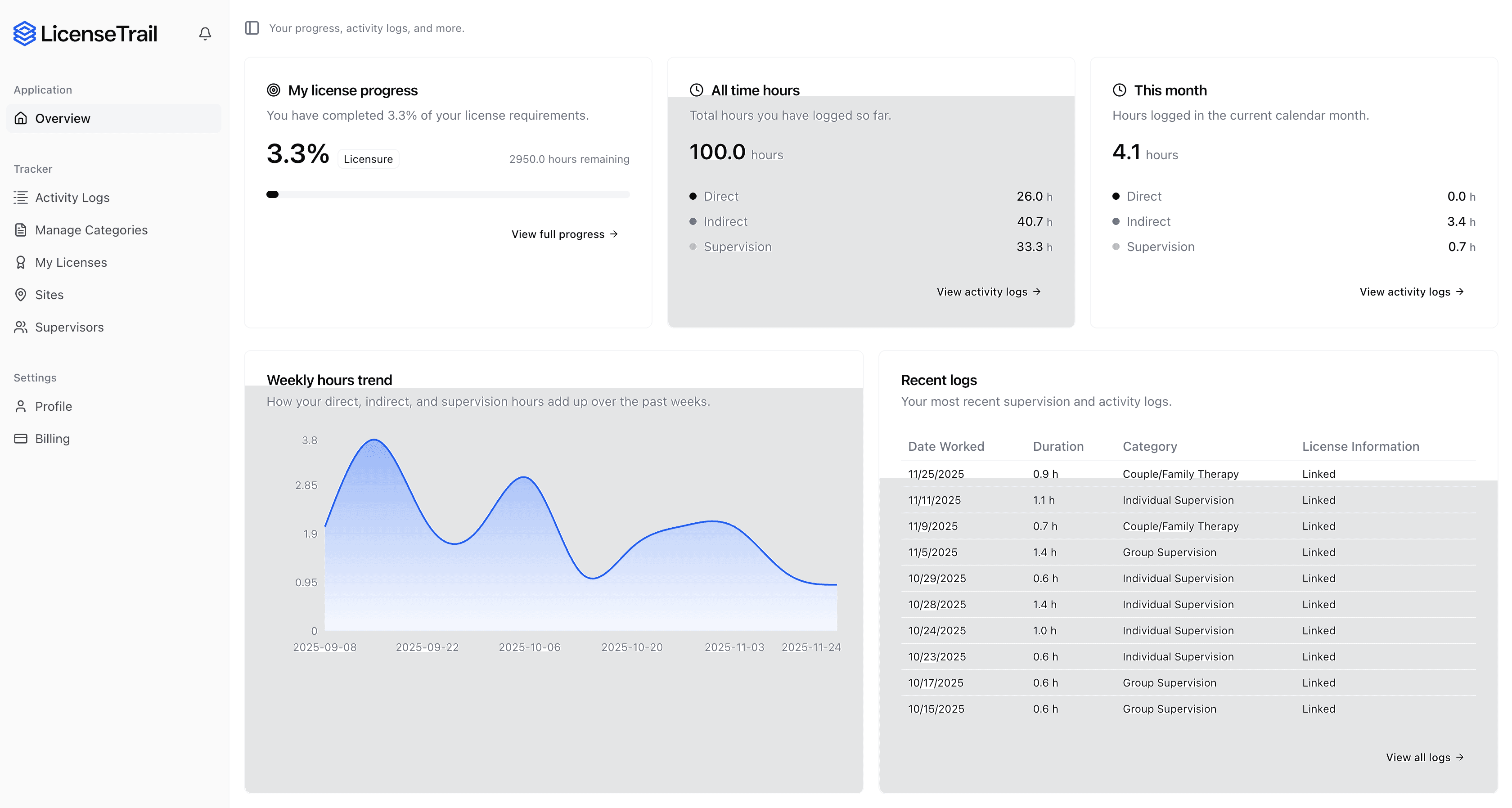
License Trail checks your direct, indirect, and supervision hours against Hawaii LMFT requirements continuously and flags mismatches before you submit.
 Start Tracking for Free
No credit card required · Free plan available
Is your spreadsheet hiding Hawaii LMFT risks?
Stop guessing if your categories match Hawaii Department of Commerce and Consumer Affairs (Marriage and Family Therapist Licensing Program) requirements. License Trail checks your direct, indirect, and supervision hours continuously and flags mismatches before you submit.
Import or log
Bring your spreadsheet or start fresh
Upload your existing tracking spreadsheet and we'll map every hour into the right Hawaii Department of Commerce and Consumer Affairs (Marriage and Family Therapist Licensing Program) categories automatically.
Verify against Hawaii
Catch mismatches before the board does
License Trail checks your direct, indirect, and supervision hours against Hawaii LMFT requirements continuously.
Export board-ready
One-click clean reports
Generate professional, board-ready reports for supervision meetings and Hawaii Department of Commerce and Consumer Affairs (Marriage and Family Therapist Licensing Program) submissions in seconds.
No credit card required · Free plan available