
Idaho LCSW Requirements: Hours, Exams & Step-by-Step Guide
Stop guessing if your categories match Idaho requirements. License Trail checks your direct, indirect, and supervision hours against LCSW requirements continuously and flags mismatches before you submit.
No credit card required · Free plan available
Quick Requirements Overview
- Governing body/rule: Idaho State Board of Social Work Examiners (DOPL); IDAPA 24.14.01.100
- Education: MSW from a CSWE-accredited (or Board-approved) program
- Exam: ASWB Clinical exam; must have been passed within the last 7 years
- Postgrad clinical experience: 3,000 hours completed in 2–5 years (post-MSW)
- Hour breakdown: 1,750 direct client contact treatment + 1,250 assessment/diagnosis/other clinical (may include indirect)
- Non-countable hours: Case management does not count toward the 3,000 clinical hours
- Supervision: ≥100 hours live face-to-face (in-person or live electronic); ≤50 hours may be group
- Supervisor qualifications: ≥50% of supervision by an LCSW; remainder may be clinical psychologist, psychiatrist, clinical professional counselor, or MFT (licensed where experience occurred)
License Details
Procedures
Licensure pathway to become a Licensed Clinical Social Worker (LCSW) in Idaho is defined in rule by the Idaho State Board of Social Work Examiners, housed within the Division of Occupational and Professional Licenses (DOPL). Although you referenced the Board of Professional Counselors and Marriage & Family Therapists (PC, MFT & Professional Counselors), LCSW licensure itself is governed by the Social Work Examiners board; the rules do, however, explicitly allow certain counselors and MFTs to serve as supervisors. (dopl.idaho.gov)
Below is a step‑by‑step guide that highlights the key requirements and the Board’s specific terminology, especially around required hours.
1. Regulatory framework and license level
Idaho recognizes several levels of social work licensure; independent clinical practice is authorized only at the Licensed Clinical Social Worker (LCSW) level. The governing rule is IDAPA 24.14.01.100 “Licensure,” under the Rules of the State Board of Social Work Examiners (effective July 1, 2024, current through June 4, 2025). (regulations.justia.com)
2. Education requirement
The Board requires an “approved college, university, or program,” defined as:
- An educational institution accredited by the U.S. Department of Education or a regionally accredited institution, and
- A social work program accredited by the Council on Social Work Education (CSWE), or otherwise approved by the Board. (regulations.justia.com)
In practical terms, for LCSW you must hold a Master of Social Work (MSW) from a CSWE‑accredited program (or Board‑approved equivalent).
3. Examination requirement
For each license type, including LCSW, Idaho requires an “approved examination”, defined as:
- “The applicable Association of Social Work Boards (ASWB) licensing examination for the license type, passed within the previous seven (7) years.” (regulations.justia.com)
For LCSW, that is the ASWB Clinical Exam, taken and passed not more than seven years before licensure.
4. Core clinical experience requirement for LCSW
Idaho’s rules are very specific about the type and breakdown of hours for LCSW licensure. The Board’s term is “Approved Postgraduate Supervised Clinical Experience for Clinical Social Worker License.” (regulations.justia.com)
4.1 Total hours and time frame
You must complete:
- 3,000 hours of supervised clinical social work experience
- Over no fewer than two (2) years and no more than five (5) years. (regulations.justia.com)
This experience is post‑graduate (after your MSW) and is clinical in nature.
4.2 Required hour types and exact breakdown
Within those 3,000 hours, the Board’s rule divides the work into:
-
Direct client contact involving treatment in clinical social work
- 1,750 hours must be “direct client contact involving treatment in clinical social work” as defined by the Board. (regulations.justia.com)
- This refers to face‑to‑face clinical treatment activities with clients (e.g., psychotherapy, clinical interventions) where you are directly engaged in providing clinical services.
-
Assessment, diagnosis, and other clinical social work (“other clinical”)
- 1,250 hours must be in “assessment, diagnosis, and other clinical social work, including indirect hours that may occur outside the presence of a client.” (regulations.justia.com)
- These hours may include:
- Diagnostic assessment work
- Treatment planning
- Clinical documentation
- Collateral contacts relevant to treatment
- Other clinically oriented tasks that are part of providing mental health treatment, even when the client is not physically present.
-
Hours that do not count as clinical social work
- The Board explicitly states: “Hours spent on case management will not count toward clinical social work hours.” (regulations.justia.com)
- Administrative or primarily case‑management‑oriented tasks cannot be counted in the 3,000 clinical hours.
You can think of the 3,000‑hour requirement as:
- 1,750 hours – direct treatment with clients
- 1,250 hours – assessment/diagnosis/other clinical activities (indirect or direct)
- All under clinical rather than case‑management or purely administrative functions.
5. Supervision requirements and who may supervise
Within the 3,000 hours of supervised clinical experience, the Board defines a separate category of face‑to‑face supervision hours and specifies who can provide them.
5.1 Required supervision hours
The rule requires:
- At least 100 hours of “in‑person or remote live electronic connection face‑to‑face contact with the supervisor”
- Of those, no more than 50 hours may be group supervision. (regulations.justia.com)
So you need:
- 100+ hours of live, face‑to‑face clinical supervision
- Minimum 50 hours can be individual or group
- Maximum 50 of those 100 hours are allowed to be group; at least 50 must be individual or some mix that ensures at least half your supervision hours are not group‑only.
The Board clarifies that supervision must be:
- “Interactive and consultative teaching”
- Directed toward improving the supervisee’s social work values, knowledge, methods, and techniques. (regulations.justia.com)
This distinguishes clinical supervision from simple administrative oversight.
5.2 Who can supervise (role of LCSWs, counselors, and MFTs)
Idaho specifies both proportions and eligible license types for supervisors:
- At least fifty percent (50%) of the supervision must be provided by a Licensed Clinical Social Worker (LCSW).
- The remaining supervision may be provided by a:
- Licensed clinical psychologist
- Psychiatrist
- Clinical professional counselor
- Marriage and family therapist. (regulations.justia.com)
These counselor and MFT supervisors are professionals licensed under the Board of Professional Counselors and Marriage & Family Therapists (the PC/MFT board you mentioned), but the overall rules for LCSW supervision come from the Social Work Examiners board.
Additional requirements:
- The supervisor must be licensed in the state in which the supervised experience was obtained. (regulations.justia.com)
- If the experience is completed in Idaho, the Board requires that qualifying supervisors be registered and that the supervision comply with Board‑approved Clinical Social Work Supervision Report Forms. (mswguide.org)
5.3 Supervision must continue until licensure
The rule makes clear that:
- “Supervision for clinical work must continue until clinical licensure is issued.” (regulations.justia.com)
If you reach the five‑year maximum period of accruing hours and are waiting on exam results:
- You “may not continue to practice under supervision and may only practice at the level of licensure that [you] currently hold.” (regulations.justia.com)
In other words, after you hit the five‑year cap, you cannot keep functioning as a provisionally supervised clinician beyond your existing license level (typically LMSW).
5.4 Age of supervised experience
If your supervised experience was completed more than five years before you apply for clinical licensure, the Board will review and may require evidence of current competency, which can include additional:
- Continuing education
- Supervised practice
- Examination
- Practice in another jurisdiction. (regulations.justia.com)
6. Typical practical sequence (how these rules play out)
While the rules themselves do not spell out each procedural step, Board materials and licensure guides describe a typical path: (mswguide.org)
- Earn an MSW from a CSWE‑accredited program.
- Obtain an LMSW license in Idaho (by application and passing the ASWB Master’s exam).
- Get your supervision plan approved:
- Submit an Application for Approval of Supervisor and Supervision Plan for Clinical Licensure (if completing hours in Idaho).
- Ensure your proposed supervisor meets Board criteria and, if in Idaho, is registered as a clinical supervisor.
- Accrue 3,000 hours of post‑master supervised clinical social work experience over 2–5 years, with:
- 1,750 hours – direct client contact focused on treatment
- 1,250 hours – assessment, diagnosis, and other clinical social work (including indirect clinical work)
- 100+ hours – live, face‑to‑face supervision (max 50 group)
- At least 50% of supervision provided by an LCSW; the remainder by an eligible clinical psychologist, psychiatrist, clinical professional counselor, or MFT.
- No counting of case‑management‑only hours toward clinical totals.
- Pass the ASWB Clinical Exam (within seven years of licensure).
- Apply for LCSW licensure with the Idaho Board of Social Work Examiners, documenting:
- Education (transcripts from an approved program)
- Supervision forms and hour breakdowns
- Exam score
- Any additional information the Board requires (e.g., for out‑of‑state supervised experience).
7. How the Board’s “hour language” answers your example
Using the Board’s exact categories instead of a generic “1,500 direct / 1,500 supervised” split, Idaho effectively requires:
- 3,000 total supervised hours, broken down as:
- 1,750 hours – direct client contact involving treatment in clinical social work
- 1,250 hours – assessment, diagnosis, and other clinical social work (which may be indirect)
- Within those 3,000 hours:
- 100 hours – in‑person or live electronic face‑to‑face supervision, not more than 50 of which can be group.
- At least half of all supervision by an LCSW, with the remainder allowed from a clinical psychologist, psychiatrist, clinical professional counselor, or marriage and family therapist.
Those are the specific hour categories and phrases used in Idaho’s current administrative rule for LCSW licensure.
Track your LCSW hours with confidence
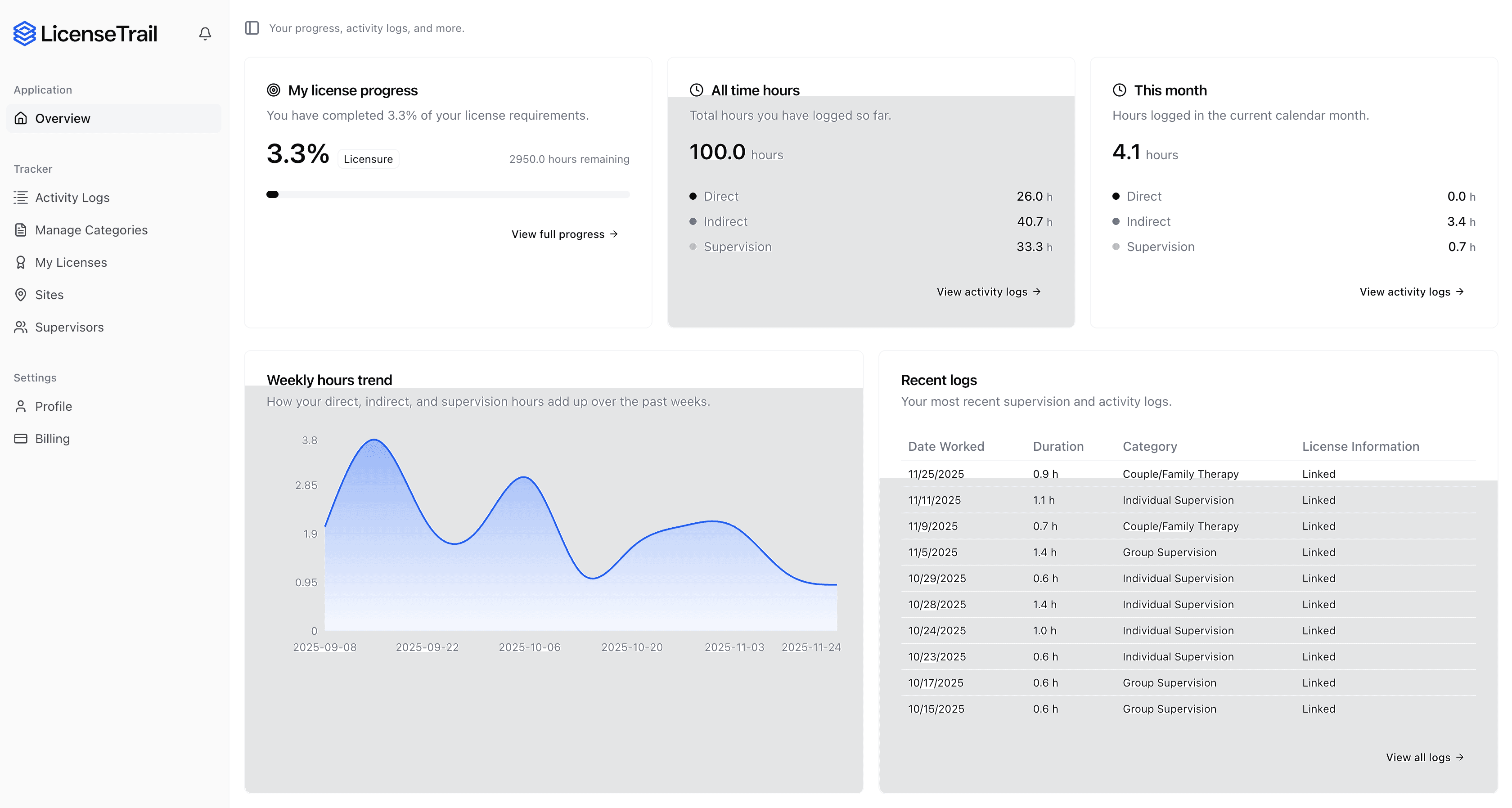
License Trail checks your direct, indirect, and supervision hours against Idaho LCSW requirements continuously and flags mismatches before you submit.
 Start Tracking for Free
No credit card required · Free plan available
Is your spreadsheet hiding Idaho LCSW risks?
Stop guessing if your categories match Idaho Board ofPC, MFT and Professional Counselors requirements. License Trail checks your direct, indirect, and supervision hours continuously and flags mismatches before you submit.
Import or log
Bring your spreadsheet or start fresh
Upload your existing tracking spreadsheet and we'll map every hour into the right Idaho Board ofPC, MFT and Professional Counselors categories automatically.
Verify against Idaho
Catch mismatches before the board does
License Trail checks your direct, indirect, and supervision hours against Idaho LCSW requirements continuously.
Export board-ready
One-click clean reports
Generate professional, board-ready reports for supervision meetings and Idaho Board ofPC, MFT and Professional Counselors submissions in seconds.
No credit card required · Free plan available