
Idaho PRESCRIBING PSYCHOLOGIST Requirements: Hours, Exams & Step-by-Step Guide
Stop guessing if your categories match Idaho requirements. License Trail checks your direct, indirect, and supervision hours against PRESCRIBING PSYCHOLOGIST requirements continuously and flags mismatches before you submit.
No credit card required · Free plan available
Quick Requirements Overview
- Hold active Idaho psychologist license: doctoral degree (psychology or Board-accepted related field), 2 supervised years/≥2,000 hours (incl. postdoc year), pass EPPP
- Complete postdoctoral M.S. in Clinical Psychopharmacology (regionally accredited; ≥2 years full-time/equivalent; APA postdoctoral psychopharmacology standards; required biomedical/clinical content + supervised clinical experience)
- Pass PEP (Psychopharmacology Examination for Psychologists)
- Obtain Provisional Certification of Prescriptive Authority with physician supervision agreement(s) (direct supervision ≥4 hrs/month & ≥48 hrs/year; defined scope; emergency/monitoring procedures; maintain docs ≥3 years)
- For full prescriptive certification: complete 2 years/≥2,000 hours of supervised prescribing under physician agreement + manage ≥50 distinct patients on formulary meds
- Pediatric/geriatric authority: within the above, 1 focused year/≥1,000 hours + ≥25 patients (peds: ≥10 age ≤12 and ≥10 age 13–17; geri: ≥25 age ≥65) with appropriate physician attestation
- Scope limits: prescribe only for psychiatric/behavioral disorders; collaborate with patient’s medical provider; formulary restrictions include no opioids (limited exception) and excludes specified systemic/medical conditions
- Renewal CE: psychologist license 30 hrs/2 yrs (incl. 4 laws/ethics) + prescriptive authority additional 30 hrs/2 yrs in psychopharmacotherapy (keep records ≥3 years; audit possible)
License Details
Procedures
Idaho is one of the states that grants limited prescriptive authority to appropriately trained psychologists. In Idaho law and rule, a “Prescribing Psychologist” is a licensed psychologist who also holds a Certification or Provisional Certification of Prescriptive Authority issued under Idaho Code §§ 54‑2317, 54‑2318, and 54‑2319 and the Board’s rules. (regulations.justia.com)
Becoming a prescribing psychologist is a multi‑stage process:
1. Become a licensed psychologist in Idaho
1.1 Doctoral education
Idaho Code § 54‑2307 requires either:
- A doctoral degree in psychology from an accredited college or university, or (law.justia.com)
- A doctoral degree in a related field, with experience and training acceptable to the Board. (law.justia.com)
1.2 Supervised experience – at least 2,000 hours
The statute requires two years of supervised experience, one of which may be a predoctoral practicum or internship and one of which must be postdoctoral. (law.justia.com)
The Board’s practice‑standards rule then defines what “a year” means:
- “A year of supervised experience is defined as a minimum of one thousand (1000) hours of supervised service provision acquired during not less than twelve (12) months and no more than a thirty‑six (36) calendar month period.” (law.cornell.edu)
Because two supervised years are required, this works out to at least 2,000 hours of supervised service provision acceptable to the Board, with:
- First year: may be predoctoral (practicum or internship), after at least one year of graduate study. (law.justia.com)
- Second year: must be postdoctoral supervised practice. (law.justia.com)
Supervision intensity is also specified:
- Minimum 1 hour of face‑to‑face individual supervision per 40 hours of applicable experience. (law.cornell.edu)
1.3 Licensing exam
The Board’s licensure rule states:
- “Applicants will pass the National Examination for Professional Practice in Psychology (EPPP).” (regulations.justia.com)
You must also submit the Board’s application, pay required fees, and meet good‑character and criminal‑history standards in § 54‑2307. (law.justia.com)
2. Complete a qualifying master’s in clinical psychopharmacology
To move into prescriptive training, Idaho law requires that a psychologist hold a specific postdoctoral degree:
- A master’s degree in clinical psychopharmacology from an accredited program within a U.S. Department of Education–approved, regionally accredited institution. (law.justia.com)
Key statutory features of this program include: (law.justia.com)
- The didactic portion must be at least two years of full‑time education (or equivalent).
- It must be substantially equivalent to the education required of an advanced practice psychiatric nurse practitioner in Idaho, as determined by an institution that offers both degrees.
- It must meet American Psychological Association requirements for designation as a postdoctoral education and training program in clinical psychopharmacology.
- The program must be established and administered by biomedically trained educators and demonstrate that all required content is covered and that students achieve clinical competency.
The statute lists content areas that must be included at minimum, such as: (law.justia.com)
- Basic sciences: anatomy, physiology, biochemistry
- Neurosciences: neuroanatomy, neurophysiology, neurochemistry
- Physical assessment and lab/radiologic assessment, medical terminology and documentation
- Clinical medicine and pathophysiology with emphasis on systems relevant to psychotropic prescribing
- Psychopharmacology, pharmacology, therapeutics of psychotropic drugs
- Research methods and evaluation of psychopharmacology research
- Professional, ethical, and legal issues, including relationships with the pharmaceutical industry
2.1 Clinical psychopharmacology experience during the program
Idaho Code further requires: (law.justia.com)
- “Clinical experience that is sufficient to attain competency in the psychopharmacological treatment of a diverse patient population under the direction of qualified practitioners including, but not limited to, licensed physicians and prescribing psychologists.”
The law does not specify a numerical hour minimum for this in‑program clinical experience; it focuses instead on demonstrated competency under qualified supervision.
3. Pass the psychopharmacology examination
Before receiving provisional prescriptive authority, you must pass a specialized national exam:
- The Board’s rule states that “the approved examination is the Psychopharmacology Examination for Psychologists” (PEP), with a passing score set by the Association of State and Provincial Psychology Boards. (regulations.justia.com)
4. Arrange physician supervision agreements
Prescribing psychologists in training first hold Provisional Certification of Prescriptive Authority and must practice under physician supervision.
Idaho Code § 54‑2317 requires that applicants for provisional certification have “supervision agreements” with qualified physicians (e.g., board‑certified psychiatrists, neurologists, family medicine physicians, or other physicians with at least two years’ experience managing psychotropic medication). (law.justia.com)
The Board’s licensure rule spells out what a supervision agreement must include: (regulations.justia.com)
- Identification of the parties and authorized scope of authority for the prescribing psychologist.
- “Direct supervision methods, including supervision on a one‑to‑one basis for a minimum of four (4) hours each month and a minimum of a total of forty‑eight (48) hours each year.”
- Requirements for collaboration/consultation or referral to the supervising physician based on patient condition, the psychologist’s education and competence, and community standards of care.
- Procedures for emergency consultation and any needed patient‑monitoring parameters.
The psychologist must maintain documentation of these supervision agreements for at least three years and provide them to the Board upon request. (regulations.justia.com)
5. Obtain Provisional Certification of Prescriptive Authority
Once you are:
- Licensed as an Idaho psychologist, (law.justia.com)
- Have completed the required master’s in clinical psychopharmacology, (law.justia.com)
- Have passed the Psychopharmacology Examination for Psychologists, (regulations.justia.com)
- Have supervision agreements with qualifying physicians, (law.justia.com)
you may apply to the Board for Provisional Certification of Prescriptive Authority under § 54‑2317 and IDAPA 24.12.01.100. (law.justia.com)
The Board regulates the application forms and fees; the Board’s fee schedule currently lists a separate “Prescribing Psychologist” application fee and certification fee. (dopl.idaho.gov)
While provisionally certified, you may prescribe only under the direct supervision of your supervising physician and within the scope defined in your supervision agreement. (law.justia.com)
6. Complete supervised prescribing as a provisional certificate holder
To move from provisional to full certification, Idaho rules and statutes impose specific experience and hour requirements.
6.1 Overall supervised prescribing requirement – 2,000 hours over two years
The Board’s Practice Standards rule provides: (law.cornell.edu)
- Before applying for certification of prescriptive authority, a provisional certificate holder must complete “two (2) years, including a minimum of two thousand (2,000) hours of satisfactory prescribing under a supervision agreement with a licensed physician.”
This is separate from the 2,000 hours of supervised psychological practice required for your original psychologist license. In other words, to become a prescribing psychologist you must complete:
- At least 2,000 supervised hours of psychological service provision for licensure, plus
- At least 2,000 supervised hours of prescribing practice as a provisional prescriber.
6.2 Patient‑volume requirement – 50 distinct patients
Within those 2,000 hours, the rule also specifies a minimum caseload: (law.cornell.edu)
- You must treat at least 50 separate patients “who are seen for the purpose of evaluation and treatment with those medications that are within the formulary established in these rules.”
This requirement applies to the general prescriber population (i.e., not limited to pediatric/geriatric).
6.3 Additional requirements for pediatric or geriatric prescriptive authority
If you wish to prescribe for pediatric (≤17 years) or geriatric (≥65 years) patients, Idaho imposes extra supervised experience, beyond the general 2,000 hours. (law.cornell.edu)
The rule states:
- Before applying to prescribe for pediatric or geriatric patients, a provisional certificate holder must complete “one (1) year, including a minimum of one thousand (1,000) hours of satisfactory prescribing under a supervision agreement with a licensed physician” focused on that population.
- That one year of satisfactory prescribing may be counted as one of the two years required for general certification (i.e., it is not in addition to the base two years). (law.cornell.edu)
For pediatric prescribing authority, the one year of satisfactory prescribing must include at least 25 separate pediatric patients, with age distribution requirements: (law.cornell.edu)
- At least 10 patients aged 12 or younger, and
- At least 10 patients aged 13–17.
For geriatric prescribing authority, the rule requires at least 25 separate geriatric patients (≥65) seen for evaluation and treatment with formulary medications during that one‑year, 1,000‑hour period. (law.cornell.edu)
7. Apply for full Certification of Prescriptive Authority (Prescribing Psychologist)
After you have completed the supervised prescribing requirements, you can seek full certification.
7.1 Base certification
Idaho Code § 54‑2318(1) provides that the Board may grant certification of prescriptive authority if: (law.justia.com)
- You already hold provisional certification, and
- You have “successfully completed two (2) years of satisfactory prescribing as attested to by the supervising physician or physicians.”
The Board relies on your supervising physician(s) to attest that your prescribing has been satisfactory.
7.2 Additional pediatric/geriatric certification
Section 54‑2318(2) adds an extra requirement for those who seek to prescribe for pediatric or geriatric patients: (law.justia.com)
- You must have completed at least one year of satisfactory prescribing to those specific populations, attested by a supervising physician with specialized training and experience in treating that population.
The hour and patient‑count details for this specialized year are governed by the Board rule described in section 6.3 above. (law.cornell.edu)
7.3 Certification by endorsement from another state or DoD program
If you already hold prescriptive authority as a psychologist elsewhere, Idaho provides an endorsement route:
- An applicant with a current, unrestricted psychology license and a current, unrestricted certification of prescriptive authority from another state, or with qualifying U.S. Department of Defense psychopharmacology training, may be certified by endorsement if the education and training are substantially equivalent and the Board approves. (law.justia.com)
The Board may credit out‑of‑state prescribing experience toward Idaho’s provisional/certification requirements but can require additional education or supervision if needed. (law.justia.com)
8. Scope and limits of prescriptive practice
Even with full certification, Idaho imposes notable limitations on prescribing psychologists:
- You may prescribe only for psychiatric, mental, cognitive, nervous, emotional, or behavioral disorders, and only within the scope of your license and prescriptive certification. (law.justia.com)
- You must collaborate with the patient’s licensed medical provider. (law.justia.com)
- The Board’s formulary rule prohibits prescribing of opioid‑controlled substances (with a narrow federal exception) and prohibits prescribing for primary endocrine, cardiovascular, neurologic, obstetric, metabolic, and other specified systemic illnesses. (law.cornell.edu)
Idaho rules also articulate detailed standards for patient assessment, documentation, collaboration with other health professionals, and emergency prescribing situations. (regulations.justia.com)
9. Ongoing continuing‑education requirements
Once certified, a prescribing psychologist must maintain both the psychology license and prescriptive certification through continuing education (CE).
The Board’s licensure rule requires: (regulations.justia.com)
- Psychologist license:
- 30 hours of CE every two calendar years, including 4 hours in Laws and Ethics.
- Prescribing psychologist (in addition to the above):
- 30 hours of CE every two calendar years in psychopharmacotherapy.
Those psychopharmacotherapy hours are in addition to the CE hours required for psychologist license renewal. Record‑keeping for CE must be maintained for at least three years, and licensees are subject to random audit. (regulations.justia.com)
10. Summary of key hour‑based requirements
Putting the numeric requirements together:
-
Psychologist licensure supervised experience
- 2 supervised years of experience acceptable to the Board. (law.justia.com)
- Each year is defined as at least 1,000 hours, for a minimum of 2,000 hours of supervised service provision. (law.cornell.edu)
-
Provisional prescribing practice (to qualify for full certification)
- Two years as a provisional certificate holder, including a minimum of 2,000 hours of satisfactory prescribing under a physician supervision agreement. (law.cornell.edu)
- At least 50 distinct patients treated with formulary psychotropic medications during this period. (law.cornell.edu)
-
Additional pediatric or geriatric prescribing authority
- Within the above two years, one focused year (minimum 1,000 hours) of satisfactory prescribing to pediatric or geriatric patients, under supervision of a licensed physician; this year counts toward the 2,000 hours total. (law.cornell.edu)
- At least 25 distinct patients in the target population during that focused year:
- Pediatric: at least 10 patients age ≤12 and at least 10 age 13–17. (law.cornell.edu)
- Geriatric: at least 25 patients age ≥65. (law.cornell.edu)
-
Continuing education for prescribing psychologists
- 30 hours/2 years (including 4 hours laws/ethics) for the psychologist license, plus
- An additional 30 hours/2 years in psychopharmacotherapy for prescriptive authority. (regulations.justia.com)
Because Idaho updates its statutes and administrative rules over time, anyone actively planning to pursue prescriptive authority should verify the current wording of Idaho Code Title 54, Chapter 23 and IDAPA 24.12.01, and confirm application procedures and fees directly with the Idaho Board of Psychologist Examiners / Division of Occupational and Professional Licenses.
Track your PRESCRIBING PSYCHOLOGIST hours with confidence
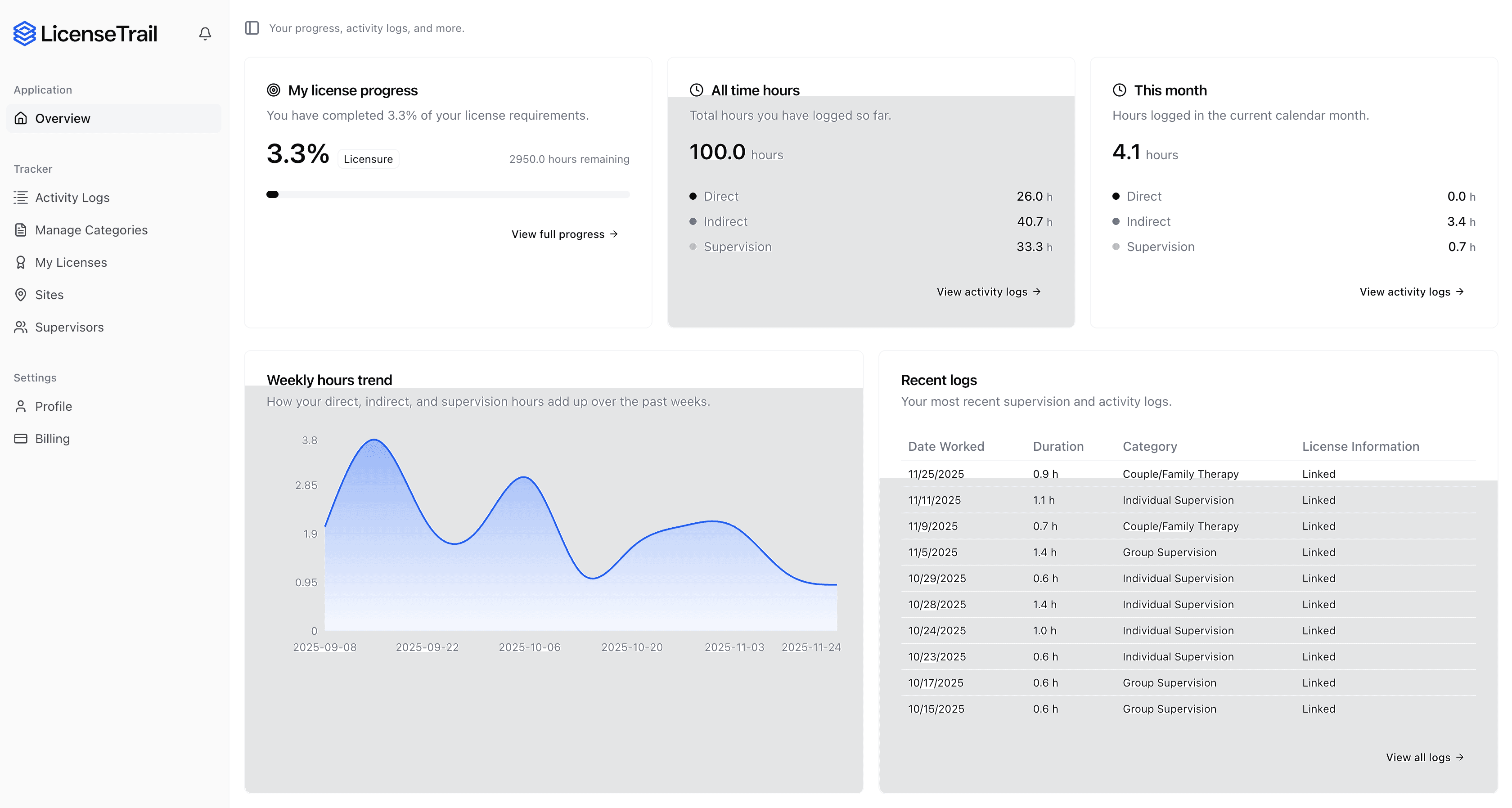
License Trail checks your direct, indirect, and supervision hours against Idaho PRESCRIBING PSYCHOLOGIST requirements continuously and flags mismatches before you submit.
 Start Tracking for Free
No credit card required · Free plan available
Related Licenses
Is your spreadsheet hiding Idaho PRESCRIBING PSYCHOLOGIST risks?
Stop guessing if your categories match Idaho Board of Psychologist Examiners requirements. License Trail checks your direct, indirect, and supervision hours continuously and flags mismatches before you submit.
Import or log
Bring your spreadsheet or start fresh
Upload your existing tracking spreadsheet and we'll map every hour into the right Idaho Board of Psychologist Examiners categories automatically.
Verify against Idaho
Catch mismatches before the board does
License Trail checks your direct, indirect, and supervision hours against Idaho PRESCRIBING PSYCHOLOGIST requirements continuously.
Export board-ready
One-click clean reports
Generate professional, board-ready reports for supervision meetings and Idaho Board of Psychologist Examiners submissions in seconds.
No credit card required · Free plan available