
Illinois LCPC Requirements: Hours, Exams & Step-by-Step Guide
Stop guessing if your categories match Illinois requirements. License Trail checks your direct, indirect, and supervision hours against LCPC requirements continuously and flags mismatches before you submit.
No credit card required · Free plan available
Quick Requirements Overview
- Master’s (or higher) in counseling/rehab counseling/psychology or similar from regionally accredited school; meets IL curriculum/core content standards (LCPC education mirrors LPC).
- Minimum coursework: 48 semester hours (72 quarter) through 6/30/2026; 60 semester hours (90 quarter) for applications on/after 7/1/2026.
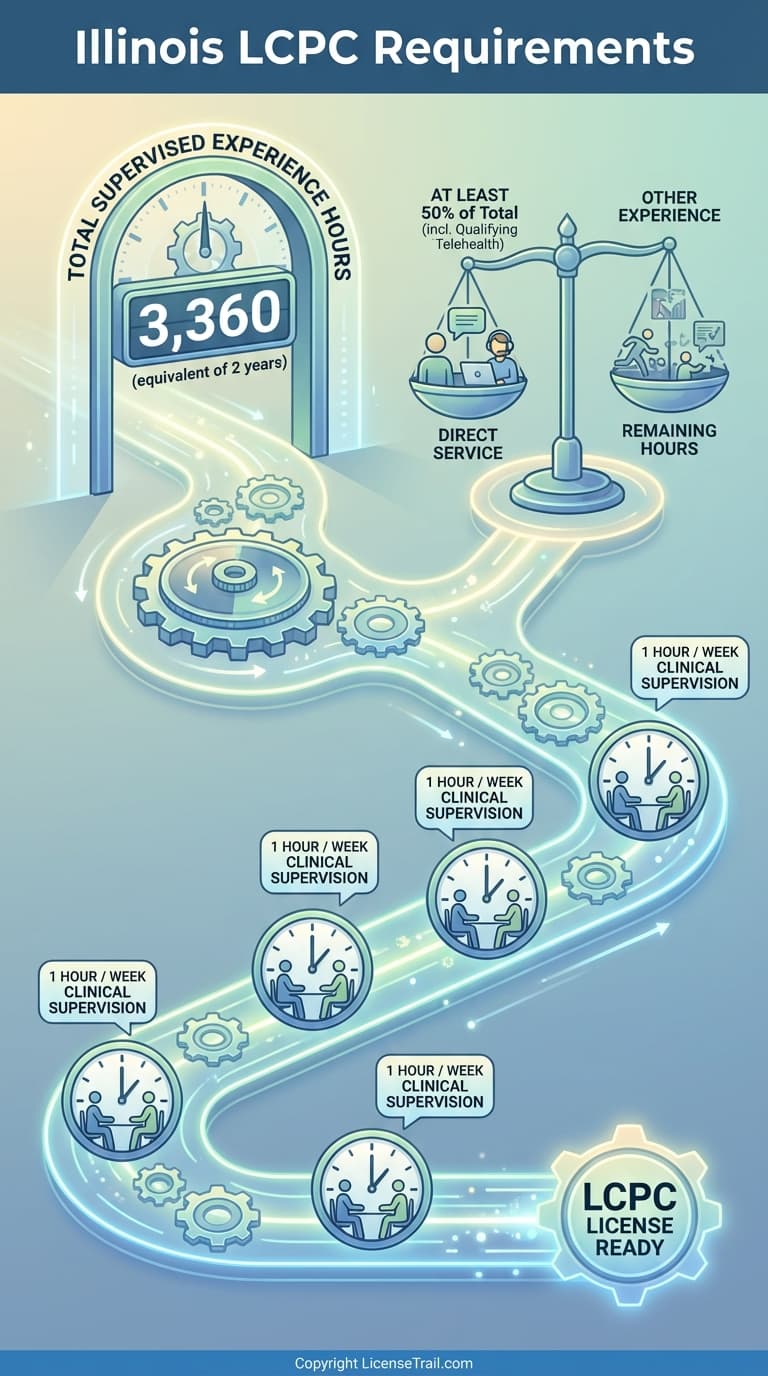
- Supervised experience: 3,360 hours post-degree over ≥2 years (1 year = 1,680 hrs in ≥48 weeks); part-time allowed but cannot be completed in <2 years.
- Direct client contact: ≥1,680 hours (50%) face-to-face with clients; synchronous A/V telehealth counts.
- Supervision: ≥1 hour/week face-to-face (A/V tele-supervision allowed) reviewing counseling/case management.
- Qualified supervisor: IL-licensed LCPC, LCSW, clinical psychologist, LMFT, or psychiatrist (IL license required if supervisee is physically in IL).
- Exams/certs: pass NCE + NCMHCE, or qualifying national certification (e.g., CRC or CCMHC) accepted by IDFPR.
- Apply to IDFPR by examination or endorsement with required verifications and fees (endorsement has reduced documentation if independently licensed 5 years w/o discipline).
License Details
Procedures
In Illinois, the Licensed Clinical Professional Counselor (LCPC) credential is issued by the Illinois Department of Financial and Professional Regulation (IDFPR) under the Professional Counselor and Clinical Professional Counselor Licensing and Practice Act (68 Ill. Adm. Code Part 1375). The Professional Counselor and Clinical Professional Counselor Licensing and Disciplinary Board advises the Department on licensure standards and applications.
The core elements for LCPC licensure are:
- Graduate education in counseling (or a closely related field) that meets state curriculum standards.
- A defined amount of supervised clinical professional counseling experience with specific hourly and supervision requirements.
- Passage of required national examinations (or qualifying national certifications).
- Submission of an application (by examination or by endorsement) and payment of fees.
The sections below break down each of these in the language and structure used by IDFPR and the Illinois Administrative Code.
1. Education Requirements for LCPC
1.1 What level and type of degree?
For LCPC, Illinois requires a master’s (or higher) degree in counseling, rehabilitation counseling, psychology, or a “similar degree program” from a regionally accredited institution recognized by the U.S. Department of Education. (law.cornell.edu)
For clinical licensure:
- Section 1375.145, Required Education for Clinical Professional Counseling Programs, states that “the educational requirements are identical to those found in Section 1375.45” and that holding an active Professional Counselor (LPC) license satisfies the LCPC education requirement. (law.cornell.edu)
In practical terms, if you meet the education requirements for the LPC (or already hold an LPC), you have met the education requirement for LCPC.
1.2 Credit hours and core content areas
Under Section 1375.45 (which LCPC education mirrors), the graduate program must:
- Be at least two academic years in length.
- Require at least 48 semester hours (72 quarter hours) of graduate coursework through June 30, 2026. (law.cornell.edu)
- Include at least one 3‑semester‑hour (or 4.5 quarter‑hour) course in each of 13 core areas (e.g., Human Growth and Development; Counseling Theory; Counseling Techniques; Group Dynamics; Appraisal; Research and Evaluation; Professional, Legal and Ethical Responsibilities; Social and Cultural Foundations; Career; Practicum/Internship; Psychopathology; Addictions/Substance Abuse; Family Dynamics). (law.cornell.edu)
A key change: for applications submitted on or after July 1, 2026, Section 1375.45 will require a minimum of 60 semester hours or 90 quarter hours in the graduate counseling program, and this higher hour requirement will also apply to LCPC because Section 1375.145 ties LCPC education to Section 1375.45. (law.cornell.edu)
2. Supervised Clinical Professional Counseling Experience
The experience requirement for LCPC is governed primarily by Section 1375.130 – Professional Experience for Licensure as a Clinical Professional Counselor and is echoed in the endorsement and application sections. (ilga.gov)
2.1 Total amount of supervised experience
Section 1375.130(a) requires that a person with a master’s degree:
- Must have completed the equivalent of two years of full‑time satisfactory supervised experience working as a clinical counselor in a professional capacity under the direction of a qualified supervisor, subsequent to obtaining the degree. (ilga.gov)
Section 1375.130(d) defines how those “two years” are measured:
- One year of supervised clinical professional counseling experience shall be 1,680 clock hours obtained in not less than 48 weeks.
- At least 50% of those hours must consist of direct face‑to‑face service to clients, which explicitly includes telehealth where there is synchronous audio‑visual communication. (ilga.gov)
From this, the state‑board‑defined totals are:
- Total supervised clinical professional counseling hours required:
3,360 hours (2 years × 1,680 hours per year). - Minimum direct client contact (“direct face‑to‑face service to clients”):
1,680 hours (50% of 3,360).
The Illinois Counseling Association and several Illinois counseling programs summarize this the same way: 3,360 hours of clinical experience, with at least 1,680 hours of face‑to‑face clinical services, completed in not less than two years. (ilcounseling.org)
There is not a separate additional “1,500 hours of supervised experience” beyond these hours; the full 3,360 hours are, by definition, supervised clinical professional counseling experience, half of which must be direct service.
2.2 Timing – when experience can begin
Section 1375.120(b) specifies that an applicant may begin gaining the required experience upon completion of the degree requirements, even if the graduation date or degree conferral is later, as long as the institution certifies the date degree requirements were completed. (ilga.gov)
The Illinois Counseling Association further interprets this as:
- “All experience post counseling master’s degree will be counted. The start date is determined by when you complete all course work including internships, not the date the degree is conferred.” (ilcounseling.org)
2.3 What counts as supervised clinical professional counseling experience?
Section 1375.130(e) defines supervised clinical professional counseling experience as:
- Experience obtained under a qualified supervisor (see next subsection) and
- Involving the provision of clinical professional counseling as defined in Section 10 of the Act (i.e., diagnostic and treatment‑oriented counseling services within the LCPC scope). (ilga.gov)
Additional key points from Section 1375.130: (ilga.gov)
- Full‑time or part‑time work both count toward the 3,360 hours, as long as they are:
- Within the required two‑year minimum duration (you may take longer than two years; you just cannot complete faster than two full years), and
- Within roles that involve clinical professional counseling under supervision.
- Volunteer experience can count only if it is clinical counseling experience and you hold a Licensed Professional Counselor (LPC) license during the volunteer period.
- Experience can be accumulated at one or multiple sites.
2.4 Supervision structure and “qualified supervisor”
Section 1375.130(c) defines a “qualified supervisor” for LCPC supervised experience as: (ilga.gov)
- A licensed clinical professional counselor (LCPC),
- A licensed clinical social worker (LCSW),
- A licensed clinical psychologist,
- A licensed marriage and family therapist (LMFT), or
- A licensed psychiatrist (as defined in Section 1‑121 of the Mental Health and Developmental Disabilities Code).
If supervision occurs outside Illinois, the supervisor must:
- Be a master’s‑ or doctoral‑level professional engaged in clinical professional counseling, clinical social work, clinical psychology, marriage and family therapy, or psychiatry; and
- Hold an active license if the jurisdiction requires licensure. (ilga.gov)
If you (the supervisee) are physically located in Illinois, Section 1375.130(c) requires that:
- The qualified supervisor must be licensed in Illinois, even if services are being delivered via telehealth to people physically located outside Illinois. (ilga.gov)
2.5 Required amount and form of supervision
Section 1375.130(e)(1) lays out the minimum supervision contact:
- The supervisor must meet face‑to‑face with the applicant at least one hour each week, and this supervision must include review of counseling and case management. (ilga.gov)
“Face‑to‑face” is defined in the Act and includes telehealth supervision if it is real‑time with audio and video. (ilcounseling.org)
Recent IDFPR rule changes (effective June 4, 2024) also clarify that an Illinois LCPC providing clinical supervision for licensure must complete required continuing education in supervision, and that weekly supervision may be offered via contract (not just on‑site employment). (ilcounseling.org)
3. Examination Requirements
Exams are governed by Section 1375.150 – Examination – Clinical Professional Counselor. (regulations.justia.com)
3.1 Standard exam route
Under Section 1375.150:
- The examination for licensure as a clinical professional counselor in Illinois is:
- The National Counselor Examination (NCE) and
- The National Clinical Mental Health Counseling Examination (NCMHCE),
- With passing scores as set by the exam vendors (NBCC). (regulations.justia.com)
In practice today:
- Many applicants take both the NCE and the NCMHCE on the way from graduate school to LPC and then LCPC.
- The NCE can satisfy the exam requirement for LPC; LCPC applicants generally need the NCMHCE in addition. (imhca.org)
3.2 Alternate national certifications
Section 1375.120(a)(1) allows an LCPC applicant to meet education and exam requirements by holding certain national certifications:
- Commission on Rehabilitation Counselor Certification (CRC), or
- Certified Clinical Mental Health Counselor (CCMHC). (law.cornell.edu)
If you hold one of these certifications:
- You may submit proof of that certification in lieu of certain educational documentation and, according to IDFPR’s rules and IMHCA’s summary, you may not need to take an additional state‑administered exam. (law.cornell.edu)
4. Application Pathways: By Examination vs. By Endorsement
4.1 Licensure by examination (typical first‑time Illinois LCPC)
Section 1375.120, Application for Licensure by Examination as a Clinical Professional Counselor, outlines the requirements: (ilga.gov)
An applicant must:
- File an application with IDFPR on Division‑provided forms.
- Meet the education requirements in Section 1375.145 (i.e., LCPC‑level graduate education equivalent to LPC requirements).
- Provide verification of supervised clinical experience meeting Section 1375.130 (the 3,360 hours, 50% direct client contact, appropriate supervision, and minimum two‑year duration).
- Submit proof of passing the required examinations per Section 1375.150 (NCE and NCMHCE, or accepted certifications like CRC/CCMHC).
- Pay the required fee set in Section 1375.205. (ilga.gov)
4.2 Licensure by endorsement (out‑of‑state or previously licensed)
Section 1375.160, Licensure by Endorsement as a Clinical Professional Counselor, sets similar requirements for applicants already independently licensed in another U.S. jurisdiction: (ilga.gov)
- Proof of education that meets Section 1375.45 / 1375.145.
- Proof of the equivalent of two years of full‑time satisfactory supervised counselor employment/experience under a qualified supervisor, as defined in Section 1375.130 (or analogous experience in another jurisdiction).
- Proof of successful completion of acceptable examinations.
- Certification of current licensure and any disciplinary history from the state(s) where the applicant is or was licensed.
Applicants who have been independently licensed for five consecutive years without discipline in another U.S. jurisdiction are exempt from submitting detailed education and supervised experience documentation, but still must meet all other conditions, including exam equivalency and fees. (ilga.gov)
5. Practical Summary of Hour and Supervision Requirements
Bringing the statutory language together into a practical checklist for Illinois LCPC licensure:
-
Graduate education
- Master’s (or doctoral) degree in counseling/rehab counseling/psychology or a closely related field from a regionally accredited school.
- Program meets the 48‑semester‑hour / 13‑core‑course standard (or 60 hours if applying on or after July 1, 2026) as described in Section 1375.45 and incorporated by Section 1375.145. (law.cornell.edu)
-
Supervised clinical professional counseling experience
- At least two years of post‑degree, full‑time‑equivalent supervised clinical professional counseling experience under a qualified supervisor (LCPC, LCSW, clinical psychologist, LMFT, or psychiatrist). (ilga.gov)
- Total hours: 3,360 clock hours of supervised clinical professional counseling experience (2 × 1,680).
- Direct client hours: At least 1,680 hours of “direct face‑to‑face service to clients” (including qualifying telehealth); this is 50% of the total 3,360 hours. (ilga.gov)
- Experience must span not less than two years; one “year” is defined as 1,680 hours in not less than 48 weeks; part‑time work counts if it adds up within these parameters. (ilga.gov)
- Experience can begin once all graduate degree requirements (including internship) are completed, even if the diploma is conferred later. (ilga.gov)
-
Supervision structure
- Supervisor must meet with the applicant at least one hour per week, face‑to‑face, to review counseling and case management. (ilga.gov)
- If the supervisee is physically in Illinois, the supervisor must hold an Illinois license in one of the qualifying professions. (ilga.gov)
- Volunteer clinical hours may count if you hold an LPC and the work is true clinical professional counseling under an appropriate supervisor. (ilga.gov)
-
Examinations
- Pass the NCE and the NCMHCE, or hold an accepted national certification such as CRC or CCMHC that IDFPR recognizes as meeting education and exam equivalency. (regulations.justia.com)
-
Application to IDFPR
- Apply either by examination (typical path for new Illinois clinicians) or by endorsement (if independently licensed in another state).
- Submit all required forms, verifications (education, supervised experience, exam scores or certifications), and fees as specified in Sections 1375.120, 1375.160, and 1375.205. (ilga.gov)
That combination—meeting the specified education standards, accumulating 3,360 supervised hours with 1,680 or more direct client hours under a qualified supervisor over at least two years, passing the required national examinations (or holding equivalent certifications), and submitting a complete application—constitutes the state‑board‑defined pathway to LCPC licensure in Illinois.
Track your LCPC hours with confidence
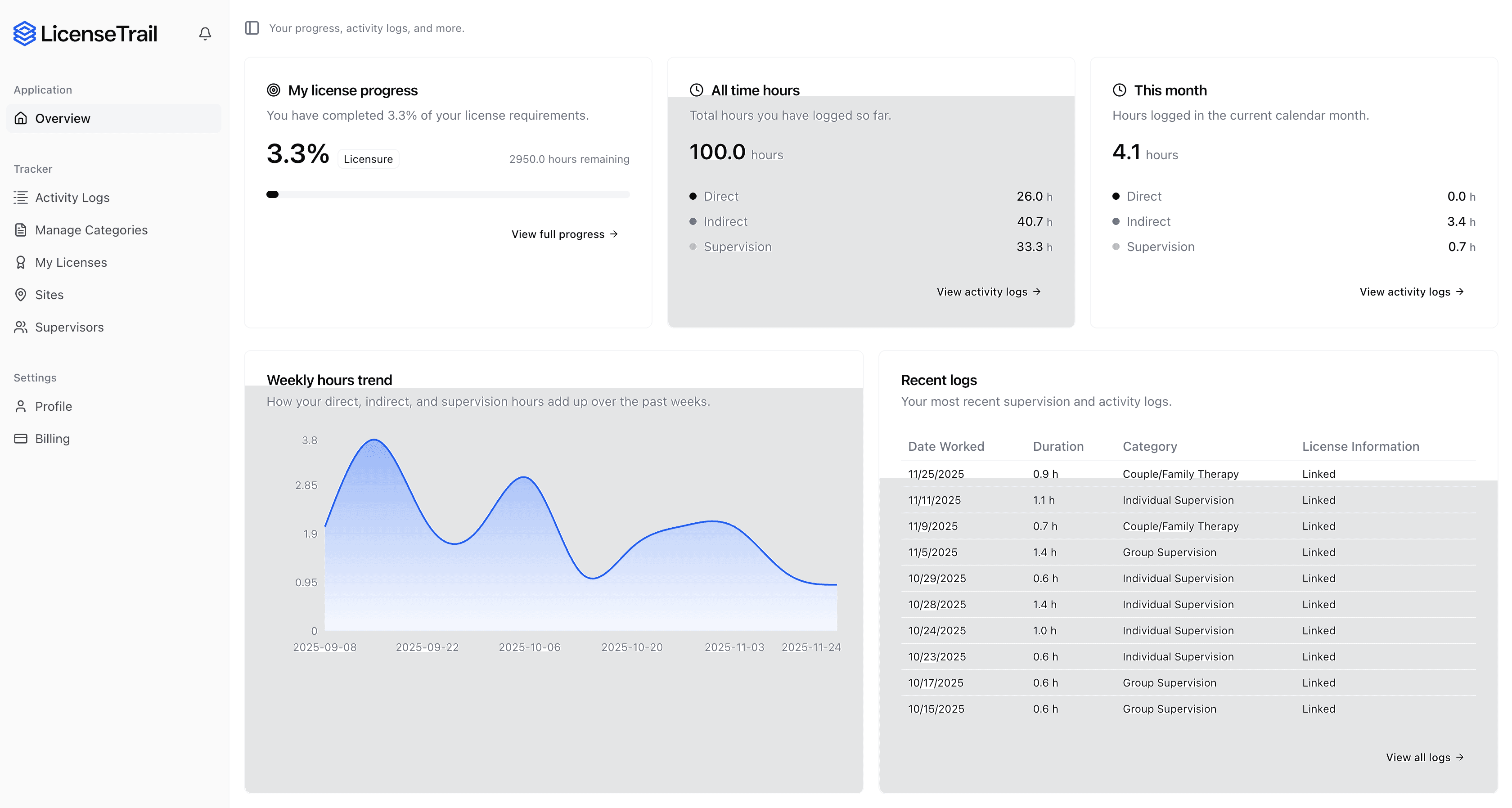
License Trail checks your direct, indirect, and supervision hours against Illinois LCPC requirements continuously and flags mismatches before you submit.
 Start Tracking for Free
No credit card required · Free plan available
Is your spreadsheet hiding Illinois LCPC risks?
Stop guessing if your categories match Illinois Department of Financial and Professional Regulation (Counselor Licensing and Disciplinary Board) requirements. License Trail checks your direct, indirect, and supervision hours continuously and flags mismatches before you submit.
Import or log
Bring your spreadsheet or start fresh
Upload your existing tracking spreadsheet and we'll map every hour into the right Illinois Department of Financial and Professional Regulation (Counselor Licensing and Disciplinary Board) categories automatically.
Verify against Illinois
Catch mismatches before the board does
License Trail checks your direct, indirect, and supervision hours against Illinois LCPC requirements continuously.
Export board-ready
One-click clean reports
Generate professional, board-ready reports for supervision meetings and Illinois Department of Financial and Professional Regulation (Counselor Licensing and Disciplinary Board) submissions in seconds.
No credit card required · Free plan available