
Illinois LCSW Requirements: Hours, Exams & Step-by-Step Guide
Stop guessing if your categories match Illinois requirements. License Trail checks your direct, indirect, and supervision hours against LCSW requirements continuously and flags mismatches before you submit.
No credit card required · Free plan available
Quick Requirements Overview
- Governing authority: IDFPR (Social Work Examining & Disciplinary Board) under 225 ILCS 20 and 68 Ill. Adm. Code 1470
- Education: IDFPR‑approved MSW or IDFPR‑approved DSW/PhD (Social Work)
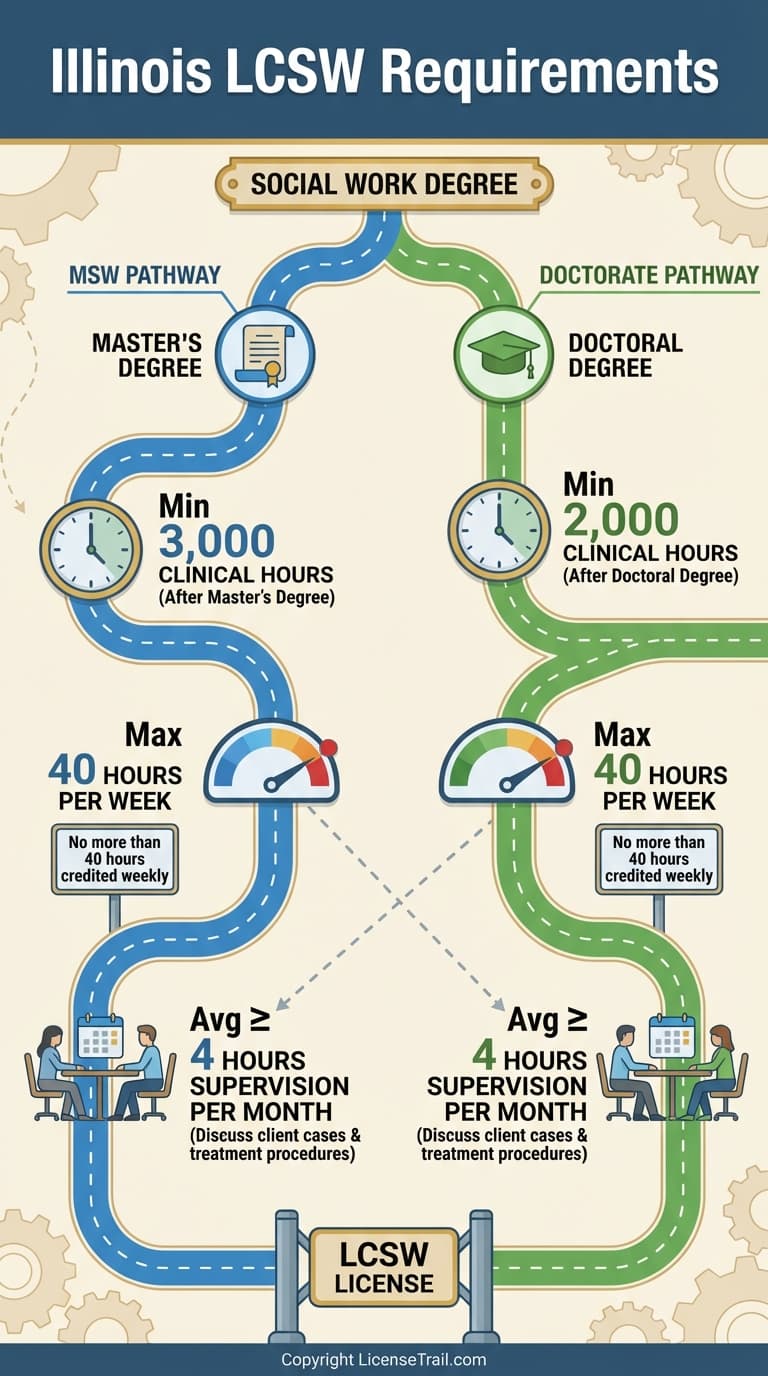
- Core post‑degree experience: 3,000 hrs (MSW) or 2,000 hrs (doctorate) of supervised clinical professional experience (all hours are counted in this total)
- Qualifying work must be “clinical social work practice”: mental/behavioral health evaluation, treatment, prevention (not primarily case management/admin)
- Weekly counting limits: full‑time 30–40 hrs/week; part‑time ≤29 hrs/week
- Supervision amount: documented avg ≥4 hrs/month focused on cases/treatment; individual or group (max 5 supervisees)
- Who can supervise core clinical hours: LCSW only; if you’re located in IL, supervisor must hold an Illinois license (effectively an IL LCSW)
- Exam requirement / alternative: normally ASWB Clinical Exam pass; if took & failed after 1/1/2019, may substitute +3,000 hrs supervised professional experience (broader SW) within the 10‑years‑before to 3‑years‑after application window; for hours on/after 1/1/2026, must already be IL LSW or IL school social work licensed before accruing those alternative hours
License Details
Procedures
Licensure as a Licensed Clinical Social Worker (LCSW) in Illinois is governed by the Clinical Social Work and Social Work Practice Act (225 ILCS 20) and the Illinois Administrative Code, Title 68, Part 1470, administered by the Illinois Department of Financial and Professional Regulation (IDFPR), Social Work Examining and Disciplinary Board. (ilga.gov)
The Board uses some very specific terms—especially “supervised clinical professional experience” and “clinical social work practice”—and it does not divide requirements into things like “1,500 direct hours and 1,500 supervised hours.” Instead, all qualifying hours are counted as supervised clinical professional experience that is directly related to clinical social work practice.
1. Educational foundation
To qualify for an Illinois LCSW, you must have:
- Either a master’s degree in social work (MSW) from a program approved by IDFPR; and
- 3,000 hours of satisfactory, supervised clinical professional experience completed after the MSW; (law.cornell.edu)
- Or a doctoral degree in social work from a program approved by IDFPR; and
- 2,000 hours of satisfactory, supervised clinical professional experience completed after the doctorate. (law.cornell.edu)
These education-and-experience pairings are written directly into the licensure rule at 68 Ill. Adm. Code 1470.10(a)(1) and 1470.20(a)(1)–(2). (law.cornell.edu)
2. Core requirement: supervised clinical professional experience
2.1 Required totals and timing
Illinois labels all qualifying LCSW hours as “supervised clinical professional experience”:
- MSW route: 3,000 hours
- DSW/PhD in social work route: 2,000 hours
- All hours must be post‑degree (i.e., after the MSW or doctorate is awarded). (law.cornell.edu)
There is no separate requirement like “X hours direct client contact and Y hours supervision.” Instead, the rule asks for a total number of supervised clinical professional hours, plus minimum supervision contact each month.
2.2 What “clinical social work practice” means
The Board ties qualifying experience to the statutory definition of “clinical social work practice” in Section 3(5) of the Act. (law.cornell.edu)
In practical terms, this means your supervised clinical professional experience must consist of mental health services that:
- Evaluate, treat, or help prevent mental and emotional disorders in individuals, families, or groups;
- Are grounded in recognized theories of psychosocial development, behavior, psychopathology, unconscious motivation, interpersonal relationships, and environmental stress;
- Typically include activities such as assessment, diagnosis (where within scope), psychotherapy, treatment planning, and related clinical interventions.
If your role is mostly case management, resource referral, administration, or community organization with very limited mental‑health assessment or treatment, it will not fully meet the Board’s concept of “clinical social work practice,” even if it is social work in a broader sense.
2.3 Full-time versus part-time hour structure
The regulations specify how your hours may be accumulated: (law.cornell.edu)
-
Full‑time experience:
- At least 30 hours per week, but no more than 40 hours per week count toward your clinical professional experience.
-
Part‑time experience:
- No more than 29 hours per week count as part‑time clinical professional experience.
- The current rule does not set a specific minimum weekly number for part‑time, but historically 15 hours/week has been treated as a practical baseline by many employers and supervisors; the binding requirement is only that part‑time not exceed 29 hours/week.
As long as you remain within these weekly limits and your duties are clinical as defined above, those hours can accrue toward your 3,000 (MSW) or 2,000 (doctorate) total.
3. Supervision: who qualifies and how it must occur
3.1 Required amount of supervision contact
The rules require ongoing, documented supervision:
- Your supervisor must meet with you an average of at least 4 hours each month to discuss client cases and treatment procedures. (law.cornell.edu)
This can be interpreted as roughly one hour per week, but the rule is stated as a monthly 4‑hour average, giving some flexibility in scheduling (e.g., two 2‑hour meetings per month).
3.2 Who can supervise the core clinical hours
For the clinical professional experience that qualifies you for LCSW licensure, the Illinois Administrative Code is very specific:
- After January 1, 1995, only experience supervised by a licensed clinical social worker (LCSW) is acceptable to meet the LCSW clinical professional experience requirement. (law.cornell.edu)
If your supervision was in another jurisdiction that does not license clinical social workers, the supervisor must:
- Be engaged in clinical social work; and
- Be credentialed at the highest level required by that jurisdiction for clinical social work practice. (law.cornell.edu)
3.3 Requirement for supervision within Illinois
A 2024 rule change added a further restriction:
- If your professional clinical experience is obtained while you are located in Illinois, it must be supervised by a social worker who holds an Illinois license. (law.cornell.edu)
Reading this together with the “LCSW‑only” supervision rule for LCSW experience means:
- Your qualifying LCSW clinical hours must be supervised by an LCSW, and
- If you are physically in Illinois while accruing those hours, that LCSW must be licensed in Illinois, not solely in another state.
This has significant implications for telehealth or out‑of‑state supervisors; if they are not licensed in Illinois and you are located in Illinois, those hours will not count toward your required supervised clinical professional experience.
3.4 Format and setting of supervision
The Board allows flexibility in how supervision is delivered, provided the above requirements are met: (law.cornell.edu)
- Individual or group supervision is acceptable.
- If it is group supervision, the group can include no more than five supervisees at a time.
- Supervision may occur within your agency of employment or outside of it (e.g., via a contracted external supervisor).
- Supervision may be paid or unpaid.
- You may contract directly with a licensed clinical social worker to provide your supervision if your employer cannot supply one internally.
All of this must still result in at least 4 hours per month of substantive supervisory contact focused on client cases and treatment procedures.
4. Examination requirement and the “exam alternative” pathway
4.1 Standard examination route
Under 68 Ill. Adm. Code 1470.10, the standard application for LCSW licensure must include: (law.cornell.edu)
- Verification of education and supervised clinical professional experience
- Either MSW + 3,000 hours or doctorate + 2,000 hours, as outlined above.
- Proof of successful completion of the ASWB Clinical Examination (the clinical‑level exam).
- Payment of the required fee (set separately in 1470.55).
The ASWB sends your official exam scores directly to IDFPR; you cannot self‑report them. (socialworkerlicense.com)
4.2 “Examination alternative”: additional supervised professional experience
Illinois allows a limited alternative route only for applicants who have taken, but not passed, the ASWB Clinical Exam on or after January 1, 2019. (law.cornell.edu)
Under 68 Ill. Adm. Code 1470.10(a)(2)(A)–(D) and Section 8.2 of the Act, this pathway requires:
-
Eligibility to use the alternative
- You must have taken the ASWB Clinical Exam at least once after January 1, 2019, and not passed. (law.cornell.edu)
-
Additional 3,000 hours of supervised professional experience
- You must complete at least 3,000 hours of supervised professional experience in addition to your initial 3,000 (MSW) or 2,000 (doctorate) hours of supervised clinical professional experience. (law.cornell.edu)
- This experience must be obtained after you complete your degree and within a specific time window:
- Between 10 years before the date you apply for licensure and 3 years after that application date, as set out in Section 8.2(b) of the Act. (ilga.gov)
-
Nature of “supervised professional experience” for the exam alternative
The Board defines these “supervised professional experience” hours more broadly than the core clinical hours. They may include: (law.cornell.edu)
- Social services to individuals, groups, or communities in any of the following fields:
- Social casework
- Social group work
- Community organization for social welfare
- Social work research
- Social welfare administration
- School social work
- Social work education
- They may also include supervised clinical social work (as described earlier) if those same hours are not being counted toward your original 3,000/2,000 clinical‑experience requirement.
In other words, the exam‑alternative 3,000 hours are professional social work hours, not necessarily all clinical psychotherapy hours, but they must still be supervised and within recognized social work practice domains.
- Social services to individuals, groups, or communities in any of the following fields:
-
Who can supervise the exam‑alternative hours
For this additional 3,000 hours, supervision may be provided by any one or combination of the following professionals: (law.cornell.edu)
- Licensed clinical social worker (LCSW)
- Licensed clinical professional counselor (LCPC)
- Licensed marriage and family therapist (LMFT)
- Licensed clinical psychologist
- Licensed psychiatrist (as defined in the Mental Health and Developmental Disabilities Code)
- Licensed advanced practice psychiatric nurse (as defined in the same Code)
This is a broader list than is allowed for the core LCSW clinical professional experience, which must be supervised by an LCSW.
-
Licensure status requirement from January 1, 2026 onward
Beginning January 1, 2026, the law adds another condition: (law.cornell.edu)
- Any applicant using the exam‑alternative route must be a licensed social worker (LSW) or be licensed in Illinois for the practice of school social work (via a Professional Educator License with a School Social Work endorsement) before accumulating the exam‑alternative supervised professional experience.
Until that date, IDFPR has allowed post‑MSW professional experience to count even if you did not yet hold an LSW or school‑social‑work license, but that window closes for hours acquired after January 1, 2026. (naswil.org)
-
Application timing
Separate from the 10‑year window for accruing hours, applicants have 3 years from the date of application to complete all requirements; if not completed, the application is denied and must be restarted under whatever rules are then in effect. (law.cornell.edu)
5. How the Board’s hour requirements actually look in practice
Putting the Board’s terminology into simple terms:
-
There is no Illinois requirement like “1,500 direct client hours + 1,500 supervision or indirect hours.”
-
Instead, for the initial licensure qualification, the state requires:
- 3,000 hours (MSW) or 2,000 hours (doctorate) of “satisfactory, supervised clinical professional experience” that is:
- Directly related to clinical social work practice (mental health evaluation, treatment, prevention work with individuals, couples/families, or groups),
- Completed under LCSW supervision (and, if you are located in Illinois, under an Illinois‑licensed social worker, practically interpreted as an Illinois‑licensed LCSW for these hours),
- Structured such that you receive at least 4 hours of supervision per month,
- Accrued within weekly limits of 30–40 hours/week for full‑time or up to 29 hours/week for part‑time. (law.cornell.edu)
- 3,000 hours (MSW) or 2,000 hours (doctorate) of “satisfactory, supervised clinical professional experience” that is:
-
If you fail the ASWB Clinical Exam at least once after January 1, 2019, you can choose instead to complete an additional 3,000 hours of “supervised professional experience” (broader social work practice) under approved supervisors, within a 10‑year‑before / 3‑years‑after application window and with the LSW/school‑social‑work licensure requirement applying to hours acquired on or after January 1, 2026. (law.cornell.edu)
Those are the core, state‑board‑defined hour and supervision requirements that govern licensure as an LCSW in Illinois.
Track your LCSW hours with confidence
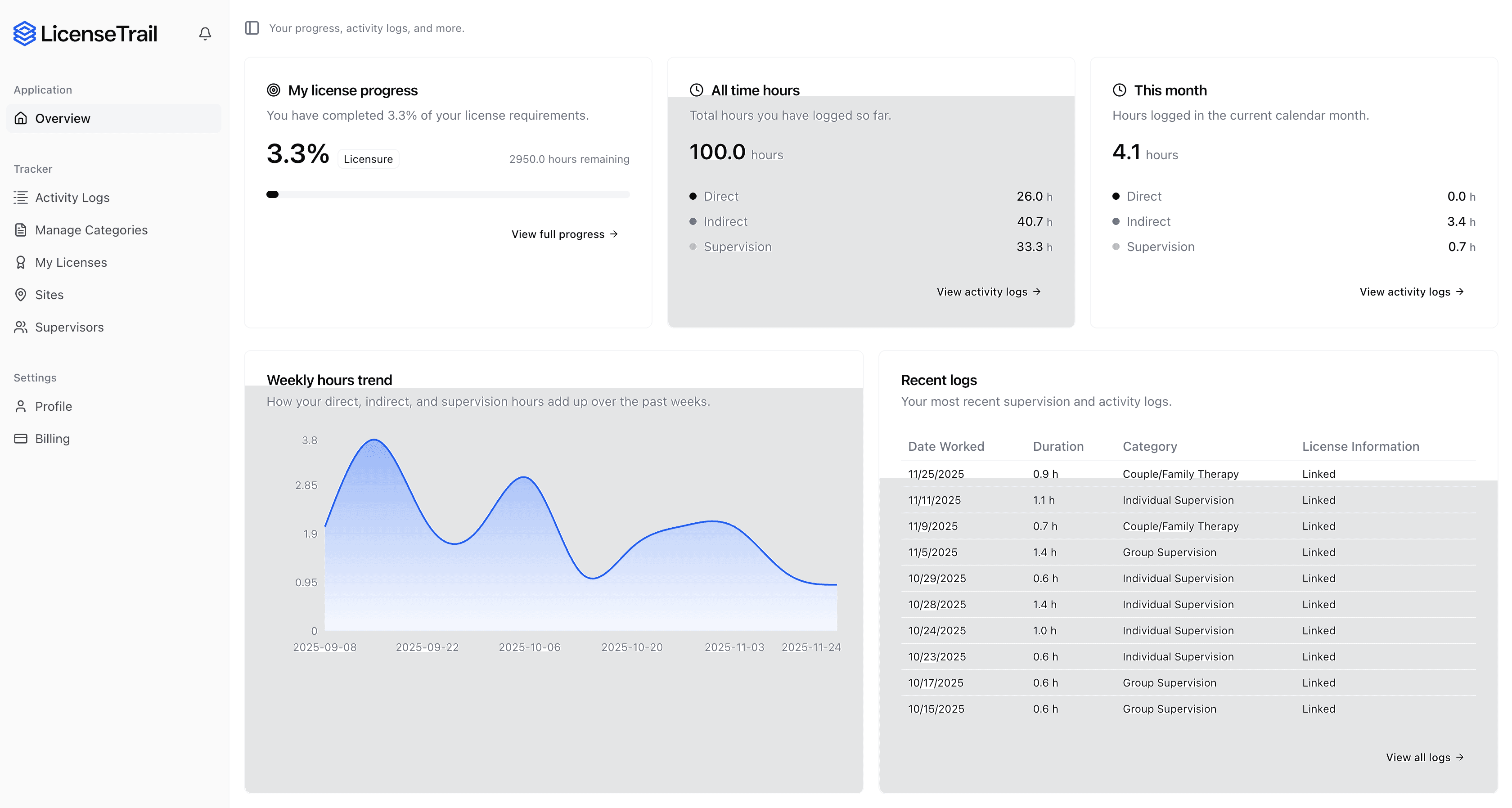
License Trail checks your direct, indirect, and supervision hours against Illinois LCSW requirements continuously and flags mismatches before you submit.
 Start Tracking for Free
No credit card required · Free plan available
Is your spreadsheet hiding Illinois LCSW risks?
Stop guessing if your categories match Illinois Department of Financial and Professional Regulation (Social Work Examining and Disciplinary Board) requirements. License Trail checks your direct, indirect, and supervision hours continuously and flags mismatches before you submit.
Import or log
Bring your spreadsheet or start fresh
Upload your existing tracking spreadsheet and we'll map every hour into the right Illinois Department of Financial and Professional Regulation (Social Work Examining and Disciplinary Board) categories automatically.
Verify against Illinois
Catch mismatches before the board does
License Trail checks your direct, indirect, and supervision hours against Illinois LCSW requirements continuously.
Export board-ready
One-click clean reports
Generate professional, board-ready reports for supervision meetings and Illinois Department of Financial and Professional Regulation (Social Work Examining and Disciplinary Board) submissions in seconds.
No credit card required · Free plan available