
Illinois LMFT Requirements: Hours, Exams & Step-by-Step Guide
Stop guessing if your categories match Illinois requirements. License Trail checks your direct, indirect, and supervision hours against LMFT requirements continuously and flags mismatches before you submit.
No credit card required · Free plan available
Quick Requirements Overview
- Must be 21+ and apply through IDFPR (225 ILCS 55; 68 Ill. Adm. Code 1283)
- Education: Master’s/Doctorate in MFT or related field with equivalent MFT curriculum (COAMFTE accepted)
- Experience: 3,000 hours professional work experience post-degree completed in 2–5 years
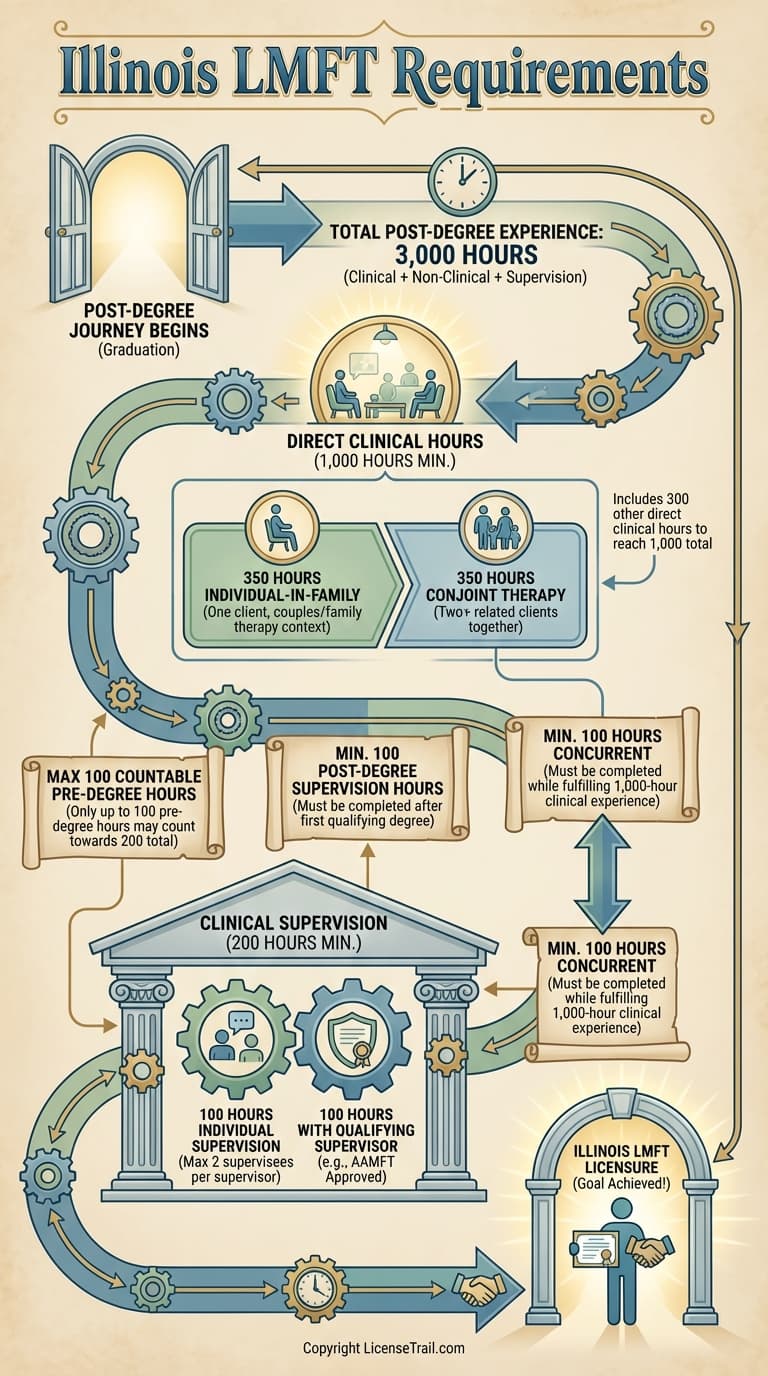
- Clinical: within the 3,000, 1,000 hours face-to-face client contact
- Clinical distribution: within the 1,000, ≥350 hrs individual-in-context (one client present, couple/family focus) and ≥350 hrs conjoint (2+ related clients present)
- Supervision: 200 hours clinical supervision; ≥100 hrs post-degree (up to 100 hrs may count from grad training)
- Supervision format/qualifications: ≥100 hrs individual (max 2 supervisees); remaining may be group (max 6); supervisors must meet rule-defined qualifications (e.g., LMFT/AAMFT-approved/other qualified clinicians)
- Must pass the IDFPR-approved MFT exam (typically AMFTRB) and submit required verifications/fees (AAMFT clinical membership may substitute for some documentation)
License Details
Procedures
Licensure requirements for Licensed Marriage and Family Therapists in Illinois are set by the Illinois Department of Financial and Professional Regulation (IDFPR) under the Marriage and Family Therapy Licensing Act (225 ILCS 55) and its administrative rules in 68 Ill. Adm. Code Part 1283. The Illinois Marriage and Family Therapy Licensing and Disciplinary Board advises the Department on standards and qualifications. (ilga.gov)
Below is a structured walkthrough of what you need to become a fully licensed LMFT in Illinois, with special emphasis on hour types and how the Board defines them.
1. Big-picture overview
To qualify as a Licensed Marriage and Family Therapist (LMFT) in Illinois, you must: (ilga.gov)
- Be at least 21 years old.
- Hold a qualifying master’s or doctoral degree in marriage and family therapy or a related field with an equivalent MFT curriculum.
- After that degree (“first qualifying degree”), complete:
- 3,000 hours of professional work experience in marriage and family therapy,
- which must include 1,000 hours of clinical experience (face-to-face client contact), and
- 200 hours of clinical supervision.
- Accumulate those 3,000 hours in no fewer than 2 years and no more than 5 years.
- Pass the required licensing examination in marriage and family therapy.
- Submit an application and fees to IDFPR with employer/supervisor verification of your education, experience, and supervision.
The rest of this guide explains these pieces in more detail, using the same terminology the Illinois rules use (e.g., “professional work experience,” “clinical experience,” “clinical supervision”).
2. Education: the “first qualifying degree”
Illinois law requires that your foundational degree be: (ilga.gov)
- A master’s or doctoral degree in marriage and family therapy from a regionally accredited institution;
or - A master’s or doctoral degree from a regionally accredited institution in a related field (such as counseling, psychology, social work, etc.) with an equivalent course of study in marriage and family therapy, as recommended by the Board and approved by IDFPR;
or - A degree from a program accredited by COAMFTE (Commission on Accreditation for Marriage and Family Therapy Education).
The rules refer to this as the “first qualifying degree.” All required post-degree experience and supervision hours must occur after this degree, with a limited allowance to count some supervision hours earned during graduate training (explained below). (ilga.gov)
3. Professional work experience: 3,000 hours total
3.1. Total hours and timeframe
The Illinois Administrative Code defines the core experience requirement as: (ilga.gov)
- At least 3,000 hours of professional work experience,
- Completed after receiving your first qualifying degree,
- Accumulated over a minimum of 2 years and a maximum of 5 years.
These 3,000 hours are not all therapy hours; the rules explicitly say they include both clinical activities and non-clinical professional activities related to marriage and family therapy. (ilga.gov)
3.2. What “professional work experience” means
“Professional work experience” is defined by rule as providing professional services in the field of marriage and family therapy. This includes: (ilga.gov)
- Clinical activities (direct client services described under clinical experience, below), and
- Non-clinical activities related to MFT practice (which can include case documentation, team meetings, treatment planning, certain administrative or program activities that are directly tied to clinical work).
Within those 3,000 hours, the rules are very explicit that you must have:
- 1,000 hours of clinical experience (face-to-face client contact as defined in Section 1283.20), and
- 200 hours of clinical supervision (as defined in Section 1283.25).
The 3,000 hours is therefore a single, unified requirement broken down into specific subcomponents (clinical experience and supervision), not separate piles of unrelated hours. (ilga.gov)
4. Clinical experience: 1,000 face-to-face hours (with specific breakdowns)
4.1. Total clinical hours
The rules state that, after your first qualifying degree, you must complete at least 1,000 hours of “face-to-face client contact” with individuals, couples, and families, for the purpose of evaluating and treating mental, emotional, behavioral, and interpersonal disorders within relationships. (ilga.gov)
These 1,000 hours are part of the 3,000 total professional work experience hours—not in addition to them. (ilga.gov)
4.2. Required distribution within the 1,000 clinical hours
Illinois rules impose a specific distribution inside those 1,000 clinical hours: (ilga.gov)
- At least 350 hours must be sessions where only one client is present, but the therapy is being provided to couples or families (often called individual-in-context work).
- At least 350 hours must be conjoint therapy, defined as sessions with two or more clients present who are in significant relationships with each other outside therapy (for example, couples or family sessions).
In practice, this means:
- You cannot meet the entire 1,000 hours with only individual therapy or only conjoint sessions;
- You must deliberately structure your caseload to meet both of these minimums, and the remaining 300 hours can be any mixture of qualifying individual-in-context or conjoint work, as long as it falls under the clinical experience definition.
5. Clinical supervision: 200 hours total, with specific conditions
5.1. Total required supervision hours
Illinois requires 200 hours of clinical supervision in marriage and family therapy. (ilga.gov)
The rules give a detailed, layered structure for how those 200 hours must be accumulated and who can provide them.
5.2. When the hours must occur
Key timing requirements: (ilga.gov)
- At least 100 of the 200 supervision hours must occur after you receive your first qualifying degree.
- Up to 100 hours of supervision completed during graduate training may be counted toward the required 200 hours.
So a typical pattern is:
- 50–100 hours of approved supervision during practicum/internship in your graduate program, plus
- 100+ hours of supervision while you are accruing your post-degree experience (often while holding an Associate LMFT license), together totaling at least 200 hours.
5.3. Who can provide the supervision
The rules require that at least 100 of the 200 hours be with a highly qualified supervisor, and they spell out several acceptable categories. At the time supervision took place, that supervisor must have met one of the following profiles (summarized): (ilga.gov)
- Certified as an approved supervisor or supervisor-in-training by AAMFT;
- A licensed marriage and family therapist with at least 5 years of clinical MFT experience after their first qualifying degree;
- An AAMFT clinical member for at least 5 years;
- A licensed clinical psychologist, licensed clinical social worker, licensed clinical professional counselor, or licensed psychiatrist
- with at least 5 years of clinical experience providing marriage and family therapy,
- at least 1,000 hours of conjoint therapy, and
- either 2 years of experience providing MFT supervision (including conjoint work) or at least one graduate-level supervision course of specified length.
The other 100 hours of supervision may be obtained from a broader group of qualified mental health professionals (LMFT, psychologist, LCSW, LCPC, or psychiatrist) with at least five years’ experience, including during practicum or internship. (ilga.gov)
5.4. Nature of supervision (individual and group)
The rules further clarify what “supervision” means. In summary: (ilga.gov)
- It is a direct clinical review of your client work for training/teaching purposes;
- It must be live, interactive, and visual, meaning in-person or synchronous video meetings where you and the supervisor can see and hear each other;
- It focuses on raw clinical data (e.g., observation, recordings, notes) from your active cases;
- At least 100 of the 200 hours must be individual supervision, defined as a supervisor meeting with no more than two supervisees;
- Group supervision is allowed for the rest, with a maximum of six supervisees per supervisor.
The rules explicitly exclude peer-only supervision, purely administrative supervision, didactic classes, and staff development as counting toward these 200 hours.
6. How the 3,000 hours, 1,000 clinical hours, and 200 supervision hours fit together
Putting the Illinois requirements in the kind of breakdown you asked for:
- Total professional work experience (post-degree): 3,000 hours
- This is the overarching requirement. (ilga.gov)
Within those 3,000 hours, you must have:
-
Clinical (direct client) experience:
- 1,000 hours of face-to-face client contact with individuals, couples, and families,
- including at least 350 hours of individual-in-context work (one client present, therapy for couple/family issues), and
- at least 350 hours of conjoint therapy (two or more related clients present). (ilga.gov)
-
Clinical supervision of MFT practice:
- 200 hours total,
- at least 100 hours after the degree,
- up to 100 hours may be from graduate training,
- at least 100 hours with a supervisor who meets the higher-level criteria in Section 1283.25(b),
- at least 100 hours must be individual supervision, with the remainder allowed as group supervision. (ilga.gov)
The remaining hours (beyond the 1,000 clinical hours and the time spent in supervision meetings) are made up of non-clinical but professional activities connected to your MFT role (documentation, professional meetings about cases, some administrative duties tied to client care, etc.) as framed by the definition of professional work experience. (ilga.gov)
7. Examination requirement
The Act requires that an applicant “passes a written examination authorized by the Department.” (ilga.gov)
The rules (Section 1283.40, referenced in the application section) treat this as the standard marriage and family therapy licensure examination adopted by IDFPR (typically the national AMFTRB exam). For LMFT licensure: (ilga.gov)
- You apply to sit for the exam through the process IDFPR specifies;
- Your exam results must be submitted directly from the testing entity to IDFPR;
- Passing the exam is a separate requirement in addition to your education and experience.
8. Application process and documentation
Section 1283.50 of the Illinois Administrative Code outlines the application for examination and licensure as an LMFT. In condensed form, you must submit: (ilga.gov)
- Application form (now through IDFPR’s CORE online system).
- Verification of education meeting the rules in Section 1283.30.
- Verification of experience:
- Employer/supervisor verification that, after your first qualifying degree, you obtained at least 3,000 hours of work experience as defined in Section 1283.15.
- If you are self-employed, three affidavits from peers, clients, or colleagues familiar with your work.
- Verification of supervision:
- Proof of at least 200 hours of clinical supervision as defined in Section 1283.25.
- Verification of clinical experience:
- Proof of at least 1,000 hours of clinical experience as defined in Section 1283.20 (including the specific breakdown of types of hours).
- Examination documentation:
- Proof you passed the approved MFT licensing exam.
- Required fees as set in Section 1283.95.
IDFPR also allows, in lieu of separately documenting education, experience, and supervision, submission of certification of clinical membership in AAMFT, which they accept as meeting those components. (ilga.gov)
9. Associate LMFT path (brief note)
Illinois now has an Associate Licensed Marriage and Family Therapist (ALMFT) license, with its own application sections in the rules (Sections 1283.45 and 1283.46). The usual modern practice path is: (ilga.gov)
- Graduate with your first qualifying MFT (or equivalent) degree.
- Obtain an Associate LMFT license.
- Under supervision, accumulate the 3,000 professional hours, 1,000 clinical hours, and 200 supervision hours described above.
- Apply for full LMFT licensure by examination, using the verification forms required in Section 1283.50.
The core hour requirements, however, are the same ones outlined earlier—they are simply accumulated while you hold the ALMFT.
10. Summary of hour requirements in Illinois LMFT licensure
To restate the hour requirements in a compact form, using the Illinois Board’s terminology:
- 3,000 hours of professional work experience in marriage and family therapy,
-
obtained after your first qualifying master’s or doctoral degree,
-
over 2–5 years,
-
including within it: (ilga.gov)
-
1,000 hours of clinical experience (face-to-face client contact with individuals, couples, and families for evaluation and treatment of mental and relational disorders), with at least:
- 350 hours of individual-in-context work (one client present, therapy for couple/family issues), and
- 350 hours of conjoint therapy (two or more related clients present).
-
200 hours of clinical supervision of your MFT practice, including:
- At least 100 hours completed after the qualifying degree (up to 100 hours during graduate training may count),
- At least 100 hours with a highly qualified supervisor as defined in the rules,
- At least 100 hours of individual supervision, with the remainder allowed in small group supervision that meets the rule’s requirements.
-
All of this must be documented to IDFPR on its official forms and combined with proof of education and successful completion of the MFT licensing examination.
Track your LMFT hours with confidence
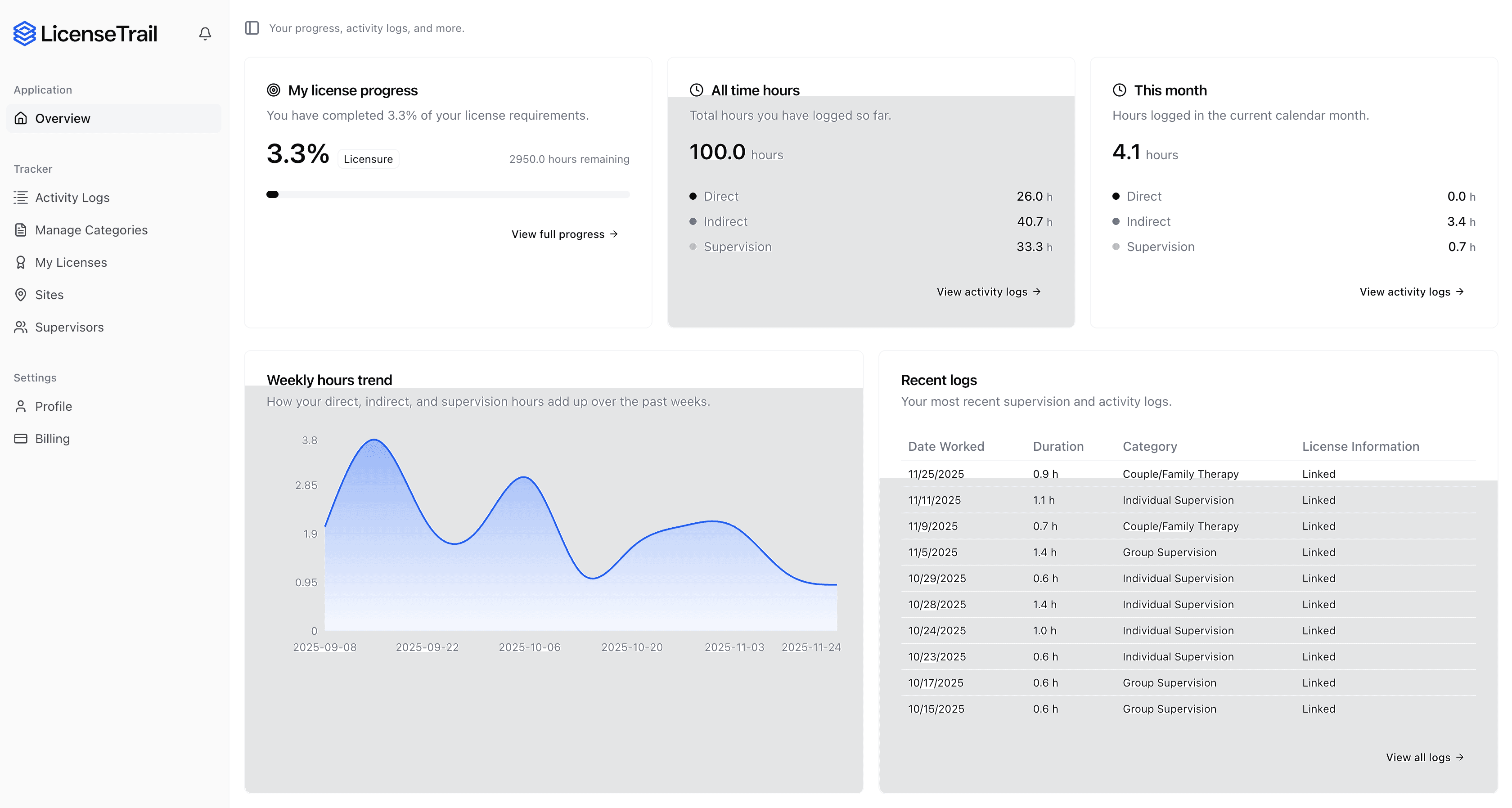
License Trail checks your direct, indirect, and supervision hours against Illinois LMFT requirements continuously and flags mismatches before you submit.
 Start Tracking for Free
No credit card required · Free plan available
Is your spreadsheet hiding Illinois LMFT risks?
Stop guessing if your categories match Illinois Department of Financial and Professional Regulation (Marriage and Family Therapy Licensing and Disciplinary Board) requirements. License Trail checks your direct, indirect, and supervision hours continuously and flags mismatches before you submit.
Import or log
Bring your spreadsheet or start fresh
Upload your existing tracking spreadsheet and we'll map every hour into the right Illinois Department of Financial and Professional Regulation (Marriage and Family Therapy Licensing and Disciplinary Board) categories automatically.
Verify against Illinois
Catch mismatches before the board does
License Trail checks your direct, indirect, and supervision hours against Illinois LMFT requirements continuously.
Export board-ready
One-click clean reports
Generate professional, board-ready reports for supervision meetings and Illinois Department of Financial and Professional Regulation (Marriage and Family Therapy Licensing and Disciplinary Board) submissions in seconds.
No credit card required · Free plan available