
Indiana Psychologist Requirements: Hours, Exams & Step-by-Step Guide
Stop guessing if your categories match Indiana requirements. License Trail checks your direct, indirect, and supervision hours against Psychologist requirements continuously and flags mismatches before you submit.
No credit card required · Free plan available
Quick Requirements Overview
- Two credentials: Psychologist license (title) + HSPP endorsement (independent diagnosis/treatment)
- Psychologist license: Board-approved doctoral degree in psychology; application/fees; 18+; character/discipline eligibility
- Exams for licensure: EPPP + Indiana jurisprudence exam (75% pass; timed completion window)
- License documentation expects practicum/internship-type training in doctoral program; internship verification required (no standalone numeric hours for license)
- HSPP supervised experience: minimum 2 years in health service setting per statute, implemented as specific hour requirements
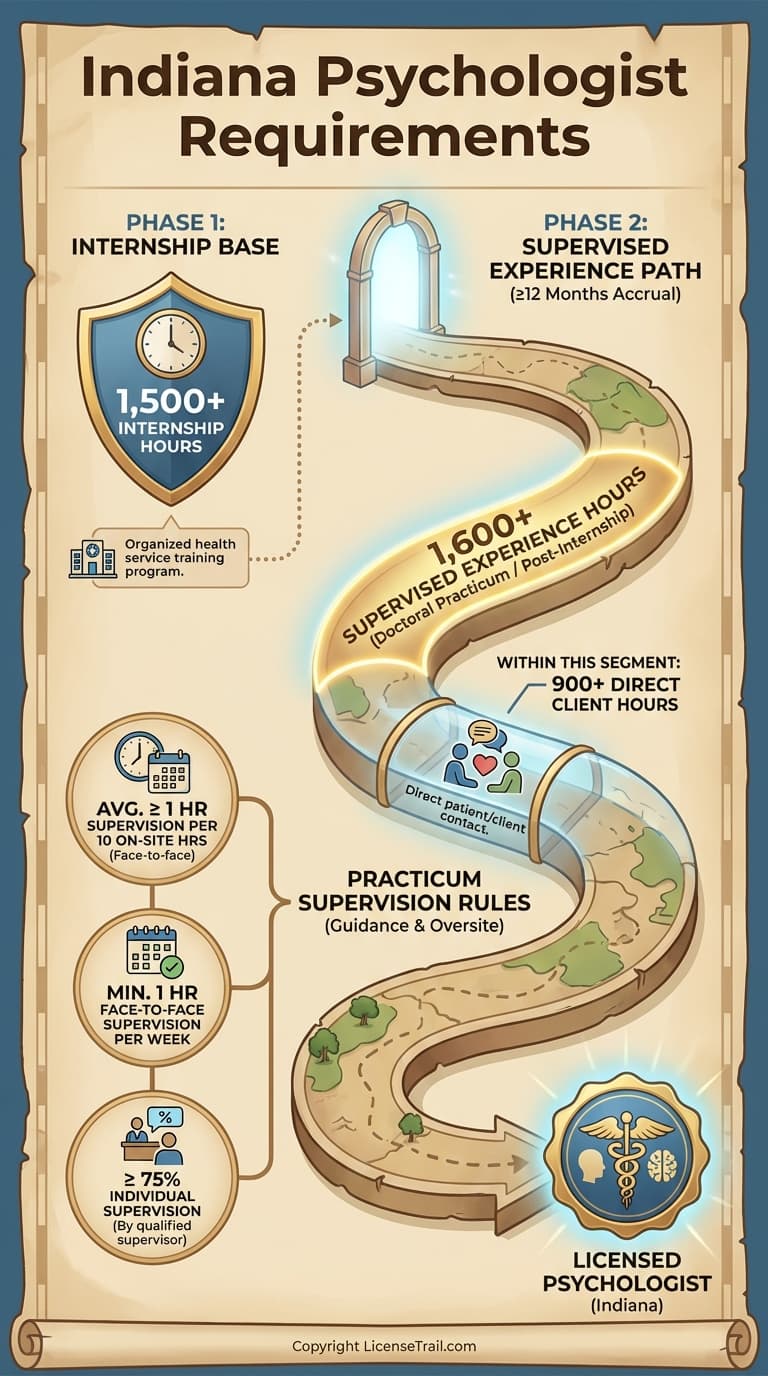
- HSPP internship: 1,500 hours in an approved organized health-service internship (must meet site/supervision structure rules)
- HSPP additional supervised experience: 1,600 hours over ≥12 months, including 900 direct client/patient contact; can be practicum and/or post-internship
- Alternate (pre-9/1/1983 degree w/o formal internship): preceptorship can satisfy 1 year—1,800 work hours + 100 supervision hours (50 dx/50 tx) within 2 years
License Details
Procedures
Becoming a licensed psychologist in Indiana involves two distinct but related credentials issued by the Indiana State Psychology Board:
- The psychologist license (allows you to use the title “psychologist”).
- The Health Service Provider in Psychology (HSPP) endorsement (allows you to independently diagnose and treat mental and behavioral disorders).
Most of the hour requirements live in the rules for the HSPP endorsement, not in the basic license statute, so it’s important to keep those two levels separate.
1. Core license as a Psychologist (no HSPP yet)
1.1. Statutory requirements
Indiana Code 25‑33‑1‑5.1(a) requires the Board to issue a psychology license to an individual who, in summary:
- Applies in the form and manner the Board prescribes. (law.justia.com)
- Is at least 18 years old. (law.justia.com)
- Has not been convicted of a crime that directly bears on the ability to practice competently. (law.justia.com)
- Possesses a doctoral degree in psychology from a recognized postsecondary institution, from a program the Board approves as a psychology program at the time the degree was conferred. (law.justia.com)
- Is not in violation of the psychology statute or Board rules. (law.justia.com)
- Has paid the Board’s fee and passed the examination required and administered by the Board (EPPP). (law.justia.com)
1.2. Educational program and practicum/internship
Board rule 868 IAC 1.1‑4‑1 (“Doctoral degree in psychology”) requires that applicants complete a doctoral program in psychology that is APA- or CPA‑accredited, or, if not accredited, meets detailed Board criteria. Among those criteria:
- In applied areas (clinical, counseling, school), the program must include educational experience with titles such as “practicum, internship, field, or laboratory training.” (law.cornell.edu)
The rule does not assign a specific internship-hour minimum for the license itself; instead, it focuses on the structure and content of the doctoral program.
On the Board’s licensing instructions page for “Psychologist by Examination,” applicants must supply:
- Official transcripts showing conferment of the doctoral degree (Ph.D. or Psy.D.).
- The Board notes that internships should be listed directly on the transcript, and if not, the program must provide a letter verifying completion of the internship. (in.gov)
So, for the psychologist license alone, Indiana law and the Board’s instructions:
- Require a board‑approved doctoral program that includes practicum/internship-type training.
- Expect documentation that an internship was completed.
- Do not specify a numeric internship-hour requirement in the licensing statute or in the “Psychologist by Examination” checklist.
1.3. Exams (EPPP and Indiana jurisprudence)
To obtain the license, you must pass:
- National exam (EPPP): Required exam “administered by the board” under IC 25‑33‑1‑5.1(a)(7). (law.justia.com)
- Indiana jurisprudence exam: The Board’s instructions state that all applicants for psychology licensure must pass a jurisprudence exam on Indiana’s psychology statutes and rules. This is a 50‑question true/false and multiple‑choice test, with a 75% passing score, to be completed within 7 days of the email being sent. (in.gov)
At this point you can be licensed as a psychologist, but you cannot independently diagnose or treat mental and behavioral disorders without the HSPP endorsement.
2. Health Service Provider in Psychology (HSPP): where the hour counts live
2.1. Why HSPP matters
The Board explains that licensed psychologists must obtain endorsement as health service providers in psychology to engage in the independent diagnosis and treatment of mental and behavioral disorders. (in.gov)
If you are licensed as a psychologist but not endorsed as HSPP, you may diagnose/treat mental and behavioral disorders only:
- Under the supervision of an HSPP (while qualifying for endorsement), or
- Under a separate, limited license under IC 25‑33‑1‑18, within that limited scope. (in.gov)
For most clinical careers, obtaining the HSPP endorsement is effectively part of “becoming licensed to practice as a psychologist” in Indiana.
2.2. Overall supervised experience structure for HSPP
Indiana Code 25‑33‑1‑5.1(c) requires that, to be endorsed as a health service provider, a licensed psychologist must have:
- A doctoral degree in an applied health service area (clinical, counseling, school, or similar).
- A psychology license under IC 25‑33‑1‑5.1, 5.3, or 9.
- At least two years of experience in a health service setting, including one year in an organized health service training program and at least one year after the doctoral degree; or equivalent “sequential and organized” supervised professional experience, as defined by Board rule. (law.justia.com)
The Board’s implementing rule, 868 IAC 1.1‑13‑3.1 (“Supervised experience”), translates this into specific hour requirements. It requires not fewer than two years of experience consisting of: (regulations.justia.com)
- Internship:
- Minimum 1,500 hours of experience in a successfully completed internship meeting specific criteria (see next subsection).
- Post‑internship supervised experience:
- Minimum 1,600 hours of supervised experience, accrued in no less than 12 months, and including a minimum of 900 hours of direct patient contact.
- These 1,600 hours may be obtained through:
- Doctoral-level practicum experiences,
- Post‑internship experience, or
- A combination of practicum and post‑internship hours.
The Board’s HSPP application instructions repeat this in almost identical terms:
- “The applicant must show completion of 1,500 hour internship” (Form A).
- “Proof of Post‑Internship Experience: This must be a minimum of 1,600 hours of supervised experience completed in no less than twelve (12) months including 900 hours of direct client hours,” obtained through doctoral practicum and/or post‑internship experience (Forms B and C). (in.gov)
In other words, for HSPP you need, in Board terms:
1,500 hours of internship + 1,600 hours of supervised experience (with 900 of those hours in direct client/patient contact).
2.3. Details of the 1,500‑hour internship (pre‑licensure year)
Board rule 868 IAC 1.1‑13‑3.1(b) specifies that an approved internship must: (regulations.justia.com)
- Occur within a 24‑month period.
- Have approval of the psychology faculty of your academic program.
- Consist of sequential and organized experiences in a supervised health service setting.
- Have at least the equivalent of two full‑time psychologists to provide supervision.
- Be designed to include at least two interns per year.
- Be declared and publicized as an internship by the site each year.
- Have a clearly designated director of training or chief psychologist in charge.
- Ensure that all psychologists responsible for case supervision are licensed or certified in that jurisdiction.
The Board’s HSPP application requires internship verification via Form A, signed by a representative of the program, confirming that the 1,500‑hour internship has been completed in such a setting. (in.gov)
2.4. Details of the 1,600 post‑internship supervised hours (with 900 direct contact)
Rule 868 IAC 1.1‑13‑3.1(a)(2) and (c)–(d) set out how the 1,600 hours of supervised experience must be structured. In summary: (regulations.justia.com)
Basic quantitative requirements
- Total hours: At least 1,600 hours of supervised experience.
- Time frame: Must be accrued in no less than 12 months.
- Direct service requirement: At least 900 hours of direct patient contact (sometimes referred to by the Board as “direct client hours”).
These hours can be assembled from:
- Doctoral-level practicum (pre‑degree) that meets specific criteria, and/or
- Post‑internship experience (usually post‑degree, often called a “postdoc” in practice).
Doctoral-level practicum (Rule 868 IAC 1.1‑13‑3.1(c)) (regulations.justia.com)
A qualifying practicum must:
- Consist of sequential and organized experiences outside the classroom where you deliver supervised psychological services in a practice, agency, institution, counseling center, graduate clinic, or another approved setting.
- Be approved in advance by the director of training or designee, with training objectives specified in terms of competencies.
- Devote at least 50% of supervised experience hours to service‑related activities, such as:
- Treatment/intervention
- Assessment
- Interviews
- Report‑writing
- Case presentations
- Consultations
- Be appropriately supervised, including:
- At least 75% of required supervised hours as individual supervision by a Board‑defined supervisor.
- Remaining supervision hours may be:
- Individual or group supervision by certain licensed allied mental health professionals (as approved), or
- Individual supervision by a qualified postdoctoral supervisee or intern under an “umbrella” supervision arrangement with an HSPP.
- Devote, on average, at least 25% of the supervised professional experience to face‑to‑face patient contact.
- Provide weekly face‑to‑face supervision on the supervisee’s cases at not less than 1 hour of supervision per 10 on‑site hours, and at least 1 hour per week.
- Count toward the required experience only after:
- Completion of at least 48 semester hours (or 72 quarter hours) of academic coursework in an applied psychology program, and
- Completion of a basic practicum of at least 400 hours in applied professional psychology or a related field.
Certain activities explicitly do not count toward direct patient contact or the required experience, including supervising others, teaching, research, and the supervisee’s own personal therapy. (regulations.justia.com)
Post‑internship experience (Rule 868 IAC 1.1‑13‑3.1(d)) (regulations.justia.com)
A qualifying post‑internship (postdoc‑type) experience must:
- Be completed within a consecutive 60‑month period.
- Occur in the supervisor’s office or in another professional setting over which the supervisor has professional responsibility.
- Include at least one hour per week of individual face‑to‑face supervision on‑site.
- Follow the same general guidelines as practicum:
- Supervisor retains authority over the psychological activities.
- Supervisor cannot be employed by, or paid as an independent contractor by, the supervisee.
- Supervision of others, teaching, research, and personal therapy do not count as direct patient contact or toward required hours.
Board verification
For HSPP, the Board requires:
- Form B to verify qualifying doctoral practicum hours.
- Form C to verify post‑internship supervised experience.
- Multiple forms can be submitted if there are several supervisors or settings; supervisors may also provide a supplemental letter summarizing total hours and locations. (in.gov)
3. Special pathway: pre‑1983 degrees without a formal internship
Indiana provides an alternative preceptorship pathway for some older practitioners.
Under IC 25‑33‑1‑5.1(d) and 868 IAC 1.1‑13‑2.1, a psychologist who: (law.justia.com)
- Received a doctoral degree in an applied health service psychology field before September 1, 1983, and
- Did not have a formal internship,
may satisfy one of the two required years of supervised health service experience by completing a preceptorship program that:
- Includes at least 1,800 hours of clinical, counseling, or school psychology work experience.
- Includes at least 100 hours of direct supervision by a psychologist:
- At least 50 hours of that supervision must involve diagnosis of mental and behavioral disorders.
- At least 50 hours must involve treatment of mental and behavioral disorders.
- Is in a health service setting providing diagnosis and treatment of mental and behavioral disorders.
- Is supervised by a psychologist who meets HSPP endorsement requirements.
- Is completed within two years after the program is started. (law.justia.com)
This preceptorship can be credited as one year of the two‑year supervised experience requirement for HSPP.
4. Putting it together: what Indiana actually requires in hours
Summarizing the numeric hour requirements grounded in Board statute and rules:
-
For the psychologist license alone (title use):
- No explicit numeric internship or postdoctoral hour totals appear in IC 25‑33‑1‑5.1(a) or the Board’s “Psychologist by Examination” checklist.
- You must, however, complete a Board‑approved doctoral psychology program that includes practicum/internship‑type training and provide documentation that the internship was completed. (in.gov)
-
For HSPP endorsement (independent clinical practice), Board rule and instructions are specific:
- Internship: At least 1,500 hours in an approved, organized health service internship. (regulations.justia.com)
- Additional supervised experience: At least 1,600 hours of supervised experience in no fewer than 12 months, of which 900 hours must be direct client/patient contact, obtained through doctoral practicum, post‑internship experience, or a combination. (regulations.justia.com)
- Structure of those hours: Must follow detailed Board rules regarding settings, minimum proportions of service‑related activities, minimum face‑to‑face patient contact and supervision ratios, and exclusions for non‑clinical activities. (regulations.justia.com)
Functionally, this means that to be fully independent in clinical practice in Indiana as a psychologist, the Indiana State Psychology Board expects a training sequence that includes:
- A doctoral degree from a Board‑approved psychology program.
- A 1,500‑hour structured health‑service internship.
- 1,600 hours of supervised experience, accumulated over at least 12 months, including 900 direct client/patient contact hours, through practicum and/or post‑internship roles.
- Successful completion of the EPPP and the Indiana jurisprudence exam. (in.gov)
Track your Psychologist hours with confidence
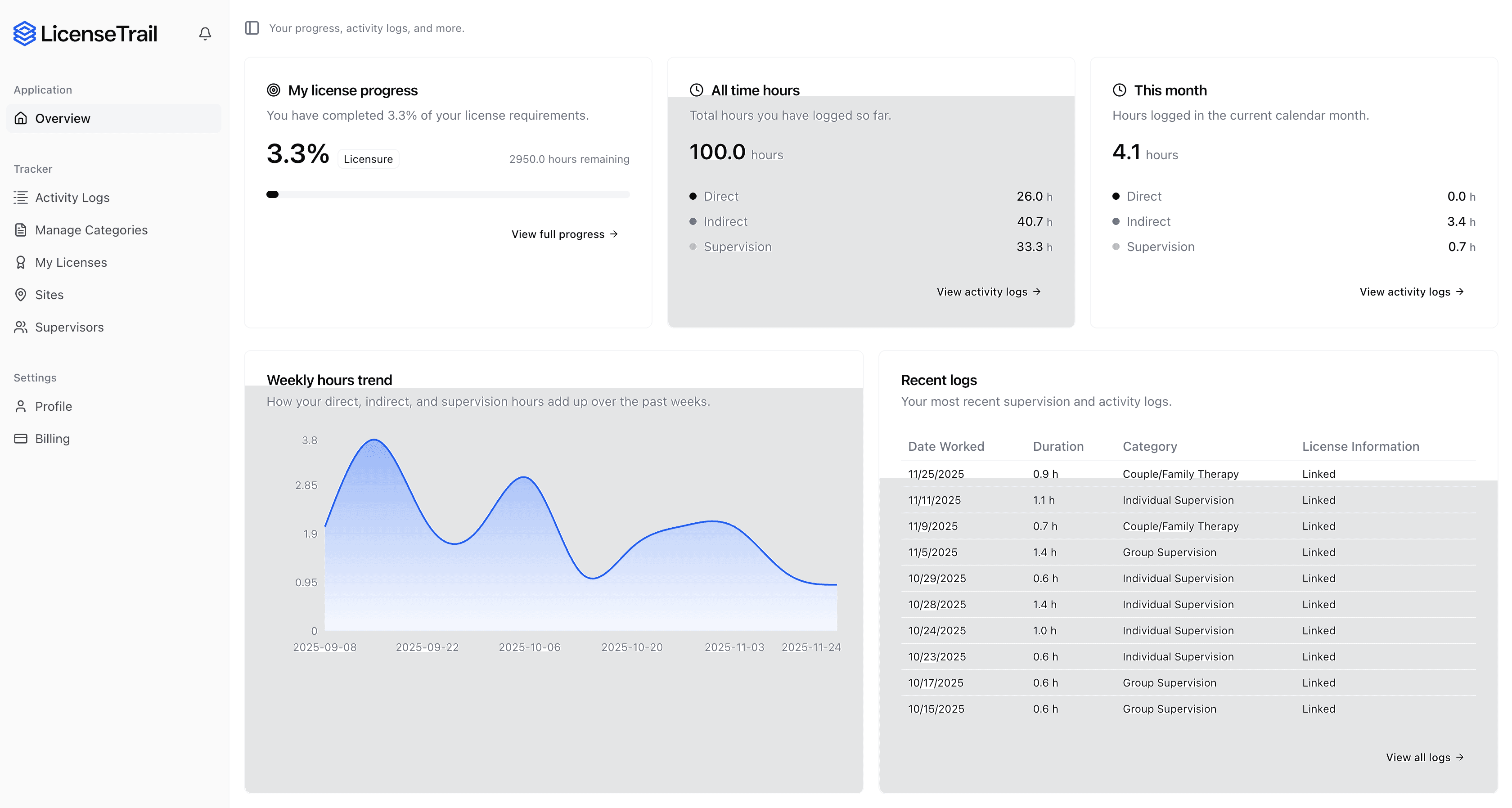
License Trail checks your direct, indirect, and supervision hours against Indiana Psychologist requirements continuously and flags mismatches before you submit.
 Start Tracking for Free
No credit card required · Free plan available
Related Licenses
Is your spreadsheet hiding Indiana Psychologist risks?
Stop guessing if your categories match Indiana State Psychology Board requirements. License Trail checks your direct, indirect, and supervision hours continuously and flags mismatches before you submit.
Import or log
Bring your spreadsheet or start fresh
Upload your existing tracking spreadsheet and we'll map every hour into the right Indiana State Psychology Board categories automatically.
Verify against Indiana
Catch mismatches before the board does
License Trail checks your direct, indirect, and supervision hours against Indiana Psychologist requirements continuously.
Export board-ready
One-click clean reports
Generate professional, board-ready reports for supervision meetings and Indiana State Psychology Board submissions in seconds.
No credit card required · Free plan available