
Iowa LISW Requirements: Hours, Exams & Step-by-Step Guide
Stop guessing if your categories match Iowa requirements. License Trail checks your direct, indirect, and supervision hours against LISW requirements continuously and flags mismatches before you submit.
No credit card required · Free plan available
Quick Requirements Overview
- CSWE‑accredited MSW (or board‑approved DSW); foreign degrees require equivalency review
- Obtain Iowa LMSW first (apply, transcripts/license verifications); pass ASWB Master/Intermediate exam
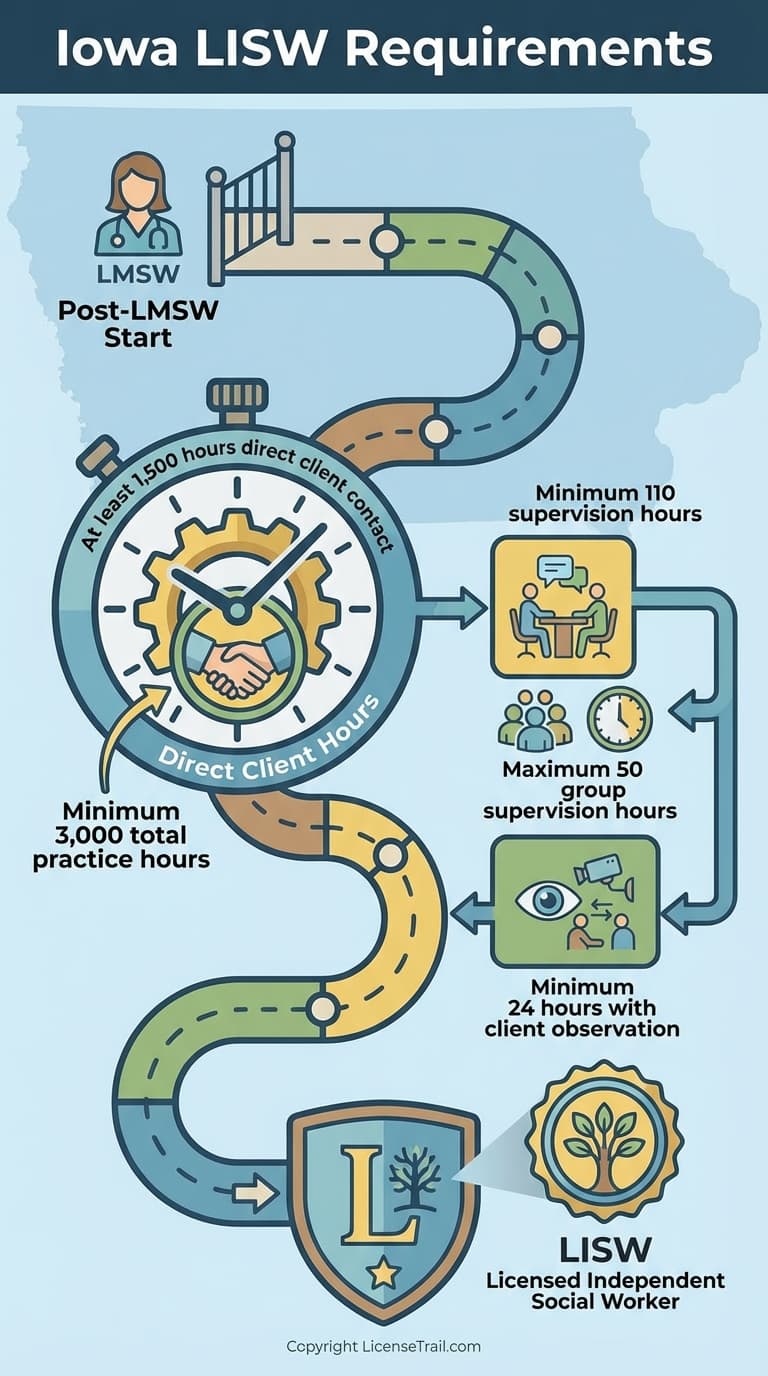
- LISW supervised clinical experience must start after LMSW, last ≥ 2 years, total ≥ 3,000 supervised practice hours
- Within 3,000 hours: ≥ 1,500 direct client contact hours
- Supervision minimum: ≥ 110 direct supervision hours, equitably distributed; ≥ 24 live/recorded observation; ≤ 50 group; in‑person or video; supervision continues beyond 110 until hours complete
- Clinical content must include psychosocial assessment, DSM diagnosis, treatment/therapy & planning, and practice readiness (ethics/law, documentation, coordination, management, self‑care)
- Supervisor: Iowa independent license (LISW/LMHC/LMFT) + 3 years independent practice + supervision training; nonqualifying supervisor requires pre‑approval
- Paperwork & exam: submit board supervision plan before starting (and with supervisor changes); file supervision reports at end/change; pass ASWB Clinical exam for LISW
License Details
Procedures
Becoming a Licensed Independent Social Worker (LISW) in Iowa means meeting the “independent level social worker” standards set by the Iowa Board of Social Work (Professional Licensure Division, Agency 645). The core of this credential is a specific supervised clinical experience completed after you are licensed at the master level, plus passing the ASWB Clinical exam.
Below is a structured walk‑through of the requirements, with emphasis on the types of hours and the Iowa Administrative Code wording that governs them.
1. Educational foundation
To qualify for LISW (independent level) licensure, you must first meet the master/independent education standard in rule 645‑280.5:
- You must have either:
- A master’s degree in social work from a program accredited by the Council on Social Work Education (CSWE) at the time of graduation, or
- A doctoral degree in social work from a program approved by the board. (law.cornell.edu)
Foreign‑trained social workers must obtain a formal equivalency evaluation; the curriculum must be equivalent to that required in Iowa. (law.cornell.edu)
2. Obtain licensure as a master level social worker (LMSW)
Iowa distinguishes between master level and independent level social workers. Before you can begin counting LISW clinical hours, you must:
- Hold the qualifying degree above. (law.cornell.edu)
- Apply for licensure at the master level (LMSW) and meet the general licensure criteria in rule 645‑280.3:
- Submit a completed application and pay the non‑refundable fee.
- Arrange for official academic transcripts to be sent directly to the board (or use ASWB Social Work Registry verification).
- Provide verification of any current or prior social work licenses in other jurisdictions, including any public or pending complaints. (law.cornell.edu)
- Pass the ASWB examination at the master level. Rule 645‑280.4 specifies:
- Master level social worker – the intermediate level ASWB exam. (law.cornell.edu)
Only after you are licensed at the master level can your LISW supervised clinical experience begin.
Key timing rule: “The supervised clinical experience cannot begin until after licensure as a master level social worker.” (law.cornell.edu)
3. Supervised clinical experience for LISW: hours and content
3.1. Overall structure and duration
Under Iowa Admin. Code r. 645‑280.6, an LISW applicant must complete a supervised clinical experience that meets all of these minimum requirements: (law.cornell.edu)
-
Timing
- Cannot begin until after licensure as a master level social worker.
-
Duration
- Must be a minimum of two years.
-
Total practice hours
- The supervised clinical experience consists of at least 3,000 hours of practice (board language). (law.cornell.edu)
In other words, Iowa does not currently require 1,500 hours of “direct experience” plus 1,500 hours of separate “supervised experience.” Instead, it requires:
- 3,000 total hours of supervised practice, within which specific subsets are defined (direct client contact and direct supervision hours).
-
Direct client contact hours
- Within those 3,000 hours, the experience must include at least 1,500 hours of direct client contact (board language). (law.cornell.edu)
“Direct client contact” is clinical work involving direct interaction with clients—assessment, diagnosis, therapy, treatment planning, and related activities, as outlined in the content requirements (see below).
-
Direct supervision hours
- The supervised clinical experience must include at least 110 hours of direct supervision, with all of the following conditions: (law.cornell.edu)
- Supervision must be equitably distributed over the supervised period (not clustered into a short span).
- At least 24 hours must be live or recorded direct observation of client interaction.
- A maximum of 50 hours of the 110 may be obtained through group supervision.
- Direct supervision can occur in person or via videoconferencing.
- After the 110 hours are reached, ongoing direct supervision must continue for the remainder of the 3,000‑hour experience (i.e., you do not stop supervision once you hit 110; it continues but 110 is the minimum required total).
- The supervised clinical experience must include at least 110 hours of direct supervision, with all of the following conditions: (law.cornell.edu)
3.2. Number of supervisors and supervisees
Iowa’s LISW rule also sets structural limits: (law.cornell.edu)
- A supervisee may have at most four supervisors at any given time.
- A supervisor determines how many supervisees they can safely and competently oversee and must not exceed that number.
3.3. Required clinical content
The board defines the content of the supervised clinical experience; it must involve all of the following types of work: (law.cornell.edu)
- Performing psychosocial assessments.
- Diagnostic practice using the current edition of the Diagnostic and Statistical Manual of Mental Disorders (DSM‑5‑TR).
- Providing treatment, including:
- Establishing treatment goals.
- Delivering psychosocial therapy using evidence‑based therapeutic modalities.
- Differential treatment planning.
- Preparation for independent practice, including training in:
- Practice management.
- Ethical standards.
- Legal and regulatory requirements.
- Documentation.
- Coordination of care.
- Self‑care.
This content language is important when you and your supervisor design your supervision plan and choose roles that will count toward LISW hours.
4. Supervisor qualifications
Rule 645‑280.6 also defines who may supervise your LISW hours. An eligible supervisor must: (law.cornell.edu)
-
Hold an active independent‑level license in Iowa as one of the following:
- Licensed independent social worker (LISW),
- Licensed mental health counselor, or
- Licensed marital and family therapist.
-
Have at least three years of independent practice.
-
Have completed either:
- At least a six‑hour continuing education course in supervision, or
- One graduate‑level course in supervision.
-
Be knowledgeable of the applicable ethical code and licensing rules governing the supervisee.
Any request to use a supervisor who does not meet these criteria must be approved by the board before supervision begins. (law.cornell.edu)
5. Supervision plan and supervision reports
Iowa requires formal documentation of supervision, both at the start and at the end (or when supervisors change). Under rule 645‑280.6: (law.cornell.edu)
-
Supervision plan (before you begin)
- Before supervision starts, you must submit a written supervision plan to the board using the current board‑published form.
- If you begin supervision with a new supervisor, you must submit a new supervision plan before that new supervision begins.
-
Supervision report (when supervision ends or changes)
- When supervision is complete, or when a supervisor stops supervising you, the supervisee must ensure a completed supervision report (using the board’s current form) is submitted to the board.
- If a supervisor reports that you are not yet adequately prepared for independent licensure or notes violations of board rules or ethical codes, the board may require additional supervision or training before granting LISW licensure.
-
Experience in other states
- If you completed some or all of your supervised clinical experience in another state without obtaining a license there, rule 645‑280.6(5) directs you to contact the Iowa Board to determine whether that experience can count toward Iowa LISW requirements. (law.cornell.edu)
-
Grandfather clause
- Any new or additional requirements imposed by the 2022–2024 amendments to rule 645‑280.6 do not apply to supervision that started before July 20, 2022. (law.cornell.edu)
6. Examination requirement for LISW
After you have met the supervised clinical experience requirements, you must pass the ASWB exam at the appropriate level for independent licensure:
- Independent level social worker – ASWB Clinical level examination. (law.cornell.edu)
The Iowa Board:
- Accepts only official exam results sent directly from ASWB (or via ASWB Social Work Registry verification).
- Uses the ASWB passing score as the Iowa passing score. (law.cornell.edu)
If you have already passed an equivalent California licensing examination at the clinical level, the board may accept that in lieu of the ASWB exam, per rule 645‑280.4(6). (law.cornell.edu)
7. Application and documentation checklist (LISW)
Putting the pieces together, becoming an LISW through the Iowa Board of Social Work currently involves:
-
Education
- Master’s or doctoral degree in social work meeting 645‑280.5. (law.cornell.edu)
-
Master level licensure (LMSW)
- Apply for licensure, submit transcripts and license verifications, and pass the ASWB intermediate‑level exam. (law.cornell.edu)
-
Supervised clinical experience (post‑LMSW)
- At least 2 years in duration.
- At least 3,000 hours of supervised practice.
- Within that total, at least 1,500 hours of direct client contact.
- At least 110 hours of direct supervision, including:
- At least 24 hours of live or recorded observation of client interaction.
- No more than 50 hours obtained via group supervision.
- Experience content must match the psychosocial assessment, DSM‑based diagnosis, treatment, and practice‑readiness elements defined in 645‑280.6. (law.cornell.edu)
-
Supervisors
- Must hold an Iowa independent‑level license (LISW, LMHC, or LMFT), have 3 years of independent practice, and have specific supervision training. (law.cornell.edu)
-
Board paperwork
- File a supervision plan before supervision starts (and whenever supervisors change).
- Ensure supervision reports are submitted when supervision ends or at completion. (law.cornell.edu)
-
Exam and final LISW application
- After the supervised experience is approved, take and pass the ASWB Clinical exam, then complete the LISW application with required fees and verifications. (law.cornell.edu)
Note on changing rules and hour counts
Iowa recently undertook substantial rule updates (effective July 17, 2024, for Chapter 280). (rules.iowa.gov) Some third‑party sites still describe the older standard of 4,000 total hours over 2–6 years; those numbers come from earlier versions of the rules and are no longer what the current, codified rule 645‑280.6 says. (legis.iowa.gov)
As of November 23, 2025, the official, in‑force requirement for LISW supervised clinical experience in Iowa is:
- 3,000 hours total supervised practice,
- Including 1,500 hours of direct client contact, and
- 110 hours of direct supervision with specified observation and distribution requirements. (law.cornell.edu)
Because Iowa continues to update its administrative rules periodically, applicants should always check the current text of Iowa Admin. Code r. 645‑280.6 and related rules at the time they apply.
Track your LISW hours with confidence
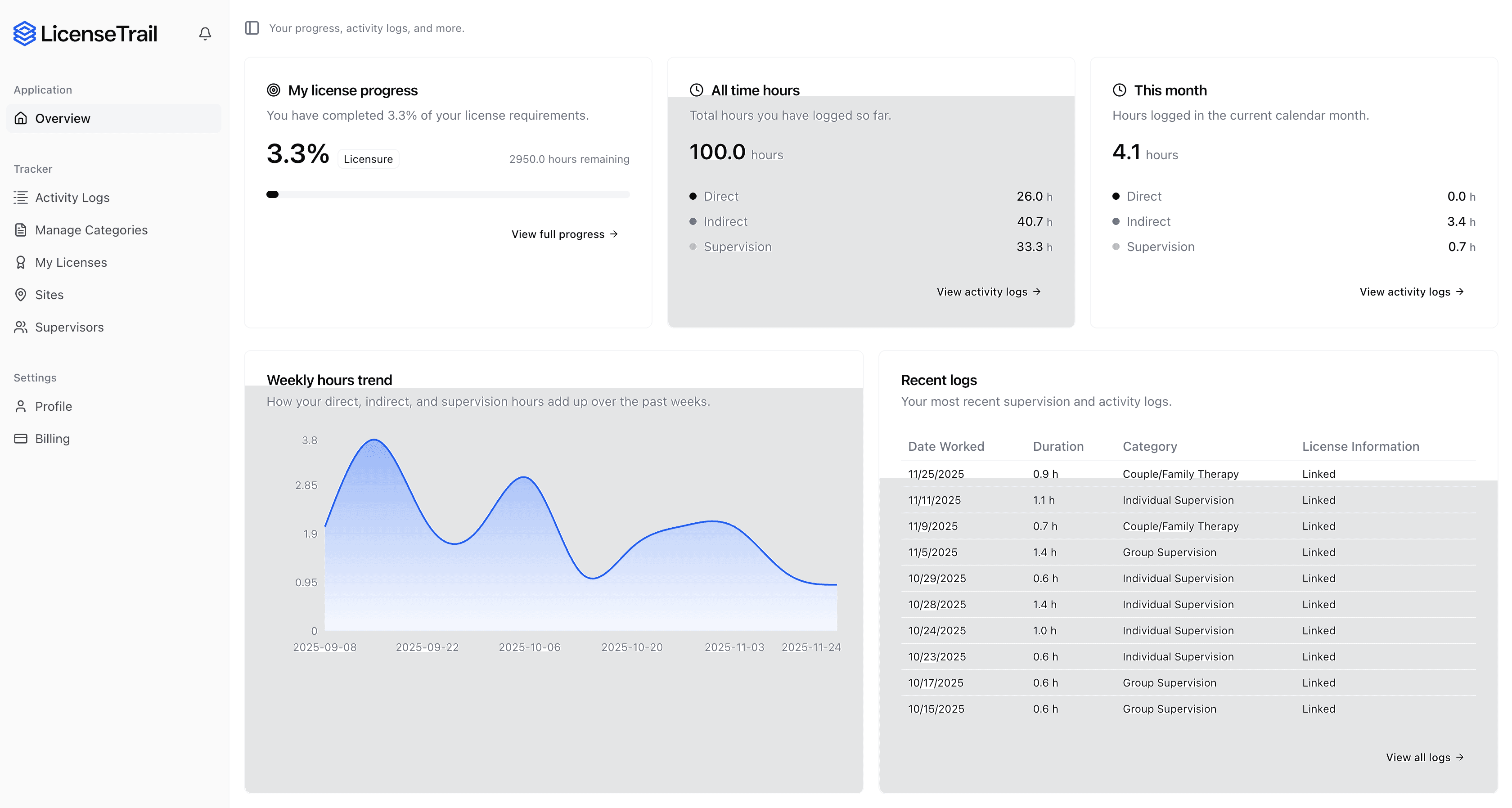
License Trail checks your direct, indirect, and supervision hours against Iowa LISW requirements continuously and flags mismatches before you submit.
 Start Tracking for Free
No credit card required · Free plan available
Is your spreadsheet hiding Iowa LISW risks?
Stop guessing if your categories match Iowa Board of Social Work requirements. License Trail checks your direct, indirect, and supervision hours continuously and flags mismatches before you submit.
Import or log
Bring your spreadsheet or start fresh
Upload your existing tracking spreadsheet and we'll map every hour into the right Iowa Board of Social Work categories automatically.
Verify against Iowa
Catch mismatches before the board does
License Trail checks your direct, indirect, and supervision hours against Iowa LISW requirements continuously.
Export board-ready
One-click clean reports
Generate professional, board-ready reports for supervision meetings and Iowa Board of Social Work submissions in seconds.
No credit card required · Free plan available