
Kansas LCSW Requirements: Hours, Exams & Step-by-Step Guide
Stop guessing if your categories match Kansas requirements. License Trail checks your direct, indirect, and supervision hours against LCSW requirements continuously and flags mismatches before you submit.
No credit card required · Free plan available
Quick Requirements Overview
- Provided text covers Arkansas LCSW, not Kansas (KS) LCSW—KS requirements can’t be confirmed from this source.
- MSW required (CSWE/CASWE-accredited program per the text).
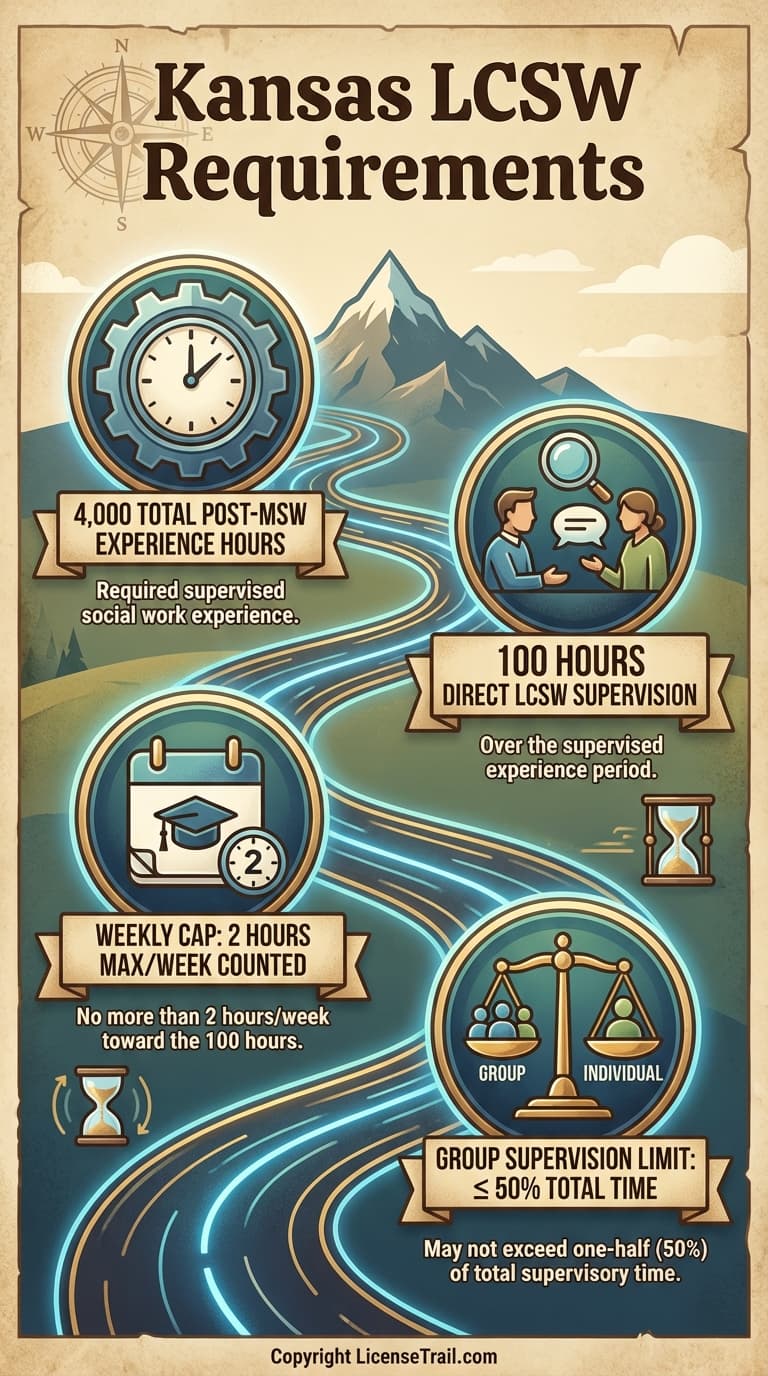
- Post‑MSW supervised experience: 24 months minimum and 4,000 hours in a supervised master’s-level social work position.
- Experience may be clinical or non‑clinical (per the text) as long as properly supervised.
- Supervision: 100 direct supervision hours with an LCSW (or board‑approved equivalent) licensed ≥3 years.
- Supervision limits: max 2 supervision hours/week counted; group supervision ≤50% and groups of ≤4 supervisees.
- Exam: ASWB Clinical (board authorization required) + criminal background check/character & fitness.
License Details
Procedures
In Arkansas, the Licensed Certified Social Worker (LCSW) is the highest level of social work licensure and authorizes independent clinical practice. The Arkansas Social Work Licensing Board (SWLB) sets the specific education, experience, and examination requirements in its statutes and administrative rules.
Below is a step‑by‑step guide organized around the Board’s own terminology, with special focus on the exact types and amounts of hours required.
1. Baseline eligibility for Arkansas LCSW
The Board’s rules and statute require that an LCSW applicant:
- Hold an MSW from a social work program accredited by the Council on Social Work Education (CSWE) or the Canadian Association for Social Work Education. (law.justia.com)
- Complete substantial supervised post‑master’s practice, defined by the Board as:
- “twenty‑four (24) months postmaster’s social work experience, and four thousand (4,000) hours in a supervised Master’s level social work position” under an LCSW (or other Board‑approved equivalent). (law.cornell.edu)
- Pass a Board‑approved examination for this level (the ASWB Clinical exam is used for LCSW). (law.justia.com)
- Apply for and clear a criminal background check and meet character and fitness criteria (“good moral character,” physical and mental competence, and no disqualifying offenses under Ark. Code § 17‑103‑307). (law.justia.com)
On the Board’s own licensing portal, the LCSW checkbox summarizes this as:
“two (2) years (4,000) hours post‑graduate LCSW supervised social work experience (clinical or non‑clinical).” (ark.org)
2. Licensure sequence: LMSW first, then LCSW
In practice, Arkansas expects you to:
- Earn the MSW.
- Become licensed as a Licensed Master Social Worker (LMSW).
- Accrue your LCSW‑level supervised experience as an LMSW under an approved LCSW supervisor pursuant to the Board’s “LCSW Supervision Guidelines.” (law.cornell.edu)
The Board publishes a required Supervision Plan and LCSW Supervision Guidelines on its website, and secondary guidance notes that the plan must be filed and approved (commonly within about 60 days of starting supervision) for hours to count. (healthy.arkansas.gov)
3. Supervised post‑master’s experience: how the hours work
3.1. Total practice hours and time frame
The core experiential requirement, as defined by Arkansas statute and rules, is:
- At least 24 months (two years) of supervised post‑master’s social work experience, and
- At least 4,000 hours in a master’s‑level social work position under qualifying LCSW supervision. (law.justia.com)
Key points about these 4,000 hours:
- The rules equate two years of social work experience with 4,000 hours, and explicitly label this as “postmaster’s” or “post‑graduate LCSW supervised social work experience.” (law.cornell.edu)
- The experience can be clinical or non‑clinical, as long as it is in a master’s‑level social work position and supervised by an LCSW (or equivalent, as approved by the Board). (ark.org)
- The 24‑month period is a minimum duration; you may take longer than two years to accrue the hours, but you cannot complete them in less than 24 months.
The law and rules do not break those 4,000 hours into sub‑categories like “X hours of direct client care” and “Y hours of administration.” Instead, they focus on:
- Overall hours in a qualifying social work position, and
- A separate, specific minimum for direct supervision hours (see next section).
3.2. Direct supervision hours (LCSW supervision)
The Board gives “supervision” a formal definition:
“Supervision is a professional relationship between a supervisor and a supervisee designed to promote responsibility, competency and accountability to the agency, clients and community.” (law.cornell.edu)
For LCSW licensure, the Board’s rules require:
- Your supervisor must be an LCSW (or Board‑approved equivalent) who has been fully licensed for at least three (3) years to provide LCSW supervision. (law.cornell.edu)
- Over the 24‑month period, you must complete at least “one hundred (100) direct supervision hours” with that supervisor. (law.cornell.edu)
The rules further specify how those 100 hours must be structured:
- No more than two (2) supervision hours can be counted in any single week. (law.cornell.edu)
- Group supervision:
- Allowed only when the group has no more than four supervisees, and
- Group supervision cannot exceed one‑half of the total supervisory time (so at least half of your 100 hours must be individual or dyadic). (law.cornell.edu)
- A companion supervision rule also states that during the two‑year LCSW supervision period, the applicant must average one hour per week of face‑to‑face LCSW supervision. (law.cornell.edu)
Putting this together in practical terms:
- Total practice hours: at least 4,000 hours in a supervised master’s‑level social work position over at least 24 months.
- Within that same 24‑month period: at least 100 hours of direct, face‑to‑face supervision with an LCSW, averaging about 1 hour/week, with:
- Maximum 2 hours/week counted, and
- Maximum 50% of those 100 hours in group supervision of four supervisees or fewer.
These “direct supervision hours” are supervisory contact hours, not additional client‑service hours; they occur during, and in relation to, your 4,000 hours of practice.
4. Acceptable settings and supervisor arrangements
Arkansas is relatively flexible about settings, as long as:
- The work is at a master’s‑level social work position (the rules use this phrase repeatedly). (law.cornell.edu)
- The position is “LCSW supervised social work experience (clinical or non‑clinical)” at the post‑graduate level. (ark.org)
Additional Board guidance on supervision logistics:
- Supervision may be provided within or outside the employing agency (e.g., you may have an external LCSW supervisor if your agency lacks one). (law.cornell.edu)
- Technology‑assisted supervision (e.g., video) is allowed, but the rules require appropriate safeguards for confidentiality, such as passwords, encryption, and private settings, and they reference national technology standards from NASW, ASWB, CSWE, and CSWA. (law.cornell.edu)
The Board also states that an LMSW seeking LCSW licensure “must adhere to the LCSW Supervision Guidelines published on the Board’s website,” which flesh out expectations for content, documentation, and evaluation of supervision. (law.cornell.edu)
5. Examination requirement
After your supervised experience is complete and accepted by the Board, you must pass a Board‑approved exam:
- Arkansas uses the Association of Social Work Boards (ASWB) Clinical examination for the LCSW level. (aswb.org)
- The exam may be taken only after the Board authorizes you (i.e., once your application and supervised experience documentation have been reviewed).
The Board’s rules note generally that each applicant must pass an examination approved by the Board for this purpose and level of practice as part of the LCSW qualification. (law.justia.com)
6. Application and documentation to the Board
When you have met the education and supervision requirements, the Arkansas SWLB process typically involves:
- Submitting an online LCSW application and fee via the state licensing portal. (ark.org)
- Criminal background check: initiating the fingerprint‑based background check as directed by the Board. (law.justia.com)
- Supervision documentation, which usually includes:
- A Board‑approved Supervision Plan on file (from when you started). (healthy.arkansas.gov)
- A completed Supervision Evaluation / verification form from your LCSW supervisor, documenting:
- The 24‑month minimum duration,
- The 4,000 total hours of post‑master’s social work in a supervised master’s‑level position, and
- The minimum 100 hours of direct supervision under an appropriately qualified LCSW. (law.cornell.edu)
- Once approved, the Board notifies ASWB that you are eligible to sit for the Clinical exam; after you pass, the Board issues the LCSW license. (publichealthonline.org)
7. Summary of Arkansas LCSW hour requirements “at a glance”
Using the Board’s own terminology:
-
Degree requirement
- Master’s degree in social work (MSW) from a CSWE‑ or CASWE‑accredited program. (law.justia.com)
-
Post‑master’s social work experience
- “Twenty‑four (24) months postmaster’s social work experience, and four thousand (4,000) hours in a supervised Master’s level social work position” under the supervision of an LCSW (or Board‑approved equivalent). (law.cornell.edu)
- The Arkansas online licensure system restates this as “two (2) years (4,000) hours post‑graduate LCSW supervised social work experience (clinical or non‑clinical).” (ark.org)
-
Direct supervision hours
- At least “one hundred (100) direct supervision hours” with an LCSW supervisor who has been fully licensed at least three years. (law.cornell.edu)
- Count no more than two (2) supervision hours per week toward this 100‑hour minimum. (law.cornell.edu)
- Group supervision allowed only with four or fewer supervisees, and it cannot exceed one‑half of total supervisory time. (law.cornell.edu)
- During the two‑year period, you must average about one hour per week of face‑to‑face LCSW supervision. (law.cornell.edu)
-
Other requirements
- Board‑approved clinical‑level exam (ASWB Clinical). (law.justia.com)
- Criminal background check, good moral character, and fitness to practice. (law.justia.com)
There is no Arkansas requirement that the 4,000 hours be split into, for example, “1,500 hours of direct experience and 1,500 hours of supervised experience.” Instead, the Board’s framework is:
- 4,000 total post‑master’s social work hours over at least 24 months in a supervised master’s‑level position,
- plus a minimum of 100 direct LCSW supervision hours (with weekly and group‑supervision limits) within that same supervised practice period.
Track your LCSW hours with confidence
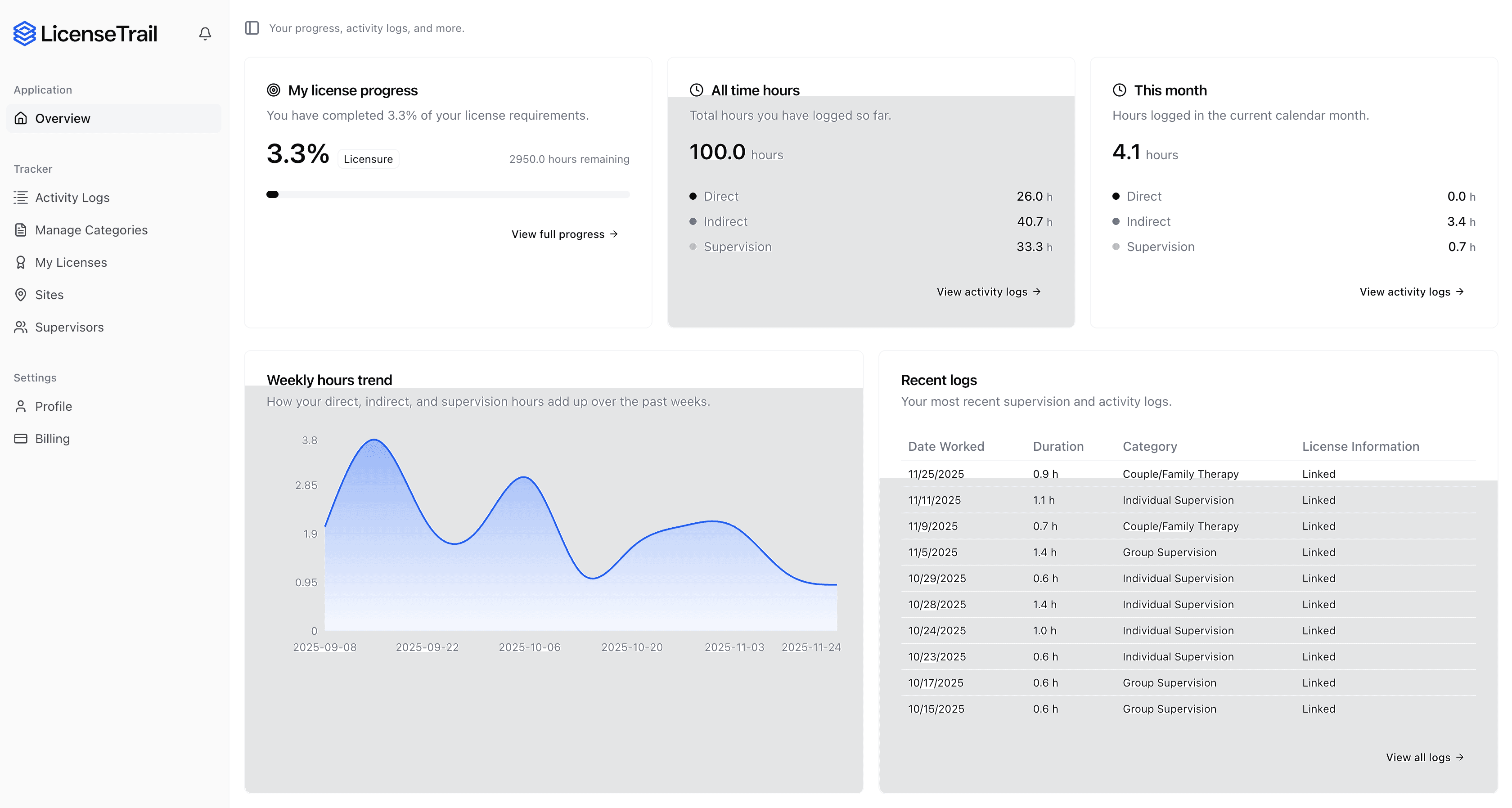
License Trail checks your direct, indirect, and supervision hours against Kansas LCSW requirements continuously and flags mismatches before you submit.
 Start Tracking for Free
No credit card required · Free plan available
Related Licenses
Is your spreadsheet hiding Kansas LCSW risks?
Stop guessing if your categories match Arkansas Social Work Licensing Board requirements. License Trail checks your direct, indirect, and supervision hours continuously and flags mismatches before you submit.
Import or log
Bring your spreadsheet or start fresh
Upload your existing tracking spreadsheet and we'll map every hour into the right Arkansas Social Work Licensing Board categories automatically.
Verify against Kansas
Catch mismatches before the board does
License Trail checks your direct, indirect, and supervision hours against Kansas LCSW requirements continuously.
Export board-ready
One-click clean reports
Generate professional, board-ready reports for supervision meetings and Arkansas Social Work Licensing Board submissions in seconds.
No credit card required · Free plan available