
Kentucky CPAF Requirements: Hours, Exams & Step-by-Step Guide
Stop guessing if your categories match Kentucky requirements. License Trail checks your direct, indirect, and supervision hours against CPAF requirements continuously and flags mismatches before you submit.
No credit card required · Free plan available
Quick Requirements Overview
- CPAF is a legacy title in KY; no new CPAF licenses issued—new applicants pursue Licensed Psychological Practitioner (LPP) instead
- Education: 60 graduate semester hours in psychology/related field (board-acceptable; typically master’s+)
- Prereq credential: must first be board-credentialed as Certified Psychologist / (Licensed) Psychological Associate (can’t go straight to LPP)
- Pre-licensure training for LPA: 600 supervised hours (organized program; ≥25% direct client contact) + EPPP ≥400 (master’s standard)
- LPP experience: 5 full-time years = 9,000 hours supervised professional practice after initial credentialing; temporary-license time doesn’t count
- Hour content: ≥50% of supervised hours in service-related clinical activities (treatment/assessment/interviews/reports/case presentations/consults)
- Exams for LPP: EPPP doctoral standard (scaled ≥500) + KY jurisprudence ≥80% + competency = 100%
- Application: 3 recommendations (incl. current supervisor + 2 mental health pros), fees (up to $200), and no unresolved board discipline/approved exception
License Details
Procedures
Licensing at the “Certified Psychologist with Autonomous Functioning” level in Kentucky today actually runs through the Licensed Psychological Practitioner (LPP) pathway. The statutory “Certified Psychologist with Autonomous Functioning” (CPAF) title is now a legacy credential: existing CPAFs may keep that title or convert it to LPP, but new applicants do not apply for CPAF directly. (codes.findlaw.com)
The Kentucky Board of Examiners of Psychology regulates this level of practice through KRS 319.053 (Licensed Psychological Practitioner) and 201 KAR 26:190, 26:171, and 26:230. The guide below walks through what you effectively need to reach the CPAF/LPP level, with special attention to hours and the board’s terminology.
1. Current status of the CPAF credential
KRS 319.056 makes clear that CPAF is not a credential you newly apply for. Instead, it states that:
- A person currently authorized to use the title “certified psychologist with autonomous functioning” may continue to function with that title… and may instead choose the title “licensed psychological practitioner.” (codes.findlaw.com)
In other words:
- No new CPAF licenses are issued.
- Existing CPAFs may:
- Keep the CPAF title, or
- Permanently change it to Licensed Psychological Practitioner (LPP) at renewal. (codes.findlaw.com)
Functionally, CPAFs and LPPs:
- Practice without supervision (unless disciplined), but
- May not supervise certified psychologists, LPPs, or licensed psychological associates. (codes.findlaw.com)
If you are planning a career now, the target credential that corresponds to CPAF-level autonomy is Licensed Psychological Practitioner.
2. Overview of the Licensed Psychological Practitioner (LPP) role
Under KRS 319.053, an LPP is a master’s‑level provider who can perform “certain functions within the practice of psychology without supervision” and use the title “licensed psychological practitioner” when all statutory conditions are met. (law.justia.com)
Scope of practice regulations (201 KAR 26:121) treat LPPs and CPAFs as parallel license types, subject to the same general scope‑of‑practice rules and competency limits. (regulations.justia.com)
From a training and hour‑requirement perspective, the LPP path has two big phases:
- Initial mid‑level credential (Certified Psychologist / Licensed Psychological Associate)
- Extended supervised practice (5 full‑time years / 9,000 hours) leading to unsupervised practice as an LPP
3. Educational foundation
3.1. Graduate education
KRS 319.053 requires:
- Documentation of at least sixty (60) semester hours of graduate study in psychology or a related field or its equivalent acceptable to the board. (law.justia.com)
In practice this means:
- A master’s degree (or higher) in psychology or a closely related field,
- From a program whose coursework totals at least 60 graduate semester hours of acceptable content.
The Board determines whether the program and coursework are “acceptable to the board.”
4. Step one: become a Certified Psychologist / Licensed Psychological Associate
You cannot jump directly to LPP (or CPAF level). KRS 319.053 requires that the five years of experience be completed “after credentialing by the board as a certified psychologist, psychological associate, or licensed psychological associate.” (law.justia.com)
4.1. Typical route: Licensed Psychological Associate (LPA)
Requirements for licensure as a psychological associate (LPA) are set out in 201 KAR 26:190 and 201 KAR 26:230. Key supervised‑experience elements:
- At least 600 hours of supervised experience (course‑related field experience, practica, and internships). (apps.legislature.ky.gov)
- These university‑sanctioned hours must:
- Occur in an organized training program with a planned sequence of training,
- Provide training in a range of diagnostic and treatment activities carried out directly with clients, and
- Include at least 25% of the trainee’s time in direct client contact. (apps.legislature.ky.gov)
For the LPA license itself, candidates must also pass:
- The national EPPP exam with at least a 400 scaled score (master’s level standard). (apps.legislature.ky.gov)
Once licensed as:
- A Certified Psychologist, Psychological Associate, or Licensed Psychological Associate, you can begin accumulating the supervised post‑licensure hours that lead to LPP.
5. Step two: supervised professional experience toward the LPP (CPAF‑equivalent level)
5.1. Statutory experience requirement
KRS 319.053 sets the core requirement:
- Completion “after credentialing…as a certified psychologist, psychological associate, or licensed psychological associate, of the equivalent of five (5) full‑time years of professional experience under the supervision of a board‑approved licensed psychologist.” (law.justia.com)
So the supervised experience that “counts”:
- Begins only after you have been credentialed in one of those mid‑level roles, and
- Must be supervised by a board‑approved licensed psychologist.
5.2. How the Board defines a “full‑time year”
201 KAR 26:190, Section 5, provides the key conversion:
- An applicant for licensure as a psychological practitioner must complete “the equivalent of five (5) full‑time years of psychological practice under the direct supervision of a licensed psychologist approved by the board.” (apps.legislature.ky.gov)
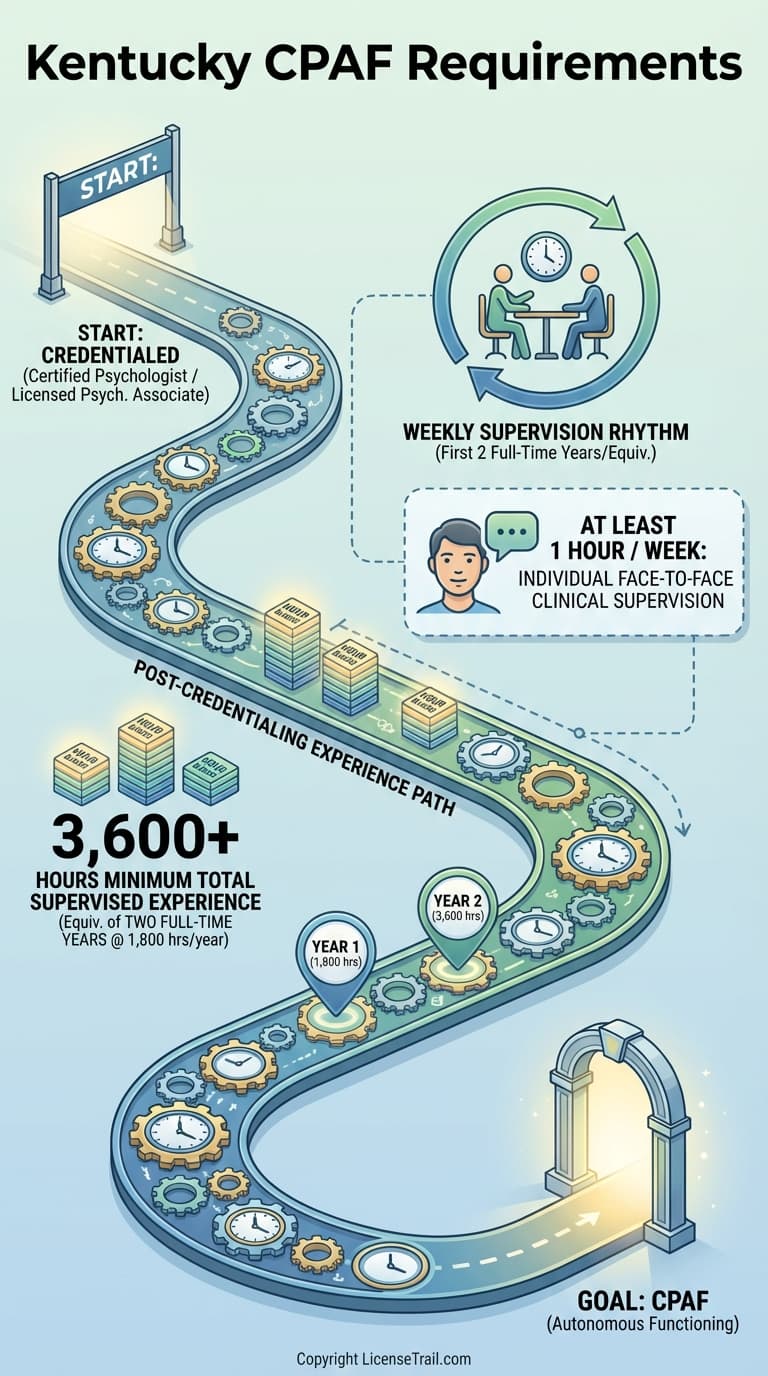
- For this requirement, “a full‑time year comprises at least 1,800 hours of supervised professional experience.” (apps.legislature.ky.gov)
Putting those together:
- Full‑time supervised year = 1,800 hours of supervised professional experience.
- Required full‑time years = 5.
- Minimum total supervised hours for LPP = 5 × 1,800 = 9,000 hours
of supervised professional experience after initial mid‑level credentialing.
Time practicing under a temporary license as a psychological associate is explicitly excluded from counting toward these years. (apps.legislature.ky.gov)
5.3. What kind of work must those hours include?
Although Section 5 focuses on the total years and hours, the same regulation defines conditions for supervised professional experience more broadly:
- At least 50% of all supervised professional experience must be “service-related activities, such as treatment, assessment, interviews, report‑writing, case presentations, and consultations.” (law.cornell.edu)
Applied to an LPP candidate’s 9,000 hours, this means:
- At least 4,500 hours must be devoted to direct service and closely related clinical activities (therapy, assessment, interviewing, writing integrated reports, case presentations, consultation).
The remaining hours can involve:
- Record‑keeping beyond report‑writing, team meetings, training, supervision received, and other professional tasks, as long as you remain in psychological practice under supervision.
5.4. Structure and frequency of clinical supervision
The requirements for how supervision is delivered come from 201 KAR 26:171:
- A licensed psychological associate or certified psychologist must have at least one hour of individual, face‑to‑face clinical supervision each week during the first two full‑time years (or equivalent) of post‑licensure practice. (apps.legislature.ky.gov)
- After two full‑time years of supervised practice, the supervisee and supervisor may petition the Board to reduce supervision, but the revised plan must still provide at least:
- Two one‑hour individual meetings every four weeks, and
- A total of at least four hours of clinical supervision per four‑week period (individual and/or group). (apps.legislature.ky.gov)
The Board also:
- Treats 1,800 hours of supervised practice as equivalent to one year for supervisory reporting purposes. (apps.legislature.ky.gov)
5.5. Practical example of the hour math
If you work approximately 40 hours/week for 50 weeks/year:
- You log about 2,000 work hours/year.
- For Board purposes, 1,800 of those can be counted toward the “full‑time year” requirement (additional hours don’t change the year‑equivalency).
- Over five such years, you would accumulate more than 10,000 clock hours, of which at least 9,000 can be counted as supervised professional experience for LPP, as long as:
- The work is within psychology practice,
- You remain under a Board‑approved supervision plan, and
- At least 50% of those hours are in the specified service‑related activities.
6. Examination requirements for the LPP (CPAF‑equivalent)
6.1. National exam (EPPP)
For LPP licensure, KRS 319.053 and 201 KAR 26:230 require:
- Passing the EPPP at the doctoral‑level standard, not the master’s cut‑score. The statute requires a score “equal to or exceeding the score required for passage for a licensed psychologist candidate at the doctoral level at the time the examination is taken.” (law.justia.com)
- The current regulation expresses this as obtaining an EPPP scaled score of 500 or greater, unless a previous EPPP score already met the doctoral criterion when it was taken. (apps.legislature.ky.gov)
You remain under supervision until the EPPP and all other requirements for LPP licensure are completed. (apps.legislature.ky.gov)
6.2. Kentucky examinations
201 KAR 26:230 sets the Kentucky‑specific examinations:
- A jurisprudence examination on Kentucky mental health law, requiring a score of at least 80%. (apps.legislature.ky.gov)
- A competency examination on ethical principles and professional practice, requiring a score of 100%. (apps.legislature.ky.gov)
For LPP candidates:
- The Board will not schedule you for the Kentucky examinations until:
- You have passed the EPPP, and
- The Board has approved your five years (9,000 hours) of supervised experience or its equivalent. (apps.legislature.ky.gov)
The competency examination for LPPs is administered by:
- At least one licensed psychologist and either a certified psychologist with autonomous functioning or a licensed psychological practitioner, highlighting again that CPAFs are treated as functionally parallel to LPPs. (apps.legislature.ky.gov)
7. Application components and professional record
Beyond hours and exams, KRS 319.053 requires that an LPP applicant:
- Submit letters of recommendation, including:
- One from the current board‑approved supervisor of record describing the scope of clinical experience; and
- Two from other licensed mental health professionals familiar with the applicant’s work. (law.justia.com)
- Pay a license application fee (up to $200 under statute; the exact current fee is set in the fee schedule regulation). (law.justia.com)
- Have no disciplinary action by the Board, or obtain an explicit exception from the Board if there has been past discipline. (law.justia.com)
You must also submit the standard application materials required by 201 KAR 26:230 and 201 KAR 26:155 (application forms, verification, and fees), either directly to the Board or through its online application management system. (apps.legislature.ky.gov)
8. How this all maps onto the CPAF title
Putting the pieces together:
- KRS 319.056 preserves CPAF only for those already authorized to use that title; it does not create a process for new applicants. (codes.findlaw.com)
- The functional equivalent for new entrants is the Licensed Psychological Practitioner (LPP), which:
- Requires at least 60 graduate semester hours in psychology or a related field;
- Requires initial credentialing as a Certified Psychologist / (Licensed) Psychological Associate;
- Requires five full‑time years (9,000 hours) of supervised professional experience after that credentialing, with at least 50% of those hours in service‑related clinical activities; (apps.legislature.ky.gov)
- Requires passing the EPPP at the doctoral‑level standard (≥500); and
- Requires passing Kentucky’s jurisprudence (≥80%) and competency (100%) examinations, plus meeting the character/discipline and reference requirements. (apps.legislature.ky.gov)
CPAFs and LPPs continue to be referenced side‑by‑side in regulations (e.g., supervision and billing rules), but under current Kentucky law and regulation, the path you actually follow to reach that autonomous level is the LPP licensure process, not a new CPAF license.
Track your CPAF hours with confidence
License Trail checks your direct, indirect, and supervision hours against Kentucky CPAF requirements continuously and flags mismatches before you submit.
 Start Tracking for Free
No credit card required · Free plan available
Is your spreadsheet hiding Kentucky CPAF risks?
Stop guessing if your categories match Kentucky Board of Examiners of Psychology requirements. License Trail checks your direct, indirect, and supervision hours continuously and flags mismatches before you submit.
Import or log
Bring your spreadsheet or start fresh
Upload your existing tracking spreadsheet and we'll map every hour into the right Kentucky Board of Examiners of Psychology categories automatically.
Verify against Kentucky
Catch mismatches before the board does
License Trail checks your direct, indirect, and supervision hours against Kentucky CPAF requirements continuously.
Export board-ready
One-click clean reports
Generate professional, board-ready reports for supervision meetings and Kentucky Board of Examiners of Psychology submissions in seconds.
No credit card required · Free plan available