
Kentucky CSW Requirements: Hours, Exams & Step-by-Step Guide
Stop guessing if your categories match Kentucky requirements. License Trail checks your direct, indirect, and supervision hours against CSW requirements continuously and flags mismatches before you submit.
No credit card required · Free plan available
Quick Requirements Overview
- Age/character: 18+ and good moral character
- Education: MSW or DSW from a CSWE-accredited graduate program
- Exam: Pass ASWB Master’s exam (and observe 3‑month wait rule after a fail)
- Application/fees: Apply online; $25 application fee + Board-set exam/initial license fees; send official transcript to Board
- No pre-licensure hours: No required practice hours to obtain the CSW license
- Temporary permit (pre-exam): Available after “approved to take exam”; typically 180 days, renewable once; clinical permit requires LCSW supervision; permit hours don’t count toward LCSW supervision period
- If doing clinical work toward LCSW: Must be W‑2 employee (no ownership interest) and have Board-approved supervision contract before starting
- Clinical supervision requirements (toward LCSW): 2 yrs full-time (30 hrs/wk) or 3 yrs part-time (20 hrs/wk); ≥60% direct client work; 150 supervision hrs (≥100 individual; ≤50 group), incl. 2 hrs individual every 2 weeks; group max 6; video supervision allowed if face-to-face and compliant
License Details
Procedures
Kentucky’s Certified Social Worker (CSW) license is the master’s‑level social work credential issued by the Kentucky Board of Social Work. It is the license you obtain after your MSW/DSW and before you qualify for independent clinical licensure as an LCSW.
The discussion below separates:
- the requirements to become licensed as a CSW, and
- the hour and supervision requirements that apply once you are a CSW and begin practicing clinical social work under supervision (usually on the way to LCSW).
1. What Kentucky Means by “Certified Social Worker” (CSW)
Under KRS 335.080, the Board issues a license as “certified social worker” to applicants who meet specified education, examination, and character requirements. (codes.findlaw.com)
A CSW:
- Holds a master’s or doctoral degree in social work from a program “approved by the board,” which 201 KAR 23:070 defines as a graduate school of social work accredited by the Council on Social Work Education. (apps.legislature.ky.gov)
- May practice social work and, if they have a board‑approved supervision contract with an LCSW, may also “engage in the practice of clinical social work” under that LCSW’s responsibility and supervision. (law.justia.com)
2. Core Eligibility Requirements to Become a CSW
KRS 335.080 sets the baseline legal requirements. To be licensed as a CSW in Kentucky you must: (codes.findlaw.com)
-
Age and character
- Be at least eighteen (18) years of age.
- Be a person of good moral character.
-
Education
- Have a master’s degree or doctorate degree in social work from an “educational institution approved by the board.”
201 KAR 23:070 clarifies that an “educational institution approved by the board” means a graduate school of social work accredited by the Council on Social Work Education (CSWE). (apps.legislature.ky.gov)
- Have a master’s degree or doctorate degree in social work from an “educational institution approved by the board.”
-
Examination
- Pay an examination fee set by the Board in regulation.
- Pass an examination prepared by the Board. In practice, Kentucky uses the ASWB Master’s‑level exam for CSW applicants; the Board’s licensure page confirms that Kentucky accepts ASWB Bachelor, Masters, and Clinical exams (but not Advanced Generalist). (bsw.ky.gov)
- Not have failed a Board exam within the preceding three (3) months.
-
Licensure fee
- Pay an initial license fee set by regulation. The Board’s licensure page lists an application fee of $25 to apply online for CSW licensure. (bsw.ky.gov)
-
Display and use of license
- Once issued, the CSW license must be displayed in your principal place of practice and entitles you to hold yourself out as providing services authorized under Kentucky’s social work statutes. (codes.findlaw.com)
Important point about hours at this stage
For initial CSW licensure itself, Kentucky does not require a set number of pre‑licensure practice hours (no “1,500 hours” style requirement). The statute and regulations focus on:
- Your degree (MSW/DSW from a CSWE‑accredited program), and
- Passing the ASWB Master’s exam and meeting the statutory criteria.
Hour counts and detailed supervision rules come into play after you are licensed as a CSW and choose to perform clinical social work under supervision to qualify for LCSW.
3. Application and Exam Process in Practice
Putting the statutory pieces into a practical sequence:
-
Complete your MSW/DSW
- From a CSWE‑accredited graduate school of social work (meets “educational institution approved by the board”). (apps.legislature.ky.gov)
-
Apply to the Kentucky Board of Social Work
- Use the Board’s online application portal and pay the $25 non‑refundable application fee listed on the Licensure page. (bsw.ky.gov)
- Arrange for your official transcript to be sent directly from your school to the Board. (bsw.ky.gov)
-
Obtain exam approval and take the ASWB Master’s exam
- The Board reviews your application and transcript.
- Once approved, you register for and take the ASWB Master’s exam. If you took the exam in another state, Kentucky requires an ASWB Official Transfer Score Report sent directly from ASWB. (bsw.ky.gov)
-
Licensure issuance
- After the Board receives your passing exam score, required fees, and any other documentation, it issues your CSW license under KRS 335.080. (codes.findlaw.com)
-
License renewal
- Licenses renew on a three‑year cycle based on your original issue date; CSW renewal currently costs $125 and requires 30 hours of continuing education in the preceding three years. (bsw.ky.gov)
Again, none of these CSW‑licensing steps require you to document a specific number of practice hours.
4. Temporary CSW Permits (Before You Pass the Exam)
Kentucky allows a temporary permit if you have finished your degree and applied for the CSW license/exam but have not yet passed the exam. Key points from the Board’s licensure page: (bsw.ky.gov)
- You must first apply for the CSW license/exam and have your official transcript on file.
- Once you receive an “approved to take exam” email, you may apply for a temporary permit.
- There are:
- Non‑clinical permits (for LSW/CSW who will not perform clinical social work), and
- Clinical permits (for CSWs who will perform clinical social work as part of their setting).
- A temporary permit holder practicing clinical social work must be under the supervision of an LCSW who qualifies as a board‑approved supervisor.
- The temporary permit is generally valid for 180 days and renewable once for another 180 days. Hours obtained under a temporary permit do not count toward CSW‑in‑supervision hours for LCSW. (bsw.ky.gov)
5. When Hours Do Matter: CSW in Clinical Supervision Toward LCSW
Once you hold a CSW, you may:
- Practice non‑clinical social work within the CSW scope; or
- Practice clinical social work under supervision, under a written Clinical Social Work Supervision Contract with an LCSW (the “supervisor of record”), as allowed by KRS 335.080(3) and 201 KAR 23:070. (law.justia.com)
If you intend to become a Licensed Clinical Social Worker (LCSW), this supervised clinical practice period is where hours and types of hours are precisely defined.
5.1. Time requirement for LCSW‑level clinical experience
KRS 335.100(1)(b) states that an LCSW applicant must have: (codes.findlaw.com)
- A minimum of two (2) years of full‑time, post‑master’s experience, consisting of at least thirty (30) hours per week, or
- Three (3) years of part‑time, post‑master’s experience, consisting of at least twenty (20) hours per week,
in the use of “specialty methods and measures to be employed in clinical social work practice,” acquired under appropriate supervision as established by the board.
The Board reiterates this on its Licensure FAQ page, noting that a CSW must be licensed two years full time (30 hours/week) or three years part-time before applying to take the LCSW exam. (bsw.ky.gov)
5.2. Required type of experience: direct client‑professional relationship
201 KAR 23:070, Section 7, defines what counts as qualifying “experience under supervision”:
- “At least sixty (60) percent of the required experience in a direct client‑professional relationship.” (apps.legislature.ky.gov)
- Direct responsibility for providing clinical social work services to specific clients.
- Broad exposure to a variety of mental disorders, diagnoses, acuity levels, and population groups. (apps.legislature.ky.gov)
The Board’s FAQ further explains the 60% rule by stating that, depending on full‑time or part‑time status, at least 60% of your work per week must be directly working with your clients. (bsw.ky.gov)
In other words:
- Kentucky does not state the requirement as a fixed number of “direct hours” (e.g., “1,500 direct hours”).
- Instead, it ties the requirement to time in practice (2 or 3 post‑master’s years) and requires that at least 60% of all those practice hours be in direct client‑professional relationship providing clinical services.
5.3. Supervision hours: minimum 150 hours, structure, and format
201 KAR 23:070, Section 8(2) sets out quantitative requirements for supervision itself: (apps.legislature.ky.gov)
- Total supervision hours
- “Supervision shall total a minimum of 150 hours” over the qualifying supervised clinical practice period.
- Frequency and format
- Must include individual supervision of at least two (2) hours during every two (2) weeks of supervised clinical social work practice during the minimum two‑year period.
- At least 100 of the 150 hours must be individual supervision.
- Up to 50 of the 150 hours may be group supervision.
- Group supervision must be in groups of no more than six supervisees, and cannot mix in supervisees from other behavioral health professions who are accruing their own supervised clinical practice hours.
- Delivery
- Virtual (electronic) supervision is allowed if supervisor and supervisee can see each other face‑to‑face and all telehealth confidentiality laws are met. (apps.legislature.ky.gov)
201 KAR 23:070 also defines “supervision” as “the educational process of utilizing a partnership between an LCSW supervisor and a CSW supervisee aimed at enhancing the professional development of the supervisee in providing clinical social work services.” (apps.legislature.ky.gov)
5.4. Supervision contract and employment conditions
Before a CSW can begin practicing clinical social work under supervision, the Board requires: (apps.legislature.ky.gov)
-
Clinical Social Work Supervision Contract
- A written Clinical Social Work Supervision Contract must be submitted to and approved by the Board before supervised clinical work begins.
- The contract must identify:
- The CSW supervisee and LCSW supervisor of record (and any additional supervisors).
- The agency or organization where services will be provided.
- The nature of the practice (types of clients, therapies, treatment modalities, mental disorders treated).
- The number of hours of supervision per week, breakdown between individual and group supervision, and manner of case review.
- A statement that the supervisor of record will be held accountable to the Board for the care given to the supervisee’s clients. (apps.legislature.ky.gov)
-
Employment status
- KRS 335.080(3) requires that, when engaging in clinical social work as a CSW, the CSW is “an employee of an institution or organization in which the certified social worker has no direct or indirect interest other than employment.” (law.justia.com)
- The supervision contract must confirm that the CSW is an employee (with Social Security and taxes withheld) rather than an independent contractor. (apps.legislature.ky.gov)
-
CSW supervision CEU
- The Board requires all CSWs in supervision to complete a Board‑provided supervision CEU (effective March 15, 2022). The licensure page notes that this CEU will be required and that CSWs receive a certificate upon completion. (bsw.ky.gov)
-
Supervisor qualifications
- The supervisor must be an LCSW, licensed at least two years, approved by the Board to provide supervision and having completed:
- An initial board‑approved six‑hour supervisory training, and
- A three‑hour refresher supervisory training each renewal period. (apps.legislature.ky.gov)
- An LCSW may not serve as supervisor of record for more than six CSWs under contract at one time, and no more than two temporary permit holders at any one time (who also count toward the total of six supervisees). (apps.legislature.ky.gov)
- The supervisor must be an LCSW, licensed at least two years, approved by the Board to provide supervision and having completed:
6. How Kentucky’s Requirements Compare to “X Hours Direct / Y Hours Supervised” Frameworks
Your example—“1,500 hours of direct experience and 1,500 hours of supervised experience”—reflects how some jurisdictions specify requirements numerically. Kentucky does it differently:
-
For CSW licensure itself:
- No specific practice hour requirement is imposed. The requirements are educational (MSW/DSW), exam‑based, and character‑based under KRS 335.080. (codes.findlaw.com)
-
For clinical practice as a CSW en route to LCSW:
- Kentucky defines requirements in terms of:
- Post‑master’s time in practice (2 years full time at 30 hours/week or 3 years part time at 20 hours/week), (codes.findlaw.com)
- A percentage of that experience that must be in a direct client‑professional relationship (at least 60%), (apps.legislature.ky.gov)
- A minimum of 150 hours of clinical supervision, with detailed rules about individual vs. group supervision and frequency. (apps.legislature.ky.gov)
- Kentucky defines requirements in terms of:
So, rather than stating something like “1,500 direct hours and 1,500 supervised hours,” the Kentucky Board’s own language centers on:
- Two years (full‑time) or three years (part‑time) post‑master’s clinical experience under supervision,
- With at least 60% of that experience in a direct client‑professional relationship, and
- At least 150 hours of supervision, including at least two hours of individual supervision every two weeks, and at least 100 individual supervision hours total. (apps.legislature.ky.gov)
7. Condensed Step‑By‑Step View
To become a CSW in Kentucky:
- Earn an MSW or DSW from a CSWE‑accredited graduate program. (apps.legislature.ky.gov)
- Ensure you meet age (18+) and good moral character requirements. (codes.findlaw.com)
- Apply online to the Kentucky Board of Social Work, pay the $25 application fee, and have your official transcript sent directly to the Board. (bsw.ky.gov)
- Obtain approval and pass the ASWB Master’s‑level exam accepted by Kentucky. (bsw.ky.gov)
- Pay the required initial license fee and receive your CSW license, which you display in your primary practice site. (codes.findlaw.com)
If you then choose to practice clinical social work and work toward LCSW:
- Secure employment with an agency or organization (W‑2 employment, no ownership interest). (law.justia.com)
- Complete the Board’s CSW supervision CEU. (bsw.ky.gov)
- Submit a Clinical Social Work Supervision Contract with an approved LCSW supervisor of record and obtain Board approval before beginning supervised clinical practice. (apps.legislature.ky.gov)
- Over at least two years full‑time (30 hours/week) or three years part‑time (20 hours/week):
- Ensure at least 60% of your weekly work is in direct client‑professional relationships, and (apps.legislature.ky.gov)
- Accrue at least 150 hours of supervision, including:
- At least two hours of individual supervision every two weeks, and
- At least 100 individual and no more than 50 group supervision hours. (apps.legislature.ky.gov)
These are the Board’s operative requirements and definitions that govern both becoming a CSW and, if you choose, using that CSW to progress toward independent clinical practice as an LCSW in Kentucky.
Track your CSW hours with confidence
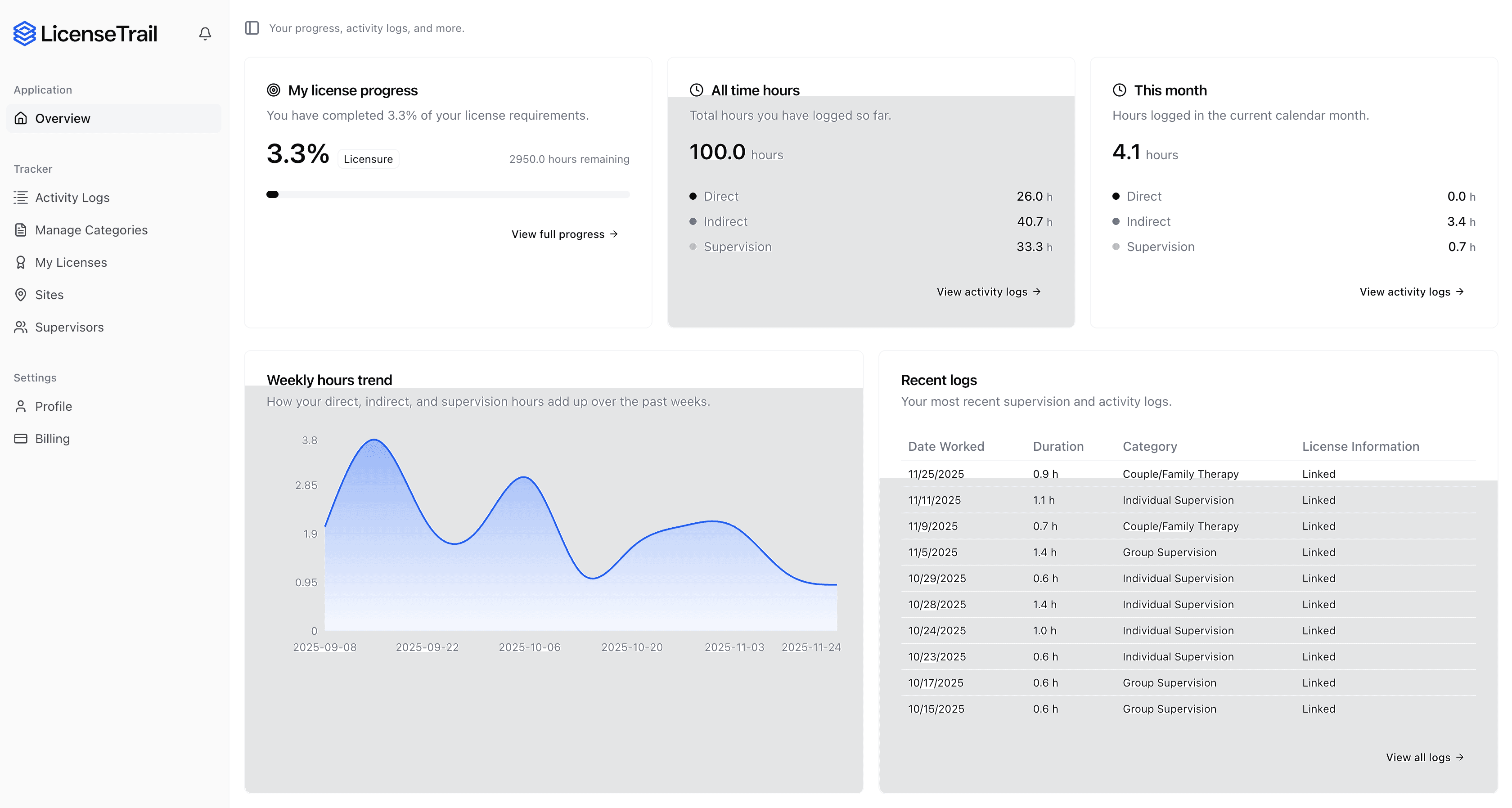
License Trail checks your direct, indirect, and supervision hours against Kentucky CSW requirements continuously and flags mismatches before you submit.
 Start Tracking for Free
No credit card required · Free plan available
Related Licenses
Is your spreadsheet hiding Kentucky CSW risks?
Stop guessing if your categories match Kentucky Board of Social Work requirements. License Trail checks your direct, indirect, and supervision hours continuously and flags mismatches before you submit.
Import or log
Bring your spreadsheet or start fresh
Upload your existing tracking spreadsheet and we'll map every hour into the right Kentucky Board of Social Work categories automatically.
Verify against Kentucky
Catch mismatches before the board does
License Trail checks your direct, indirect, and supervision hours against Kentucky CSW requirements continuously.
Export board-ready
One-click clean reports
Generate professional, board-ready reports for supervision meetings and Kentucky Board of Social Work submissions in seconds.
No credit card required · Free plan available