
Kentucky LPCA Requirements: Hours, Exams & Step-by-Step Guide
Stop guessing if your categories match Kentucky requirements. License Trail checks your direct, indirect, and supervision hours against LPCA requirements continuously and flags mismatches before you submit.
No credit card required · Free plan available
Quick Requirements Overview
- Qualifying graduate degree (master’s/specialist/doctoral) in counseling or related field from a regionally accredited institution + 60 graduate semester hours across KY’s 9 required content areas (KRS 335.525; 201 KAR 36:070).
- Degree must include practicum/internship meeting KY standards: 600 total hours with 240 direct service hours (diagnosis, treatment planning, assessment, interventions, groups) (201 KAR 36:070).
- Must secure a Board-approved LPCC‑S supervisor of record and file an LPCA Supervision Agreement; you may not practice until the Board approves it (201 KAR 36:060).
- Supervision frequency minimums: full-time (25+ hrs/wk) = 3×/month, 1 hr each; part-time = 1 hr supervision per 30 client-contact hrs (201 KAR 36:060).
- LPCA application requires: application + fee, official transcript, proof of required coursework, FBI background check within 90 days, and syllabi if not CACREP (201 KAR 36:070).
- LPCA practice is only under ongoing Board-approved supervision; supervision/setting changes require a new agreement (201 KAR 36:060; KRS 335.525).
- Toward LPCC: complete 4,000 post-master’s supervised hours, including 1,600 direct counseling hours and 100 hours individual, face-to-face clinical supervision (KRS 335.525).
License Details
Procedures
In Kentucky, the Licensed Professional Counselor Associate (LPCA) credential is the entry‑level counseling license that allows you to practice only under ongoing, board‑approved supervision while you complete the clinical hours and examination needed to become a Licensed Professional Clinical Counselor (LPCC).
The requirements are set by KRS 335.525 and the Board’s regulations in 201 KAR 36:060 and 201 KAR 36:070. The sections below walk through those requirements in the order you actually experience them, with the state’s own terminology (“direct counseling,” “experience under supervision,” “LPCA Supervision Agreement,” etc.) highlighted.
1. Statutory framework: what an LPCA is, in law
Kentucky’s licensing statute first defines the requirements for the full professional license (LPCC), then explains when the Board “may issue a ‘professional counselor associate’ license.”
Under KRS 335.525(2), the Board may issue a professional counselor associate license (the LPCA) to an applicant who:
-
Has completed all requirements in KRS 335.525(1)(a)–(d):
- paid the applicable fees;
- is of good moral character;
- has a qualifying master’s/specialist/doctoral degree in counseling or a related field from a regionally‑accredited institution; and
- has completed at least 60 graduate semester hours in nine specified counseling content areas (helping relationship, human growth and development, lifestyle and career development, group dynamics, assessment, social/cultural foundations, diagnosis & treatment planning, research & evaluation, and professional orientation & ethics).
-
Has not yet met the supervised‑experience and examination requirements in KRS 335.525(1)(e)–(f).
-
Has obtained a board‑approved supervisor of record.
In other words, the LPCA is granted to someone who has completed the education but not yet the 4,000 hours of post‑degree supervised experience or the exam required for the LPCC, and who has entered into Board‑approved supervision.
2. Educational and practicum / internship hour requirements
2.1. Degree and content areas
To qualify for any counseling license (including LPCA), your graduate degree must meet both statute and regulation:
- A master’s, specialist, or doctoral degree in counseling or a related field from a regionally accredited institution, as required by KRS 335.525(1)(c).
- A minimum of 60 graduate semester hours covering the nine content areas listed in KRS 335.525(1)(d) (helping relationship, human development, etc.).
201 KAR 36:070 further spells out that coursework must include specific graduate courses in each of those nine areas.
2.2. Practicum / internship hours built into the degree
Kentucky regulation requires substantial supervised field experience as part of the degree:
- Practicum or internship experiences must be for a minimum of two semester courses and provide supervised counseling experience in an appropriate clinical setting.
- These experiences must include at least:
- 600 clock hours of total experience, and
- at least 240 clock hours of direct service, defined by the regulation as including diagnosis, treatment planning, assessment, techniques and intervention, and experience leading groups.
Separately, KRS 335.525(1)(e) states that “all applicants shall complete an organized practicum or internship consisting of at least four hundred (400) hours.”
In practice, the Board’s regulation is more specific and stricter (600 total / 240 direct service); programs designed for Kentucky licensure typically follow the 600‑hour standard.
Summary of pre‑licensure (within‑degree) hours required:
- 600 total practicum/internship hours, including
- at least 240 hours of “direct service” to clients (face‑to‑face diagnosis, treatment, assessment, and group work).
These hours are part of your degree and are not the same as the post‑master’s 4,000 supervised hours you will later accrue as an LPCA toward LPCC.
3. Securing a board‑approved supervisor and LPCA Supervision Agreement
You cannot function as an LPCA or start accruing Kentucky‑countable post‑master’s experience until the Board approves your supervision arrangement.
3.1. Supervisor qualifications
Under 201 KAR 36:060:
- A “supervisor of record” must be licensed by the Board as a Licensed Professional Clinical Counselor Supervisor (LPCC‑S).
- The supervisor “shall manage, oversee, and direct the supervisee, taking responsibility for the professional clinical counseling practice of the supervisee” and must have access to your clinical documentation and client sessions, either live or by recording, to provide appropriate oversight.
The regulation also allows the Board to approve more than one supervisor of record if you submit a written request.
3.2. The LPCA Supervision Agreement
Before you may practice as an LPCA, you must enter into a written LPCA Supervision Agreement with the supervisor and file it with the Board. 201 KAR 36:060 Section 3 requires that the agreement include, among other things:
- Your name and address.
- The supervisor’s name, address, license number, and years of practice (and information on any additional supervisors).
- The agency, institution, or organization where the supervised experience will be received.
- A detailed description of the nature of the practice, including:
- types of clients,
- therapies and treatment modalities,
- types of problems to be treated.
- A description of the nature, duration, and frequency of supervision, including:
- number of hours of supervision per week,
- number of hours of individual supervision,
- methodology for transmission of case information,
- number of hours of face‑to‑face supervision that will count toward the statutory requirements.
- A supervision‑frequency statement that:
- for full‑time practice (25+ clock hours/week), supervision shall occur a minimum of three times per month, one hour per meeting; and
- for part‑time practice (<25 clock hours/week), supervision shall be at least one hour for every 30 hours of client contact.
The Board explicitly states that “the licensed professional counselor associate may begin the practice of professional counseling upon the board’s approval of the agreement.”
If you change supervisor or job setting, a new supervision agreement must be filed.
4. Applying for the LPCA license
The procedural requirements for the LPCA are in 201 KAR 36:070 Section 2. Each applicant for licensure as a Licensed Professional Counselor Associate must:
- Submit an Application for Licensed Professional Counselor Associate to the Board.
- Pay the fee established in 201 KAR 36:020.
- Submit an official transcript from the graduate program.
- Demonstrate the required coursework in the nine core content areas (you must satisfy the same curriculum requirements listed for LPCC applicants in Section 4(1)(a)4).
- Submit the results of a background check performed within the last 90 days by the FBI. Expunged cases do not have to be disclosed and are not treated as convictions.
- If your degree is not from a CACREP‑accredited program, submit course syllabi for each course used to satisfy the statutory content areas in KRS 335.525(1)(d).
Additionally, 201 KAR 36:070 Section 5 requires that “an applicant for licensure shall be of good moral character,” and if there are past issues, you bear the burden of providing evidence of rehabilitation.
After the Board approves both:
- your LPCA application, and
- your LPCA Supervision Agreement,
you are issued the LPCA license and may begin practicing only under supervision.
5. Hour requirements while you are an LPCA (toward LPCC)
The Board and statute are very specific about the post‑master’s clinical hours you must complete under supervision as an LPCA in order to later become an LPCC.
5.1. Total supervised experience
KRS 335.525(1)(e) requires a “minimum of four thousand (4,000) hours of experience in the practice of counseling”:
- All 4,000 hours must be obtained after you receive the master’s degree.
- All 4,000 hours must be under approved supervision.
201 KAR 36:060 references this same requirement and describes this as “experience under supervision.”
5.2. Breakdown of those 4,000 hours
Within the 4,000 total hours, the statute requires that they “shall include but not be limited to”:
- At least 1,600 hours of direct counseling with individuals, couples, families, or groups.
- “Direct counseling” here is the Board’s term for face‑to‑face clinical work—individual, couple, family, or group sessions where you are directly providing counseling services.
- At least 100 hours of individual, face‑to‑face clinical supervision with an approved supervisor.
- These 100 hours are supervision meetings (not client contact), conducted individually and in person or through approved synchronous video, and are part of your 4,000‑hour total.
The statute also encourages—but does not require—that applicants include at least 10 hours of direct counseling with individuals in a jail or corrections setting as part of the 4,000 hours.
Everything beyond those minimums (the remaining 2,300+ hours) can be other counseling‑related, supervised practice activities that meet the Board’s definition of “experience under supervision,” such as:
- case conceptualization and treatment planning,
- documentation and record keeping,
- coordination with other providers,
- non‑direct but clinically relevant client work within the agency,
provided it occurs under your approved supervision arrangement and within the Board’s definitions.
5.3. How the Board defines “experience under supervision”
201 KAR 36:060 Section 5 states that “experience under supervision” must consist of:
- Direct responsibility for a specific individual or group of clients, and
- Broad exposure and opportunity for skill enhancement with a variety of developmental issues, dysfunctions, diagnoses, acuity levels, and population groups.
The same regulation emphasizes that supervision should focus on:
- appropriate diagnosis and use of recognized clinical nomenclature,
- development and modification of treatment plans,
- development of treatment skills across all phases of therapy,
- ethical issues in the practice of professional counseling, and
- development and use of the “professional self” in therapy.
5.4. Ongoing supervision requirement for LPCAs
KRS 335.525(5)(a) provides that “a licensed professional counselor associate shall maintain ongoing supervision as approved by the board.”
If the LPCA Supervision Agreement is not being followed, or supervision is terminated, you may not continue to practice professional counseling except in the short “temporary supervision” situations (up to 60 calendar days) described in Section 8 of 201 KAR 36:060, where a qualified mental health provider steps in while a new board‑approved supervisor is sought.
6. Putting it together: practical sequence to become an LPCA in Kentucky
-
Complete a qualifying graduate degree
- Master’s/specialist/doctoral in counseling or related field from a regionally accredited institution.
- At least 60 graduate semester hours in the nine required content areas.
- Practicum/internship totaling at least 600 hours, including at least 240 hours of “direct service.”
-
Confirm your coursework and practicum meet the Board’s standards
- If your program is CACREP‑accredited in counseling, it will ordinarily already meet these.
- If not CACREP, collect syllabi and course descriptions for each class you will use to show compliance with KRS 335.525(1)(d).
-
Secure a board‑eligible supervisor and a site
- Find an LPCC‑S (licensed professional clinical counselor supervisor) willing to serve as your “supervisor of record.”
- Identify the agency or practice setting where you will gain your supervised experience.
-
Complete and submit the LPCA Supervision Agreement
- Work with your supervisor (and agency, if off‑site) to complete every part of the agreement as required in 201 KAR 36:060 Section 3, including supervision frequency and access to records.
-
Submit your LPCA application
- Application form, fee, official transcript, FBI background check (within 90 days), and syllabi if required.
-
Wait for Board approval
- Once both the LPCA application and Supervision Agreement are approved, you receive your Licensed Professional Counselor Associate license and may begin the practice of professional counseling under supervision.
-
As an LPCA, accumulate the hours required for LPCC
- At least 4,000 hours of post‑master’s experience in the practice of counseling under approved supervision.
- Within that, at least 1,600 hours of direct counseling with individuals, couples, families, or groups.
- At least 100 hours of individual, face‑to‑face clinical supervision with an approved supervisor.
All of this must be consistent with your Supervision Agreement and the Board’s definition of “experience under supervision.”
7. Quick hour‑requirement snapshot for Kentucky LPCAs
-
Within‑degree (before LPCA):
- 600 practicum/internship hours total, including
- 240 direct‑service hours (diagnosis, treatment, assessment, groups).
-
Post‑degree, as LPCA (to qualify for LPCC):
- 4,000 hours total “experience in the practice of counseling” under approved supervision, all after the master’s degree.
- Of those 4,000 hours:
- at least 1,600 hours are “direct counseling” with clients;
- at least 100 hours are individual, face‑to‑face clinical supervision with an approved supervisor.
Kentucky does not use a simple “X hours direct experience plus Y hours supervised experience” formula like 1,500/1,500; instead, it uses a 4,000‑hour total with specific minimum sub‑requirements for direct counseling and individual supervision, and a detailed definition of “experience under supervision” that emphasizes breadth of clinical exposure under a board‑approved LPCC‑S.
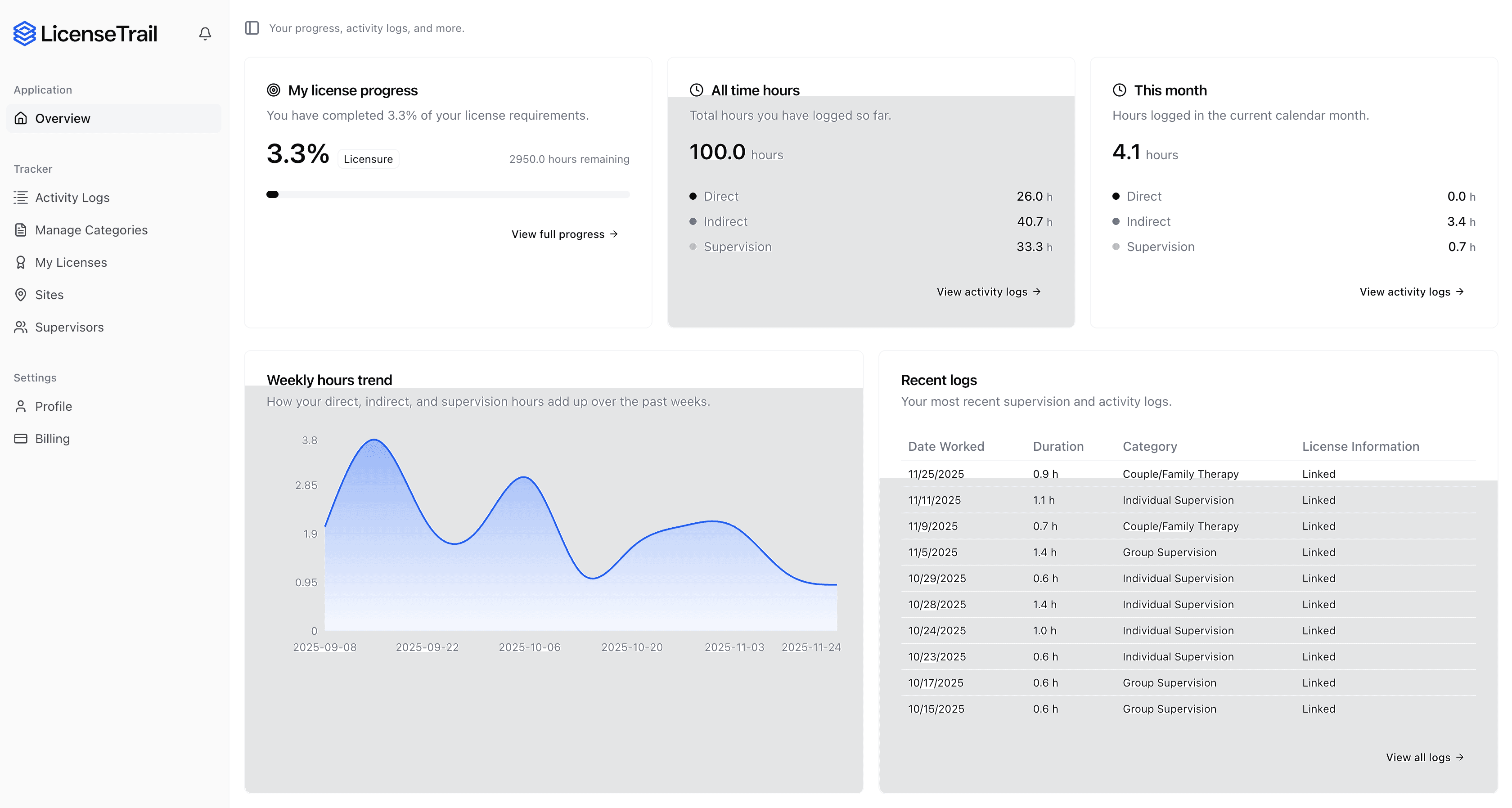
Track your LPCA hours with confidence
License Trail checks your direct, indirect, and supervision hours against Kentucky LPCA requirements continuously and flags mismatches before you submit.
 Start Tracking for Free
No credit card required · Free plan available
Related Licenses
Is your spreadsheet hiding Kentucky LPCA risks?
Stop guessing if your categories match Kentucky Board of Licensed Professional Counselors requirements. License Trail checks your direct, indirect, and supervision hours continuously and flags mismatches before you submit.
Import or log
Bring your spreadsheet or start fresh
Upload your existing tracking spreadsheet and we'll map every hour into the right Kentucky Board of Licensed Professional Counselors categories automatically.
Verify against Kentucky
Catch mismatches before the board does
License Trail checks your direct, indirect, and supervision hours against Kentucky LPCA requirements continuously.
Export board-ready
One-click clean reports
Generate professional, board-ready reports for supervision meetings and Kentucky Board of Licensed Professional Counselors submissions in seconds.
No credit card required · Free plan available