
Louisiana LCSW Requirements: Hours, Exams & Step-by-Step Guide
Stop guessing if your categories match Louisiana requirements. License Trail checks your direct, indirect, and supervision hours against LCSW requirements continuously and flags mismatches before you submit.
No credit card required · Free plan available
Quick Requirements Overview
- Authority: Louisiana State Board of Social Work Examiners (LABSWE); LA Admin Code Title 46, Part XXV
- Prereqs to start counting hours: CSWE-accredited MSW/DSW + LMSW license (ASWB Master exam); LCSW supervision hours count only after LMSW is issued
- Supervisor required: Board-Approved Clinical Supervisor (BACS); supervision documented on Board forms
- Paperwork timing: Supervision contract + employment verification due to LABSWE within 60 days of first supervision session (late filing forfeits earlier hours beyond the 60-day lookback); new contract required within 60 days of job/supervisor/agency supervisor change
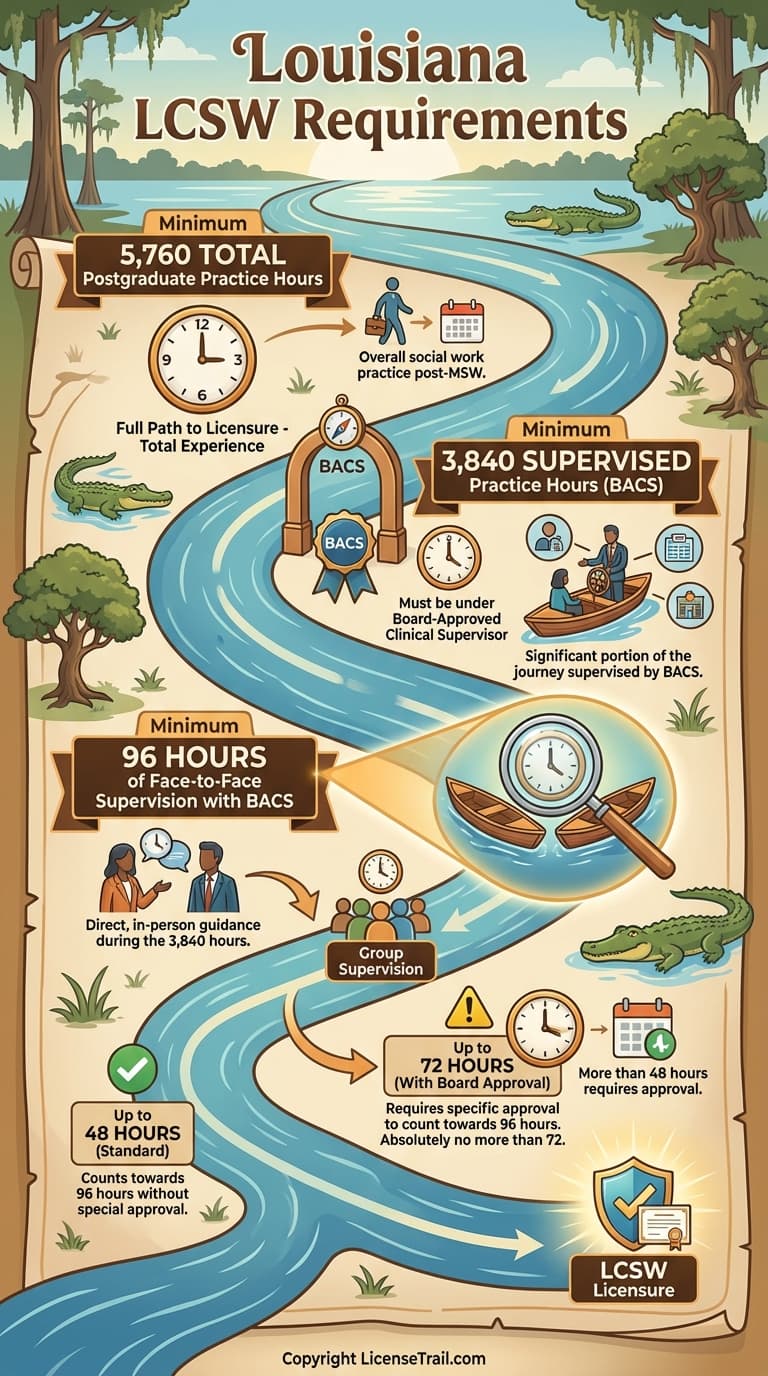
- Experience hours: 5,760 hours postgraduate social work practice total; at least 3,840 hours must be under BACS supervision
- Supervision hours: 96 hours face-to-face supervision within the 3,840 supervised hours; sessions 30–120 min; ≤80 practice hours allowed between supervision meetings
- Group supervision limits: Up to 48 of 96 hours may be group (max 5 supervisees; group session max 2 hours); Board may approve up to 72 group hours by written request
- Licensure step: Apply to LABSWE when hours/forms complete, then pass ASWB Clinical exam (or Board-approved equivalent) for LCSW issuance
License Details
Procedures
In Louisiana, the Licensed Clinical Social Worker (LCSW) credential is regulated by the Louisiana State Board of Social Work Examiners (LABSWE) and implemented through the Louisiana Administrative Code, Title 46, Part XXV. The Board’s rules spell out in detail the required types and amounts of supervised practice a Licensed Master Social Worker (LMSW) must complete before becoming an LCSW. (regulations.justia.com)
Below is a step‑by‑step guide that tracks the Board’s own categories and terminology.
1. Educational foundation and LMSW licensure
To move toward LCSW, you first must qualify and practice as an LMSW.
Education
- Master’s or Doctorate in Social Work from a CSWE‑accredited program (this is the standard underlying all Louisiana social work licenses). (publichealthonline.org)
LMSW license
- Apply to LABSWE for LMSW after graduation and pass the ASWB Master‑level exam. (humanservicesedu.org)
- Once you hold the LMSW, you may begin counting qualifying experience toward LCSW (see next section).
2. When supervision for LCSW can begin
The Board’s rules specify that:
- Supervision for the LCSW license can begin only after the MSW has obtained LMSW. Supervision must be documented on Board-provided forms. (regulations.justia.com)
In other words, any supervised hours you want to count toward LCSW must be obtained while licensed as an LMSW and under the Board’s supervision framework.
3. Supervision structure: contracts, supervisors, and employment
Board‑approved clinical supervisor (BACS)
- Supervision “for the LCSW license is conducted by a board‑approved clinical supervisor (BACS).” (regulations.justia.com)
- LMSWs must work under a BACS if they want those hours to count toward LCSW.
Supervision contract and employment verification
Before (or very soon after) supervision starts, the Board requires formal paperwork:
-
Supervision contract
- Completed by:
- the supervisor (BACS),
- the supervisee (LMSW),
- and the agency supervisor.
- Must be submitted to the Board office within 60 days of the first supervision session. (regulations.justia.com)
- Completed by:
-
Employment verification
- Completed by the employer and submitted by the supervisee along with the supervision contract. (regulations.justia.com)
-
Late submission penalty:
If the supervisee fails to submit the contract and employment verification on time, supervision credit is only issued starting from a date 60 days before the date the Board received the contract (you lose earlier hours). (regulations.justia.com) -
Changes in job or supervisor:
A new supervision contract (and, if applicable, new employment verification) must be submitted within 60 days whenever the supervisee:- changes employment,
- changes supervisor, and/or
- there is a change in the agency supervisor.
The Board will email the supervisee and supervisor confirming receipt and the official beginning date of supervision for that contract. (regulations.justia.com)
4. Core hour requirements for LCSW (Louisiana terminology)
Louisiana does not divide hours into “direct” vs. “indirect” practice the way some states do. Instead, the rules use these categories:
- Postgraduate social work practice (overall total)
- Postgraduate social work practice under BACS supervision (a subset of the total)
- Face‑to‑face supervision hours (a subset of the supervised hours)
- Group vs. individual supervision hours (breakdown of the face‑to‑face supervision)
4.1. Total postgraduate social work practice
The Administrative Code states that:
- LMSWs seeking the LCSW credential must complete a minimum of 5,760 hours of postgraduate social work practice. (regulations.justia.com)
These 5,760 hours:
- Must be post‑MSW;
- Must be completed while working in social work practice (as an LMSW);
- Are typically accumulated in one or more social work employment positions (verified later via Board forms).
At a 40‑hour workweek, 5,760 hours is roughly three years of full‑time work, but the regulation itself does not prescribe a specific minimum number of calendar years.
4.2. Hours that must be supervised by a BACS
Within the 5,760‑hour total:
- At least 3,840 hours of that postgraduate social work practice must be under the supervision of a Board‑approved clinical supervisor (BACS). (regulations.justia.com)
This 3,840‑hour segment is your “supervised postgraduate social work practice” for LCSW purposes. The remaining 1,920 hours may be in social work roles that are not being actively counted as BACS supervision (for example, non‑clinical duties within the same job), as long as they are legitimate postgraduate social work practice in approved employment settings.
5. Face‑to‑face supervision requirements inside the supervised hours
Within the 3,840 supervised hours, Louisiana has further requirements about supervision meetings themselves:
- You must complete 96 hours of face‑to‑face supervision between supervisor and supervisee during the 3,840 supervised hours. (regulations.justia.com)
The Board then places several conditions on how these 96 hours are structured:
- Each supervisory meeting must last no less than 30 minutes and no more than 2 hours. (regulations.justia.com)
- No more than 80 hours of practice may occur between supervisory meetings.
- If this rule is violated, supervision credit is not issued for the time period in which the requirement is not met. (regulations.justia.com)
So the Board is not only concerned with total hours but with ongoing, regular supervisory contact tied to your actual work hours.
6. Group vs. individual supervision
The 96 required supervision hours can be a mix of individual and group supervision, with limits:
- Up to one‑half of the 96 hours (a maximum of 48 hours) may be completed through group supervision. (regulations.justia.com)
The Board defines the parameters for group supervision:
- Group supervision sessions must be no more than 2 hours per group meeting. (regulations.justia.com)
- No more than five supervisees may participate in a supervision group at one time. (regulations.justia.com)
The Board may allow additional group time in some circumstances:
- A BACS can request up to 72 hours of group supervision (instead of 48) by submitting a written rationale to the Board; the Board considers such requests at a scheduled meeting. (regulations.justia.com)
7. Remote (electronic) supervision options
Louisiana allows for supervision via secure electronic communication in certain situations:
- If the supervisee can demonstrate an undue burden (e.g., hardship, disability, or significant travel time), the Board may approve alternatives to in‑person supervision. (regulations.justia.com)
- The supervisee must submit a written request with specific details; if approved, the supervisor and supervisee must use secure, real‑time visual technology and maintain confidentiality. (regulations.justia.com)
All remote supervision still counts toward the same hour requirements but must be explicitly Board‑approved.
8. Record‑keeping and verification of hours
The Board’s rules contain detailed record‑keeping expectations for both supervisee and supervisor:
Supervisee responsibilities
-
Keep accurate records of:
- dates of supervision sessions,
- time spent in supervision,
- brief content summaries.
-
Both supervisor and supervisee must sign for each supervisory session on the Board’s Record of Supervision form.
-
When supervision is complete, the supervisee submits:
- Record of Supervision, and
- Evaluation of Supervision to the Board office (these are reviewed when the LCSW application is filed). (regulations.justia.com)
-
For each place of employment, the supervisee must later submit a Professional Experience Verification (or “professional experience verification record”) completed by the employer, verifying employment dates and hours of social work practice. (regulations.justia.com)
Supervisor (BACS) responsibilities
-
Maintain a supervision folder including:
- copy of the supervision contract;
- narrative of supervisory sessions (cases, decisions, ethical issues, problems and resolutions);
- copies of memos/correspondence;
- copy of Evaluation of Supervision form;
- copies of the Record of Supervision. (regulations.justia.com)
-
The Board notes that supervisors have a professional responsibility to:
- cover content in the supervision contract,
- maintain accurate records,
- make themselves available for required sessions,
- submit forms in a timely manner.
Repeated failure can lead the Board to withdraw the BACS designation. (regulations.justia.com)
Out‑of‑state supervision
If some supervised experience occurs outside Louisiana, it can still be accepted if:
- The out‑of‑state supervisor completes Louisiana’s authorized forms; and
- That supervisor holds a license substantially equivalent to a Louisiana LCSW‑BACS, with verification of that license submitted on the Board’s form. (regulations.justia.com)
9. Applying for the LCSW license and exam
Once you have:
- At least 5,760 hours of postgraduate social work practice;
- At least 3,840 hours of that practice under a BACS;
- At least 96 hours of qualifying face‑to‑face supervision, structured according to the Board’s meeting and group rules;
- Completed all required forms (Record of Supervision, Evaluation of Supervision, Professional Experience Verification for each employer, Employment Verification for each relevant job),
you may apply to LABSWE for LCSW.
Typical sequence (based on Board‑aligned summaries):
- Create an online account with LABSWE and submit an LCSW application with supporting documentation (records of supervision and employer verifications). (publichealthonline.org)
- Once the Board deems you eligible, you sit for the ASWB Clinical examination (or Board‑approved equivalent). (publichealthonline.org)
- After you pass the exam and meet all other Board requirements (including any background checks/law‑specific steps then in force), the Board issues the LCSW license.
10. Maintaining the LCSW
Continuing education and annual renewal are also governed by the Board’s rules (Section 317 of the same Title/Part):
- LCSWs must complete 20 hours of continuing education per year, including:
- 3 hours in ethics at least every two years, and
- at least 10 hours in clinical social work (diagnosis and treatment). (athealth.com)
Requirements and deadlines can be updated by the Board, so LCSWs are expected to check current LABSWE rules regularly.
Core hour requirements at a glance (Louisiana LCSW)
- 5,760 hours total postgraduate social work practice (post‑MSW, as an LMSW).
- Within that, 3,840 hours of postgraduate social work practice under BACS supervision.
- Within those supervised hours, 96 hours of face‑to‑face supervision, with:
- Sessions 30–120 minutes,
- No more than 80 practice hours between supervisory meetings.
- Of the 96 supervision hours:
- Up to 48 hours may be group supervision by default,
- Up to 72 hours of group supervision may be approved by the Board upon written request. (regulations.justia.com)
All of these figures and terms—“postgraduate social work practice,” “under the supervision of a board‑approved clinical supervisor (BACS),” and “face‑to‑face supervision”—come directly from the Louisiana Administrative Code provisions promulgated by the Louisiana State Board of Social Work Examiners. (regulations.justia.com)
Track your LCSW hours with confidence
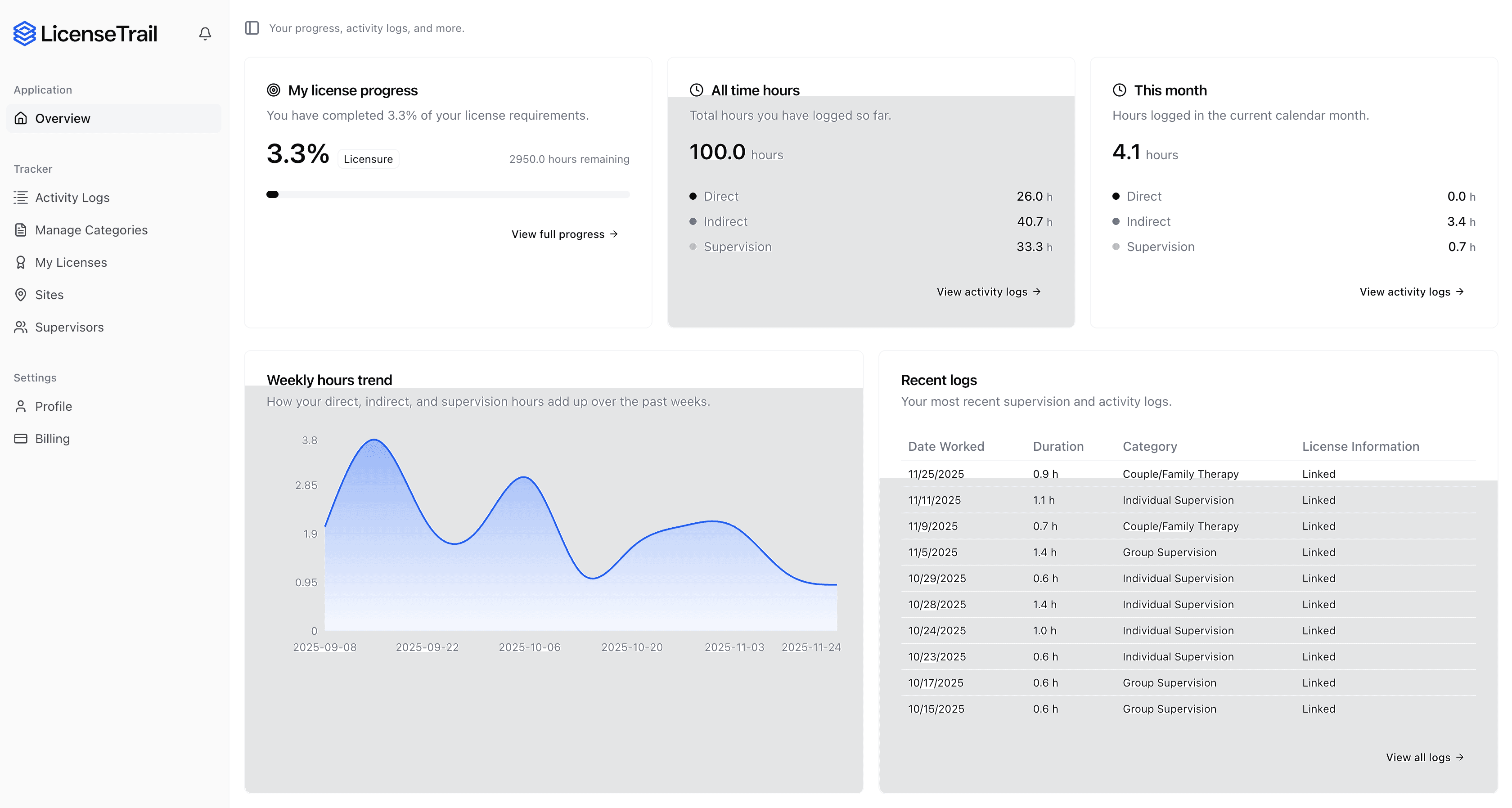
License Trail checks your direct, indirect, and supervision hours against Louisiana LCSW requirements continuously and flags mismatches before you submit.
 Start Tracking for Free
No credit card required · Free plan available
Related Licenses
Is your spreadsheet hiding Louisiana LCSW risks?
Stop guessing if your categories match Louisiana State Board of Social Work Examiners requirements. License Trail checks your direct, indirect, and supervision hours continuously and flags mismatches before you submit.
Import or log
Bring your spreadsheet or start fresh
Upload your existing tracking spreadsheet and we'll map every hour into the right Louisiana State Board of Social Work Examiners categories automatically.
Verify against Louisiana
Catch mismatches before the board does
License Trail checks your direct, indirect, and supervision hours against Louisiana LCSW requirements continuously.
Export board-ready
One-click clean reports
Generate professional, board-ready reports for supervision meetings and Louisiana State Board of Social Work Examiners submissions in seconds.
No credit card required · Free plan available