
Maine PSY Requirements: Hours, Exams & Step-by-Step Guide
Stop guessing if your categories match Maine requirements. License Trail checks your direct, indirect, and supervision hours against PSY requirements continuously and flags mismatches before you submit.
No credit card required · Free plan available
Quick Requirements Overview
- Doctoral degree in psychology meeting Board standards (APA/CPA/NASP or Board‑approved equivalent); includes coordinated practicum (≥2 semesters) and predoctoral internship component
- Required coursework: ≥3 hours in family/intimate partner violence screening, referral, and intervention strategies
- Supervised experience: 2 years total—1 predoctoral + 1 postdoctoral (each ≥1,500 “actual work” hours; practica for academic credit cannot be counted)
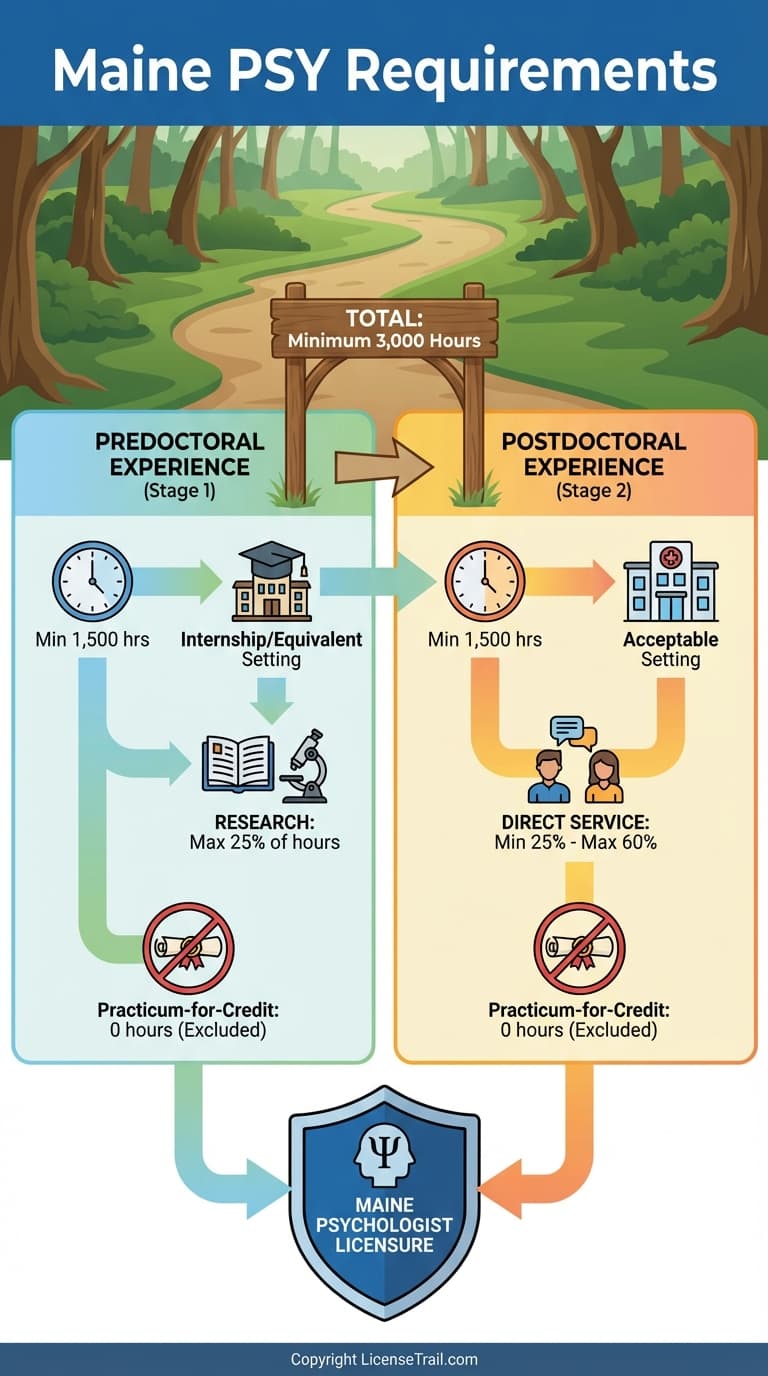
- Predoctoral (internship): 1,500 hrs over 48–104 weeks (avg 16–40 hrs/wk); ≥50% service‑related; within service time ≥25% direct face‑to‑face client contact; ≤25% research; weekly ≥2 hrs face‑to‑face supervision + ≥2 hrs other learning activities
- Postdoctoral: 1,500 hrs over 48–104 weeks (avg 16–40 hrs/wk); 25–60% of weekly time in direct service; majority of work in intended practice area; weekly ≥1 hr individual supervision + ≥1 hr other learning activities (minimum 4 hrs/month 1:1 allowed in special circumstances)
- Setting/supervision structure: organized training program with written training plan and evaluations at least every 6 months; ≥50% of supervision provided by a licensed psychologist (APA programs deemed compliant)
- Exams: pass EPPP (70% per Maine rule) + Maine jurisprudence exam; exams taken only after required education and supervised experience completed
- Application/fees: submit application, official transcript, supervised‑experience documentation, exam scores sent to Board, and license verifications; fees include $250 initial license + $21 background check; renews annually (Apr 30)
License Details
Procedures
Licensure as a doctoral‑level psychologist (“Psychologist”/PSY) in Maine is set by the State Board of Examiners of Psychologists in statute (Title 32, chapter 56) and in the Board’s rules (C.M.R. 02‑415). At a high level, you must:
- Earn a qualifying doctoral degree in psychology
- Complete two full years of supervised experience (one predoctoral and one postdoctoral), each built around at least 1,500 hours of “actual work experience”
- Pass the EPPP and the Maine jurisprudence exam
- Meet character, coursework, and documentation requirements
Below is a step‑by‑step guide with a focus on the types and amounts of hours required.
1. Educational foundation (doctoral degree requirement)
Statutory requirement
Maine law requires that a psychologist candidate:
- Be “trustworthy and competent” to safeguard the public
- Hold a doctorate reflecting comprehensive training in psychology from an accredited institution recognized by the Board
- Have at least 2 years of experience in psychology of a type the Board considers qualifying
- Pass examinations the Board requires
- Not have failed an examination in the preceding six months (legislature.maine.gov)
Since January 1, 2020, candidates must also complete a minimum of 3 hours of coursework in family or intimate partner violence screening and referral and intervention strategies, including knowledge of community resources and cultural factors. (legislature.maine.gov)
Board rule on the doctoral program itself
Under Chapter 4, Section 1 of the Board’s rules, your doctoral degree must be in psychology and meet one of these options: (law.cornell.edu)
- Accredited by the American Psychological Association (APA); or
- Accredited by the Canadian Psychological Association (CPA); or
- Approved by NASP at the doctoral level (for school psychology); or
- Designated by the ASPPB/NR program or meet a detailed set of Board criteria.
Key structural elements the Board requires if your program is not simply APA/CPA/NASP‑accredited include: (law.cornell.edu)
- Regionally accredited institution (or equivalent, if outside the U.S./Canada)
- Program clearly identified and labeled as a psychology program with the intent to train professional psychologists
- Recognizable, coherent psychology unit with identifiable psychology faculty and students
- Integrated, organized sequence of study and a clear curriculum
- Minimum of 3 academic years of full‑time graduate study
- At least 2 years of full‑time residency at the institution granting the doctoral degree
- Required coursework covering core areas (ethics, research design, statistics, psychometrics, biological bases, cognitive‑affective bases, social bases, individual differences, and applied psychology)
Critically, the education rule also requires:
- A “coordinated practicum” of at least two semesters, and
- One year of predoctoral supervised experience (internship) that meets the supervised‑experience requirements described in Section 2 of Chapter 4 (summarized below). (law.cornell.edu)
2. Overall supervised‑experience structure
For full psychologist licensure, the Board’s rule on supervised experience (Chapter 4, Section 2) states that each applicant must show: (regulations.justia.com)
- One year of predoctoral supervised experience; and
- One year of postdoctoral supervised experience;
taken from one or more supervisors who meet the Board’s supervisor‑qualification rules in Chapter 7.
A candidate in postdoctoral re‑specialization in clinical psychology may, instead, complete two years of postdoctoral supervision (i.e., may substitute a second postdoc year for the predoctoral supervised year), at the Board’s discretion. (regulations.justia.com)
The rules make clear that supervised experience does not include work experience earned in connection with practica for which academic credit has been awarded—you cannot double‑count course practicum hours as the required pre‑ or postdoctoral supervised experience. (regulations.justia.com)
3. Predoctoral supervised experience (internship year)
3.1 Amount and timing of hours
For the predoctoral supervised experience, the Board requires: (regulations.justia.com)
- Minimum total hours:
- At least 1,500 hours of “actual work experience”
- Time frame:
- Completed in not less than 48 weeks and not more than 104 weeks
- Weekly range:
- Average of at least 16 hours per week and no more than 40 hours per week
“Actual work experience” is defined in contrast to absences—holidays, sick leave, vacations and similar time off do not count toward the 1,500 hours.
3.2 Required content of predoctoral hours
Within those 1,500 predoctoral hours, the rule requires a specific mix of activities: (regulations.justia.com)
- At least 50% of the predoctoral supervised hours must be “service‑related activities”, such as:
- Assessment
- Interviews
- Report writing
- Case presentations
- Treatment
- Consultation
- Within those service‑related activities, at least 25% of the time must be face‑to‑face, direct patient/client contact.
- No more than 25% of the total predoctoral supervised time may be allocated to research.
So, functionally, the Board expects a predoctoral internship where the majority of your 1,500 hours are clinical or service‑related, with a substantial portion of that time spent directly with clients, and only a limited portion devoted to research.
3.3 Supervision and learning‑activity hours
During the predoctoral supervised year, the Board specifies minimum weekly supervision and training hours: (regulations.justia.com)
- At least 2 hours per week of face‑to‑face supervision with the supervisor
- At least 2 additional hours per week of other learning activities, such as:
- Group supervision
- Seminars
- Case conferences
These supervision and learning hours are in addition to your general work hours; they are part of the structured training component of the internship.
4. Postdoctoral supervised experience (postdoc year)
4.1 Amount and timing of hours
For the postdoctoral supervised experience, the Board imposes a parallel set of hour requirements: (regulations.justia.com)
- Minimum total hours:
- At least 1,500 hours of actual work experience
- Time frame:
- Completed in not less than 48 weeks and not more than 104 weeks
- Weekly range:
- Average of at least 16 hours per week and no more than 40 hours per week
Again, holidays, sick leave, vacations and similar absences do not count toward the 1,500 hours.
4.2 Required content of postdoctoral hours
The postdoctoral experience is more focused on your intended area of professional practice. The Board requires: (regulations.justia.com)
- At least 25% and not more than 60% of your weekly time must be devoted to direct service (direct clinical or service activities with clients).
- The majority of the work must be in your intended area of practice (e.g., clinical, school, neuropsychology), reflecting an advanced or specialized focus.
Unlike the predoctoral year, the rule for postdoctoral experience specifies a range (25–60%) for direct service rather than a requirement that at least half of all hours be “service‑related.” The structure is designed to balance clinical service, professional development, and other activities (e.g., supervision, record‑keeping, scholarly work) at a postdoctoral level.
4.3 Supervision minimums and possible variances
Supervision requirements for the postdoctoral year are as follows: (regulations.justia.com)
- At least 1 hour per week of individual (one‑to‑one) supervision
- At least 1 additional hour per week of learning activities, such as seminars, group supervision, or case conferences
The rules also allow for special‑circumstance variances (e.g., geographic or documented physical hardship). In such cases, a jurisdiction may allow a different meeting pattern, so long as a minimum of four hours per month of one‑to‑one supervision is maintained.
4.4 Limits on what counts as supervised experience
The same prohibition that applies at the predoctoral level applies at the postdoctoral level: you cannot count work experience that was part of a practicum for which you received academic credit toward the Board’s required supervised experience. (regulations.justia.com)
5. Nature of acceptable supervised‑experience settings and supervisors
Both predoctoral and postdoctoral supervised experiences must occur in structured training settings. The Board’s supervised‑experience rule specifies that acceptable settings must: (regulations.justia.com)
- Be an organized public or private agency, private practice, school, institution, or organization
- Provide opportunities for:
- Contact with other professional disciplines
- Work with a broad range of clients
- Have a well‑defined and established psychological services program with appropriate physical resources (office space, support staff, equipment)
- Be training‑oriented, not primarily revenue‑driven
Additionally:
- Both predoctoral and postdoctoral programs must be organized education and training programs with a planned sequence of supervised experience, written program rules, and a written individualized training plan developed at the outset.
- Supervisors must complete regular written evaluations (at least every six months) of the supervisee; supervisees also evaluate supervisors at the end of training.
- For doctoral‑level candidates, at least 50% of supervision must be provided by a licensed psychologist; supervisors may use allied professionals for specific skill training but cannot delegate core supervision below that threshold. (regulations.justia.com)
An APA‑accredited internship or postdoctoral program is deemed to satisfy these supervision‑program requirements automatically. (regulations.justia.com)
6. How the “two years of experience” requirement is operationalized
The statute requires that a psychologist candidate have “at least 2 years of experience in psychology” of a qualifying nature. (legislature.maine.gov) The Board’s regulations operationalize this by requiring:
- One year of predoctoral supervised experience (internship) = at least 1,500 hours of actual work experience, and
- One year of postdoctoral supervised experience = at least 1,500 hours of actual work experience. (regulations.justia.com)
Together, those two supervised years provide the minimum 3,000+ hours of formal, Board‑approved experience that support full licensure.
7. Examination requirements
Under Chapter 3, Section 2 of the Board’s rules and the Board’s licensing page for psychologists, examinations work as follows: (law.cornell.edu)
- Written national exam:
- Examination for Professional Practice in Psychology (EPPP)
- Maine specifies a passing score of 70% (for the traditional scoring; this corresponds to the ASPPB scaled passing score on the computer‑administered exam).
- State jurisprudence exam:
- All psychologist applicants must pass a Maine jurisprudence examination covering state law and Board rules.
The rules also state that no person may take an examination before completing all required education and supervised experience. In other words, you must have the qualifying doctoral degree and both the pre‑ and postdoctoral supervised experience in place before the Board deems you eligible for the EPPP/jurisprudence exam sequence. (law.cornell.edu)
(There are separate provisions for temporary and conditional licenses that can allow limited supervised practice during an interim period, but those do not replace the core supervised‑experience and exam requirements for full licensure.)
8. Application and documentation
The Board’s licensing page for psychologists lists the standard application requirements: (maine.gov)
General application items
- Completed application form
- Documentation of supervised experience (typically, Board forms completed by supervisors and/or program directors)
- Official transcript showing the doctoral degree
- Copy of a current license, if you already hold any professional license in psychology or related fields
- Exam scores for the EPPP sent directly from the testing company to the Board
- If applying for a conditional or temporary license, a letter of agreement signed by you and a Maine‑licensed psychologist who will supervise your work
- Official license verifications for all professional licenses you currently hold or have ever held, including any discipline history
Education and experience (as summarized by the Board)
- Doctoral degree from an accredited institution
- At least 2 years of experience in psychology (as defined by the pre‑ and postdoctoral supervised‑experience rules)
Fees and license term
- Initial psychologist license fee: $250
- Criminal background check fee: $21
- Conditional license fee: $200 (non‑renewable)
- Temporary license fee: $200 (non‑renewable)
- License term: renews annually on April 30 (maine.gov)
9. After licensure: continuing education (briefly)
For license renewal, the Board requires 40 hours of continuing professional education every two years, including: (law.cornell.edu)
- At least 3 hours in ethics
- At least 20 hours in your current or anticipated practice area
- If you perform supervision as defined in Board rules, at least 3 hours in supervision skills/principles
These hours are separate from, and in addition to, the pre‑ and postdoctoral supervised‑experience hours required for initial licensure.
Practical hour summary for a Maine PSY Psychologist
Putting this into a concise hour‑based picture:
-
Predoctoral supervised experience (internship)
- ≥ 1,500 hours actual work over 48–104 weeks (16–40 hrs/week)
- ≥ 50% service‑related; within that, ≥ 25% direct face‑to‑face client contact
- ≤ 25% research
- Weekly: ≥ 2 hrs individual or face‑to‑face supervision + ≥ 2 hrs additional learning activities
-
Postdoctoral supervised experience (postdoc)
- ≥ 1,500 hours actual work over 48–104 weeks (16–40 hrs/week)
- 25–60% of weekly time in direct service, with majority of work in intended practice area
- Weekly: ≥ 1 hr individual supervision + ≥ 1 hr additional learning activities
Combined, these experiences satisfy the statutory requirement of two years of qualifying experience in psychology and are mandatory pieces of the pathway to full PSY psychologist licensure in Maine.
Track your PSY hours with confidence
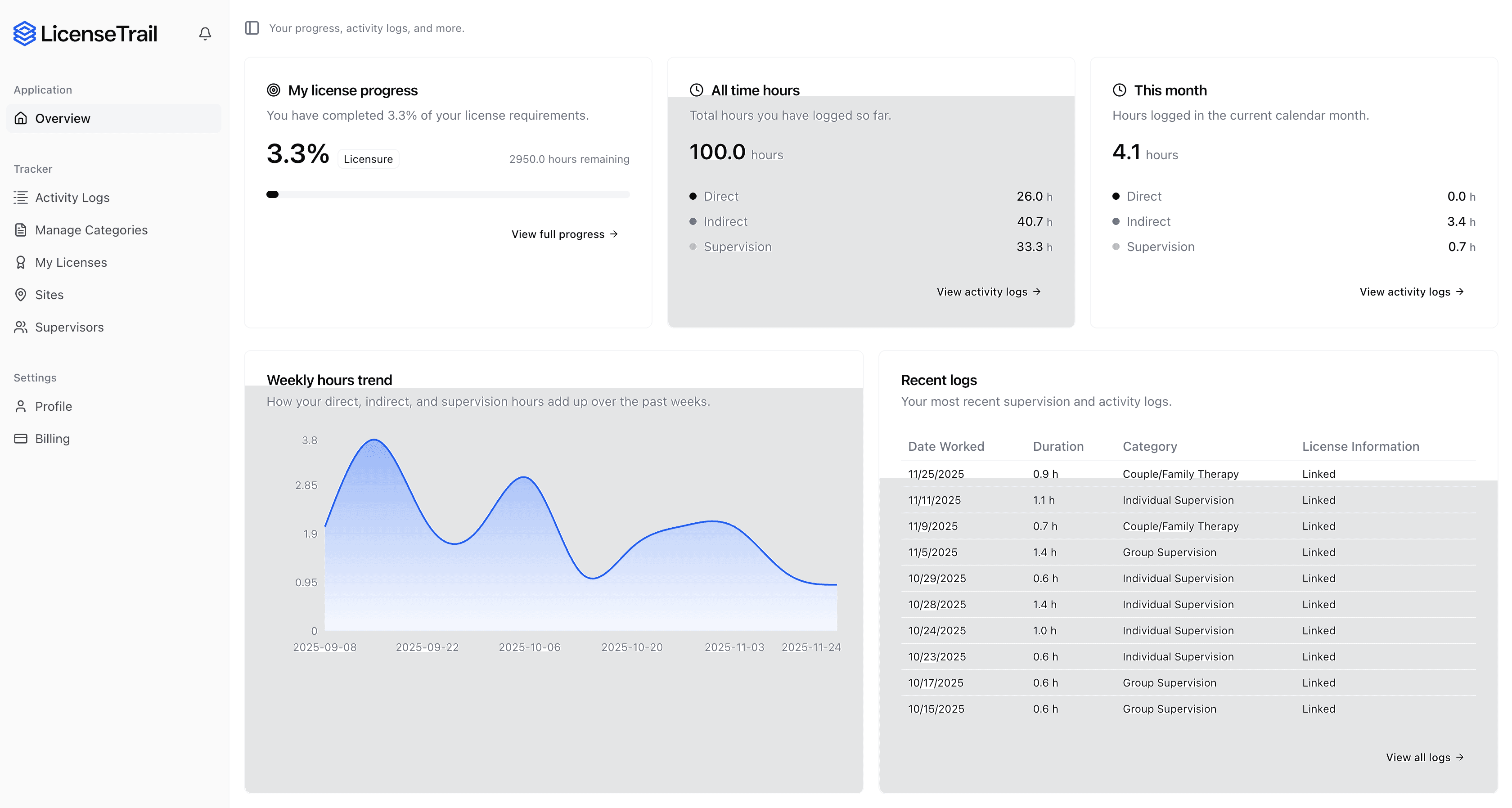
License Trail checks your direct, indirect, and supervision hours against Maine PSY requirements continuously and flags mismatches before you submit.
 Start Tracking for Free
No credit card required · Free plan available
Is your spreadsheet hiding Maine PSY risks?
Stop guessing if your categories match Maine Board of Examiners of Psychologists requirements. License Trail checks your direct, indirect, and supervision hours continuously and flags mismatches before you submit.
Import or log
Bring your spreadsheet or start fresh
Upload your existing tracking spreadsheet and we'll map every hour into the right Maine Board of Examiners of Psychologists categories automatically.
Verify against Maine
Catch mismatches before the board does
License Trail checks your direct, indirect, and supervision hours against Maine PSY requirements continuously.
Export board-ready
One-click clean reports
Generate professional, board-ready reports for supervision meetings and Maine Board of Examiners of Psychologists submissions in seconds.
No credit card required · Free plan available