
Maryland Licensed psychologist Requirements: Hours, Exams & Step-by-Step Guide
Stop guessing if your categories match Maryland requirements. License Trail checks your direct, indirect, and supervision hours against Licensed psychologist requirements continuously and flags mismatches before you submit.
No credit card required · Free plan available
Quick Requirements Overview
- Doctoral degree in psychology meeting MD statutory definition (APA/CPA accredited or designated; or regionally accredited; or National Register–vetted equivalency)
- Supervised professional experience: 3,250 hours minimum over at least 2 years
- Practice‑oriented track: internship ≥1,750 hours completed within 24 months (APA/CPA, APPIC, or equivalently recognized)
- Practice‑oriented track: pre‑internship + pre‑doctoral post‑internship up to 1,500 hours; per 20 hours include 2 hrs individual supervision + 2 hrs other learning activities
- If short of 3,250 pre‑doctoral hours: post‑doctoral supervised experience may count up to 1,500 hours
- Non‑practice‑oriented track: qualifying work may include teaching/research/I‑O; full‑time requires ≥1 hr/week face‑to‑face individual supervision (waivable in exceptional cases)
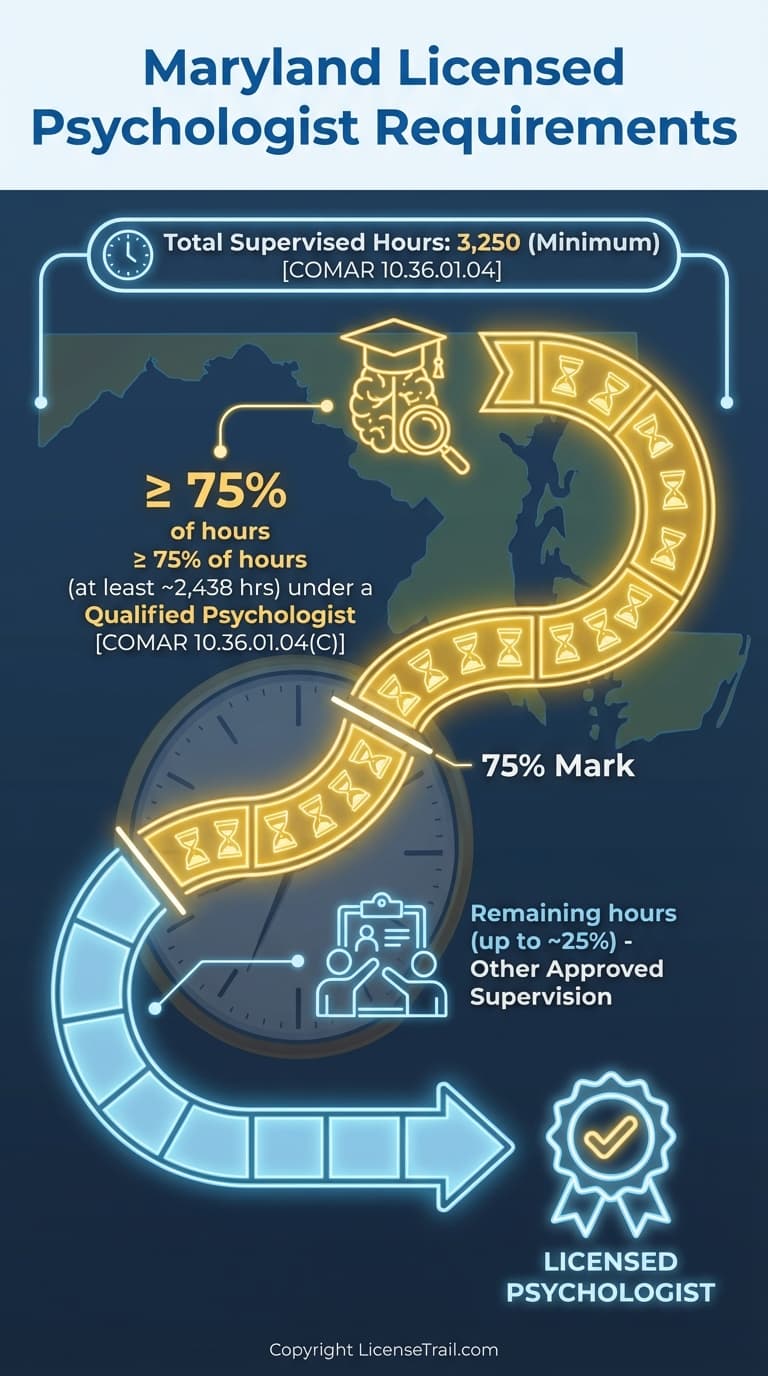
- Supervision rule: ≥75% of all supervised experience must be supervised by a qualified psychologist
- Exams: pass EPPP (scaled 500) and MD Jurisprudence exam (75%); generally after completing supervised experience
License Details
Procedures
To practice independently as a psychologist in Maryland, you must meet specific education, supervised experience, and examination requirements set by the Maryland Board of Examiners of Psychologists. The Board’s rules are primarily contained in the Health Occupations Article, Title 18, and COMAR Title 10.36.
Below is a structured summary of those requirements, with emphasis on exactly how hours are defined and counted.
1. Educational requirement: qualifying doctoral degree in psychology
Maryland requires a doctoral degree in psychology as defined in Health Occupations Article §18‑101(c). (regs.maryland.gov)
In practical terms, your degree must meet one of the following:
-
Doctoral program accredited or designated at the time your degree was awarded:
- A program accredited by the American Psychological Association (APA) or the Canadian Psychological Association (CPA), or
- A program listed in the designated doctoral programs in psychology published by the Council for the National Register of Health Service Providers in Psychology. (mgaleg.maryland.gov)
-
Doctoral program in psychology from a regionally accredited institution
- A doctoral degree in psychology from a school or university that, when you graduated, had regional accreditation recognized by the Council for Higher Education Accreditation or the Canadian Psychological Association. (mgaleg.maryland.gov)
-
Certain foreign or older domestic programs vetted by the National Register
- A doctoral degree in psychology from a program that the National Register determines meets its criteria, for example:
- Programs outside the U.S. and Canada, or
- Programs completed before 1981 (U.S.) or 1988 (Canada), or
- Programs that are now accredited/designated but were not at the time, or programs no longer in existence. (mgaleg.maryland.gov)
- A doctoral degree in psychology from a program that the National Register determines meets its criteria, for example:
COMAR 10.36.01.03 then summarizes this requirement simply by stating that the applicant for licensure shall have a doctoral degree in psychology as defined in that statute. (regs.maryland.gov)
2. Core supervised experience requirement: 3,250 hours over (at least) 2 years
Maryland uses the term “supervised professional experience” rather than “direct client hours” or “indirect hours” for psychologist licensure.
Under COMAR 10.36.01.04:
- You must complete 2 years of supervised professional experience.
- Those 2 years must total a minimum of 3,250 hours. (regs.maryland.gov)
So the basic numeric requirement is:
3,250 hours of supervised professional experience over at least two years.
The way you accumulate those hours depends on whether your doctoral program is:
- Practice-oriented, or
- Not practice-oriented.
3. If your program is practice‑oriented: how hours are broken down
For applicants from practice‑oriented programs, COMAR 10.36.01.04‑2 lays out how supervised professional experience can be accrued. (dsd.maryland.gov)
3.1 Types of experience that can count
For practice‑oriented programs, supervised professional experience may be accrued through:
- Pre‑internship experience
- Internship
- Pre‑doctoral post‑internship experience
- Post‑doctoral experiences (dsd.maryland.gov)
All of these count toward the same 3,250‑hour supervised professional experience requirement.
3.2 Pre‑internship and pre‑doctoral post‑internship: up to 1,500 hours
COMAR 10.36.01.04‑2(C) allows you to use:
- Pre‑internship + pre‑doctoral post‑internship experience to accrue up to 1,500 hours toward the required 3,250 hours. (dsd.maryland.gov)
Key supervision/learning structure for these pre‑internship and pre‑doctoral post‑internship hours:
- Every 20 hours of pre‑internship or pre‑doctoral post‑internship experience must include:
- At least 2 hours of regularly scheduled, formal, face‑to‑face individual supervision focusing on the direct psychological services you provide; and
- At least 2 hours of “other learning activities”, which the regulation defines to include:
- Case conferences
- Seminars on applied issues
- Co‑therapy with a staff person plus case discussion
- Group supervision (dsd.maryland.gov)
So for these portions of your training, 4 of every 20 hours (20%) must be structured supervision/training activities, split between individual supervision and other learning activities.
3.3 Internship: minimum 1,750 hours in ≤24 months
COMAR 10.36.01.04‑2(G) defines internship requirements for practice‑oriented programs:
- An internship must consist of a minimum of 1,750 hours of supervised experience.
- Those 1,750 hours must be completed within 24 months. (dsd.maryland.gov)
The same section also defines what kinds of internships qualify:
- The internship must be:
- Accredited by APA or CPA, or
- A member program of APPIC, or
- Part of an academic program that:
- Is approved or designated by APA, CPA, or ASPPB/National Register, and
- Includes an internship that the academic training director approves as meeting the program’s criteria for an internship. (dsd.maryland.gov)
In other words, Maryland wants a formal, recognized internship that reaches at least 1,750 supervised hours.
3.4 Post‑doctoral supervised professional experience: up to 1,500 hours if needed
If your pre‑doctoral supervised experience (pre‑internship + internship + pre‑doctoral post‑internship) does not reach the full 3,250 hours, COMAR 10.36.01.04‑2(I) allows you to use post‑doctoral supervised experience:
- A maximum of 1,500 hours may be obtained as post‑doctoral supervised experience.
- Post‑doctoral supervised experience is required if you do not have 3,250 hours of pre‑doctoral supervised experience. (dsd.maryland.gov)
Many candidates will satisfy the requirement entirely pre‑doctorally (1,750 internship + up to 1,500 pre‑internship/pre‑doctoral post‑internship = 3,250). But if your total pre‑doctoral supervised hours fall short, Maryland expects you to make up the difference post‑doctorally, up to 1,500 post‑doctoral hours.
3.5 Total hour picture for practice‑oriented programs
Putting the practice‑oriented requirements together:
-
Total supervised professional experience required:
- 3,250 hours over at least 2 years. (regs.maryland.gov)
-
Minimum internship hours within that total:
- At least 1,750 hours (completed within 24 months). (dsd.maryland.gov)
-
Maximum pre‑internship + pre‑doctoral post‑internship hours counted toward total:
- Up to 1,500 hours. (dsd.maryland.gov)
-
Maximum post‑doctoral supervised hours that can count (if needed to reach 3,250):
- Up to 1,500 hours of post‑doctoral supervised professional experience. (dsd.maryland.gov)
Maryland does not divide these psychologist hours into “direct client contact hours” and “indirect hours” in the way some other professions do. Instead, the Board uses the umbrella concept of “supervised professional experience” and then imposes detailed supervision and learning‑activity requirements for different components of that experience.
4. If your program is not practice‑oriented: what counts and how hours are supervised
Separate rules apply for applicants from doctoral programs that are not practice‑oriented (for example, heavily research‑focused programs).
Under COMAR 10.36.01.04‑1:
4.1 Types of activities that can count
For these applicants, supervised professional experience may be accrued in professional work in psychology using the methods, principles, and procedures of psychology, including (but not limited to):
- Teaching
- Research
- Industrial or organizational consultation (regs.maryland.gov)
These activities still must qualify as supervised professional experience under COMAR 10.36.01.04 and count toward the same 3,250‑hour / 2‑year requirement. (regs.maryland.gov)
4.2 Supervision requirement for full‑time supervised professional experience
COMAR 10.36.01.04‑1 specifies the supervision needed for this work to qualify as full‑time supervised professional experience:
- To qualify as full‑time supervised professional experience, the applicant must receive at least 1 hour of individual supervision per week in a face‑to‑face meeting with the supervisor. (regs.maryland.gov)
The Board can waive the face‑to‑face requirement in exceptional circumstances if appropriate assurances are provided (for both pre‑doctoral and post‑doctoral experience), but the standard expectation is in‑person supervision or equivalent (e.g., televideo, where specifically allowed). (regs.maryland.gov)
5. Supervision structure and who may supervise
Beyond counting hours, Maryland specifies who can supervise and how much of your experience must be under a psychologist.
5.1 General supervision rules for all supervised professional experience
COMAR 10.36.01.04(C) sets out baseline rules:
-
At least 75% of your supervised professional experience must be supervised by a psychologist qualified to supervise the activities performed. (regs.maryland.gov)
-
The supervisor must be:
- Licensed to practice psychology in Maryland, or
- Exempt from licensure under specific provisions of the Health Occupations Article, or
- Licensed, certified, or exempt in the state or country where the experience occurs, or
- In some cases, a student, fellow, intern, or resident in a Board‑approved supervisory training arrangement, provided that individual is themselves supervised by someone who meets the licensure/exemption criteria. (regs.maryland.gov)
-
The applicant is responsible for ensuring that supervised professional experience is adequately documented, and the Board may request additional information to evaluate its extent and quality. (regs.maryland.gov)
5.2 If you accrue post‑doctoral hours as a Psychology Associate
If your post‑doctoral supervised professional experience is in settings that are not exempt from licensure (under Health Occupations 18‑301 or 18‑102(3)), COMAR 10.36.01.04‑4 requires that you be registered as a psychology associate while you accrue those hours. (regs.maryland.gov)
In that context, supervision requirements under COMAR 10.36.07.03 become important. For full‑time practice as a registered psychology associate, “adequate and appropriate” supervision includes: (regs.maryland.gov)
-
Doctoral‑level associates (already have a doctoral degree in psychology):
- At least 1 hour of supervision per week.
-
Doctoral candidates in specific accredited programs (e.g., clinical, counseling, school):
- At least 2 hours of supervision per week.
-
All other registered psychology associates:
- At least 3 hours of supervision per week.
In addition, for all psychology associates:
- There must be at least 1 hour of supervision for every 5 hours of comprehensive evaluation and testing performed. (regs.maryland.gov)
Supervision must be face‑to‑face (which may include videoconferencing unless exempted) and must be distinct from administrative supervision. (regs.maryland.gov)
6. Application process and documentation of hours
6.1 Application packet contents
Under COMAR 10.36.01.02 and the Board’s General Licensure Information handout, a new applicant must submit: (regs.maryland.gov)
- A Practice Oriented Program Application (for practice‑oriented programs).
- The required nonrefundable application fee.
- Official transcripts for all post‑baccalaureate study, sent directly from the educational institution(s).
- Documentation of supervised professional experience, including:
- Attestations and reference forms from supervisors using the Board’s specific coversheets (pre‑internship, internship, post‑doctoral, or general reference coversheet, depending on the experience). (health.maryland.gov)
- An EPPP score (if already taken), sent directly by ASPPB. (regs.maryland.gov)
- Criminal history records check results, using the Board’s listed CJIS and FBI ORI numbers. (health.maryland.gov)
The Board reviews only complete applications; a file is established only after an application and fee are received. (health.maryland.gov)
6.2 New licensure vs. licensure by mobility
For new licensure applicants (never licensed in Maryland), you follow the full process described above. (health.maryland.gov)
Maryland also offers:
- Licensure by mobility / abbreviated application for psychologists licensed in other states who hold ABPP certification or National Register Health Service Psychologist credential; this pathway can waive some documentation but still requires a passing Maryland Jurisprudence Examination and a criminal history check. (dsd.maryland.gov)
For your purposes—becoming licensed for the first time—the new applicant pathway and its hour requirements are typically most relevant.
7. Examination requirements
Before licensure, Maryland requires you to pass two examinations:
-
Examination for Professional Practice in Psychology (EPPP)
- Required scaled score of 500 on administrations on or after January 1, 2002, or
- A score of 73% on EPPPs given before that date. (regs.maryland.gov)
-
Maryland Jurisprudence Examination (Maryland Examination)
- Required score of 75%. (regs.maryland.gov)
- The exam covers the Code of Ethics and Professional Conduct and other laws and regulations governing the practice of psychology in Maryland; the Board must make these materials available to you. (regs.maryland.gov)
You must typically complete your 2 years (3,250 hours) of supervised professional experience before taking the examinations required in COMAR 10.36.01.06. (regs.maryland.gov)
8. How Maryland’s hour requirements function in practice
To summarize the “type of hours” and the Board’s terminology:
-
Maryland’s key measure is “supervised professional experience” totaling 3,250 hours over at least 2 years.
-
For practice‑oriented programs:
- Internship must be ≥ 1,750 hours of supervised experience in ≤24 months in an APA/CPA‑accredited, APPIC member, or equivalently recognized setting.
- Pre‑internship + pre‑doctoral post‑internship supervised experience can supply up to 1,500 of the 3,250 hours, under strict supervision/learning‑activity ratios (2 hours individual supervision + 2 hours other learning activities for every 20 hours of experience).
- Post‑doctoral supervised experience can supply up to 1,500 hours if your pre‑doctoral supervised experience totals <3,250 hours. (dsd.maryland.gov)
-
For non‑practice‑oriented programs:
- Supervised professional experience may be in teaching, research, or industrial/organizational consultation, as long as they involve the methods, principles, and procedures of psychology.
- To qualify as full‑time supervised professional experience, you must receive at least 1 hour per week of individual face‑to‑face supervision. (regs.maryland.gov)
-
Across all pathways:
- At least 75% of supervised professional experience must be under a qualified psychologist supervisor. (regs.maryland.gov)
- If you accrue post‑doctoral hours in non‑exempt settings, you must generally do so as a registered psychology associate, with 1–3 hours/week of supervision depending on your degree/candidacy status, plus additional supervision for psychological testing. (regs.maryland.gov)
These are the core, Board‑defined hour and supervision requirements you must meet to become licensed as a psychologist by the Maryland Board of Examiners of Psychologists. Always cross‑check the current text of COMAR 10.36.01 and 10.36.07 and the Board’s own application materials, as regulations and forms can change over time.
Track your Licensed psychologist hours with confidence
License Trail checks your direct, indirect, and supervision hours against Maryland Licensed psychologist requirements continuously and flags mismatches before you submit.
 Start Tracking for Free
No credit card required · Free plan available
Is your spreadsheet hiding Maryland Licensed psychologist risks?
Stop guessing if your categories match Maryland Board of Examiners of Psychologists requirements. License Trail checks your direct, indirect, and supervision hours continuously and flags mismatches before you submit.
Import or log
Bring your spreadsheet or start fresh
Upload your existing tracking spreadsheet and we'll map every hour into the right Maryland Board of Examiners of Psychologists categories automatically.
Verify against Maryland
Catch mismatches before the board does
License Trail checks your direct, indirect, and supervision hours against Maryland Licensed psychologist requirements continuously.
Export board-ready
One-click clean reports
Generate professional, board-ready reports for supervision meetings and Maryland Board of Examiners of Psychologists submissions in seconds.
No credit card required · Free plan available