
Massachusetts Psychologist Requirements: Hours, Exams & Step-by-Step Guide
Stop guessing if your categories match Massachusetts requirements. License Trail checks your direct, indirect, and supervision hours against Psychologist requirements continuously and flags mismatches before you submit.
No credit card required · Free plan available
Quick Requirements Overview
- Credential structure: MA Psychologist license + separate Health Service Provider (HSP) certification required for independent health services (therapy/testing).
- Education: Doctoral degree from a qualifying “program in psychology” (APA CoA within allowed window or ASPPB/National Register designated); foreign degrees require credential evaluation/equivalency.
- Total supervised experience: 3,200 clock hours (2 years) completed within 60 months; hours can’t start until after 2 full-time graduate years.
- Internship requirement: At least 1,600 hours in a qualifying health service training program (internship) over ≥10 months (~43 weeks).
- Remaining hours: Additional 1,600 hours from qualifying post-internship and/or advanced practicum meeting Board criteria (e.g., written plan; advanced practicum: ≥50% service-related; ≥25% client contact; ≥2 hrs individual supervision/week).
- Supervision minimums: Typically ≥1 hour supervision per 16 hours work, ≥1 hour individual supervision/week; group supervision limited (max 3 trainees); supervisor must be a qualified/licensed psychologist (HSP expected for health-service supervision).
- Health-service/direct service thresholds (HSP): In supervised health service experience, ≥800 hours direct health services total and ≥25% direct client contact each year; ≥50% of supervision by a licensed psychologist.
- Exams: Pass EPPP + MA Jurisprudence Exam (timing/retake limits apply, incl. ~3-month minimum between attempts).
License Details

Procedures
Massachusetts regulates psychologists through the Board of Registration of Psychologists under 251 CMR 3.00. To become licensed as a Psychologist (and, separately, as a Health Service Provider) you must meet specific academic, supervised-experience, and examination requirements that are defined in regulation rather than simply “1,500 hours of X and 1,500 hours of Y.”
Below is a structured summary of those requirements, with special attention to the exact types of hours and how the Board defines them.
1. Two different credentials in Massachusetts
Massachusetts separates:
- License as a Psychologist (the basic license under M.G.L. c. 112, §119), and
- Certification as a Health Service Provider (HSP) (under M.G.L. c. 112, §120).
Key points:
- You cannot independently provide “health services” (psychotherapy, psychological testing, etc.) to the public just with a Psychologist license; you need HSP certification for independent health service practice.(mass.gov)
- The same pool of supervised experience hours is typically used both to qualify for licensure and to satisfy the “two years of full-time supervised health service experience” required for HSP.(law.cornell.edu)
The Board’s own FAQ clarifies that Massachusetts no longer requires a fixed “one-year postdoc.” Instead, it requires 3,200 hours of qualifying supervised experience, with at least one year that meets all requirements for a “health service training program” (internship) and the remaining 1,600 hours from post‑internship and/or advanced practicum experiences that meet Board standards.(mass.gov)
2. Academic requirements (251 CMR 3.03)
To be licensed as a Psychologist, you must have a doctoral degree in psychology that meets the Board’s academic requirements. In regulatory language, you must have a degree from a “program in psychology” that:(law.cornell.edu)
- Is either:
- Designated as a doctoral program in psychology by the Association of State and Provincial Psychology Boards (ASPPB) or National Register of Health Service Psychologists, or
- Accredited by APA’s Commission on Accreditation (CoA) at the time the degree is granted or within three years thereafter; and
- Meets structural criteria such as:
- Doctoral-level training in psychology offered by a recognized educational institution.
- A recognizable, coherent program entity with an identifiable psychology faculty and a psychologist responsible for the program.
- An organized sequence of study, including specialty-area coursework and a dissertation (or equivalent) using psychological methods and content.(law.cornell.edu)
If your psychology doctorate is from outside the United States, the Board requires a formal credentials evaluation to establish equivalency and you must meet all the same course and supervised-experience standards.(law.cornell.edu)
3. Overall supervised-experience requirement for licensure
Total amount and timing
For initial Psychologist licensure, Massachusetts requires:
- “Two years of supervised experience”, defined as not less than 3,200 clock hours.(law.cornell.edu)
- These 3,200 hours must be completed within 60 consecutive calendar months (5 years), unless the Board grants more time for good cause.(law.cornell.edu)
The Board FAQ frames this as:(mass.gov)
- 3,200 hours of qualifying supervised experience, of which:
- At least 1,600 hours must meet all requirements for a “health service training program” (internship), usually over at least 43 weeks / 10 months.
- The other 1,600 hours can be met through qualifying post‑internship or advanced practicum hours that meet the Board’s regulatory criteria.
When you can start counting hours
You cannot count supervised experience hours toward the 3,200 until you have completed two full‑time academic years of graduate training in psychology (or equivalent).(law.cornell.edu)
Structure of each training placement
For any supervised placement you want to count:
- Each training experience must be at least four months long.
- You must work a minimum of 16 hours per week at that site.
- You must receive no less than one hour of individual supervision per week during that placement.(law.cornell.edu)
The Board credits experience at a maximum rate of 16 hours of work for each hour of “acceptable supervision”, reinforcing the 1:16 supervision ratio.(law.cornell.edu)
4. What “supervision” and “supervised experience” mean
Supervision
251 CMR defines “supervision” as a formal relationship between a qualified supervisor and a trainee engaged in training.(law.cornell.edu)
Under 251 CMR 3.05, supervision:(law.cornell.edu)
- Must occur at least weekly.
- Involves face‑to‑face contacts (individual or groups of up to three trainees).
- Requires the supervisor to assess and constructively critique the trainee’s work.
- Requires that the supervisor be on the premises where the trainee is rendering services (for teletherapy, the Board has interpreted “on‑premises” flexibly, as long as the supervisor is available in real time and has access to records).(law.cornell.edu)
- Must be provided by a licensed psychologist or one clearly eligible for licensure, and the supervisor must be a regular staff member or consultant of the organization where you are training.(law.cornell.edu)
Supervisees are responsible for verifying that their direct supervisor is a licensed Psychologist, and if the work is health‑service oriented in Massachusetts, that the supervisor holds HSP certification.(mass.gov)
“Supervised health service experience” and “health service setting”
For HSP and for health‑service hours that count toward licensure, Massachusetts law and Board policy define “supervised health service experience” as:(mass.gov)
- Training at a site where health services in psychology are normally provided,
- In which the trainee has a formal relationship,
- With at least one hour of supervision for every 16 hours of training,
- At least half of that supervision provided by a Board‑licensed psychologist on the training site’s staff, and
- At least 25% of the trainee’s time in direct client contact.
The regulations further define a “health service setting” as a setting that presents itself to the public as providing health services and where clients usually seek health services (e.g., clinics, hospitals, counseling centers).(mass.gov)
The Board also excludes some activities from counting as “supervised health service experience,” such as pure vocational guidance, industrial/organizational consulting, teaching, and research; client contact for research only does not qualify.(law.cornell.edu)
5. Advanced practicum, internship, and post‑internship hours
The 3,200 supervised hours typically come from a combination of:
- Advanced practica (pre‑internship, but after two academic years)
- Predoctoral internship (a “health service training program”)
- Post‑internship supervised employment or fellowship
Advanced practica (251 CMR 3.04(7))
Advanced practica can count toward the 3,200 hours if they meet detailed requirements, including:(law.cornell.edu)
- Occur after at least two full‑time post‑bachelor’s academic years of graduate education in psychology, with at least one year in the degree‑granting doctoral program.
- Involve services that are within the scope of the doctoral program’s training.
- Have a written training plan among the student, practicum site, and graduate program, specifying:
- Goals and objectives,
- How the trainee’s time is allocated,
- Evaluation methods,
- Nature and frequency of supervision.
Hour‑type requirements for advanced practicum:
- At least 50% of total hours must be service‑related activities (treatment/intervention, assessment, interviews, report writing, case presentations, consultations).
- At least 25% of supervised professional experience must be face‑to‑face patient/client contact.
- The student must receive a minimum of two hours of individual supervision per week, and at least one hour of individual or group supervision for each 16 hours of work, with group supervision limited to three trainees.(law.cornell.edu)
Predoctoral internship and post‑internship experience (251 CMR 3.04(8); 3.06)
For internship and post‑internship supervised experience:(law.cornell.edu)
- A full‑time internship year meets one of the two required years of supervised experience if it totals at least:
- 1,600 clock hours,
- Completed in not less than ten calendar months (often framed as at least 43 weeks/10 months in Board FAQs).
- For internship and post‑internship:
- You must receive at least one hour of supervision for each 16 hours of work, including at least one hour per week of individual supervision.
- The 1,600 internship hours must be completed in 10 to 36 consecutive months.
For HSP, the Board defines two years of full‑time supervised health service experience as:(law.cornell.edu)
- At least 3,200 clock hours completed within 60 months,
- At least 800 of those hours “providing health services directly to clients” (this is your minimum direct service quota), and
- Each training experience used toward this requirement must be at least four months and at least 16 hours per week.
In each of the two years of supervised health service experience:
- At least half of the supervision must be provided by a licensed psychologist, and
- At least 25% of your hours must be in direct client contact (assessment or treatment).(law.cornell.edu)
So, in the Board’s own structure, instead of “1,500 hours of direct experience and 1,500 hours of supervised experience,” the key quantitative requirements look like:
- 3,200 total clock hours of qualifying supervised experience,
- Of which at least 1,600 hours are in a qualifying health service training program (internship),
- At least 800 hours must be direct health services to clients (which corresponds to at least 25% of the 3,200 hours), and
- Supervision must meet minimum 1:16 ratios, with much stricter ratios and content requirements for advanced practica.
6. Examinations (251 CMR 3.08)
Once the academic and supervised‑experience requirements are met (or nearly met), you must pass:
- A national examination in psychology – in practice, this is the EPPP.
- The Massachusetts Jurisprudence Examination, which tests knowledge of state law, regulations, and ethical requirements.(regulations.justia.com)
Regulatory details include:(regulations.justia.com)
- You must pass the national exam within three calendar years of the Board’s approval for examination, or you must reapply and meet current standards.
- There is a mandatory three‑month minimum between exam attempts, and a limit of four attempts per calendar year on each exam.
- The Board FAQ also notes there is a 90‑day waiting period between administrations, which aligns with the three‑month spacing requirement.
7. Application and titles during training
Application process
The administrative steps, in brief, are:(mass.gov)
- Create an account and apply through the Massachusetts Health Professions Licensing Portal.
- Have your doctoral program submit transcripts and verification of your degree.
- Arrange for supervision forms documenting all qualifying supervised experience (advanced practicum, internship, post‑internship) to be sent to the Board.
- Once your education and experience are approved, the Board authorizes you to take the EPPP and MA Jurisprudence exam.
- After passing both exams and paying the required fees, the Board issues your Psychologist license, and, if your supervised hours qualify, HSP certification.
Titles you may use while accruing hours
The Board is explicit that an individual without a psychology license may not use the term “Psychologist” to describe their professional status in Massachusetts (for example, “unlicensed psychologist” is not allowed).(mass.gov)
While accruing supervised hours, acceptable titles include variants such as:
- “Post‑doctoral fellow,”
- “Post‑doctoral trainee,”
- “Psychology trainee,”
- “Intern,” “resident,” or “fellow,”
as long as the title clearly designates training status rather than licensed status.(mass.gov)
8. Practical summary of key hour requirements
Putting the Board’s regulatory language into a concise, hour‑focused summary:
-
Total supervised experience required for licensure
- 3,200 clock hours of qualifying supervised experience, completed within 60 months.
- Cannot begin counting until after two full‑time academic years of graduate training.
-
Internship (“health service training program”)
- ≥1,600 hours over ≥10 months (≈43 weeks).
- Must meet the Board’s health‑service training program criteria (health service setting, supervision ratio, direct contact requirements, structured learning activities).(law.cornell.edu)
-
Other qualifying supervised hours (advanced practicum + post‑internship)
- Another 1,600 hours minimum from advanced practica and/or post‑internship supervised positions that meet 251 CMR 3.04 standards.
- Advanced practica: ≥50% service‑related, ≥25% face‑to‑face client contact, ≥2 hours individual supervision/week, with at least 1 hour of supervision per 16 hours of work.(law.cornell.edu)
-
Direct client contact / direct health services requirement for HSP
- Within the 3,200 hours of supervised health service experience, at least:
- 25% of your time each year must be direct client contact, and
- In total, at least 800 hours must be direct health services to clients.(law.cornell.edu)
- Within the 3,200 hours of supervised health service experience, at least:
-
Supervision ratios and source
- Minimum 1 hour of supervision for every 16 hours of work.
- In supervised health service experience:
- At least half of supervision hours must be provided by a licensed psychologist, and
- The supervisor must generally be on‑site and legally/clinically responsible for the services provided.(law.cornell.edu)
Taken together, Massachusetts does not use a simple “X hours direct / Y hours supervised” formula. Instead, it requires 3,200 supervised hours configured so that a significant and clearly defined proportion is:
- In approved health service settings,
- Under qualifying supervision at specified ratios, and
- In direct client contact (at least 800 direct‑service hours and at least 25% of your time in each health‑service year).
Track your Psychologist hours with confidence
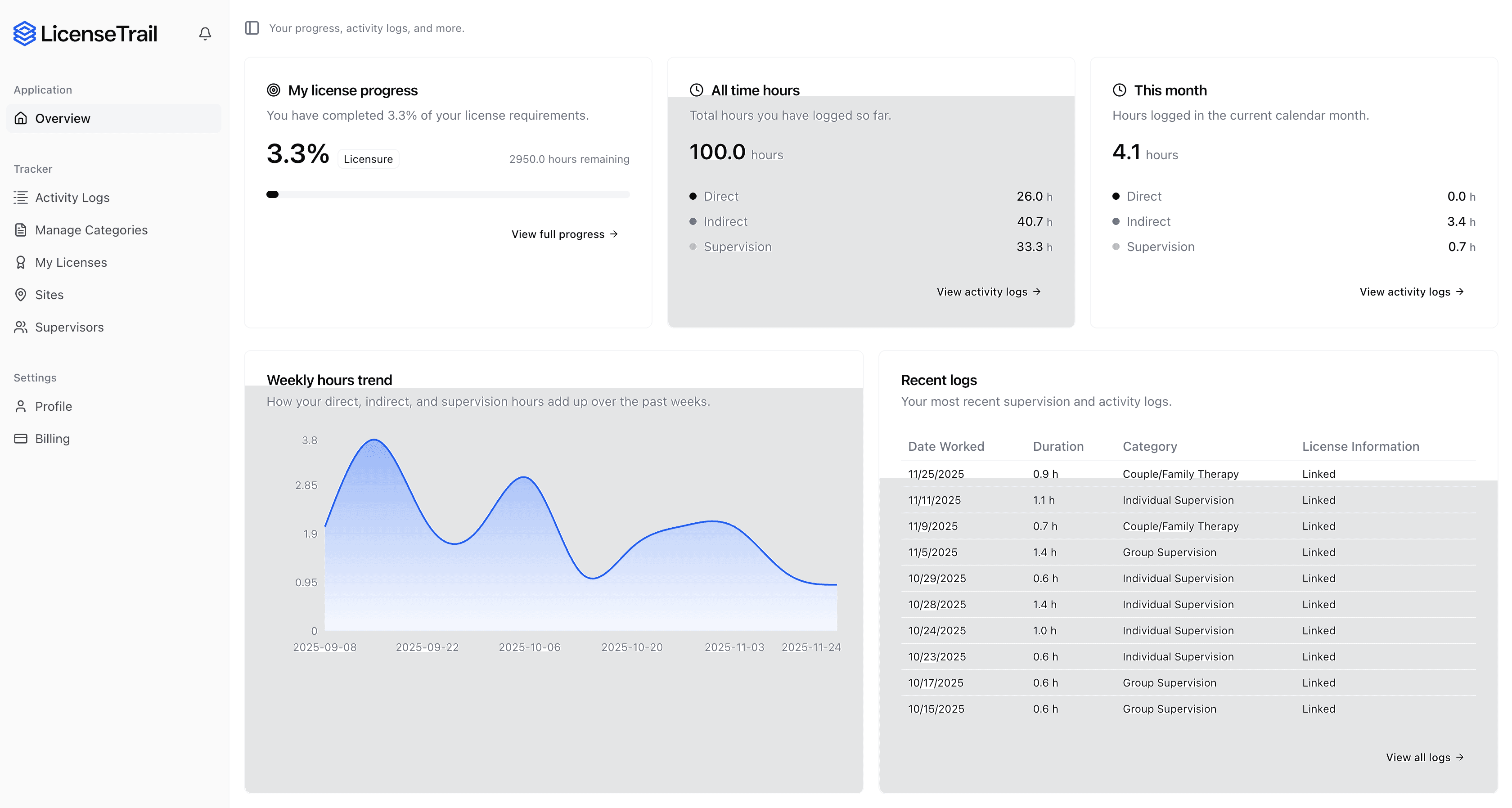
License Trail checks your direct, indirect, and supervision hours against Massachusetts Psychologist requirements continuously and flags mismatches before you submit.
 Start Tracking for Free
No credit card required · Free plan available
Is your spreadsheet hiding Massachusetts Psychologist risks?
Stop guessing if your categories match Massachusetts Board of Registration of Psychologists requirements. License Trail checks your direct, indirect, and supervision hours continuously and flags mismatches before you submit.
Import or log
Bring your spreadsheet or start fresh
Upload your existing tracking spreadsheet and we'll map every hour into the right Massachusetts Board of Registration of Psychologists categories automatically.
Verify against Massachusetts
Catch mismatches before the board does
License Trail checks your direct, indirect, and supervision hours against Massachusetts Psychologist requirements continuously.
Export board-ready
One-click clean reports
Generate professional, board-ready reports for supervision meetings and Massachusetts Board of Registration of Psychologists submissions in seconds.
No credit card required · Free plan available