
Michigan LBSW Requirements: Hours, Exams & Step-by-Step Guide
Stop guessing if your categories match Michigan requirements. License Trail checks your direct, indirect, and supervision hours against LBSW requirements continuously and flags mismatches before you submit.
No credit card required · Free plan available
Quick Requirements Overview
- Education: BSW from a MI board‑approved/CSWE‑compliant program
- Initial license stage: Apply for Limited BSW (LLBSW) (application + fee); required before hours count
- Limited license term: Valid 1 year; renewable up to 6 times (max ~7 years total)
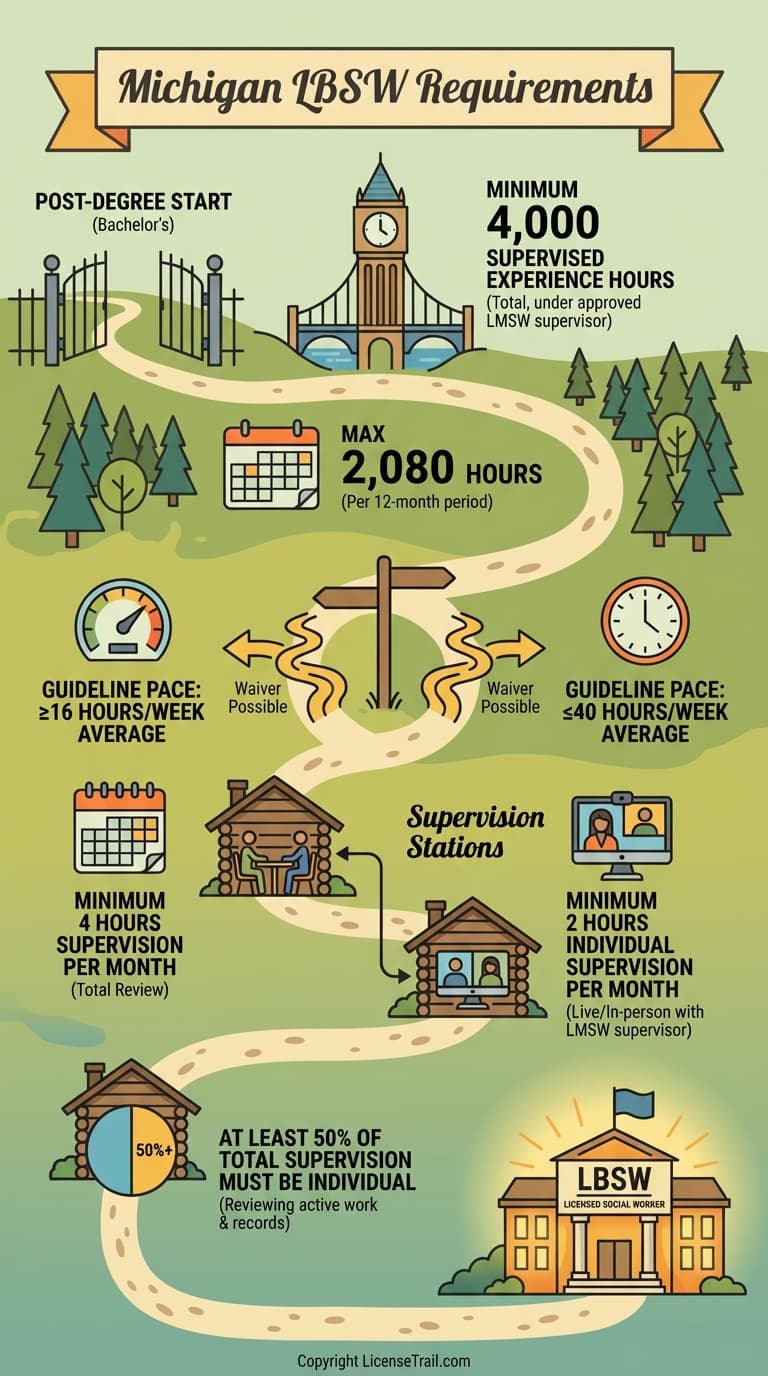
- Experience: 4,000 hours post‑degree supervised bachelor’s‑level social work over ≥ 2 years
- Where/under whom: Hours only while LLBSW; in a board‑approved entity; supervised by a MI LMSW in good standing (paid or volunteer OK)
- Hour structure limits: Avg 16–40 hrs/week; max 2,080 hrs per 12 months; supervision ≥ 4 hrs/month (≥2 hrs individual; group allowed with required individual review)
- Exam: Pass ASWB Bachelor’s exam (send score to LARA)
- Full LBSW: Apply to upgrade to LBSW after BSW + hours + exam (fees apply); renewal requires 45 CE/3 years incl 5 ethics, 2 pain, 2 human trafficking
License Details
Procedures
In Michigan, becoming licensed as a bachelor’s-level social worker (LBSW – “licensed bachelor’s social worker”) is a structured, two‑stage process: you first practice under a limited license while accumulating supervised experience, then you upgrade to a full LBSW license. The Michigan Department of Licensing and Regulatory Affairs (LARA), Bureau of Professional Licensing, Board of Social Work sets these requirements in statute and administrative rules.
Below is a step‑by‑step outline with the key “verbiage” and hour requirements used by the Michigan Board of Social Work.
1. Understand the Two Licenses at the Bachelor’s Level
Michigan recognizes:
- Limited Bachelor’s Social Worker license (LLBSW / “limited bachelor’s social worker”)
- Full Licensed Bachelor’s Social Worker (LBSW / “licensed bachelor’s social worker”)
You must hold the limited license while you earn the supervised hours that qualify you for the full LBSW. (regulations.justia.com)
The Board’s general rule for the limited license states that an applicant for a limited bachelor’s social worker license must:
“accumulate the supervised work experience hours required pursuant to R 338.2941” and must have “completed a baccalaureate degree program from a program of social work that complies with the standards in R 338.2923.” (regulations.justia.com)
2. Step One – Meet the Education Requirement
For both the limited and full LBSW licenses, you must have:
- A bachelor’s degree in social work from a program “that complies with the standards in R 338.2923” (i.e., a CSWE‑compliant BSW program). (regulations.justia.com)
The Public Health Code similarly provides that a licensed bachelor’s social worker:
“shall have been awarded a bachelor’s degree in social work from a college or university social work program approved by the board.” (legislature.mi.gov)
3. Step Two – Apply for the Limited Bachelor’s License (LLBSW)
Once you have completed all graduation requirements for your BSW:
-
Submit the LLBSW application
- You submit a completed application “on a form provided by the department, together with the required fee.” (regulations.justia.com)
-
Verify BSW completion
- You must have “completed a baccalaureate degree program from a program of social work that complies with the standards in R 338.2923.” (regulations.justia.com)
-
License validity and renewals
- The LLBSW is issued for 1 year and “may be renewed no more than 6 times” for purposes of accumulating experience. (regulations.justia.com)
In practice, that gives you up to 7 years total (initial year plus 6 renewals) to complete your supervised experience.
4. Step Three – Accumulate the Required Supervised Work Experience
4.1 Total hours and timeframe
To qualify for the full LBSW by examination, Michigan requires:
- At least 4,000 hours of post‑degree supervised work experience
- Accrued over not less than 2 years
The Board’s rule states that an applicant for a bachelor’s social worker license by examination must:
“have completed at least 4,000 hours of post-degree supervised work experience accrued over not less than 2 years, as required in section 18509(1)(a) of the code.” (regulations.justia.com)
Section 333.18509 of the Public Health Code expresses the same requirement in time terms:
a licensed bachelor’s social worker “shall have completed at least 2 years of full‑time postbachelor’s degree experience, or the equivalent in part‑time hours, in the practice of social work at the bachelor’s level under the supervision of a licensed master’s social worker.” (legislature.mi.gov)
Important: Michigan does not split these hours into separate “direct” vs. “supervised” categories (e.g., “1,500 direct + 1,500 supervised”). All 4,000 hours must be post‑degree supervised work experience at the bachelor’s level under an LMSW.
4.2 Type of work that counts toward the 4,000 hours
The Board explains that “supervised work experience includes, but is not limited to” the following activities: (regulations.justia.com)
-
Direct practice with clients
- “Assessment, planning, and intervention with individuals, couples, families, or groups to enhance or restore the capacity for social functioning.”
-
Case management
- “Case management of health and human services.”
-
Information and referral
- “Providing information about and referring individuals to resources.”
-
Community and organizational work
- “Planning and collaborating with communities, organizations, or groups to improve their social or health services.”
- “Working with clients in accessing, coordinating, or developing resources to develop solutions for interpersonal or community problems.”
In other words, your hours can include:
- Direct service to individuals, couples, families, and groups
- Case management and coordination of services
- Community organizing, program planning, and systems‑level work
as long as the work falls within the statutory scope of **“practice of social work at the bachelor’s level.” (law.justia.com)
4.3 Where and under whom the experience must be gained
Michigan is strict about the setting and supervision:
-
License status while accruing hours
- “Supervised work experience may be earned only while holding a Michigan limited bachelor’s of social work license issued pursuant to R 338.2939.” (regulations.justia.com)
-
Supervisor’s license
- The experience “must be completed under the supervision of a Michigan‑licensed master’s social worker whose license is in good standing throughout the period of supervision.” (regulations.justia.com)
-
Type of agency
- A limited bachelor’s social worker “shall accumulate supervised work experience in an agency, health facility, institution, or other entity approved by the board” – defined as a setting where “a master’s social worker engages in the practice of social work at the master’s level.” (regulations.justia.com)
The Board allows the experience to be paid or volunteer: “The experience may be earned either in an employment or volunteer capacity.” (regulations.justia.com)
4.4 Weekly, yearly, and supervision‑hour limits
The rules further define how the 4,000 hours must be structured:
-
Weekly minimum and maximum
- “An applicant shall accumulate an average of at least 16 hours, but not more than 40 hours, of supervised work experience per week.” (regulations.justia.com)
-
Annual maximum
- “An applicant may not accumulate more than 2,080 hours of supervised work experience during any 12‑month period.” (regulations.justia.com)
-
Minimum supervisory review per month
- Supervisory review “must be conducted for at least 4 hours per month with at least 2 hours being conducted between the applicant and the supervisor” individually, in person or via real‑time telecommunication. (regulations.justia.com)
-
Format of supervision
- You may meet individually or in a group format, but “50% of the supervision” in a group modality must consist of individual contact in which the supervisor reviews your active work functions and records. (regulations.justia.com)
Taken together, the Board treats all 4,000 hours as supervised bachelor’s‑level social work, with structured, ongoing contact with your LMSW supervisor.
5. Step Four – Pass the ASWB Bachelor’s Examination
To become fully licensed as an LBSW by examination, you must also:
- “have passed the bachelor’s examination approved pursuant to R 338.2925” (this is the ASWB Bachelor’s exam). (regulations.justia.com)
Standard practice in Michigan is:
- Apply for the exam after or near completion of your supervised hours
- Have ASWB send your score directly to LARA / the Board of Social Work (legalclarity.org)
6. Step Five – Apply for the Full LBSW (Licensed Bachelor’s Social Worker)
Once you have:
- A qualifying BSW degree
- 4,000 hours of acceptable post‑degree supervised work experience over at least two years
- A passing score on the ASWB Bachelor’s exam
you submit your application for the bachelor’s social worker license by examination with the appropriate fee. (regulations.justia.com)
Statute and rule require, in summary, that a licensed bachelor’s social worker:
- Have a BSW from a board‑approved program (legislature.mi.gov)
- Have “completed at least 2 years of full‑time postbachelor’s degree experience, or the equivalent in part‑time hours,” under LMSW supervision (operationalized as 4,000 hours of post‑degree supervised work experience in the rules) (legislature.mi.gov)
- Have “passed the bachelor’s examination approved pursuant to R 338.2925” (regulations.justia.com)
Fees
Under the Public Health Code, fees for social work licenses include:
- Application processing fee: $15
- Licensed bachelor’s social worker license fee (per year): $25 (legislature.mi.gov)
(LARA can adjust fees by rule, so you should verify current amounts in the online application system.)
7. Licensure by Endorsement (Out‑of‑State LBSW Moving to Michigan)
If you already hold a bachelor’s‑level social work license elsewhere and seek Michigan licensure:
- You apply for licensure by endorsement and submit a completed application and fee. (regulations.justia.com)
- If you have been actively practicing for at least 10 years in good standing, the Board presumes you meet Michigan’s endorsement requirements. (regulations.justia.com)
- If you do not meet the 10‑year presumption, you must:
- Pass the ASWB bachelor’s exam (if you have not already), and
- Document “a minimum of 4,000 hours of supervised work experience, work experience, or both, at the bachelor’s level.” (regulations.justia.com)
8. After You Are Licensed – Renewal and Continuing Education
Once you hold the full LBSW license, you must renew it and complete continuing education (CE):
- Every 3‑year renewal cycle, a licensed bachelor’s social worker must accumulate at least 45 continuing education contact hours, including:
- 5 hours in ethics
- 2 hours in pain and symptom management
- 2 hours in human trafficking (regulations.justia.com)
You must retain documentation of your CE for at least 5 years in case of audit. (regulations.justia.com)
9. Notes on Possible Future Changes
There has been recent legislative activity and advocacy proposing to remove the post‑degree experience and exam requirements at the bachelor’s level and to restructure Michigan’s social work licensure system. However, as of the most recent updates to the Michigan Administrative Code (through June 15, 2025) and the current text of MCL 333.18509, the requirements outlined above—4,000 supervised post‑degree hours over at least 2 years plus the ASWB Bachelor’s exam—remain in force. (regulations.justia.com)
Because licensure rules can change, anyone planning for LBSW licensure should always confirm the current requirements directly with:
- Michigan Department of Licensing and Regulatory Affairs (LARA), Bureau of Professional Licensing – Social Work Section (nasw-michigan.org)
Track your LBSW hours with confidence
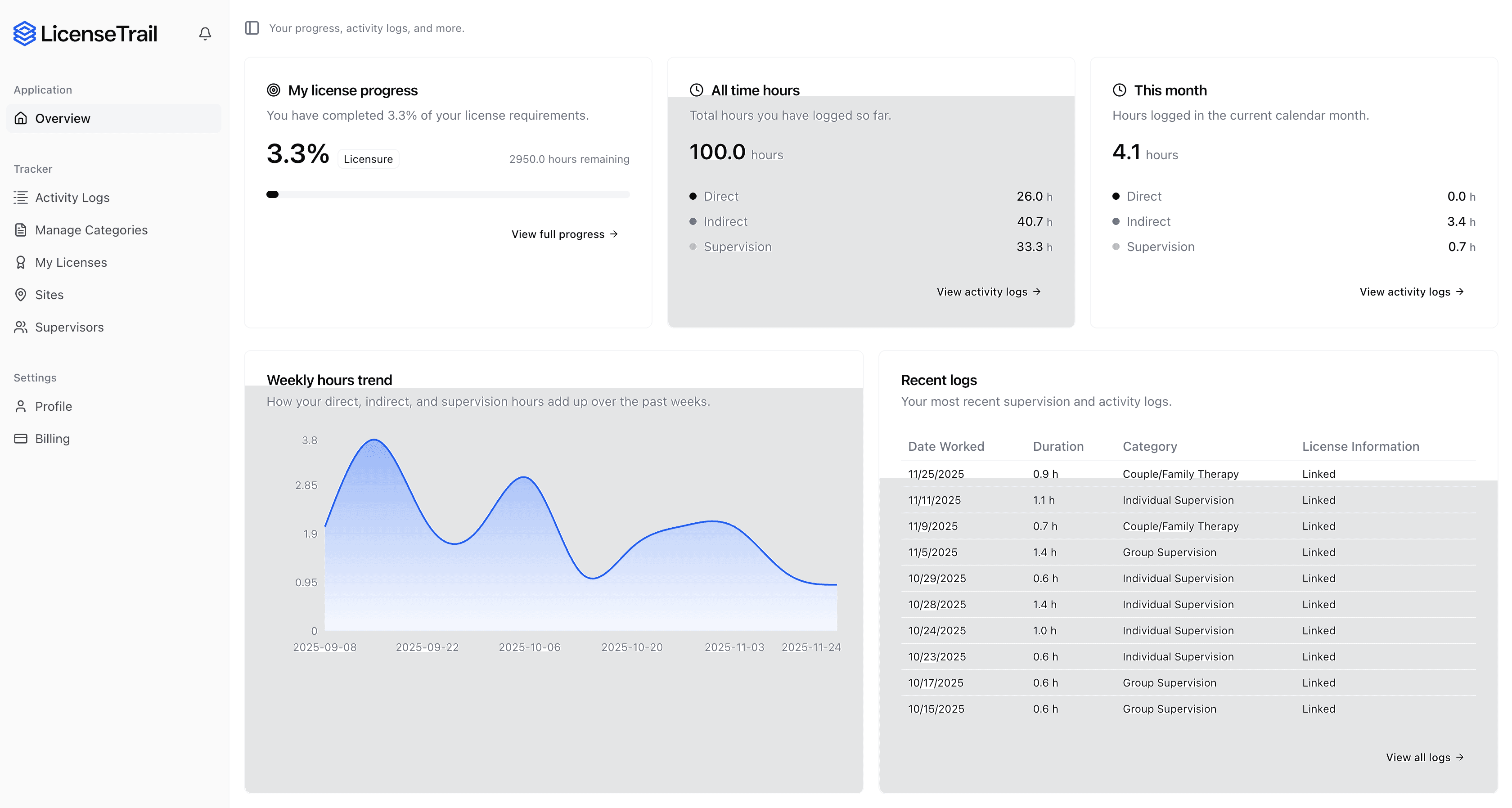
License Trail checks your direct, indirect, and supervision hours against Michigan LBSW requirements continuously and flags mismatches before you submit.
 Start Tracking for Free
No credit card required · Free plan available
Related Licenses
Is your spreadsheet hiding Michigan LBSW risks?
Stop guessing if your categories match Michigan Board of Social Work requirements. License Trail checks your direct, indirect, and supervision hours continuously and flags mismatches before you submit.
Import or log
Bring your spreadsheet or start fresh
Upload your existing tracking spreadsheet and we'll map every hour into the right Michigan Board of Social Work categories automatically.
Verify against Michigan
Catch mismatches before the board does
License Trail checks your direct, indirect, and supervision hours against Michigan LBSW requirements continuously.
Export board-ready
One-click clean reports
Generate professional, board-ready reports for supervision meetings and Michigan Board of Social Work submissions in seconds.
No credit card required · Free plan available