
Michigan LMFT Requirements: Hours, Exams & Step-by-Step Guide
Stop guessing if your categories match Michigan requirements. License Trail checks your direct, indirect, and supervision hours against LMFT requirements continuously and flags mismatches before you submit.
No credit card required · Free plan available
Quick Requirements Overview
- Education: Master’s+ in MFT (board-approved) or master’s+ plus required MFT coursework (family studies, MFT methods, development/psychopathology, ethics/law, research)
- Graduate practicum: ≥300 direct client contact hours over ≥8 consecutive months; ≥150 with couples/families/subsystems physically present
- Practicum supervision: ≥60 supervision hours, 1:5 (1 hour supervision per 5 direct hours), concurrent
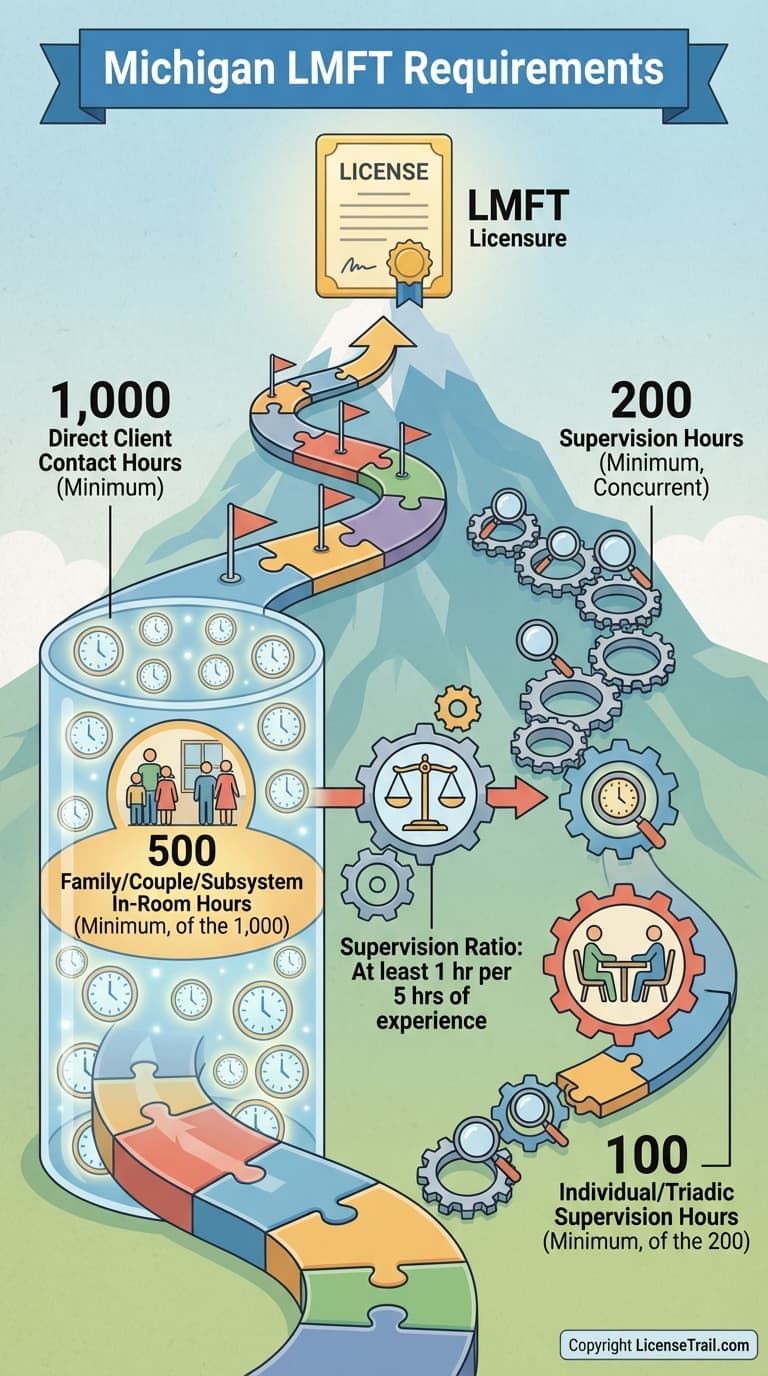
- Post-degree experience (under limited license): ≥1,000 direct client contact hours; ≥500 with couples/families/subsystems physically present; verified by supervising LMFT
- Post-degree supervision: ≥200 supervision hours, 1:5 concurrent; ≥100 individual (≤1 other supervisee); remaining may be group (≤6 supervisees)
- Limited license constraints: Use “Limited Licensed MFT” title; no independent practice; practice only under LMFT supervision in board-approved setting; limited license not renewable beyond 6 years
- Exam: Pass AMFTRB national MFT exam
- Other: Complete MI required human trafficking + implicit bias training; apply via LARA (incl. background check/fees)
License Details
Procedures
Becoming a Licensed Marriage and Family Therapist (LMFT) in Michigan is structured around two main phases of supervised clinical experience: a graduate-level practicum and a post‑degree supervised practice period completed under a limited license. The Michigan Board of Marriage and Family Therapy operates under the Michigan Public Health Code, primarily §333.16903 and §333.16909, and those sections spell out the required hours and the exact terminology the state uses. (codes.findlaw.com)
Below is a breakdown of the requirements, with emphasis on the type and number of hours and the statutory wording.
1. License types and regulatory framework
Michigan regulates the profession through the Michigan Board of Marriage and Family Therapy within the Department of Licensing and Regulatory Affairs (LARA). (michigan.gov)
There are effectively two license statuses relevant to clinical hours:
-
Educational Limited Marriage and Family Therapist license
Often referred to as Educational Limited MFT or LLMFT. This is the license you hold while you are completing your post‑degree supervised clinical hours. The board may “grant a limited license to an individual who has met the requirements of section 16909(a) and (b)”—that is, who has completed the qualifying degree and the supervised clinical practicum. (legislature.mi.gov) -
Full Licensed Marriage and Family Therapist (LMFT)
Granted after you meet education requirements, complete the required supervised experience (including the 1,000 direct client contact hours described below), and pass the national exam. (codes.findlaw.com)
A limited licensee must:
- Use only the title “limited licensed marriage and family therapist” or “limited licensed marriage counselor.”
- Not represent that they are engaged in the independent practice of marriage and family therapy.
- Practice only under the supervision of a fully licensed marriage and family therapist.
- Confine practice to an organized health care setting or other arrangement approved by the board. (legislature.mi.gov)
The board cannot renew a limited license for more than six years under current law. (legislature.mi.gov)
2. Educational foundation and practicum hour requirements
2.1 Graduate degree
To qualify for licensure, you must provide evidence of one of the following:
- A master’s or higher graduate degree from an accredited training program in marriage and family therapy approved by the board; or
- A master’s or higher degree from an accredited college or university plus specified graduate-level coursework in:
- Family studies (3 courses, at least 6 semester or 9 quarter hours)
- Family therapy methodology (3 courses, at least 6 semester or 9 quarter hours)
- Human development, personality theory, or psychopathology (3 courses, at least 6 semester or 9 quarter hours)
- Ethics, law, and standards of professional practice (at least 2 semester or 3 quarter hours)
- Research (at least 2 semester or 3 quarter hours) (codes.findlaw.com)
AAMFT’s Michigan summary is consistent with this and notes that the program must include a supervised practicum with a minimum of 300 hours of direct client contact. (aamft.org)
2.2 Supervised clinical practicum (during the degree)
Michigan law requires “supervised clinical marriage and family therapy experience in conjunction with the applicant's educational program.” This practicum must meet all of the following: (codes.findlaw.com)
-
Setting and structure
- Obtained either:
- In a clinical practicum during graduate education, or
- In a postgraduate marriage and family institute training program acceptable to the board.
- Obtained over not less than 8 consecutive months.
- Obtained either:
-
Minimum direct client contact hours in practicum
- At least 300 direct client contact hours of supervised clinical marriage and family therapy experience.
- At least ½ of the 300 hours (≥150 hours) must be completed “in a setting in which families, couples, or subsystems of families were physically present in the therapy room.” (codes.findlaw.com)
-
Practicum supervision hours and ratio
- Supervision must be provided at a ratio of at least 1 hour of supervision for each 5 hours of direct client contact,
- For a total of not less than 60 hours of supervision concurrent with those 300 hours. (codes.findlaw.com)
In other words, at the graduate practicum level Michigan requires:
- 300 direct client contact hours, with ≥150 hours including couples/families/subsystems in the room.
- 60 hours of supervision tied to those 300 hours (1:5 ratio).
This practicum (300/60) is distinct from, and in addition to, the post‑degree 1,000‑hour requirement described next.
3. Post‑degree supervised clinical experience for full LMFT
After earning the qualifying degree and practicum, you move into a supervised post‑degree phase, generally while holding an Educational Limited MFT (LLMFT) license.
3.1 Required direct client contact hours
For full licensure, the statute requires that the applicant provide “satisfactory evidence to the board of having completed a minimum of 1,000 direct client contact hours in supervised marriage and family therapy experience.” (codes.findlaw.com)
Key points from §333.16909(1)(c): (codes.findlaw.com)
-
Amount and type of hours
- Minimum of 1,000 direct client contact hours in supervised marriage and family therapy experience.
- At least ½ of those hours (≥500) must be completed “with families, couples, or subsystems of families physically present in the therapy room.”
-
Timing and where hours can come from
These 1,000 hours:- Are generally obtained after completion of the qualifying degree, and
- May also be obtained:
- Concurrent with or following the required coursework if you followed the “related degree + specified courses” pathway, or
- As part of a doctoral program in marriage and family therapy approved by the board.
-
Verification
- The hours must be verified by the supervising licensed marriage and family therapist.
AAMFT’s Michigan summary aligns with this, describing “completion of a minimum of 1,000 hours of supervised direct client contact, half of which must be direct client contact hours with families, couples, or subsystems of families.” (aamft.org)
3.2 Required supervision of the 1,000 hours
Michigan attaches a detailed supervision requirement to these 1,000 post‑degree hours. The statute requires that this experience: (codes.findlaw.com)
- Be “supervised in a ratio of at least 1 hour of supervision for each 5 hours of experience”; and
- Include “not less than 200 hours of supervision concurrent with the 1,000 hours of supervised experience.”
Within those 200 hours of supervision:
- At least 100 hours must be individual supervision, defined as supervision with no more than one other supervisee present.
- The remaining supervision hours may be group supervision with no more than six supervisees with one supervisor.
- Supervision is to be given in face‑to‑face contact with the supervisee (i.e., not solely via written review). (codes.findlaw.com)
AAMFT’s summary uses essentially the same language: “One hour of supervision is required for each 5 hours of experience, for a total of not less than 200 hours, 100 hours must be individual supervision.” (aamft.org)
Put together, the post‑degree requirement is:
- 1,000 direct client contact hours (≥500 with couples/families/subsystems present).
- 200 hours of supervision attached to those hours:
- ≥100 hours individual supervision (1:1 or 1:2 max).
- ≤100 hours group supervision (up to 6 supervisees per supervisor).
These supervision hours are in addition to the 60 supervision hours tied to the 300‑hour graduate practicum.
4. Hour requirements at a glance (current law)
All numbers below are minimums as defined by Michigan statute and board-aligned summaries. (codes.findlaw.com)
Graduate practicum (during degree)
- 300 direct client contact hours in supervised clinical marriage and family therapy.
- ≥150 hours with families, couples, or subsystems of families physically present.
- 60 supervision hours, at least 1 hour of supervision per 5 hours of client contact.
Post‑degree supervised MFT experience (typically under LLMFT)
- 1,000 direct client contact hours in supervised marriage and family therapy.
- ≥500 hours with families, couples, or subsystems of families physically present.
- 200 supervision hours, at least 1 hour of supervision per 5 hours of experience.
- ≥100 supervision hours must be individual (no more than 1 other supervisee).
- Remaining supervision hours may be group (up to 6 supervisees).
Total minimum across the pathway (master’s-level route)
- Direct client contact:
- 300 practicum + 1,000 post‑degree = 1,300 direct client contact hours.
- Supervision:
- 60 practicum + 200 post‑degree = 260 supervision hours. (careersinpsychology.org)
This structure is different from a “1,500 direct + 1,500 supervised” model some states use; Michigan explicitly separates direct client contact hours from the supervision hours that accompany them.
5. Supervision requirements and titles during training
5.1 Who can supervise
For the educational practicum, supervisors must hold at least a master’s degree and be one of the following: (codes.findlaw.com)
- Marriage and family therapist
- Certified or registered social worker
- Licensed professional counselor
- Physician practicing in a mental health setting
- Fully licensed psychologist
- Approved supervisor or supervisor‑in‑training through an AAMFT program approved by the board
For the post‑degree 1,000 hours, the statute requires that hours be verified by a supervising licensed marriage and family therapist. (codes.findlaw.com)
5.2 Titles during training
Michigan controls titles closely: (legislature.mi.gov)
- Once licensed at the full level, you may use “licensed marriage and family therapist,” “licensed marriage counselor,” or “L.M.F.T.”
- While completing post‑degree hours under a limited license, you must use “limited licensed marriage and family therapist” or “limited licensed marriage counselor.”
- An individual engaged in obtaining practicum experience under §333.16909(1)(b) (the educational practicum) may use “marriage and family therapist intern” or “marriage and family therapist trainee” during that training period.
6. Examination and ancillary requirements
Beyond the hour requirements, the board also requires:
- National MFT exam: Passing the AMFTRB national Examination in Marital and Family Therapy, administered monthly by Professional Testing Corporation. Eligibility is established by the Board once your Educational Limited license is issued or your education and practicum verification are approved. (michigan.gov)
- Human trafficking training and implicit bias training for health professionals, as part of Michigan’s broader licensing requirements. (counselingdegreeguide.org)
- Criminal background check and application/fee through LARA’s online system. (counselingdegreeguide.org)
7. Doctoral waivers
The statute provides that the board shall waive the practicum and post‑degree supervised experience requirements in §333.16909(1)(b) and (c) for an applicant who “provides satisfactory evidence to the board of having obtained a doctoral degree from an accredited doctoral training program in marriage and family therapy approved by the board.” (law.justia.com)
Even with this waiver, the individual must still meet any other licensure requirements (exam, application, trainings, etc.).
8. Legislative activity and the importance of checking for updates
As of November 23, 2025, the requirements summarized above reflect the language currently in Michigan Compiled Laws §333.16909 and related sections, and they are consistent with the AAMFT’s Michigan licensure summary and major licensure guides. (codes.findlaw.com)
However, Michigan’s legislature has introduced bills (for example, HB 5074 and SB 707) that would significantly revise LMFT requirements, including increasing supervised post‑degree clinical hours to 3,000 hours and restructuring limited licenses and degree standards. These bills have not taken effect as law at the time of writing, but they signal potential future changes. (legiscan.com)
Because licensure rules can change, it is wise to:
- Verify current requirements on LARA’s Marriage and Family Therapy profession page and
- Consult the most recent text of MCL §333.16903 and §333.16909 before making long‑term plans. (michigan.gov)
In summary, Michigan’s LMFT licensure pathway is built around 1,300 minimum direct client contact hours (300 practicum + 1,000 post‑degree) and 260 supervision hours (60 practicum + 200 post‑degree), with detailed statutory language about how many hours must involve families or couples, how supervision is structured, who may supervise, and what titles you may use at each stage.
Track your LMFT hours with confidence
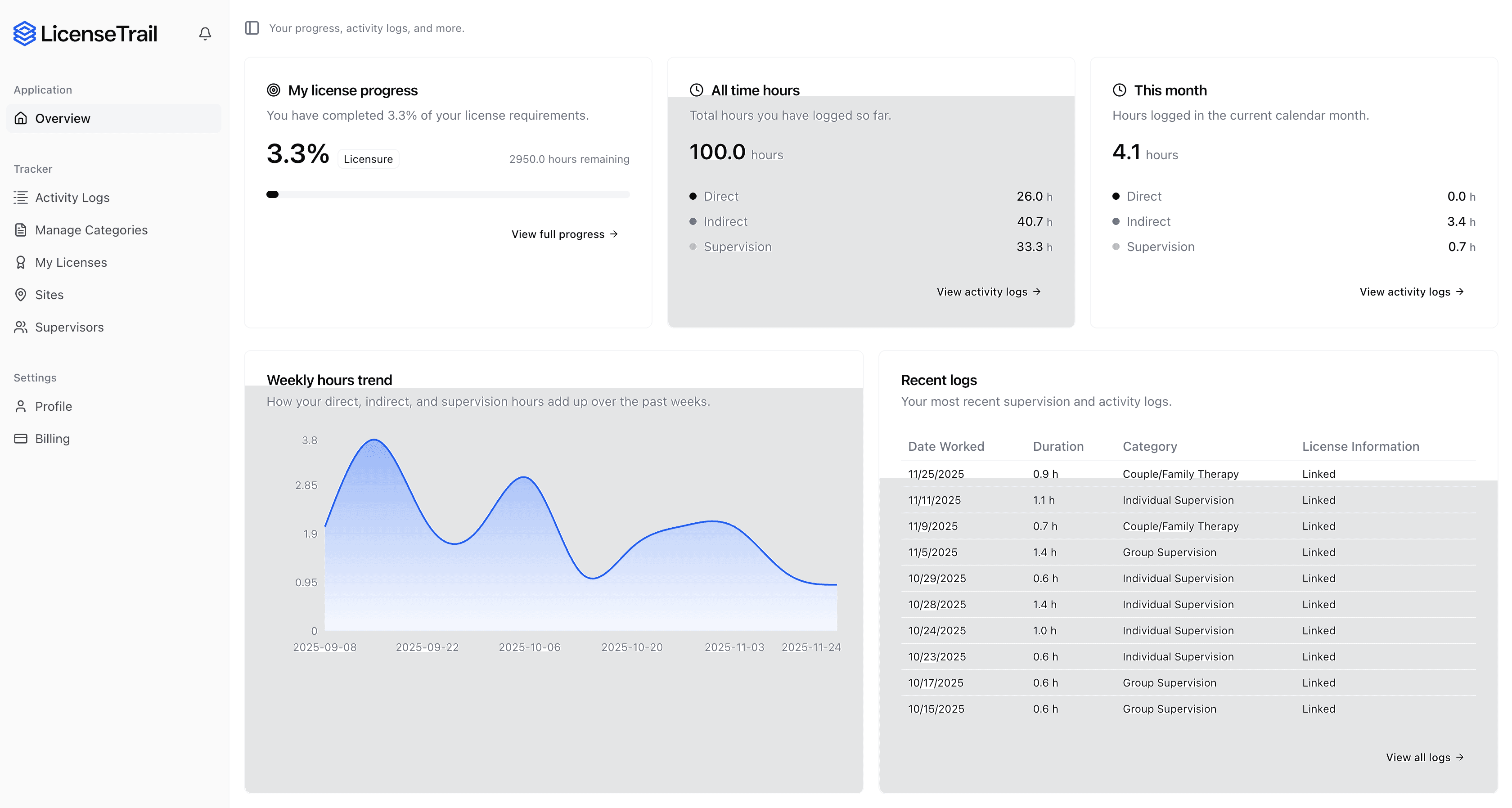
License Trail checks your direct, indirect, and supervision hours against Michigan LMFT requirements continuously and flags mismatches before you submit.
 Start Tracking for Free
No credit card required · Free plan available
Is your spreadsheet hiding Michigan LMFT risks?
Stop guessing if your categories match Michigan Board of Marriage and Family Therapy requirements. License Trail checks your direct, indirect, and supervision hours continuously and flags mismatches before you submit.
Import or log
Bring your spreadsheet or start fresh
Upload your existing tracking spreadsheet and we'll map every hour into the right Michigan Board of Marriage and Family Therapy categories automatically.
Verify against Michigan
Catch mismatches before the board does
License Trail checks your direct, indirect, and supervision hours against Michigan LMFT requirements continuously.
Export board-ready
One-click clean reports
Generate professional, board-ready reports for supervision meetings and Michigan Board of Marriage and Family Therapy submissions in seconds.
No credit card required · Free plan available