
Michigan LPC Requirements: Hours, Exams & Step-by-Step Guide
Stop guessing if your categories match Michigan requirements. License Trail checks your direct, indirect, and supervision hours against LPC requirements continuously and flags mismatches before you submit.
No credit card required · Free plan available
Quick Requirements Overview
- Required pathway: Must first hold LLPC (limited license); MI post‑degree hours count only after LLPC issuance and must be under ongoing LPC supervision
- Education: Master’s/doctoral in counseling from a qualified program; if non‑CACREP, must include CACREP‑equivalent coursework incl. practicum + internship; minimum 48 sem/72 qtr hrs (program start ≤6/30/2023) or 60 sem/90 qtr hrs (start ≥7/1/2023)
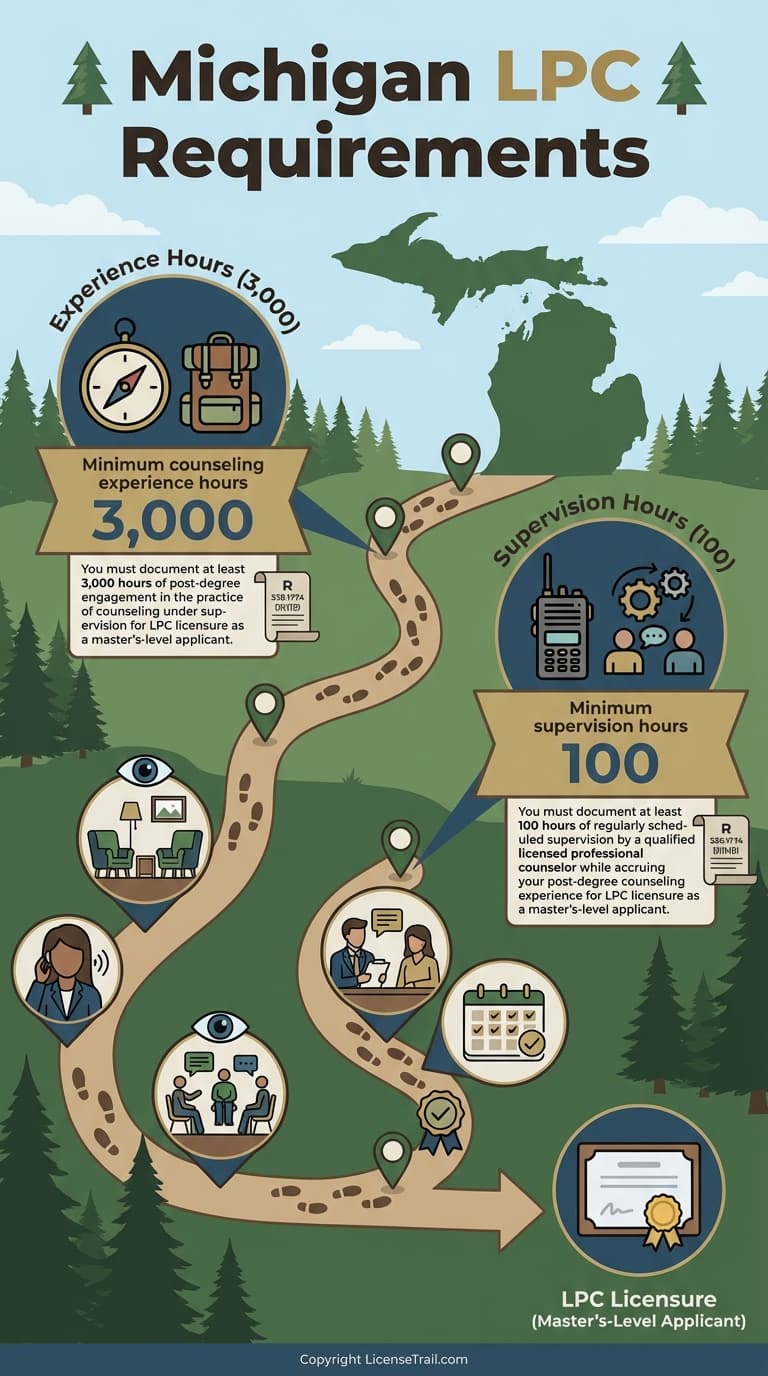
- Supervised experience (Master’s): 3,000 hrs counseling practice over ≥2 years + ≥100 hrs regularly scheduled supervision
- Supervised experience (Doctoral): 1,500 hrs over ≥1 year + ≥50 hrs supervision
- Supervision format: In‑person or two‑way real‑time audiovisual; continues from LLPC issuance until LPC issued
- Exam: Pass one of NCE / NCMHCE / CRC; official scores sent directly to the board
- Training/other: Human trafficking (one‑time) + Implicit bias (≥2 hrs within 5 years); application via MiPLUS includes background check, transcripts, work experience form, and PDS/supervisor documentation
License Details
Procedures
Michigan licenses mental health counselors through the Michigan Board of Counseling within LARA’s Bureau of Professional Licensing. The process is two‑tiered: you must first be a Limited Licensed Counselor (LLC/LLPC) and then qualify for full Professional Counselor (LPC) licensure.
Below is a step‑by‑step outline focused on the official hour requirements and the board’s own terminology.
1. Understand the Two Licenses
Limited Licensed Counselor (LLC / LLPC)
- Allows you to “engage in the practice of counseling under the supervision of a licensed professional counselor.” (michigan.gov)
- Must always practice under the “ongoing supervision” of a qualified LPC supervisor as defined in the Counseling General Rules. (ars.apps.lara.state.mi.us)
Professional Counselor (LPC)
- Allows you to independently engage in the practice of counseling (no ongoing supervision required once licensed). (michigan.gov)
- This is the “licensed professional counselor” title protected under Michigan law. (legislature.mi.gov)
You cannot skip the limited license: all Michigan post‑degree experience used for LPC must be completed after the limited license is issued. (michigan.gov)
2. Educational Requirements
Michigan requires a master’s or doctoral degree in counseling from a “qualified program” (or substantially equivalent degree) from an accredited institution. (michigan.gov)
The Counseling General Rules add that:
- The program must be at an accredited higher education institution and meet specific accreditation/standards. (ars.apps.lara.state.mi.us)
- If not CACREP‑accredited, it must still include “graduate coursework and training in the diagnosis and treatment of mental and emotional disorders and all other coursework requirements of CACREP, including a practicum and an internship.” (ars.apps.lara.state.mi.us)
Credit‑hour minimums (for non‑CACREP programs): (ars.apps.lara.state.mi.us)
- Entered program on or before June 30, 2023:
- At least 48 semester hours (or 72 quarter hours).
- Entered program on or after July 1, 2023:
- At least 60 semester hours (or 90 quarter hours).
These education standards apply to both the Limited Licensed Counselor and Professional Counselor applications.
3. Step One: Qualify for the Limited Licensed Counselor (LLC/LLPC)
3.1. Core application elements
To obtain the Limited Licensed Counselor credential, you must: (michigan.gov)
- Submit the online application for a Limited Counselor License via MiPLUS and pay the fee.
- Complete a criminal background check.
- Answer Good Moral Character questions and provide documentation if required.
- Provide your Social Security number (or SSN affidavit, if legally exempt).
- Have official transcripts sent directly to LARA verifying your qualifying counseling degree.
- Complete human trafficking training (one time, meeting Administrative Rule 338.1771). (michigan.gov)
- Complete implicit bias training (at least 2 hours within the 5 years immediately before license issuance). (michigan.gov)
3.2. Supervisory structure for the LLPC
Before your limited license is issued, you must: (michigan.gov)
- Submit a Professional Disclosure Statement (PDS) that:
- States you will practice under the supervision of a licensed professional counselor in this state in good standing, and
- Identifies your supervising LPC.
- Submit the Supervising LPC Qualifications Form, documenting that your supervisor satisfies the supervision requirements in R 338.1781.
The board explicitly notes that if you are applying for the limited license, your PDS must include “the name and license number of the licensed professional counselor who will be supervising your 3000 hours of post‑degree experience.” (michigan.gov)
The limited license is: (michigan.gov)
- Issued for one year at a time.
- Renewable annually, but “no more than 10 times.”
4. Step Two: Accrue the Required Supervised Counseling Hours
This is the core of what the board requires before granting LPC status.
4.1. What counts as qualifying experience?
Under Counseling Rule R 338.1774, the board requires “engagement in the practice of counseling under section 18101(d) of the code” that: (ars.apps.lara.state.mi.us)
- Involves opportunities to work with a broad range of the population, and
- Occurs in organized settings such as:
- Education,
- Business,
- Health,
- Private practice, or
- Human services settings,
- And must be under the supervision of a licensed professional counselor (meeting supervision training requirements).
Rule R 338.1751 defines “under the supervision of a licensed professional counselor” as ongoing supervision by an LPC in Michigan (or similarly qualified out‑of‑state licensee) who meets the board’s supervisor standards. (ars.apps.lara.state.mi.us)
In practice, this means your hours should consist of typical professional counseling activities—assessment, diagnosis, treatment planning, counseling interventions, documentation, consultation, etc.—performed as an LLPC and overseen by your LPC supervisor.
4.2. Master’s‑level applicants: 3,000 hours + 100 supervision hours
For applicants with a master’s degree:
- The board requires “not less than 3,000 hours” of counseling practice experience. (ars.apps.lara.state.mi.us)
- These hours must be:
- Accrued in not less than a 2‑year period (i.e., at least two years of supervised practice), and
- Completed under the supervision of a licensed professional counselor while holding the limited license. (ars.apps.lara.state.mi.us)
Within those 3,000 hours, the rules and licensing guide require a minimum amount of formal supervision:
- At least 100 hours of regularly scheduled supervision,
- Supervision must be:
- In the immediate physical presence of the supervisor, or
- Via two‑way real‑time audiovisual technology that allows direct, contemporaneous interaction by sight and sound between supervisor and supervisee. (ars.apps.lara.state.mi.us)
- Supervision begins when the limited license is issued and continues until the LPC is issued. (ars.apps.lara.state.mi.us)
The board does not further subdivide the 3,000 hours into “direct client contact” versus “indirect” hours in its rules. Instead, it speaks broadly of practice of counseling plus a specified minimum of supervision hours within that period.
Summarizing for master’s‑level LPC applicants in Michigan:
- 3,000 hours of post‑degree, supervised counseling practice
- Across at least 2 years
- Including at least 100 hours of scheduled supervision meetings (in‑person or approved video) with a qualified LPC supervisor.
4.3. Doctoral‑level applicants: 1,500 hours + 50 supervision hours
For applicants with a doctoral degree in counseling:
- The board allows a reduced experience requirement: “not less than 1,500 hours” of counseling practice.
- These hours must be:
- Accrued in not less than a 1‑year period, and
- Completed under LPC supervision while holding the limited license. (ars.apps.lara.state.mi.us)
Within those 1,500 hours, the board requires:
- At least 50 hours of regularly scheduled supervision,
- Again, either in immediate physical presence or via compliant two‑way real‑time audiovisual technology. (ars.apps.lara.state.mi.us)
So doctoral‑level pathway:
- 1,500 hours of post‑degree supervised counseling practice
- Across at least 1 year
- Including at least 50 hours of supervision.
4.4. All Michigan supervised hours must follow these constraints
From both the Counseling Rules and the licensing guide: (michigan.gov)
- Only hours completed after your limited license is issued can count toward the 3,000/1,500 total.
- Any supervised experience before you hold the limited license “cannot be counted toward licensure.”
- For experience gained in Michigan, the applicant must:
- Have held the limited license throughout the period, and
- Have practiced under the supervision of a licensed professional counselor in this state in good standing.
5. Step Three: Pass a Board‑Approved National Exam
Michigan adopts three national examinations for counselor licensure: (ars.apps.lara.state.mi.us)
- National Counselor Examination (NCE) – NBCC
- Certified Rehabilitation Counselor (CRC) Examination – CRCC
- National Clinical Mental Health Counseling Examination (NCMHCE) – NBCC
You must obtain a passing score on at least one of these exams, and your official score report must be sent directly to the Michigan Board of Counseling.
6. Step Four: Apply for the Professional Counselor (LPC) License
Once you have:
- Completed the qualifying counseling degree,
- Held the Limited Licensed Counselor credential,
- Accrued the required 3,000 (master’s) or 1,500 (doctoral) supervised hours with the minimum supervision hours, and
- Passed one of the board‑approved national exams,
you apply for the Professional Counselor license by examination in MiPLUS. (michigan.gov)
The application must include:
- Online application and fee (currently listed in the Professional Counselor Licensing Guide). (michigan.gov)
- Criminal background check (unless exempt for recent relicensure). (michigan.gov)
- Confirmation of human trafficking and implicit bias training completion. (michigan.gov)
- Official transcripts (unless already on file as part of limited licensing) demonstrating the qualifying degree. (michigan.gov)
- Counseling Work Experience form, documenting that you completed the required hours and supervision under a qualified LPC. (michigan.gov)
- Professional Disclosure Statement (PDS) meeting the content requirements in the licensing guides and statute. (michigan.gov)
- Proof of passing score on one of the approved national examinations. (michigan.gov)
Under Michigan law (MCL 333.18107), the department may grant a professional counselor license to an individual who: (law.justia.com)
- Is at least 18 years of age,
- Has the qualifying master’s or doctoral counseling degree, and
- Has at least 2 years of counseling experience under supervision by an LPC (or 1 year if the applicant has a doctoral degree), as implemented through the 3,000/1,500‑hour rules.
7. How the Michigan Board Describes the “Types” of Hours
Based on the statute, rules, and licensing guides, Michigan divides experiential requirements into these categories rather than “direct vs indirect” hours:
-
Degree‑embedded clinical training
- Required practicum and internship within your counseling degree, aligned with CACREP standards (no separate clock‑hour figure is specified in the Michigan rules; instead they incorporate CACREP by reference and require a practicum and internship). (ars.apps.lara.state.mi.us)
-
Post‑degree counseling practice hours
- 3,000 hours (master’s) over ≥ 2 years, or
- 1,500 hours (doctoral) over ≥ 1 year,
- All defined as “engagement in the practice of counseling” in approved settings and under supervision. (ars.apps.lara.state.mi.us)
-
Supervision hours (within the post‑degree period)
- At least 100 hours of regularly scheduled supervision for master’s applicants.
- At least 50 hours of regularly scheduled supervision for doctoral applicants.
- Conducted in person or via real‑time audiovisual technology, beginning at issuance of the limited license and continuing until LPC issuance. (ars.apps.lara.state.mi.us)
The board does not state, for example, “1,500 hours direct client contact and 1,500 hours supervised experience.” Instead, its official language focuses on:
- Total post‑degree practice hours, and
- Minimum supervision hours and time frames,
all performed under the LLPC with a qualified LPC supervisor.
8. Quick Numeric Summary (Master’s Route)
Using the board’s own structure and terminology for a typical master’s‑level applicant:
-
Degree:
- Master’s in counseling from a qualified program (48 or 60 graduate semester hours depending on entry date, with required practicum and internship). (ars.apps.lara.state.mi.us)
-
Limited License:
- Obtain LLPC; practice only under the supervision of a licensed professional counselor; identify supervisor in PDS and submit Supervising LPC Qualifications Form. (michigan.gov)
-
Post‑degree practice:
- 3,000 hours of practice of counseling under an LPC,
- Accrued in at least 2 years,
- In approved clinical or human‑services settings,
- All after the limited license is issued. (ars.apps.lara.state.mi.us)
-
Supervision (part of that period):
- At least 100 hours of regularly scheduled supervision,
- In person or real‑time audiovisual,
- Supervision begins when the limited license is issued and continues until the LPC is granted. (ars.apps.lara.state.mi.us)
-
Exam:
- Pass NCE, CRC, or NCMHCE, with official scores sent directly to LARA. (ars.apps.lara.state.mi.us)
-
Additional trainings:
- Human trafficking (one‑time, per R 338.1771).
- Implicit bias (minimum 2 hours before initial licensure; additional hours required for renewals). (ars.apps.lara.state.mi.us)
These are the current board‑defined requirements as of the April 17, 2025 Counselor Licensing Guides and the April 26, 2023 Counseling General Rules. (michigan.gov)
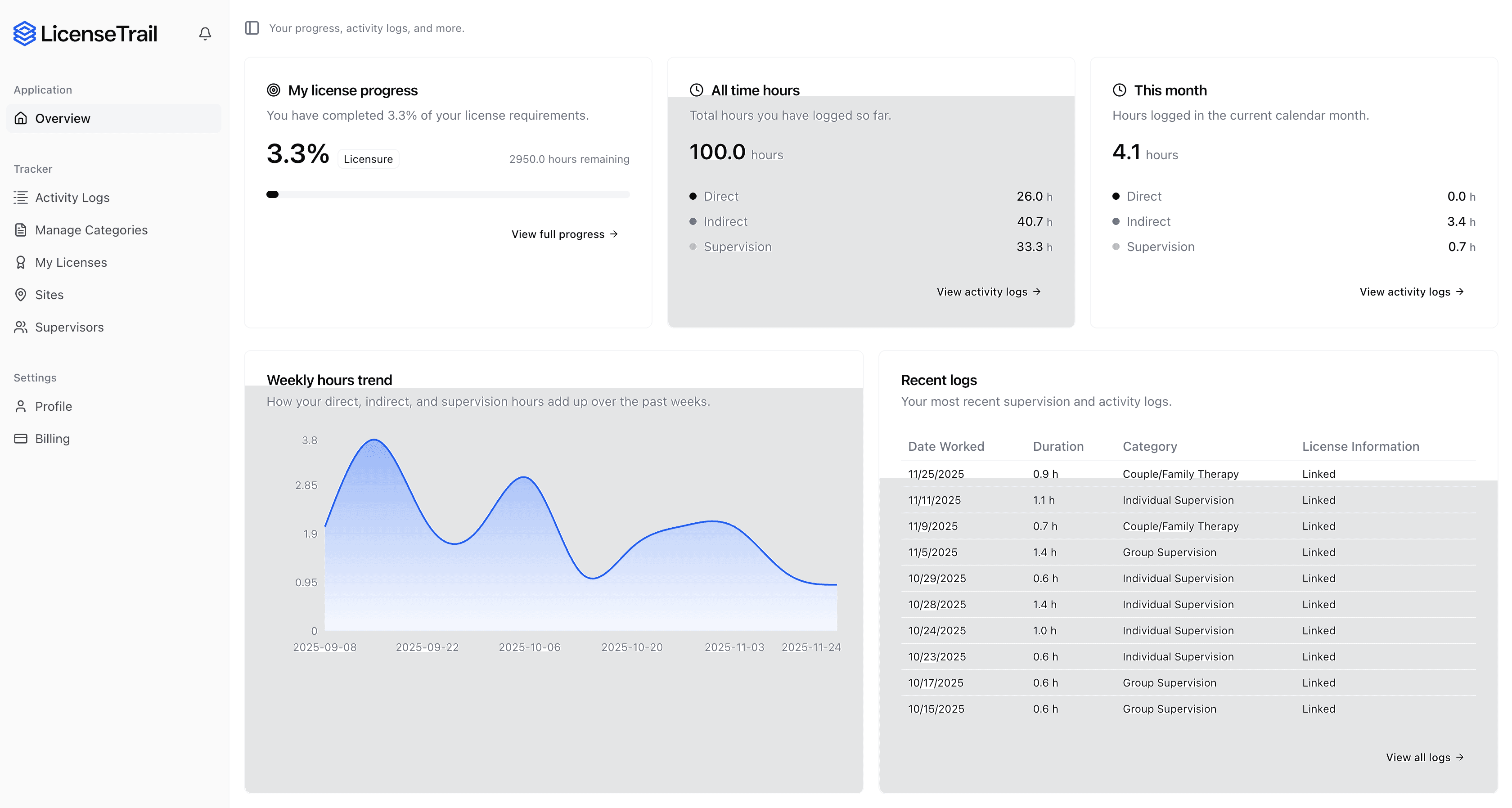
Track your LPC hours with confidence
License Trail checks your direct, indirect, and supervision hours against Michigan LPC requirements continuously and flags mismatches before you submit.
 Start Tracking for Free
No credit card required · Free plan available
Is your spreadsheet hiding Michigan LPC risks?
Stop guessing if your categories match Michigan Board of Counseling requirements. License Trail checks your direct, indirect, and supervision hours continuously and flags mismatches before you submit.
Import or log
Bring your spreadsheet or start fresh
Upload your existing tracking spreadsheet and we'll map every hour into the right Michigan Board of Counseling categories automatically.
Verify against Michigan
Catch mismatches before the board does
License Trail checks your direct, indirect, and supervision hours against Michigan LPC requirements continuously.
Export board-ready
One-click clean reports
Generate professional, board-ready reports for supervision meetings and Michigan Board of Counseling submissions in seconds.
No credit card required · Free plan available