
Michigan LP Requirements: Hours, Exams & Step-by-Step Guide
Stop guessing if your categories match Michigan requirements. License Trail checks your direct, indirect, and supervision hours against LP requirements continuously and flags mismatches before you submit.
No credit card required · Free plan available
Quick Requirements Overview
- Doctoral degree in psychology/closely related field from a regionally accredited institution; program must be APA/CPA/PCSAS accredited or National Register/ASPPB-designated (per MI rules)
- Internship required: integrated doctoral-program internship or Board-approved substantially equivalent post-degree internship (APPIC-equivalent standards); MI does not set a specific hour minimum beyond those standards
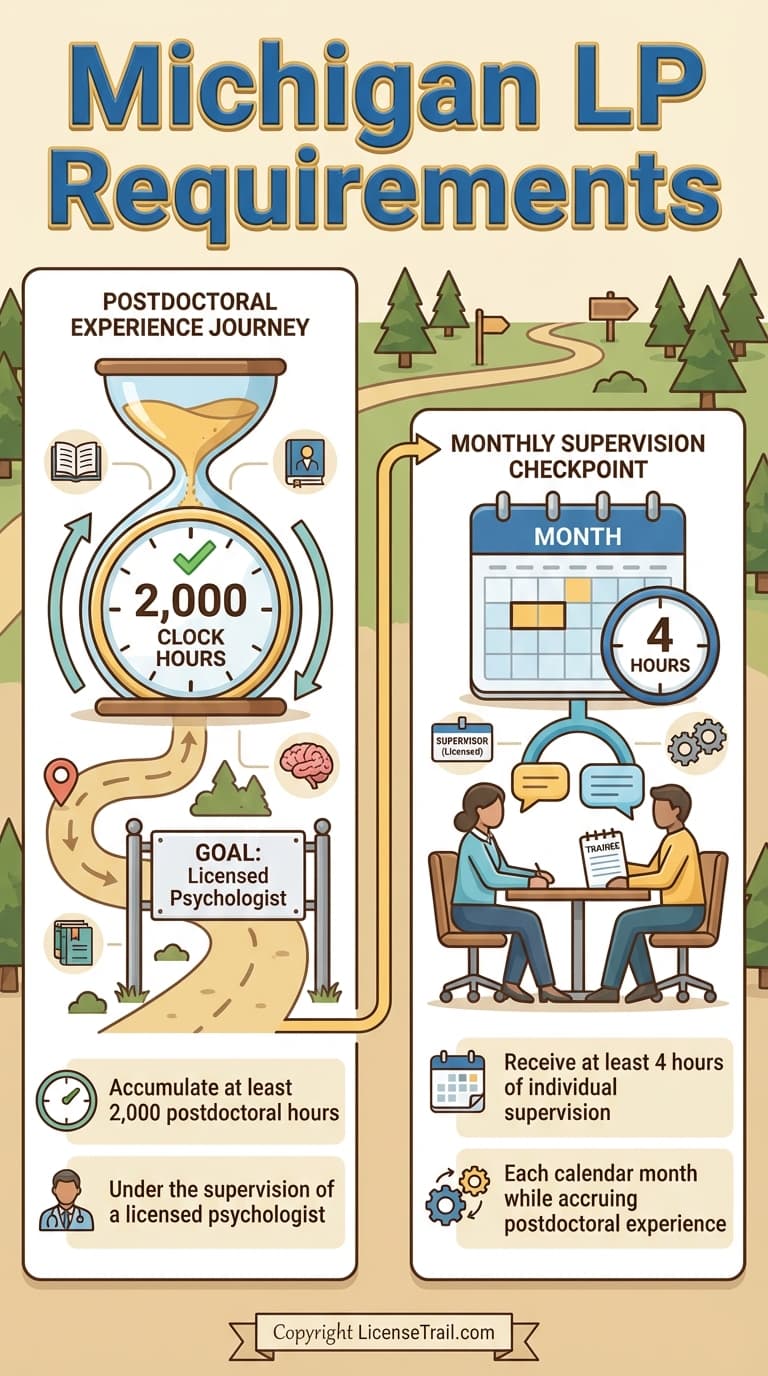
- Postdoctoral supervised experience: 2,000 clock hours practicing psychology under a licensed psychologist
- Timing: 2,000 hours must be completed within ≤ 2 consecutive years
- Supervision: weekly individual supervision (in-person or real-time AV) totaling ≥ 4 hours/month, including review of work functions/records
- Setting: postdoctoral experience must be in an organized healthcare setting (as defined by MI rules)
- Exam: pass EPPP Part 1 (MI guidance: ≥ 500 for full licensure)
- Admin/training: apply via MiPLUS + fee; criminal background check; human trafficking training (one-time) and 2 hours implicit bias training (within prior 5 years); submit Supervision Evaluation Form(s) documenting internship and postdoc hours
License Details
Procedures
In Michigan, the title “Licensed Psychologist” (often abbreviated LP) is the doctoral‑level license that permits independent practice. The Michigan Board of Psychology (through the Department of Licensing and Regulatory Affairs, LARA) sets out the requirements in its Psychology General Rules and in several licensing guides revised in June 2025. (michigan.gov)
Below is a step‑by‑step description focused on the supervised experience and hour requirements, using the board’s own terminology.
1. License types involved on the way to LP
To become an LP you will typically hold two earlier, time‑limited licenses:
-
Psychologist – Doctoral Temporary Educational Limited License (Doctoral TLLP)
- Purpose: Allows you to “engage in the practice of psychology, under the supervision of a fully licensed psychologist, while obtaining the internship hours required for the doctoral educational limited license.” (michigan.gov)
- Valid for 24 months, renewable up to 3 additional 24‑month terms. (michigan.gov)
-
Psychologist – Doctoral Educational Limited License
- Purpose: Allows you to practice psychology “under the supervision of a fully licensed psychologist to obtain post‑degree experience hours required for full licensure.”
- This license is issued for 12 months and may be renewed a maximum of 4 times. (michigan.gov)
-
Licensed Psychologist (LP)
- This is the full, independent license. The 2025 Psychologist Licensing Guide describes it as allowing the licensee “to engage in the practice of psychology.” (michigan.gov)
2. Doctoral education requirement
Under Rule R 338.2543(b), an LP applicant must have a doctoral degree in psychology or a closely related field that meets both of the following: (ars.apps.lara.state.mi.us)
- The degree is from a regionally accredited college, university, or institution that meets general accreditation standards adopted in Rule R 338.2529 (CHEA or U.S. Department of Education recognition). (ars.apps.lara.state.mi.us)
- The program itself is either:
- Designated under the National Register/ASPPB “National Register Doctoral Degree Guidelines,” or
- Accredited by APA, CPA, or PCSAS, whose accreditation standards are adopted by reference in Rule R 338.2541. (ars.apps.lara.state.mi.us)
The rules do not specify a numeric total of “doctoral training hours” beyond what is embedded in those national accreditation/designation standards.
3. Internship requirement (predoctoral or post‑degree)
The Board’s rules require a supervised internship in psychology, but they do not set a Michigan‑specific numerical hour minimum; instead they tie the internship to accredited/recognized program standards and, for post‑degree internships, to APPIC criteria.
Rule R 338.2543(c) requires: (ars.apps.lara.state.mi.us)
- Proof of completion of “an internship that was an integrated part of a doctoral degree program” that meets the doctoral program requirements above; or
- A “substantially equivalent postdoctoral internship” approved by the Board, completed:
- Through an accredited institution (meeting R 338.2529 accreditation standards),
- For academic graduate credit,
- And following standards “substantially equivalent” to APPIC Internship Membership Criteria.
In other words:
- If your internship is part of an APA/CPA/PCSAS‑accredited or National Register/ASPPB‑designated doctoral program, Michigan does not add its own hour count on top of what those accrediting bodies require.
- If your internship is a post‑degree internship you seek to have approved, you must demonstrate that it follows standards substantially equivalent to APPIC’s internship criteria (which themselves describe structure and minimum hours, but those numbers live in APPIC’s documents, not in Michigan rule). (ars.apps.lara.state.mi.us)
The state’s own licensing guides simply require that you submit a Supervision Evaluation Form to show proof of internship hours, without stating a numeric minimum. (michigan.gov)
4. Required postdoctoral supervised experience for LP
The one place where Michigan does state a hard number of hours for an LP is the postdoctoral experience.
4.1. One year of postdoctoral degree experience
Rule R 338.2543(d) requires that an LP applicant: (ars.apps.lara.state.mi.us)
- Provide proof of completion of “1 year of postdoctoral degree experience in the practice of psychology” that meets Rule R 338.2553(3).
This postdoctoral year is what you complete under a Doctoral Educational Limited license.
4.2. Number and type of postdoctoral hours
Rule R 338.2553(3) defines the postdoctoral experience in detail. In summary, it must meet all of the following: (ars.apps.lara.state.mi.us)
-
Total hours and timeframe
- The experience must consist of not less than 2,000 clock hours of practice in psychology.
- Those 2,000 hours must be completed under the supervision of a licensed psychologist during a period of not more than 2 consecutive years.
-
Nature of the work
- You must “function as a psychologist” using generally accepted applications of psychological knowledge and techniques acquired during your education and training.
- This means the hours are expected to be professional practice in psychology (assessment, intervention, consultation, etc.), not generic human‑services work.
-
Supervision format and minimum supervision time
- You must meet individually with your supervising psychologist, in person or via two‑way real‑time audiovisual technology that allows direct contemporaneous interaction.
- These supervisory meetings must occur weekly, and must total a minimum of 4 hours per month, during which all active work functions and records are reviewed.
-
Practice setting
- The experience must be obtained in an “organized healthcare setting” as defined in Rule R 338.2521(1)(j) – essentially a clinic, hospital, institution, governmental entity, nonprofit, or private agency that delivers healthcare services and provides opportunities for interdisciplinary interaction, a variety of theories and techniques, and work with diverse populations. (ars.apps.lara.state.mi.us)
-
Hardship variance (optional)
- In cases of “extreme hardship,” a supervisee may request an alternative supervision arrangement, but it cannot be implemented until approved by the Board. (ars.apps.lara.state.mi.us)
Key point:
Michigan does not split these 2,000 hours into categories like “direct client contact” vs. “administrative” for LPs. The rule speaks only in terms of “2,000 clock hours” of postdoctoral experience, with the qualitative conditions above.
5. Comparison: post‑master’s experience for limited licensed psychologists (LLP)
Although your question is about the LP, many applicants first get a Master’s Limited Psychologist (LLP) license and later complete a doctorate. For context, the rules require: (ars.apps.lara.state.mi.us)
- A post‑master’s degree experience of not less than 2,000 clock hours under the supervision of a licensed psychologist, obtained under a temporary limited license.
- The same supervision structure—individual meetings, in person or via two‑way real‑time audiovisual technology, at least 4 hours of supervision per month, and in an organized healthcare setting.
So both LLP and LP involve 2,000‑hour supervised practice periods, but:
- LLP: post‑master’s degree experience.
- LP: postdoctoral degree experience after the doctoral degree and internship.
6. Examination requirement (EPPP)
For the Licensed Psychologist (LP):
- Rule R 338.2545(1) requires passing Part 1 – Knowledge of the EPPP, with the passing score being the score recommended by ASPPB for psychologists in independent practice. (ars.apps.lara.state.mi.us)
- LARA’s Psychology Examination page specifies that to become a fully licensed psychologist in Michigan, you must score at least 500 on the EPPP. (michigan.gov)
For comparison, limited licensed psychologists (LLPs) must pass the same exam but only need a minimum score of 350 for supervised practice. (michigan.gov)
7. General licensing conditions and trainings
The Psychologist Licensing Guide (rev. 6/18/2025) lists additional requirements that apply to all new LP applicants (except simple renewals): (michigan.gov)
- Online application via MiPLUS and payment of the psychologist license fee (currently $270.20).
- Criminal Background Check.
- Good Moral Character attestation; supporting documents are required if you answer “yes” to criminal or disciplinary history questions.
- Human Trafficking training: one‑time training “in identifying victims of human trafficking” that meets Rule R 338.2525 standards, completed before initial licensure. (ars.apps.lara.state.mi.us)
- English language proficiency, demonstrated by education in English or an approved language‑proficiency exam. (michigan.gov)
- Implicit Bias training: 2 hours completed in the 5 years immediately preceding issuance of the license. (michigan.gov)
- Submission of the Supervision Evaluation Form documenting your internship and postdoctoral supervised hours, sent directly to the Bureau. (michigan.gov)
8. Putting the Michigan hour requirements together
For an individual aiming to become an LP (doctoral‑level Licensed Psychologist) in Michigan, the experience‑hour requirements defined by the Michigan Board of Psychology can be summarized as:
-
Internship hours
- Must complete a psychology internship integrated into an approved doctoral program, or a board‑approved post‑degree internship that is substantially equivalent to APPIC standards.
- Michigan rules do not specify a numeric hour requirement for this internship; the hours are governed by APA/CPA/PCSAS/APPIC standards rather than by a Michigan number. (ars.apps.lara.state.mi.us)
-
Postdoctoral supervised experience
- 2,000 clock hours of postdoctoral degree experience in the practice of psychology.
- Must be completed under the supervision of a licensed psychologist in not more than 2 consecutive years.
- Must be in an organized healthcare setting, and include weekly individual supervision totaling at least 4 hours per month, reviewing your active work and records. (ars.apps.lara.state.mi.us)
Michigan does not break those 2,000 hours into “direct client contact hours” vs. “supervision hours” for LPs, nor does it add a separate second block like “1,500 hours of supervised experience” on top of the 2,000 hours. The controlling language is the 2,000‑clock‑hour postdoctoral experience with specified supervision frequency and setting, plus a qualifying internship embedded in an accredited or designated doctoral program.
Track your LP hours with confidence
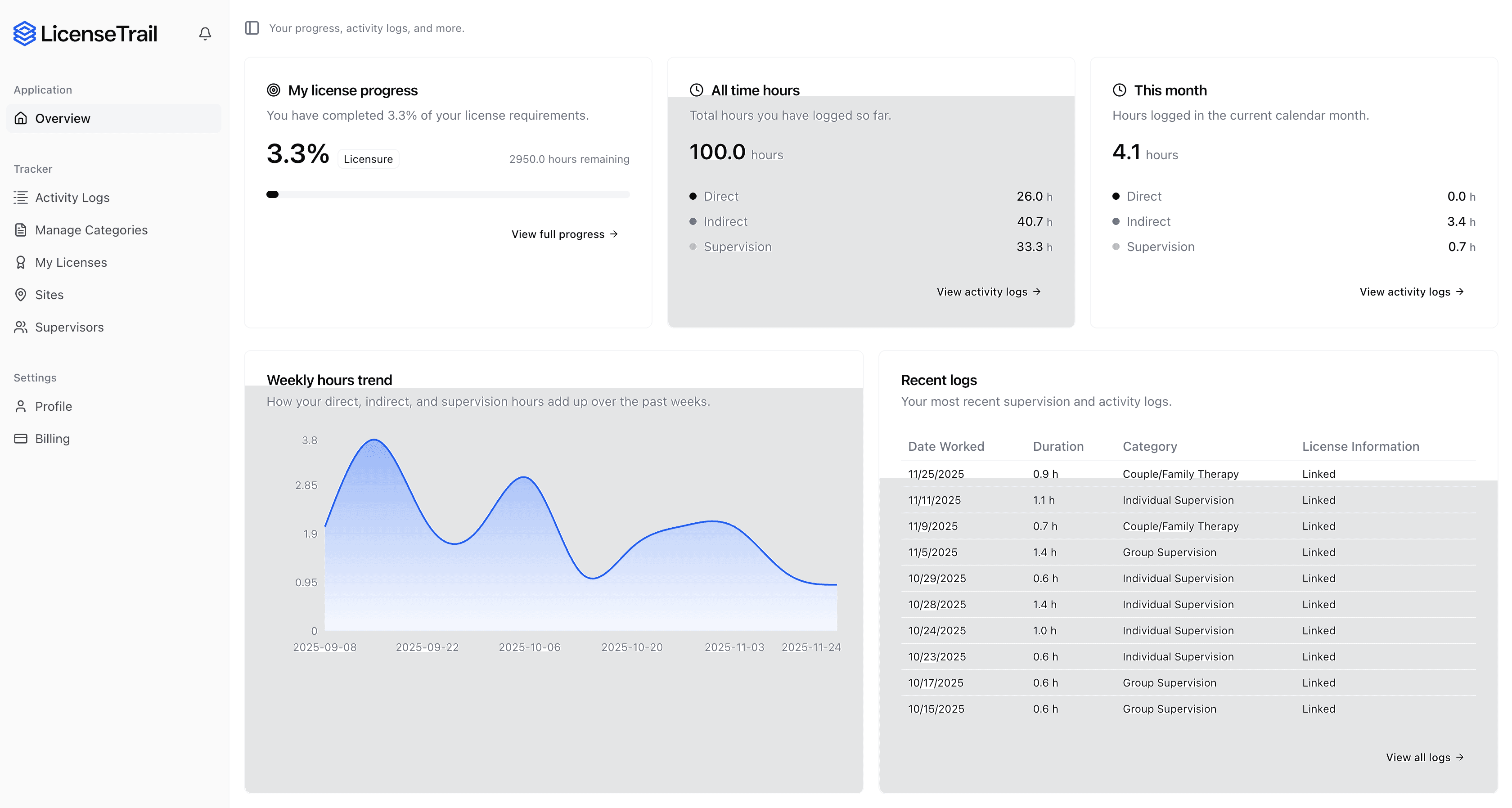
License Trail checks your direct, indirect, and supervision hours against Michigan LP requirements continuously and flags mismatches before you submit.
 Start Tracking for Free
No credit card required · Free plan available
Is your spreadsheet hiding Michigan LP risks?
Stop guessing if your categories match Michigan Board of Psychology requirements. License Trail checks your direct, indirect, and supervision hours continuously and flags mismatches before you submit.
Import or log
Bring your spreadsheet or start fresh
Upload your existing tracking spreadsheet and we'll map every hour into the right Michigan Board of Psychology categories automatically.
Verify against Michigan
Catch mismatches before the board does
License Trail checks your direct, indirect, and supervision hours against Michigan LP requirements continuously.
Export board-ready
One-click clean reports
Generate professional, board-ready reports for supervision meetings and Michigan Board of Psychology submissions in seconds.
No credit card required · Free plan available