
Minnesota LICSW Requirements: Hours, Exams & Step-by-Step Guide
Stop guessing if your categories match Minnesota requirements. License Trail checks your direct, indirect, and supervision hours against LICSW requirements continuously and flags mismatches before you submit.
No credit card required · Free plan available
Quick Requirements Overview
- Graduate degree: MSW (CSWE/Board-recognized) or accredited DSW
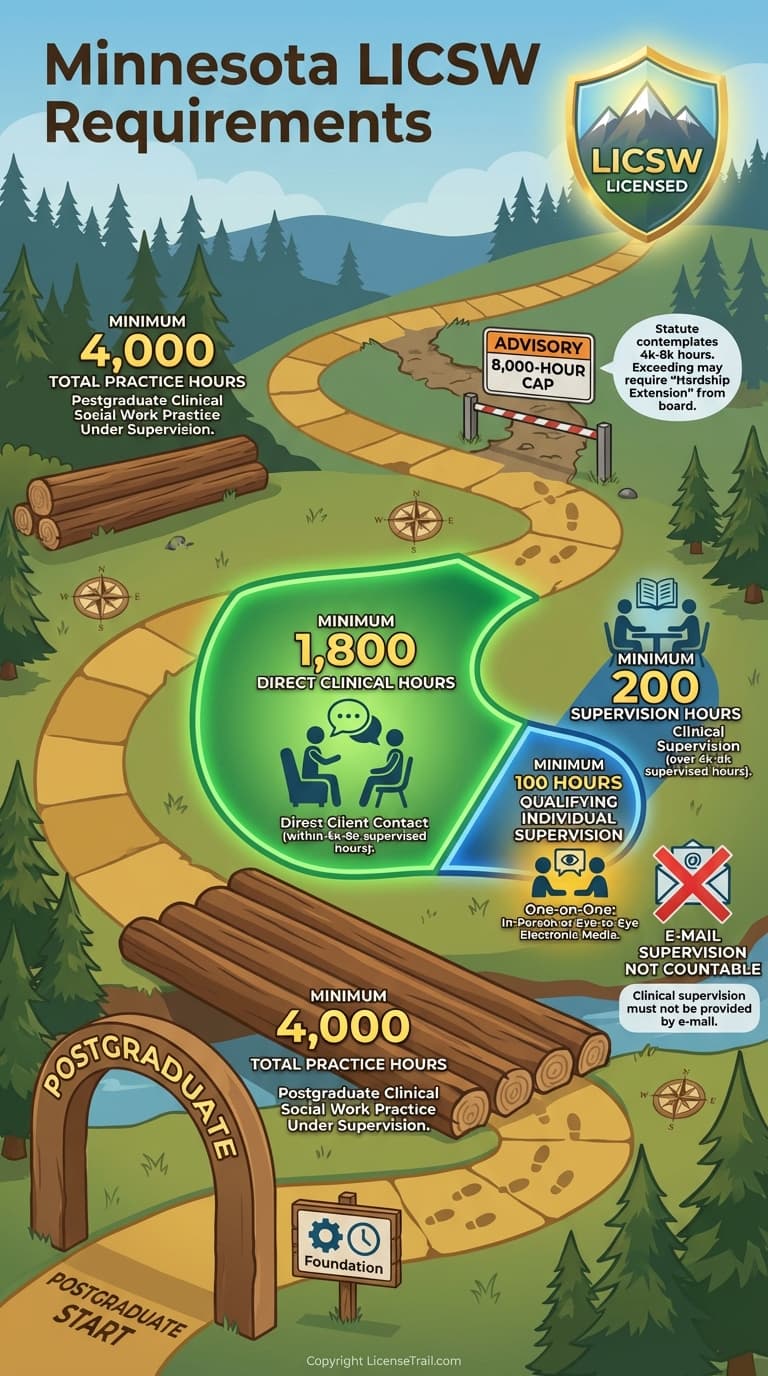
- Clinical knowledge coursework: 360 clinical clock hours across 6 required areas (up to 120 may be clinical CE)
- Postgraduate clinical practice: 4,000–8,000 hours of clinical social work practice
- Direct clinical client contact: ≥1,800 hours (within the 4,000–8,000)
- Licensing supervision: 200 hours total, at 4–8 hrs/160 practice hrs
- Supervision format: ≥100 hours must be 1:1 (in-person or video); remainder 1:1 or group (≤6 supervisees)
- Supervisor eligibility/alternates: LICSW supervisor with required post-licensure practice + supervision training; up to 25% supervision by qualified “mental health professional” (100% only with Board-approved exceptions)
- Other: Pass ASWB Clinical exam; fingerprint-based criminal background check; submit supervision plan/verification documentation as required
License Details
Procedures
Licensed Independent Clinical Social Worker (LICSW) licensure in Minnesota is built around three main components: graduate education, clinical knowledge coursework, and a substantial block of supervised clinical social work practice. The Minnesota Board of Social Work and Minnesota Statutes Chapter 148E spell these out in detail.
Below is a structured guide that focuses especially on the hours and definitions the Board uses.
1. License type and overall framework
The Board defines the LICSW as “a master’s license type plus clinical supervised practice.” (mn.gov)
In practice, this means you must complete:
- A qualifying graduate degree in social work
- 360 “clinical clock hours” in specified clinical knowledge areas
- 4,000–8,000 hours of postgraduate clinical practice, including:
- At least 1,800 hours of direct clinical client contact
- 200 hours of licensing supervision (4–8 hours per 160 practice hours)
- The ASWB Clinical exam and a criminal background check
The supervised clinical practice piece is where most of the hours come in and is the core of becoming an LICSW.
2. Educational requirement
The academic degree requirement for LICSW by examination is: (mn.gov)
- A master’s degree in social work from a program accredited by:
- The Council on Social Work Education (CSWE), or
- The Canadian Association of Schools of Social Work, or
- Another accreditation body designated by the Board
OR
- A doctorate in social work from an accredited university.
3. Required “360 Clinical Clock Hours”
In addition to the graduate degree, LICSW applicants by examination must document 360 clinical clock hours spread across six “clinical knowledge areas.” (mn.gov)
The Board allocates them as:
- 108 hours – differential diagnosis and biopsychosocial assessment (including normative development and psychopathology across the life span)
- 36 hours – assessment-based clinical treatment planning with measurable goals
- 108 hours – clinical intervention methods informed by research and current standards of practice
- 18 hours – evaluation methodologies
- 72 hours – social work values and ethics, including cultural context, diversity, and social policy
- 18 hours – culturally specific assessment and intervention (mn.gov)
These 360 hours may come from: (mn.gov)
- Graduate coursework in an accredited social work degree program
- Other graduate coursework at an accredited institution
- Up to 120 hours from clinical continuing education (CE), including CE independent learning
4. Core supervised clinical practice requirement
4.1 Statutory requirement for LICSW
Minnesota Statutes section 148E.115 provides the central rule:
Before licensure as an LICSW, you must obtain at least 200 hours of supervision at a rate of 4–8 hours of supervision for every 160 hours of practice, completed within no fewer than 4,000 and no more than 8,000 hours of postgraduate clinical practice, including at least 1,800 hours of direct clinical client contact. (revisor.mn.gov)
In Board language, this is “postgraduate clinical practice” and “supervised practice” required by law.
4.2 Board guidance on clinical supervision and practice hours
The Board’s “Standard License Clinical Supervision” page restates and explains how these numbers work in practice: (mn.gov)
- Total clinical practice hours required:
- 4,000 to 8,000 hours of clinical practice
- Direct clinical client contact:
- At least 1,800 hours must be direct clinical client contact
- Supervision hours:
- 4 to 8 hours of supervision for every 160 hours of practice
- For a total of 200 hours of supervision over 4,000 to 8,000 hours of practice
Put numerically, the state does not split the 4,000–8,000 hours into “direct vs supervised” blocks (e.g., 1,500 + 1,500). Instead, the requirements are:
- 4,000–8,000 hours of postgraduate clinical social work practice
- Within those practice hours, at least 1,800 hours must be direct clinical client contact
- Within that same practice period, you must also receive 200 hours of licensing supervision, at 4–8 hours per 160 practice hours
The Board notes that: (mn.gov)
- 160 hours of practice ≈ about one month full-time
- 4,000 hours ≈ about two years full-time
- 8,000 hours ≈ about four years full-time
4.3 Definitions the Board uses
Key terms are defined in Board materials and statute:
-
Clinical practice – the Board describes clinical practice as applying professional social work knowledge, skills, and values to the differential diagnosis and treatment of psychosocial functioning, disability or impairment, including addictions and emotional, mental, and behavioral disorders, often including psychotherapy for individuals, couples, families, or groups. (mn.gov)
-
Direct clinical client contact – defined by the Board as in‑person or electronic media interaction with a client, including client systems and service providers, related to the client’s mental and emotional functioning, differential diagnosis, and treatment. (mn.gov)
-
Licensing supervision – described by the Board as “an intentional professional relationship between a supervisor and a social worker” that promotes competent and ethical services and develops the supervisee’s knowledge, skills, values, and ethical standards of practice. (mn.gov)
5. Supervision structure: who can supervise and in what format
5.1 Minimum and types of supervision hours
Of the 200 total supervision hours required for LICSW-level clinical supervised practice: (mn.gov)
- At least 100 hours must be one‑on‑one supervision, delivered:
- In person, or
- Via “eye‑to‑eye electronic media” (video)
- Up to 100 hours can be:
- Additional one‑on‑one supervision, or
- Group supervision (maximum six supervisees), which can be:
- In person
- One‑on‑one phone
- Eye‑to‑eye electronic media
Supervision must be maintained at 4–8 hours per 160 practice hours until an LICSW is obtained. (mn.gov)
5.2 Who may provide clinical supervision
For LGSWs and LISWs in clinical practice working toward the LICSW, supervision may be provided by: (mn.gov)
- A LICSW who has:
- Completed 2,000 hours of post‑LICSW practice, including
- At least 1,000 hours of clinical practice, and
- 30 hours of training in supervision
In addition, alternate licensing supervisors are allowed for part of the requirement:
- Up to 25% of supervision hours may be provided by a “mental health professional” as defined in Minn. Stat. §§ 245.462 and 245.4871 (e.g., licensed psychologist, psychiatrist, LMFT, LPCC), provided they are qualified to supervise under their own board.
- In certain circumstances (e.g., few social workers in the county, exempt settings, out‑of‑state practice), up to 100% of the supervised practice requirement may be provided by an alternate supervisor, if specific Board criteria are met. (mn.gov)
6. Documentation of supervised practice
The Board uses two main forms (or their online equivalents) to “bookend” your supervised practice: (mn.gov)
-
Supervision Plan
- Submitted within 60 days of beginning a social work position that requires supervision.
- Updated within 60 days whenever supervision or position changes (e.g., new employer, new supervisor).
- A separate plan is needed for each social work position.
-
Supervision Verification
- Reports the actual supervised practice hours completed, including supervision hours and clinical practice hours.
- Required:
- At license renewal, even before all hours are completed
- When you apply for an LISW or LICSW
- A separate verification form is required for each supervisor and each social work position.
For LICSW application, the Board specifically requires “documentation of 200 hours of supervision over 4,000 to 8,000 hours of clinical practice… including 1,800 direct clinical client contact hours,” typically via the Clinical Supervision Verification form(s) or online equivalent. (mn.gov)
7. Exam, background check, and professional conduct
In addition to the education and supervised practice hours, LICSW applicants by examination must complete: (mn.gov)
-
ASWB Clinical Examination
- Board approval is required before you register.
- Passing the exam is not the same as being licensed; licensure occurs only after all requirements (including supervision and CBC) are satisfied and the initial license fee is paid.
-
Criminal Background Check (CBC)
- A fingerprint‑based CBC under Minn. Stat. § 214.075 is required for initial licensure, unless you already hold a current standard or temporary Minnesota social work license.
-
Ethical standards
- You must “not have engaged in conduct in violation of the Board’s ethical standards of practice,” which are set out in rules and Board policy.
8. Step‑by‑step path to LICSW in Minnesota (by examination)
-
Complete qualifying graduate education
- MSW (or DSW) from an accredited or Board‑recognized program.
-
Obtain an initial license (LGSW or LISW)
- Depending on your experience and degree, you’ll typically first be licensed as a Licensed Graduate Social Worker (LGSW) or Licensed Independent Social Worker (LISW).
-
Begin clinical practice under supervision
- Engage in clinical practice as defined by the Board (diagnosis and treatment of mental, emotional, behavioral disorders, including psychotherapy) under an approved supervisor. (mn.gov)
- Submit a Supervision Plan within 60 days of starting the position.
-
Accumulate supervised clinical practice hours
- 4,000–8,000 hours of postgraduate clinical social work practice
- At least 1,800 hours must be direct clinical client contact
- Receive 200 hours of licensing supervision at 4–8 hours per 160 practice hours, with:
- ≥100 hours one‑on‑one
- Remaining hours one‑on‑one or group
- Maintain required ongoing supervision until LICSW is issued. (mn.gov)
-
Complete and document 360 Clinical Clock Hours
- Ensure you have the required 360 hours in the six clinical knowledge areas and document them on the Board’s forms. (mn.gov)
-
Apply for LICSW by examination
- Submit application and fee (online or paper).
- Arrange for official transcripts.
- Submit:
- 360 Clinical Clock Hours forms, and
- Clinical Supervision Verification showing your 4,000–8,000 hours clinical practice, 1,800 direct client hours, and 200 supervision hours.
-
Obtain exam approval and pass the ASWB Clinical exam
- After all supporting documents are in, the Board approves you to sit for the exam.
- Take and pass the ASWB Clinical examination.
-
Complete the criminal background check
- Follow CBC Program Office instructions for fingerprinting and processing.
-
Pay the initial LICSW license fee
- Once approved, pay the prorated initial license fee.
- The LICSW license becomes effective when the Board receives this fee. (mn.gov)
9. Hour requirements summarized at a glance (Minnesota LICSW)
All numbers below reflect Minnesota Board of Social Work / Minnesota Statutes requirements:
- Postgraduate clinical practice hours
- 4,000–8,000 hours of clinical social work practice under supervision
- Direct clinical client contact (within the above)
- At least 1,800 hours of direct clinical client contact
- Licensing supervision (within the same practice period)
- 200 hours of supervision
- Supervision rate: 4–8 hours per 160 hours of practice
- At least 100 hours must be one‑on‑one supervision
- Clinical knowledge coursework
- 360 clinical clock hours in six specified clinical content areas
- Other requirements
- ASWB Clinical exam (pass)
- Fingerprint‑based criminal background check
- Compliance with Board ethical standards
These figures and terms—“postgraduate clinical practice,” “direct clinical client contact,” “licensing supervision,” and “360 clinical clock hours”—are the specific language and structure Minnesota uses to define the LICSW path. (mn.gov)
Track your LICSW hours with confidence
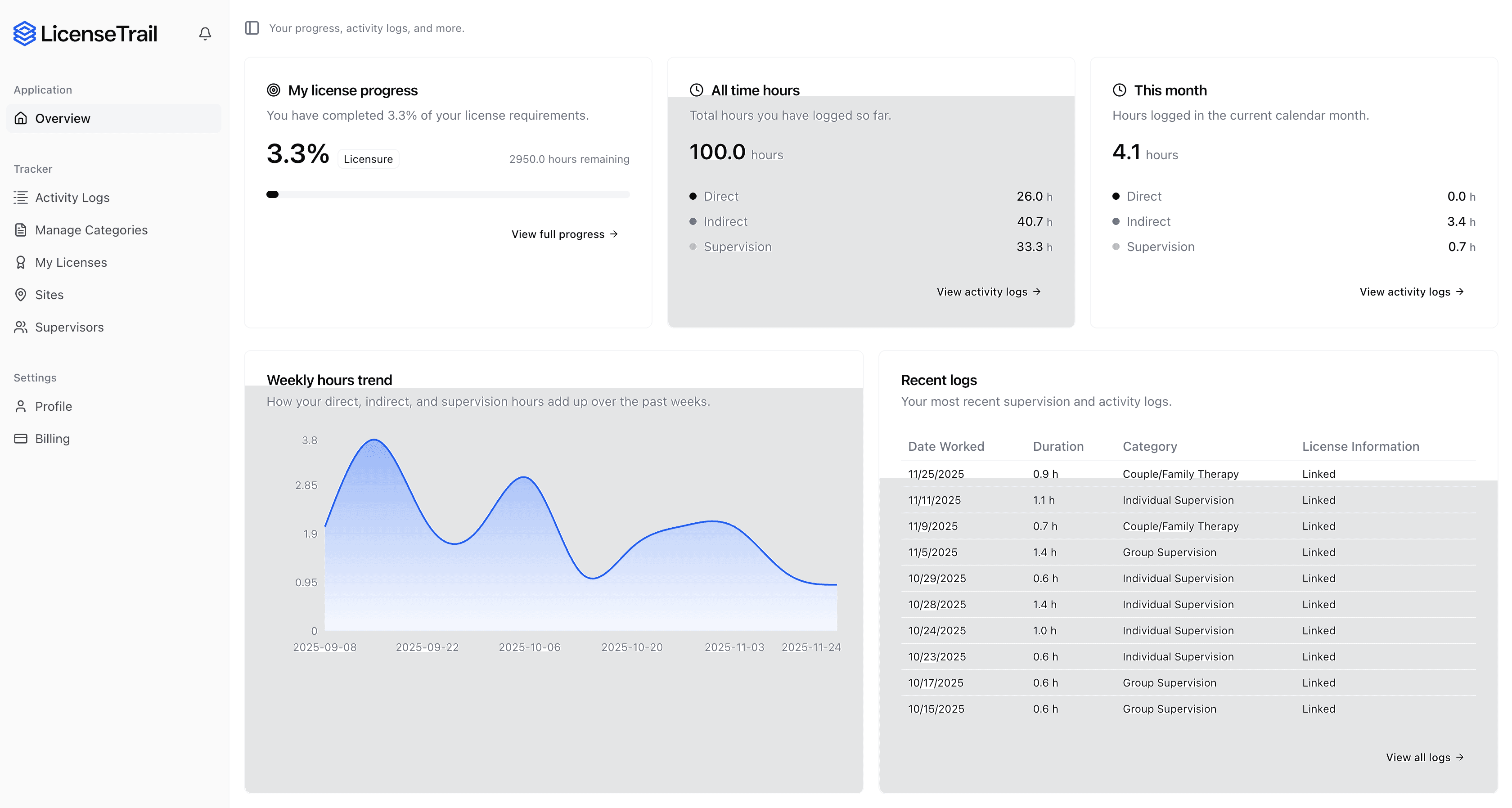
License Trail checks your direct, indirect, and supervision hours against Minnesota LICSW requirements continuously and flags mismatches before you submit.
 Start Tracking for Free
No credit card required · Free plan available
Related Licenses
Is your spreadsheet hiding Minnesota LICSW risks?
Stop guessing if your categories match Minnesota Board of Social Work requirements. License Trail checks your direct, indirect, and supervision hours continuously and flags mismatches before you submit.
Import or log
Bring your spreadsheet or start fresh
Upload your existing tracking spreadsheet and we'll map every hour into the right Minnesota Board of Social Work categories automatically.
Verify against Minnesota
Catch mismatches before the board does
License Trail checks your direct, indirect, and supervision hours against Minnesota LICSW requirements continuously.
Export board-ready
One-click clean reports
Generate professional, board-ready reports for supervision meetings and Minnesota Board of Social Work submissions in seconds.
No credit card required · Free plan available