
Minnesota LMFT Requirements: Hours, Exams & Step-by-Step Guide
Stop guessing if your categories match Minnesota requirements. License Trail checks your direct, indirect, and supervision hours against LMFT requirements continuously and flags mismatches before you submit.
No credit card required · Free plan available
Quick Requirements Overview
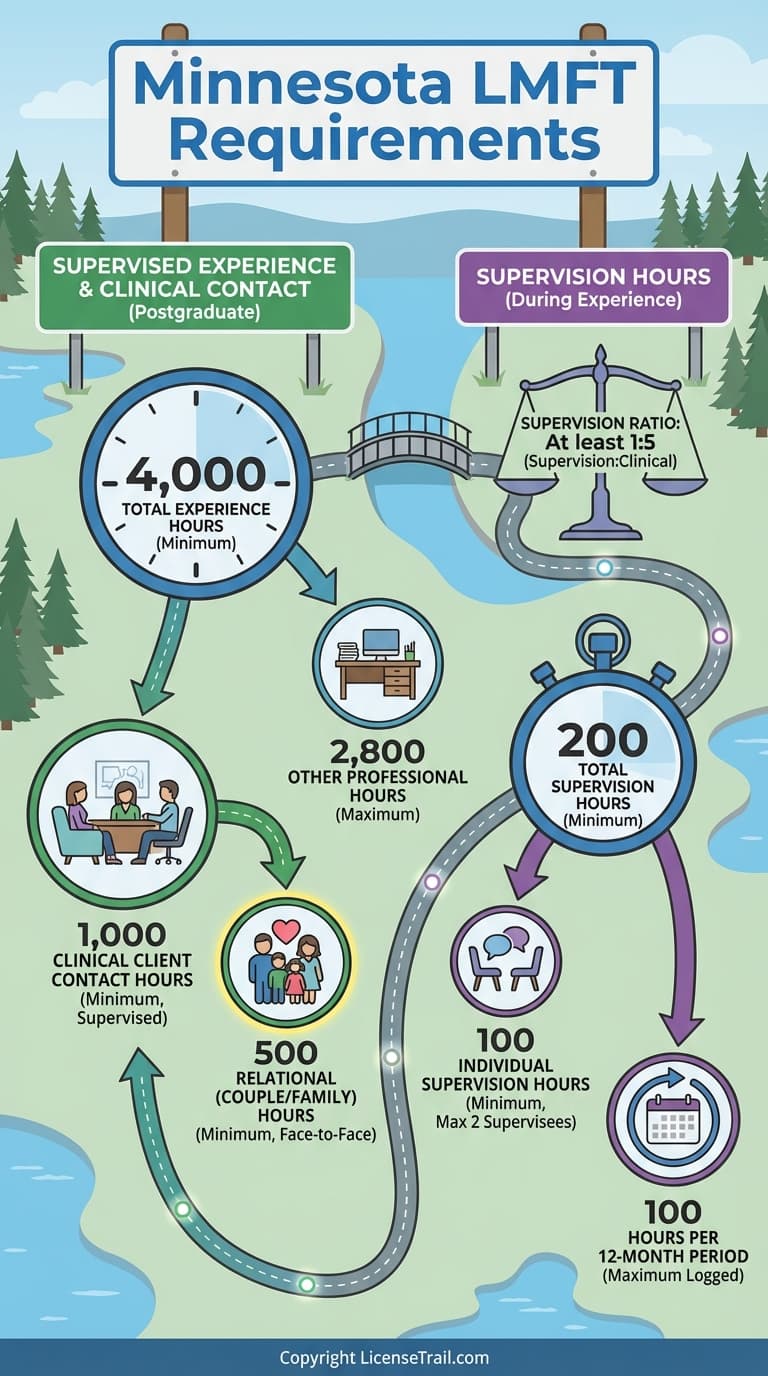
- Qualifying graduate degree in MFT/related field meeting MN coursework + practicum rules; post‑graduate hours start day after degree award (per transcript).
- 4,000 hours post‑graduate supervised MFT experience, completed in ≥24 months (generally must finish licensure within 7 years of initial application if education completed after 8/1/2016).
- Within 4,000: ≥1,000 hours face‑to‑face clinical client contact (assessment/diagnosis/treatment; psychoeducation counts only within an existing therapeutic relationship).
- Within the 1,000 clinical hours: ≥500 hours with couples, families, or other relational groups.
- Supervision: ≥200 hours tied to the 1,000 clinical hours; average 1 hour supervision per 5 hours direct clinical contact; ≥50% must be individual (max 2 supervisees).
- Supervision must be by a MN Board‑approved LMFT supervisor for clinical client contact; clinical data must be made directly available (notes/observation/audio/video/etc.); real‑time two‑way audio/visual electronic supervision permitted for all supervision hours.
- Other hours: up to 2,800 may be other supervised professional activities; no more than 2,800 may be supervised by a “licensed mental health professional” (per MN statute definitions).
- Must pass AMFTRB national MFT exam + MN state written exam; provide ≥2 qualified endorsements/references; maintain a detailed permanent log of all professional activity/hours.
License Details
Procedures
Becoming a Licensed Marriage and Family Therapist (LMFT) in Minnesota is governed by the Minnesota Board of Marriage and Family Therapy and by Minnesota Rules, Chapter 5300. The process is structured, hour‑specific, and uses very particular language around “post-graduate supervised experience,” “clinical client contact,” and “supervision.”
Below is a step‑by‑step guide that tracks the Board’s terminology and breaks down the hours and requirements.
1. Meet basic eligibility and degree requirements
Minnesota Rule 5300.0130 lays out the global requirements to be eligible for LMFT licensure. To qualify, an applicant must: (law.cornell.edu)
- Complete the education requirements in Minnesota Statutes §148B.33, subd. 1(5), as defined in Minn. R. 5300.0140 (a qualifying graduate degree in marriage and family therapy or closely related field, meeting specific course and practicum requirements).
- Have “obtained the age of majority,” defined as at least 18 years old.
- Complete the required post‑graduate supervised experience in marriage and family therapy (detailed below).
- Provide endorsements from at least two individuals who meet the Board’s qualifications for endorsers.
- Agree to conduct all professional activities according to the Board’s code of ethics (Minn. R. 5300.0350).
- Pass both the national MFT examination and the Minnesota state written exam.
The “requisite graduate degree” or “qualifying MFT degree” must be awarded before you can begin logging any post‑graduate hours toward licensure. Logging may begin the day after the degree is awarded, as reflected on the official transcript. (mn.gov)
2. Understand the core post‑graduate experience requirement: 4,000 hours
The central experience requirement is:
“A minimum of 4000 hours of post-graduate supervised experience in the practice of MFT under the supervision of a Board-approved LMFT supervisor.” (mn.gov)
This “4000 professional hours” must be accumulated in not less than two years following award of the qualifying degree. (mn.gov)
For individuals who commence supervised experience on or after August 1, 2016, these 4,000 hours are structured as follows under Minn. R. 5300.0155 and the Board’s “Supervision Requirements” guidance: (mn.gov)
-
At least 1,000 hours of face‑to‑face clinical client contact, including:
- “Assessment, diagnosis, and treatment of mental illness and cognitive, emotional and behavioral disorders.”
- Psychoeducation and skills‑building activities may count as clinical client contact only when they are “provided within an existing therapeutic relationship providing family therapy as defined in Minn. Stat. 148B.29, subd. 3.” (mn.gov)
-
Of those 1,000 clinical hours, at least 500 hours must be with couples, families, or similar relational groups. (mn.gov)
-
A minimum of 200 hours of supervision that:
- Is “related to the 1000 hours of clinical client contact.”
- Is obtained at an average rate of one hour of supervision for every five hours of direct clinical client contact, for a minimum total of 200 hours.
- Consists of at least half of these hours as individual supervision (no more than two supervisees present). (mn.gov)
- Involves a focus on the supervisee’s clinical work, with clinical data made “directly available to the supervisor via written clinical materials, direct observation, audio or video recordings, or other reporting methods.” (mn.gov)
-
No more than 2,800 hours supervised by a licensed mental health professional as defined in Minn. Stat. §§245.462 and 245.4871. These hours “include the assessment, diagnosis, and treatment of mental illness, and cognitive, emotional, and behavioral disorders, as well as all other professional responsibilities” associated with practice. (mn.gov)
In practical terms, the 4,000 hours break down as:
- 1,000 hours: “face‑to‑face clinical client contact,” including at least 500 hours with couples/families/relational groups.
- 200 hours: “supervision” related to those 1,000 clinical hours, at a 1:5 supervision‑to‑practice ratio, at least 100 of which must be individual supervision.
- Up to 2,800 hours: other supervised professional activities (documentation, preparation, staff meetings, consultation, etc.). The Board states: “The other 2800 hours should include everything else you do of a professional nature, such as session preparation, case notes, staff meetings, continuing education, etc.” (mn.gov)
All of this must occur over a minimum of 24 months (two years) and, for degrees completed after August 1, 2016, licensure must be completed within seven years of filing the initial application with the Board. (mn.gov)
3. Distinguish “clinical client contact” from other professional hours
The Minnesota Board uses precise language to distinguish direct clinical work from general professional activity:
-
“Clinical client contact” is defined, by rule and board guidance, as:
- Direct, face‑to‑face therapy with clients that includes “assessment, diagnosis, and treatment of mental illness, and cognitive, emotional, and behavioral disorders.” (mn.gov)
- Includes at least 500 hours of work “with couples, families, or other relational groups.” (law.cornell.edu)
- May include psychoeducation/skills‑building only if provided within an ongoing therapeutic relationship providing family therapy.
-
“Professional hours” or “supervised professional experience” include:
- All clinical client contact hours.
- All other work “of a professional nature, such as session preparation, case notes, staff meetings, continuing education, etc.” (mn.gov)
The rules and board site repeatedly emphasize that all clinical client contact hours must be completed under the supervision of a Board‑approved LMFT supervisor. (mn.gov)
4. Understand supervision: who can supervise and in what format
4.1. Board‑approved LMFT supervisor requirement
The rules and the Board’s supervision page require that: (mn.gov)
- All clinical client contact hours being logged toward licensure must be supervised by a Minnesota LMFT Board‑approved supervisor.
- The supervisor must be listed as “board‑approved” on the Minnesota Board of Marriage and Family Therapy’s website (or, for hours obtained in another jurisdiction, an AAMFT‑Approved Supervisor or LMFT authorized to supervise for licensure in that jurisdiction). (mn.gov)
A Board‑approved LMFT supervisor must:
- Be licensed as an LMFT in Minnesota.
- Have “at least four years and 4,000 hours of experience in clinical practice as a licensed marriage and family therapist.”
- Provide evidence of formal training in supervision (e.g., board‑approved MFT supervisor coursework or AAMFT‑Approved Supervisor training). (revisor.mn.gov)
4.2. Amount, structure, and content of supervision
By rule and guidance, supervision must: (mn.gov)
- Total a minimum of 200 hours during the 4,000‑hour postgraduate period.
- Be “obtained at an average rate of one hour of supervision per five hours of direct clinical client contact.”
- Be “regular and continuous until supervisee is licensed as an LMFT.”
- Include at least half of the supervision hours as individual supervision (no more than two supervisees present).
Supervision must focus on clinical work and rely on direct access to clinical material:
“Supervision must involve a focus on the supervisee’s clinical work and supervisee must make clinical data directly available to supervisor via written clinical materials, direct observation, audio or video recordings, or other reporting methods.” (mn.gov)
4.3. Electronic supervision
Effective May 24, 2022, Minnesota law expressly permits fully electronic supervision:
“The Board must allow an applicant to satisfy the requirement for supervised postgraduate experience in marriage and family therapy with all required hours of supervision provided through real-time, two-way interactive audio and visual communication.” (mn.gov)
This means the entire 200 required supervision hours may be conducted electronically, provided they are synchronous audio‑visual sessions that meet all other supervision standards.
5. Time frames and logging requirements
The Board expects structured tracking of hours:
- Accumulate the 4,000 hours of professional experience in not less than two years following the degree award date. (mn.gov)
- For those completing the required graduate education after August 1, 2016, “licensure process must be completed within 7 years of filing initial application with Board.” (mn.gov)
Applicants must maintain a “detailed log” of all professional activity during the supervised period:
“A detailed log shall be maintained of all professional activity during this time period. This log shall be permanently maintained by the applicant.” (law.cornell.edu)
The Board provides a sample Supervision Log, but explicitly allows any similar format (spreadsheet, table, etc.) so long as it allows verification that the applicant has met supervision and experience requirements. Regular review and sign‑off by the supervisor are strongly recommended. (mn.gov)
6. Examination requirements
To become fully licensed as an LMFT, an applicant must: (mn.gov)
- Pass the AMFTRB National Examination in Marriage and Family Therapy (national exam approved by the board).
- After completing the 4,000 hours of supervised experience and passing the national exam, submit the Application for Marriage and Family Therapist Licensure (LMFT) by State Examination.
- Upon approval, sit for and pass the Minnesota state written licensure examination, administered by the Board in St. Paul.
An approved applicant must take the national exam within two years of initial application approval for that exam. (mn.gov)
7. Endorsements / references
Minnesota Rule 5300.0130 also requires that an applicant:
“Provide evidence of meeting the requirements of Minnesota Statutes, section 148B.33, subdivision 1, clause (2), through endorsements from at least two individuals with the qualifications in part 5300.0230.” (law.cornell.edu)
These are often described as “two letters of endorsement from other LMFTs, either licensed in Minnesota, or another jurisdiction with substantially equivalent licensing requirements.” (aamft.org)
8. Licensure pathway and interim status (LAMFT)
In practice, the path commonly looks like:
- Complete qualifying MFT degree (with required coursework and practicum).
- Apply as a new applicant with the Minnesota Board (often as a Licensed Associate Marriage and Family Therapist, LAMFT), once education/practicum are approved. (mn.gov)
- Begin accumulating post‑graduate supervised experience under a Board‑approved LMFT supervisor, tracking 4,000 total hours with the required breakdown of client contact and supervision.
- Pass the AMFTRB National Examination in MFT.
- If, at the time of passing, all post‑graduate requirements have also been completed, the candidate may file the Application for LMFT Licensure in lieu of LAMFT. (mn.gov)
- Once the Board verifies education, supervised experience, examinations, and endorsements, and the applicant passes the Minnesota state exam, the Board grants LMFT licensure.
9. Key hour numbers and phrases, summarized in Board/Rule language
To match your example of explicit hour types and state verbiage, Minnesota’s LMFT requirements (for most current applicants) are:
- “A minimum of 4000 hours of post-graduate supervised experience in the practice of MFT under the supervision of a Board-approved LMFT supervisor.” (mn.gov)
- Within those 4,000 hours:
- “At least 1000 hours of face-to-face clinical client contact”, which “shall include the assessment, diagnosis, and treatment of mental illness and cognitive, emotional and behavioral disorders.” (mn.gov)
- Of the 1,000 hours, “the 1,000 hours shall include at least 500 hours of face-to-face therapy with couples, families, or similar relational groups.” (law.cornell.edu)
- “A minimum of 200 hours of supervision… obtained at an average rate of one hour of supervision per five hours of direct clinical client contact, for a minimum total of 200 hours of supervision.” At least half must be individual supervision. (mn.gov)
- “No more than 2,800 hours supervised by a licensed mental health professional” other than the board‑approved LMFT supervisor, including all other professional responsibilities. (mn.gov)
These figures collectively satisfy the statutory requirement of two years of supervised postgraduate experience totaling at least 4,000 hours in marriage and family therapy. (law.cornell.edu)
10. Special note on older cohorts
Minnesota maintains separate rule language for “persons eligible to commence postgraduate supervised experience prior to August 1, 2016” (Minn. R. 5300.0150). The overall structure (4,000 hours, 1,000 clinical, 500 couples/families, 200 supervision hours over at least 24 months) is very similar, though some details regarding electronic supervision and certain supervisory definitions have been updated in the newer rule (5300.0155). (law.cornell.edu)
Anyone who began their supervised experience before that date should consult both 5300.0150 and the Board for case‑specific interpretation.
This reflects the Minnesota Board of Marriage and Family Therapy’s and Minnesota Rules’ current published requirements as of late 2025. For an actual application, it is important to cross‑check your specific situation directly against the Board’s official forms, the “Supervision Requirements” and “New Applicants” pages, and Minnesota Rules Chapter 5300.
Track your LMFT hours with confidence
License Trail checks your direct, indirect, and supervision hours against Minnesota LMFT requirements continuously and flags mismatches before you submit.
 Start Tracking for Free
No credit card required · Free plan available
Is your spreadsheet hiding Minnesota LMFT risks?
Stop guessing if your categories match Minnesota Board of Marriage and Family Therapy requirements. License Trail checks your direct, indirect, and supervision hours continuously and flags mismatches before you submit.
Import or log
Bring your spreadsheet or start fresh
Upload your existing tracking spreadsheet and we'll map every hour into the right Minnesota Board of Marriage and Family Therapy categories automatically.
Verify against Minnesota
Catch mismatches before the board does
License Trail checks your direct, indirect, and supervision hours against Minnesota LMFT requirements continuously.
Export board-ready
One-click clean reports
Generate professional, board-ready reports for supervision meetings and Minnesota Board of Marriage and Family Therapy submissions in seconds.
No credit card required · Free plan available