
Mississippi LPC Requirements: Hours, Exams & Step-by-Step Guide
Stop guessing if your categories match Mississippi requirements. License Trail checks your direct, indirect, and supervision hours against LPC requirements continuously and flags mismatches before you submit.
No credit card required · Free plan available
Quick Requirements Overview
- Degree: Master’s in Counseling (or qualifying related) 60 semester hrs/90 quarter hrs meeting MS rules
- Initial license: Obtain P‑LPC; practice only under MS LPC‑S with supervision contract + Declaration of Practice + fingerprints/background check
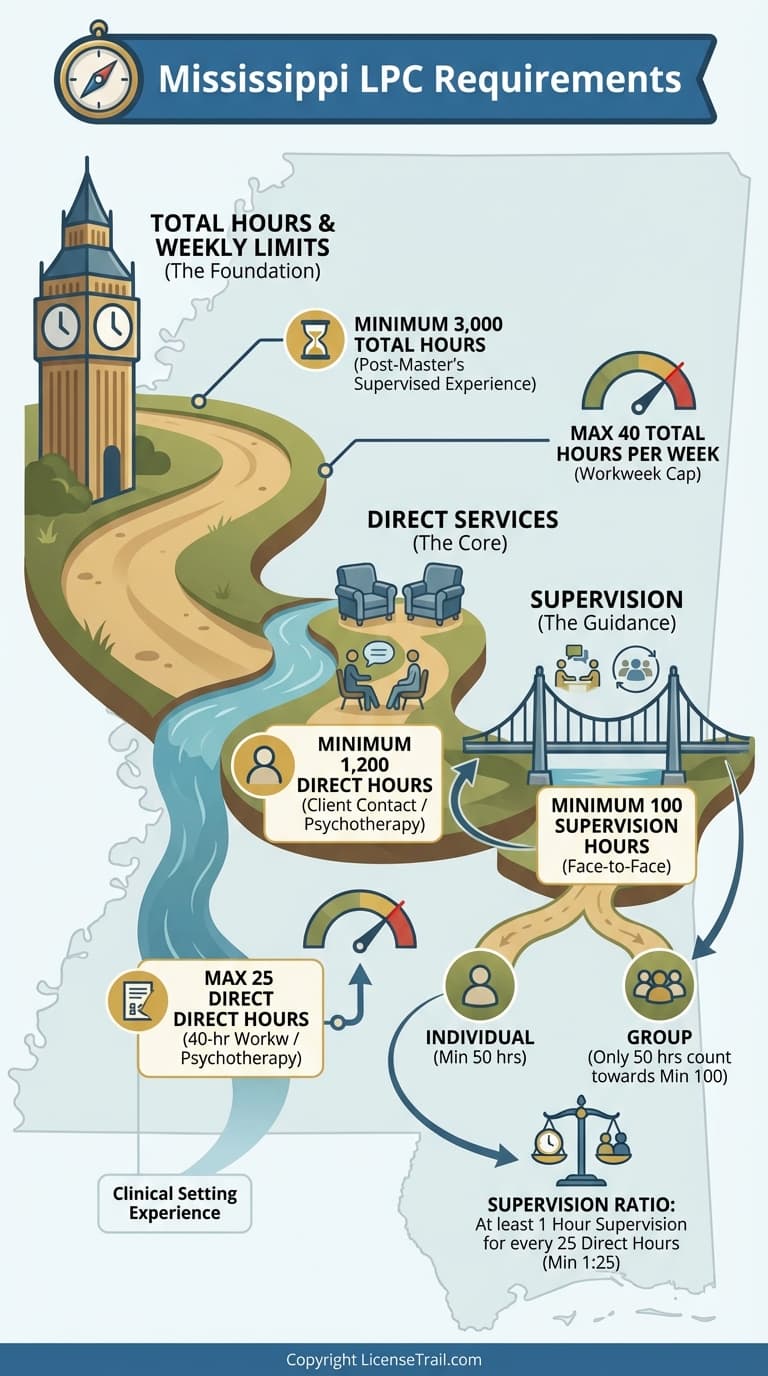
- Experience: 3,000 post‑master’s supervised hours in a clinical setting, ≥18 months, under MS LPC‑S
- Direct services: ≥1,200 hours (face‑to‑face/synchronous counseling; incl. individual, couples/family, group, testing/assessment)
- Supervision: 100 hours individual face‑to‑face; ≤50 may be group ( 2 group = 1 individual ); supervision ratio 1:40 total or 1:25 direct
- Weekly caps: Max 40 supervised hrs/week; max 25 direct‑service hrs/week
- Timing/logging: Hours must be within 7 years; report via online Supervision Reporting Log; continue supervision until LPC issued (after applying: ≥1 individual hr/month)
- Exams: Pass NCE or NCMHCE + MS jurisprudence exam
License Details
Procedures
Licensure as a Licensed Professional Counselor (LPC) in Mississippi is a two‑step process overseen by the Mississippi State Board of Examiners for Licensed Professional Counselors and codified in the Mississippi Administrative Code, Title 30, Part 2201, Rule 4.3. It moves you from graduate training, to Provisional‑LPC (P‑LPC), and finally to independent LPC status.
Below is a structured guide with emphasis on the supervised‑experience hour requirements and the Board’s terminology.
1. Big‑picture pathway to LPC in Mississippi
To practice independently as an LPC in Mississippi, you must:
- Earn a qualifying graduate degree in counseling (or closely related field that meets Rule 4.2).
- Obtain a Provisional‑Licensed Professional Counselor (P‑LPC) license.
- Complete specific post‑master’s supervised experience requirements under a Board‑approved supervisor (LPC‑S).
- Pass the required national exam (NCE or NCMHCE) and the Mississippi jurisprudence exam.
- Apply for full LPC licensure and meet background‑check and administrative requirements. (msblpc.org)
Most of the complexity lies in step 3, where the hour requirements apply.
2. Educational foundation (to be eligible for P‑LPC / LPC)
The Board describes a qualifying degree as:
- A master’s degree in Counseling with at least 60 semester hours (or 90 quarter hours), or
- A master’s program with the word “counseling” in the title that meets the Board’s structure, including 12 specified counseling courses, or
- A qualifying doctoral/Ed.S. degree primarily in counseling/guidance that meets similar standards. (msblpc.org)
This degree is the prerequisite for:
- Applying for a P‑LPC license. (msblpc.org)
- Later documenting supervised experience for LPC. (msblpc.org)
3. Step One: Provisional‑Licensed Professional Counselor (P‑LPC)
What P‑LPC status is
A P‑LPC:
- Has completed the qualifying degree under Rule 4.2.
- Is authorized to practice counseling in Mississippi only under supervision of a Mississippi Licensed Professional Counselor–Supervisor (LPC‑S).
- May not practice independently. (msblpc.org)
The P‑LPC is the status under which you accumulate the supervised hours that will count toward LPC.
Key P‑LPC requirements (summary)
Before applying for P‑LPC, you must: (msblpc.org)
- Have the qualifying counseling degree.
- Secure an LPC‑S and enter into a Supervisory Agreement/Contract.
- Prepare and upload a Declaration of Practice (your informed‑consent style statement describing your qualifications, supervision, and limits of practice).
- Submit a P‑LPC application, fees, official transcripts, and a fingerprint background check.
- Take and pass the Mississippi Pass/Fail Jurisprudence Examination (Board rules + ACA Code of Ethics).
Once approved as a P‑LPC, you can begin accruing the supervised hours required for LPC and reporting them in the online Supervision Reporting Log. (msblpc.org)
4. Core definitions the Board uses for experience
Understanding the Board’s terminology helps decode the hour requirements:
-
“Direct Services” / “Direct Service”
The Board uses this term for time spent directly related to clients in counseling or psychotherapy, including:- individual counseling
- couples/family counseling
- group counseling
- testing and assessment
In updated rules, “Direct Services” are only face‑to‑face or synchronous methods of counseling (e.g., in‑person or secure video), not email or text. (sos.ms.gov)
-
“Supervised hours”
In Rule 4.3, “supervised hours” refers to your total counseling experience hours in a clinical setting under an LPC‑S after the master’s degree. These include direct client work plus other counseling‑related duties and supervision time itself, subject to weekly caps and sub‑requirements. (regulations.justia.com) -
“Individual supervision”
Defined as face‑to‑face supervision of one supervisee by an LPC‑S. (sos.ms.gov) -
“Group supervision”
Supervision of more than one but no more than six supervisees at a time by an LPC‑S; in the hour rules, two hours of group supervision count as one hour of individual supervision toward the supervision requirement. (sos.ms.gov) -
“LPC‑S” (Board Qualified Supervisor)
A Mississippi LPC who has met additional training and experience requirements and is approved by the Board to provide supervision for P‑LPCs. (sos.ms.gov)
5. Step Two: Post‑master’s supervised experience for LPC
5.1 Total supervised experience requirement
Under Miss. Admin. Code 30‑2201‑4.3, current through June 12, 2025, an applicant for LPC must document: (regulations.justia.com)
- 3,000 supervised hours
- In not less than 18 months
- Of counseling in a clinical setting post‑master’s degree
- Under a Mississippi Board‑qualified supervisor (LPC‑S)
These 3,000 supervised hours are then broken down into specific categories.
Weekly caps on experience
Within those 3,000 supervised hours, the Board sets maximums per week: (regulations.justia.com)
- Maximum 40 supervised hours per workweek.
- Maximum 25 hours of Direct Services per 40‑hour workweek.
This prevents front‑loading all hours in a short span and emphasizes a reasonable caseload.
5.2 Required “Direct Services” hours (client contact)
Within the 3,000 supervised hours, the Board requires:
- At least 1,200 hours of “Direct Services” with clients and/or psychotherapy services to clients. (regulations.justia.com)
Per Rule 4.3(B)(1)(c), “Direct Services” in this context means face‑to‑face or synchronous counseling activities, including:
- individual counseling
- couples/family counseling
- group counseling
- testing and assessment
As a practical breakdown:
- Total supervised hours required: 3,000
- Of these, minimum direct‑service hours: 1,200
- Remaining hours (up to ~1,800): other counseling‑related duties (indirect services, documentation, consultation, trainings, etc.) plus supervision time, as long as all are under an LPC‑S and properly logged.
5.3 Required supervision hours (time with your LPC‑S)
Within the 3,000 supervised hours, the Board also requires specific supervisor contact:
- 100 hours of “individual face‑to‑face supervision.” (regulations.justia.com)
Rule 4.3 further specifies:
-
Ratios. Supervision must occur at no less than these maximum ratios:
- 1 hour of supervision for every 40 hours of overall services or
- 1 hour of supervision for every 25 hours of Direct Services. (regulations.justia.com)
-
Group supervision allowance.
- No more than 50 hours of the required 100 supervision hours may be met by group supervision.
- Two hours of group supervision = one hour of individual supervision for meeting the 100‑hour requirement (you record the full group time; the Board halves it in review). (regulations.justia.com)
-
No double‑counting multiple supervisors.
Supervision from more than one supervisor regarding the same direct client service hours at the same site and time will not be accepted. (regulations.justia.com)
Functionally, the Board expects a consistent, longitudinal supervisory relationship that guides your clinical development, not sporadic or overlapping sign‑offs.
5.4 Time window and reporting requirements
In addition to the numeric hour requirements, Rule 4.3 sets procedural conditions:
-
Experience must be recent.
“Supervised experience must be within the past seven (7) years of the application date.” (regulations.justia.com) -
Online logging is mandatory.
Supervision hours and supervised experience must be reported in the Board’s online Supervision Reporting Log. Supervisees must keep their own backup records; supervisors keep their supervision notes. (regulations.justia.com) -
Ongoing supervision until LPC is issued.
A P‑LPC must remain under supervision until the LPC license is actually issued. Once an LPC application is submitted, the Board requires that supervision continue to be reported at a minimum of one (1) hour of individual supervision per month until licensure is granted. (regulations.justia.com)
5.5 Who can supervise and in what settings
The Board requires that:
- Your supervisor be a Mississippi Board Qualified Supervisor (LPC‑S).
- Supervision must occur in an appropriate clinical setting (e.g., agencies, clinics, schools, hospitals, practices) where clinical mental‑health counseling is provided. (sos.ms.gov)
Distance (telehealth) supervision is allowed but tightly regulated:
- The LPC‑S must meet the Board’s TeleMental Health / Distance Professional Services training or credential requirement (e.g., BC‑TMH or equivalent).
- Supervision sessions must use secure, synchronous video; phone, email, chat, etc. are only for emergencies.
- The Supervision Contract must explicitly describe distance‑supervision procedures and backup plans for technology failure. (regulations.justia.com)
6. Examinations for LPC
Once you have met the education and supervised‑experience requirements, you must demonstrate competence by passing:
-
A national counseling examination
- Either the National Counselor Exam (NCE) or the National Clinical Mental Health Counselor Exam (NCMHCE), administered by NBCC.
- Current rules allow you to take the NCE or NCMHCE at any time, even before you apply for LPC; Board approval is not required to sit for the exam. (regulations.justia.com)
-
Mississippi Pass/Fail Jurisprudence Examination
- A timed, “open‑book” test on the Mississippi Rules and Regulations and the ACA Code of Ethics.
- Registration opens in your Board profile once the relevant P‑LPC or LPC application and fees are submitted. (msblpc.org)
7. Administrative step: applying for LPC
After you:
- Hold a P‑LPC (or meet P‑LPC requirements as an out‑of‑state applicant),
- Complete 3,000 supervised hours (including 1,200 Direct Services and 100 hours of individual supervision, with group‑supervision limits),
- Meet the recency and logging requirements, and
- Pass the NCE or NCMHCE and the Mississippi jurisprudence exam,
you then:
- Apply online for LPC through the Board’s system,
- Ensure all supervision verification forms (Form B) are submitted by each LPC‑S, and
- Complete any remaining background‑check and fee requirements. (msblpc.org)
Upon Board approval, your status changes from P‑LPC to LPC, and you may provide counseling services independent of supervision in Mississippi, subject to ongoing renewal and continuing‑education requirements. (msblpc.org)
8. Hour‑requirement summary at a glance
Using the Board’s terms and numbers:
-
Total supervised experience:
- 3,000 supervised hours post‑master’s,
- At least 18 months in a clinical setting,
- Under a Mississippi LPC‑S.
-
Within the 3,000 hours:
- Minimum 1,200 hours “Direct Services” (face‑to‑face or synchronous counseling, including individual, couples/family, group, testing/assessment).
- 100 hours of “individual face‑to‑face supervision” with an LPC‑S, with:
- Ratios of approx. 1 hour supervision per 40 total service hours or per 25 direct‑service hours.
- Up to 50 of those 100 hours allowed via group supervision, counting at 2 hours group = 1 hour individual.
-
Weekly caps:
- No more than 40 supervised hours per week.
- No more than 25 Direct Services hours per week.
-
Other conditions:
- Supervised experience must fall within 7 years of the LPC application date.
- All hours must be logged in the online Supervision Reporting Log.
- P‑LPCs must remain under supervision until the LPC license is issued, with at least 1 hour of individual supervision per month after LPC application has been filed. (regulations.justia.com)
These requirements reflect the Mississippi Board’s rules and the Mississippi Administrative Code as of mid‑2025; for any application or supervision plan, you should always cross‑check against the Board’s current rules, forms, and online guidance before proceeding.
Track your LPC hours with confidence
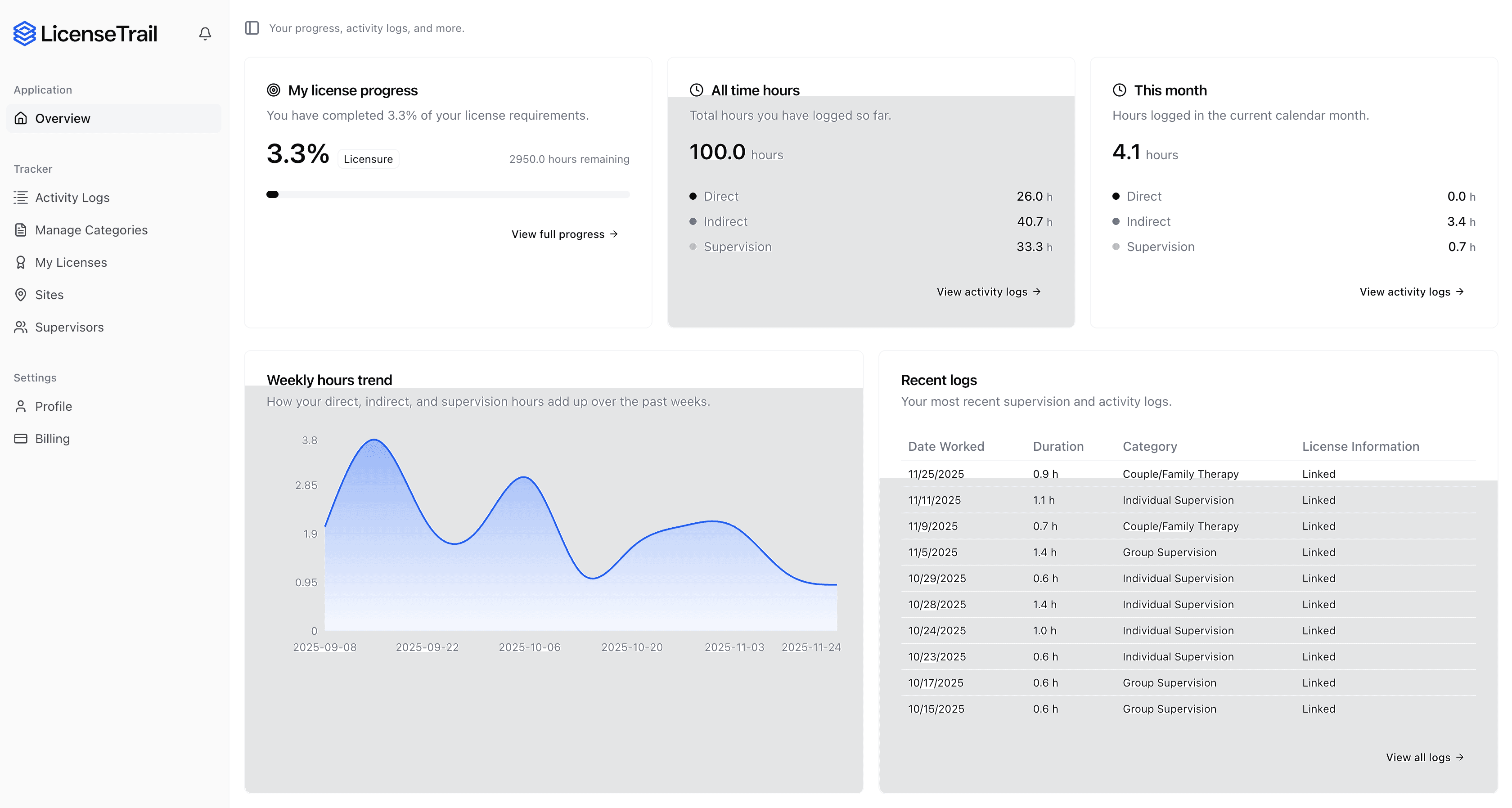
License Trail checks your direct, indirect, and supervision hours against Mississippi LPC requirements continuously and flags mismatches before you submit.
 Start Tracking for Free
No credit card required · Free plan available
Is your spreadsheet hiding Mississippi LPC risks?
Stop guessing if your categories match Mississippi State Board of Examiners for Licensed Professional Counselors requirements. License Trail checks your direct, indirect, and supervision hours continuously and flags mismatches before you submit.
Import or log
Bring your spreadsheet or start fresh
Upload your existing tracking spreadsheet and we'll map every hour into the right Mississippi State Board of Examiners for Licensed Professional Counselors categories automatically.
Verify against Mississippi
Catch mismatches before the board does
License Trail checks your direct, indirect, and supervision hours against Mississippi LPC requirements continuously.
Export board-ready
One-click clean reports
Generate professional, board-ready reports for supervision meetings and Mississippi State Board of Examiners for Licensed Professional Counselors submissions in seconds.
No credit card required · Free plan available