
Mississippi Licensed Psychologist Requirements: Hours, Exams & Step-by-Step Guide
Stop guessing if your categories match Mississippi requirements. License Trail checks your direct, indirect, and supervision hours against Licensed Psychologist requirements continuously and flags mismatches before you submit.
No credit card required · Free plan available
Quick Requirements Overview
- Doctoral degree in psychology from APA/CPA-accredited program (or Board-approved equivalent); official transcript sent directly to Board
- Complete 2 years supervised experience in specialty area: 4,000 hours total (2,000 internship + 2,000 postdoc)
- Predoctoral internship: 2,000 hours (finish within 2 years); APA/CPA accredited or individually Board-approved
- Internship supervision (full-time): 4 hrs/week supervision, incl. 2 hrs/week individual face-to-face
- Postdoctoral supervision year: 2,000 hours (finish within 2 years) with 2 hrs/week individual face-to-face supervision by licensed psychologist; Board-approved plan if not yet completed
- Exams: pass EPPP (scaled 500), then oral exam + jurisprudence (law/rules) exam
- Application: Board forms/ASPPB PLUS + fees; criminal background check/fingerprints; 3 psychologist references (within past 5 years) and complete supervised-experience documentation
License Details

Procedures
Mississippi licenses psychologists at the doctoral level through the Mississippi Board of Psychology. The core requirements are set out in the Board’s Rules and Regulations (Title 30, Part 3201 of the Mississippi Administrative Code) and in Mississippi statute (Title 73, Chapter 31). (psychologyboard.ms.gov)
Below is a step‑by‑step outline of what the Board actually requires, with the key hours and the Board’s own terminology highlighted.
1. Basic eligibility: degree and program type
Degree level
- You must have a doctoral degree in psychology.
- The doctoral program must be:
- Accredited by the American Psychological Association (APA) or the Canadian Psychological Association (CPA), or
- In a psychology specialty where no APA/CPA accreditation exists but is designated as a psychology program by the National Register/ASPPB Designation Committee (or otherwise shown to meet “recognized acceptable professional standards” and approved by the Board). (psychologyboard.ms.gov)
Documentation
- An official transcript must be sent directly from the institution to the Board and must show the conferral of the doctoral degree in psychology from a qualifying program. (psychologyboard.ms.gov)
2. Supervised experience: structure and total hours
Mississippi’s supervised‑experience requirement is set up as two supervised years:
- One year is a predoctoral internship.
- One year is a post‑doctoral year of supervised experience.
2.1 The two‑year supervised experience requirement
Rule 4.6 of the Board’s Rules and Regulations states that an applicant must show:
- “two (2) years of supervised experience” in the same area of emphasis as the doctoral degree, and
- This must include an internship and one (1) year of supervised post‑doctoral experience meeting the Board’s standards in Chapter 6. (psychologyboard.ms.gov)
The same rule goes on to specify that:
- Each year (or equivalent) must comprise “at least two thousand (2,000) hours of actual work, which may include direct service, training and supervisory time.” (psychologyboard.ms.gov)
What this means in practice
- Total supervised experience required for a standard applicant:
- 4,000 hours of supervised experience, broken down as:
- 2,000 hours in a qualifying predoctoral internship, and
- 2,000 hours in a qualifying post‑doctoral supervised year.
- 4,000 hours of supervised experience, broken down as:
Mississippi does not break this into separate “direct client contact hours” vs “other hours” the way some states do. Instead, it defines totals and supervision ratios, and it allows “direct service, training and supervisory time” to be counted within the 2,000 hours for each year. (psychologyboard.ms.gov)
3. Predoctoral internship requirements (first 2,000 hours)
The internship is governed primarily by Rule 6.2 and Rule 6.3. (psychologyboard.ms.gov)
3.1 General structure
- At least “one year of full‑time, or two years of half‑time predoctoral experience” is required for the internship. (psychologyboard.ms.gov)
- The internship must be:
- APA‑ or CPA‑accredited, or
- If not accredited, it must meet all of the Board’s criteria in Rule 6.3 and be individually reviewed and approved by the Board.
3.2 Required internship hours
Rule 6.3 provides the explicit internship hour requirement:
- “The internship consists of a minimum of 2000 hours of supervised experience and must be completed within a two year period.” (psychologyboard.ms.gov)
So, for the internship:
- Minimum total: 2,000 hours of supervised experience.
- Timeframe: no more than two years to complete those hours.
3.3 Required supervision during the internship
The same rule specifies the nature and intensity of supervision:
- Full‑time interns must receive at least four hours of supervision per week, of which at least two hours must be individual supervision (face‑to‑face with a supervisor). (psychologyboard.ms.gov)
- The internship site(s) must:
- Provide a broad spectrum of psychological services,
- Serve varied client populations, and
- Offer supervision by licensed psychologists with appropriate professional qualifications. (psychologyboard.ms.gov)
- The Board emphasizes that supervision must be for the “direct provision of psychological services” by the intern; classroom, practicum, or the intern’s own personal therapy cannot be counted as part of the required supervised hours. (psychologyboard.ms.gov)
Bottom line for the internship
- You must complete a Board‑qualifying internship of at least 2,000 supervised hours, generally at the APA/CPA‑accredited (or Board‑approved) level, with structured weekly face‑to‑face supervision.
4. Post‑doctoral year requirements (second 2,000 hours)
The post‑doctoral supervised year is spelled out in Rule 6.4 and referenced in Rule 4.6 as the “second year of supervised experience.” (psychologyboard.ms.gov)
4.1 Required hours
Rule 6.4 states:
- “The post‑doctoral year consists of a minimum of 2000 hours of supervised experience and must be completed within a two-year period.” (psychologyboard.ms.gov)
Thus:
- Minimum total: 2,000 hours of supervised experience post‑doctorally.
- Timeframe: No more than two years to accrue those 2,000 hours.
4.2 Nature of the experience
- The post‑doctoral year must be appropriate to your graduate training specialization (e.g., clinical, counseling, school). (psychologyboard.ms.gov)
- If you have not already completed this post‑doctoral year when you apply, you must submit a plan of supervision for the post‑doctoral year to the Board for approval, along with your licensure application and fee. (psychologyboard.ms.gov)
4.3 Required supervision structure
Rule 6.4 requires:
- At least two hours per week of formal, face‑to‑face individual supervision.
- Supervision must be direct, formal contact with a senior professional responsible for your professional development; course work and practicum activities do not count toward these supervised hours. (psychologyboard.ms.gov)
- Supervision must again be focused on your direct provision of psychological services to individuals or groups; personal therapy, encounter groups, or supervising others cannot be counted toward the required supervised experience. (psychologyboard.ms.gov)
- The supervisor must:
- Be licensed for the practice of psychology in the jurisdiction where the supervision occurs,
- Be employed at least 12 hours per week at the facility (or have a documented contractual relationship),
- Have qualifications appropriate to the services being supervised, and
- Not be in a dual relationship with you (e.g., not a close relative, business partner, etc.). (psychologyboard.ms.gov)
Bottom line for the post‑doc
- You must complete a Board‑approved post‑doctoral supervised year totaling at least 2,000 hours, with at least two hours per week of face‑to‑face individual supervision by a licensed psychologist, over no more than two years.
5. Total supervised hours and how they fit together
Putting the rules together:
-
Total supervised professional experience:
- 4,000 supervised hours, consisting of:
- 2,000‑hour predoctoral internship, plus
- 2,000‑hour post‑doctoral year.
- 4,000 supervised hours, consisting of:
-
Board’s terminology:
- The overall requirement is “two (2) years of supervised experience” in your specialty area. (psychologyboard.ms.gov)
- Those two years “must include an internship and one (1) year of supervised post‑doctoral experience.” (psychologyboard.ms.gov)
The Mississippi Board does not subdivide these 4,000 hours into fixed amounts of “direct client contact” versus “indirect” work in its rules. Instead, it defines:
- Total hours per year (2,000),
- Time limits (two years for internship; two years for post‑doc),
- Weekly minimums for individual face‑to‑face supervision, and
- Qualifying features of settings and supervisors. (psychologyboard.ms.gov)
6. Examination requirements
Mississippi uses both a national exam and a state‑specific process.
6.1 EPPP (written exam)
- The Board uses the Examination for Professional Practice in Psychology (EPPP) as its written exam. (psychologyboard.ms.gov)
- You must achieve at least the ASPPB‑recommended scaled score of 500 to pass. (psychologyboard.ms.gov)
6.2 Oral and jurisprudence examination
- After you pass the EPPP and complete the post‑doctoral supervision requirement, you become eligible for the oral examination. (psychologyboard.ms.gov)
- The oral exam:
- Is conducted by a panel of three psychologists (one is a Board member),
- Is held at least twice a year, usually lasting 45–60 minutes, and
- Includes submission of a written jurisprudence examination (covering Mississippi’s psychology law and rules) at the time of the oral exam. (psychologyboard.ms.gov)
Passing both the EPPP and the oral/jurisprudence examination is required before the Board will issue a full license.
7. Application process and background check
7.1 Application format
Under Chapter 4, the Board requires that:
- Applications be submitted on Board‑specified forms (now typically via the ASPPB PLUS system), including:
- Personal and professional information,
- A recent photograph,
- Notarized signature (for paper forms), and
- Required fees. (psychologyboard.ms.gov)
7.2 Background and references
- All applicants must undergo a criminal history background check and provide fingerprints. (psychologyboard.ms.gov)
- To show “good moral character,” the Board requires:
- Three references from licensed psychologists who have known or worked with you within the five years before application, and
- An absence of felony or specified misdemeanor convictions. (psychologyboard.ms.gov)
7.3 Experience documentation
- You must account for your entire supervised experience record from the start of that experience, including:
- Description of settings,
- Dates, hours, and supervised roles,
- Identification and credentials of supervisors. (psychologyboard.ms.gov)
8. Alternative licensure pathways (briefly)
The hour requirements above describe the “never been licensed” path. Mississippi also has other routes:
-
Licensure of senior psychologists / diplomates / CPQ holders
- Psychologists with long‑standing licenses elsewhere (e.g., 20+ years) or with ABPP or ASPPB CPQ may, in some cases, be granted licensure without repeating standard education or EPPP requirements, though an oral/jurisprudence exam is typically still required. (psychologyboard.ms.gov)
-
Applicants previously licensed in another jurisdiction
- Chapter 9 of the Rules and Title 73, §73‑31‑15 describe endorsement/credentialing pathways for experienced psychologists licensed in other U.S. or Canadian jurisdictions. (regulations.justia.com)
-
Temporary license / temporary practice certificate
- Duly licensed psychologists from other jurisdictions may obtain temporary authorization to practice in Mississippi on a limited basis (e.g., not more than 30 days in a 12‑month period), subject to Board approval and, in some cases, jurisprudence examination. (psychologyboard.ms.gov)
These options can alter which documentation you must provide, but they do not change the underlying standards that Mississippi considers equivalent to its own 4,000‑hour supervised‑experience model.
9. After licensure: continuing education (for completeness)
Although not part of initial licensure, the Board’s Rules require that licensed psychologists complete 20 hours of continuing education every two years, including 2 hours in ethics/legal issues, to maintain their license. (psychologyboard.ms.gov)
Summary of Mississippi’s supervised‑experience hours, in the Board’s own terms
- “Two (2) years of supervised experience” in your doctoral specialty area.
- Those two years must “include an internship and one (1) year of supervised post‑doctoral experience.” (psychologyboard.ms.gov)
- Each year must be “comprised of at least two thousand (2,000) hours of actual work”, which can include direct service, training, and supervisory time. (psychologyboard.ms.gov)
- The internship must be “a minimum of 2000 hours of supervised experience”, and the post‑doctoral year must likewise be “a minimum of 2000 hours of supervised experience,” each completed within a two‑year period. (psychologyboard.ms.gov)
That combination yields 4,000 total supervised hours for a standard applicant for licensure as a Licensed Psychologist in Mississippi.
Track your Licensed Psychologist hours with confidence
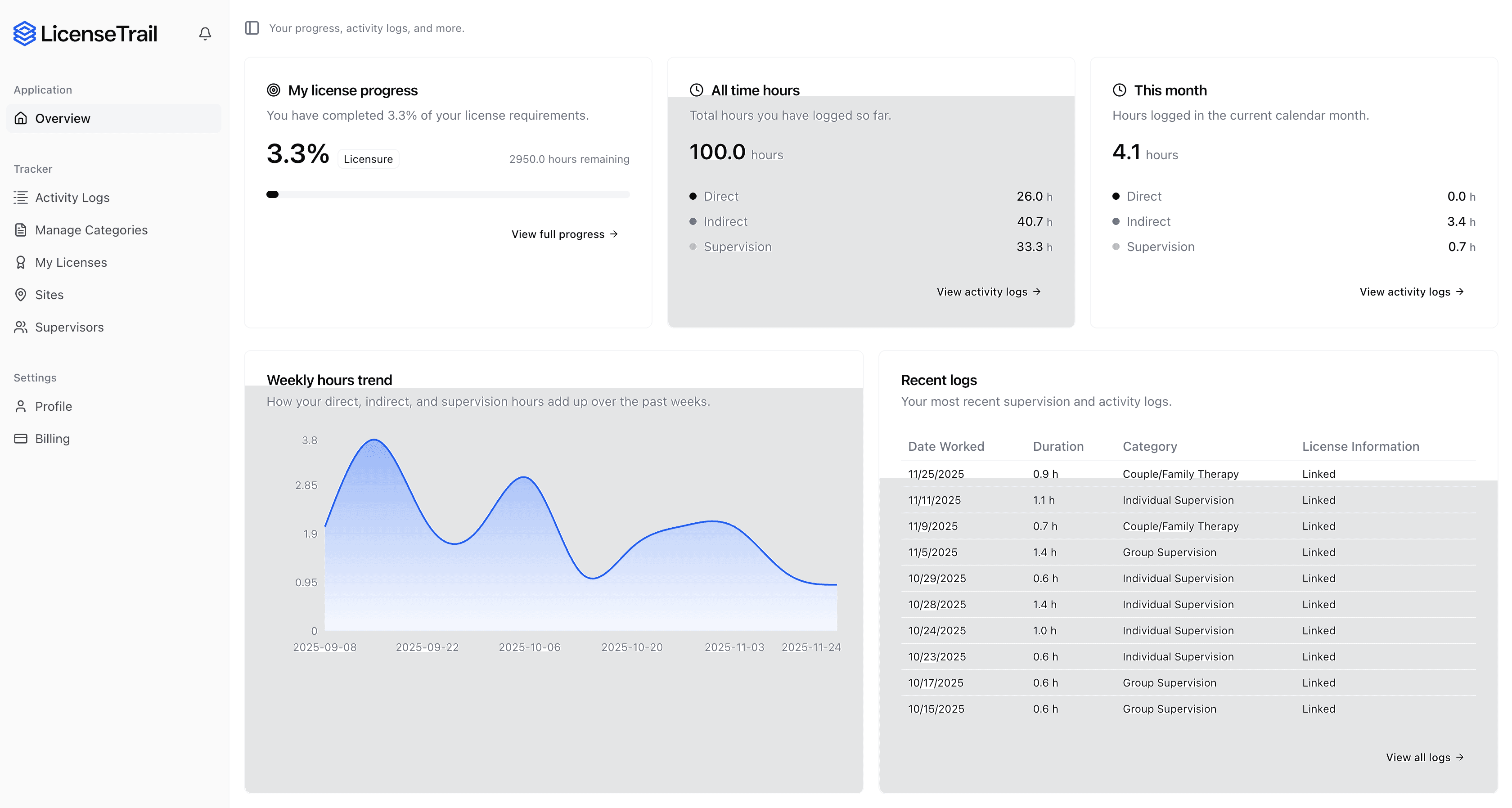
License Trail checks your direct, indirect, and supervision hours against Mississippi Licensed Psychologist requirements continuously and flags mismatches before you submit.
 Start Tracking for Free
No credit card required · Free plan available
Is your spreadsheet hiding Mississippi Licensed Psychologist risks?
Stop guessing if your categories match Mississippi Board of Psychology requirements. License Trail checks your direct, indirect, and supervision hours continuously and flags mismatches before you submit.
Import or log
Bring your spreadsheet or start fresh
Upload your existing tracking spreadsheet and we'll map every hour into the right Mississippi Board of Psychology categories automatically.
Verify against Mississippi
Catch mismatches before the board does
License Trail checks your direct, indirect, and supervision hours against Mississippi Licensed Psychologist requirements continuously.
Export board-ready
One-click clean reports
Generate professional, board-ready reports for supervision meetings and Mississippi Board of Psychology submissions in seconds.
No credit card required · Free plan available