
Missouri LCSW Requirements: Hours, Exams & Step-by-Step Guide
Stop guessing if your categories match Missouri requirements. License Trail checks your direct, indirect, and supervision hours against LCSW requirements continuously and flags mismatches before you submit.
No credit card required · Free plan available
Quick Requirements Overview
- CSWE-accredited MSW (or acceptable social work doctorate) required
- Must hold Missouri LMSW (or LBSW) before supervision hours can begin counting
- Register supervision with the Committee (form + fee); submit change of supervisor/setting within 14 days or hours won’t count
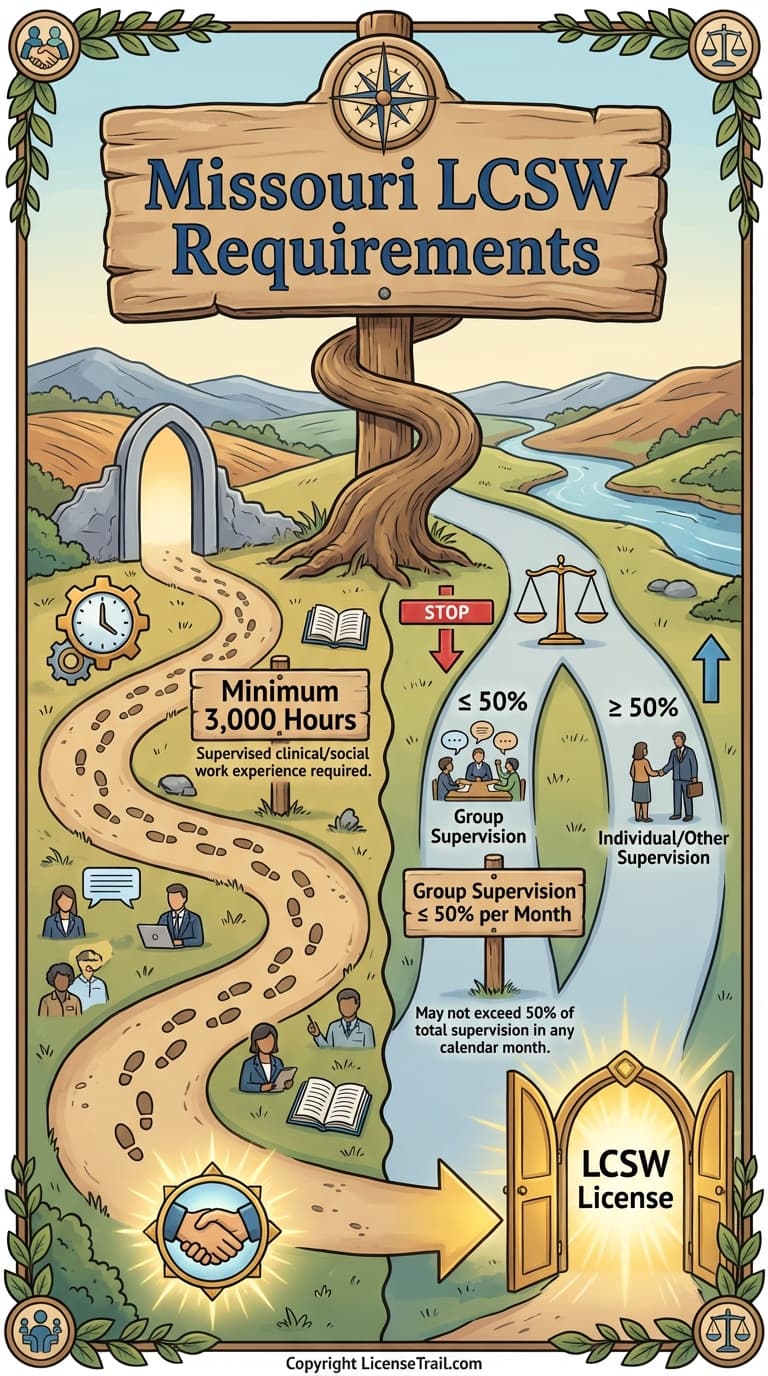
- Complete 3,000 hours supervised clinical/licensed social work experience in 24–48 consecutive months (supervision time counts within the 3,000)
- Supervision minimum: 2 hrs individual face-to-face every 2 weeks (or 4 hrs per 4 weeks); up to 50% group (2–6 supervisees); interactive video allowed if confidential
- Supervisor must be a qualified LCSW: 5+ years practice in area + 16 hrs approved supervision training; cannot be a relative
- May sit ASWB Clinical exam after 2,250 hours + 18 months (with supervisor confirmation); LCSW issuance requires full 3,000 hrs/24+ months + passing exam
- Application extras: 2 hrs suicide training within prior 2 years + fingerprint background check; must meet age/character/citizenship/10-year felony restriction criteria
License Details
Procedures
Becoming a Licensed Clinical Social Worker (LCSW) in Missouri is a structured, multi‑stage process governed by the Missouri State Committee for Social Workers under Chapter 337 of the Missouri Revised Statutes and Title 20, Division 2263 of the Missouri Code of State Regulations. The key elements are education, initial licensure (LMSW), supervised clinical experience, examination, and final LCSW licensure.
Below is a step‑by‑step outline emphasizing the exact hour requirements and terminology used by the Missouri board and statutes.
1. Educational foundation
Missouri statute §337.615 requires that an LCSW applicant:
- Have “a master’s degree from a college or university program of social work accredited by the Council on Social Work Education or a doctorate degree from a school of social work acceptable to the committee.” (codes.findlaw.com)
This degree is a prerequisite for both your initial LMSW license and later LCSW licensure.
2. Obtain your LMSW and register supervision
2.1. Licensure as a master social worker (LMSW)
Supervised clinical experience cannot start counting toward LCSW until after the Committee issues a social work license (typically LMSW). The supervision rule states:
- “Supervision of the applicant for licensure shall not begin, and will only be acceptable to the committee, after the issuance of the license as a master social worker or licensed baccalaureate social worker.” (law.cornell.edu)
So, the usual sequence is:
- Complete your CSWE‑accredited MSW.
- Apply for and obtain LMSW licensure in Missouri.
- Then register for supervision toward LCSW.
2.2. Registration of supervised experience
To have hours count toward LCSW, you must register supervision with the Committee:
- The applicant for registration of supervision must:
- Hold an LMSW (for the clinical path),
- Submit a “registration of supervision” form, and
- Pay the registration of supervision fee. (law.cornell.edu)
You must also file a change of status form within 14 days for any change in supervisor or setting, or those hours may not be counted toward the required hours:
- “Failure to submit a change will result in supervision hours not calculated towards the three thousand (3,000) hours of supervised licensed social work experience.” (regulations.justia.com)
Additionally:
- “All persons engaged in the practice of clinical social work in the state of Missouri shall either be licensed as a licensed clinical social worker or be registered for supervision as required by statute and these regulations.” (law.cornell.edu)
3. Supervised clinical experience: hours and structure
3.1. Total hours and time frame
Missouri law and regulation use the terms “supervised clinical experience” and “supervised licensed social work experience” for what many states call your “post‑master clinical hours.”
The controlling statute (§337.615) and regulation (20 CSR 2263‑2.030) require:
- A minimum of 3,000 hours of supervised experience.
- Completed in no less than 24 months and no more than 48 consecutive calendar months. (law.cornell.edu)
Verbatim regulatory language (paraphrased for brevity) states that the “minimum acceptable supervised experience shall be three thousand (3,000) hours obtained in no less than twenty‑four (24) and no more than forty‑eight (48) consecutive calendar months,” and hours outside a consecutive 48‑month period are not eligible. (law.cornell.edu)
Important distinction:
Missouri does not divide those 3,000 hours into specific sub‑categories such as “1,500 direct client hours + 1,500 indirect hours” or a separate block of “supervision” versus “practice.” Instead, the rules talk about a single pool of “three thousand (3,000) hours of supervised clinical experience / supervised licensed social work experience” accompanied by specified minimum supervision frequency (see below). (law.cornell.edu)
Supervision time itself does count as part of the 3,000 supervised hours; the regulation notes that the required supervision hours “shall be included in the total number of supervised hours required” toward the 3,000‑hour total. (law.cornell.edu)
3.2. Nature of the hours: “supervised clinical experience”
By statute, the experience must be:
- At least 3,000 hours of “supervised clinical experience with a qualified clinical supervisor”, obtained in the 24–48 month window. (codes.findlaw.com)
The rules describe this as “supervised licensed social work experience” performed under the oversight, guidance, control, and full professional responsibility of the supervisor and in compliance with all laws and regulations for practice of social work. (law.cornell.edu)
In practice this means:
- Your work must be clinical social work (assessment, diagnosis, psychotherapy, clinical intervention, treatment planning, etc.) appropriate to LCSW scope.
- It must occur in the settings and position(s) approved on your supervision registration.
- It must remain under your supervisor’s ongoing oversight during the entire supervised period.
3.3. Supervision frequency and format
Missouri specifies how much formal supervision you must receive while accruing those hours:
-
Minimum individual supervision
- “A minimum of two (2) hours every two (2) weeks of individual face‑to‑face supervision by the supervisor.” (law.cornell.edu)
-
Consolidation option
- You may consolidate for up to four weeks, for a total of four (4) hours of individual face‑to‑face supervision per four‑week period, and those hours are counted toward the 3,000‑hour total. (law.cornell.edu)
-
Group supervision allowance
- Up to 50% of supervision per month may be group supervision.
- Group supervision must consist of at least two (2) and no more than six (6) supervisees. (law.cornell.edu)
-
Use of technology
- Electronic communication is acceptable only if it is visually and verbally interactive (e.g., secure video) and confidentiality standards are maintained. (law.cornell.edu)
These supervision requirements are part of what the rule terms “allowable supervision.” (law.cornell.edu)
3.4. Who can supervise: “qualified clinical supervisor”
By statute and regulation, LCSW hours must be completed with a “qualified clinical supervisor.” Missouri law defines a qualified clinical supervisor as: (house.mo.gov)
- A licensed clinical social worker, who:
- Has practiced in the field of social work in the area for which they are supervising for a minimum of five (5) years, and
- Has successfully completed a minimum of sixteen (16) hours of supervisory training from ASWB, NASW, an accredited university, or another program approved by the Committee, adhering to the Committee’s content and quality standards, and
- Meets all other requirements under §§337.600–337.689 and applicable rules.
The detailed supervision rule (20 CSR 2263‑2.031) also confirms that an LCSW may supervise LCSW candidates (LMSWs under clinical supervision) and describes additional expectations for supervisory responsibility. (law.cornell.edu)
Note that supervisors cannot be relatives (spouse, parent, child, sibling, etc.) of the supervisee. (law.cornell.edu)
4. Mid‑process milestone: eligibility to sit for the LCSW exam
While full licensure requires 3,000 hours and at least 24 months, Missouri allows candidates to sit for the ASWB Clinical exam earlier, once they have met a specific benchmark.
Regulation and the Committee’s website together state that: (pr.mo.gov)
- The ASWB Clinical examination for LCSW cannot be taken before completion of:
- At least 2,250 hours of supervised work experience, and
- At least 18 months of supervision.
The Committee’s site further explains that LCSW exam candidates may sit once they have completed 2,250 hours and 18 months of supervision, provided:
- Their supervisor(s) email the Committee confirming the individual has completed “at least 2250 hours and 18 months and is on track to finish supervision,” and
- The applicant has submitted the application for licensure, fee, and required documentation. (pr.mo.gov)
Even if you pass the exam early, you still must complete:
- The full 3,000 hours of supervised clinical experience, and
- At least 24 months of supervision
before full LCSW licensure can be granted. (law.cornell.edu)
5. Application and examination requirements
When you are ready to apply for LCSW (and/or exam approval), Missouri regulation 20 CSR 2263‑2.050 outlines the application package. For LCSW this includes: (law.cornell.edu)
- Completed application form specifying LCSW as the license sought.
- Official transcripts sent directly from your CSWE‑accredited program.
- Completed Attestation of Supervision form(s) sent directly by each supervising LCSW (“qualified clinical supervisor”). These forms document your 3,000 hours and time frame.
- Verification of passing score on the ASWB Clinical Exam, sent directly from ASWB.
- Proof of completing two (2) hours of training in suicide assessment, referral, treatment, and management within the 2 years prior to application submission.
- Fingerprint background check through the Missouri State Highway Patrol’s approved vendor (covering both state and FBI checks).
The Committee’s LCSW page also links to: (pr.mo.gov)
- “Application for Licensure – LCSW/LAMSW (includes Attestation Form)”
- Fingerprinting/background check instructions
- Forms for exam approval and related processes.
6. Additional statutory conditions for licensure
Under §337.615, in addition to hours and education, the LCSW applicant must show that they: (house.mo.gov)
- Are at least 18 years of age.
- Are of good moral character.
- Are a United States citizen or have legal resident alien status.
- Have not been convicted of a felony in the ten years immediately prior to application.
7. How Missouri’s hours compare to the example you gave
Using your example of “1,500 hours of direct experience and 1,500 hours of supervised experience,” Missouri’s system is different:
- Missouri requires at least 3,000 hours of “supervised clinical experience / supervised licensed social work experience.” (law.cornell.edu)
- The regulations do not subdivide these 3,000 hours into separate buckets of “direct client contact vs indirect” or separate “practice vs supervision” tallies.
- Instead, the rules require:
- A single total of 3,000 supervised hours within 24–48 consecutive months, and
- A minimum supervision schedule (2 hours individual supervision every 2 weeks, with limited group supervision and allowances for consolidation and video). (law.cornell.edu)
Supervision sessions themselves are explicitly counted within the 3,000 hours of supervised experience.
8. Key numbers and terminology at a glance
-
Educational requirement:
- MSW from a CSWE‑accredited program or acceptable DSW/PhD in social work. (codes.findlaw.com)
-
Initial license:
- LMSW (supervision cannot count before LMSW/LBSW is issued). (law.cornell.edu)
-
Experience requirement for LCSW:
- 3,000 hours of “supervised clinical experience” / “supervised licensed social work experience”
- Within 24–48 consecutive calendar months. (law.cornell.edu)
-
Supervision structure (“allowable supervision”): (law.cornell.edu)
- Minimum 2 hours of individual face‑to‑face supervision every 2 weeks
- May consolidate to 4 hours every 4 weeks
- Up to 50% of supervision per month may be group (2–6 supervisees)
- Video/electronic supervision allowed if visually and verbally interactive and confidential
-
Supervisor qualifications (“qualified clinical supervisor”):
- LCSW with at least 5 years post‑licensure practice in the supervised area and at least 16 hours of approved supervisory training. (house.mo.gov)
-
Exam eligibility milestone:
- May sit for ASWB Clinical exam after 2,250 hours and 18 months of supervision, with supervisor confirmation and Committee approval. (pr.mo.gov)
-
Final licensure:
- Completion of full 3,000 hours / 24+ months, passing ASWB Clinical exam, required suicide‑prevention training, background check, and satisfaction of age, character, and felony‑history requirements. (law.cornell.edu)
This is the structure and wording currently used by the Missouri State Committee for Social Workers and reflected in the Missouri statutes and regulations governing the LCSW license.
Track your LCSW hours with confidence
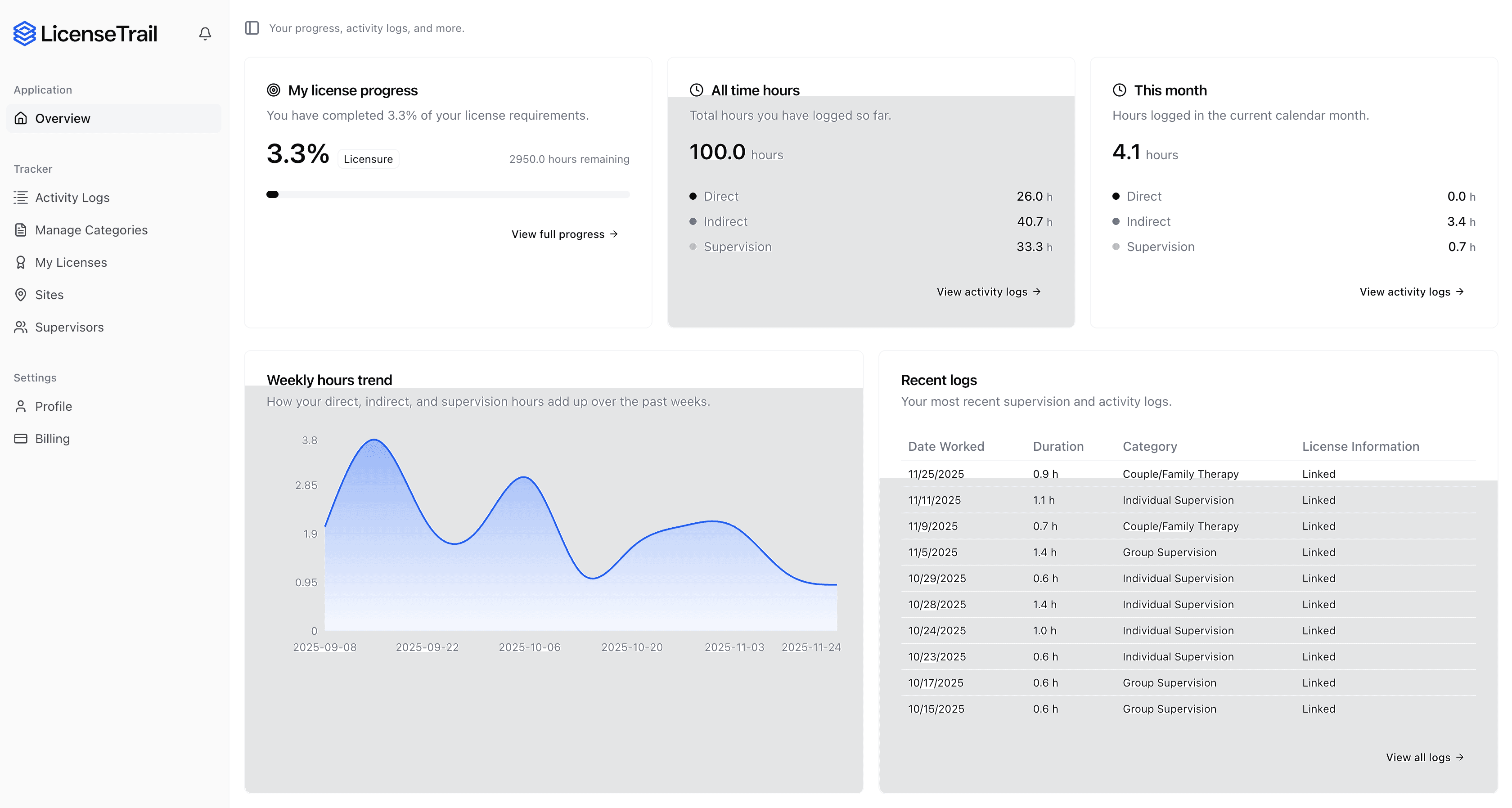
License Trail checks your direct, indirect, and supervision hours against Missouri LCSW requirements continuously and flags mismatches before you submit.
 Start Tracking for Free
No credit card required · Free plan available
Is your spreadsheet hiding Missouri LCSW risks?
Stop guessing if your categories match Missouri Committee for Social Workers requirements. License Trail checks your direct, indirect, and supervision hours continuously and flags mismatches before you submit.
Import or log
Bring your spreadsheet or start fresh
Upload your existing tracking spreadsheet and we'll map every hour into the right Missouri Committee for Social Workers categories automatically.
Verify against Missouri
Catch mismatches before the board does
License Trail checks your direct, indirect, and supervision hours against Missouri LCSW requirements continuously.
Export board-ready
One-click clean reports
Generate professional, board-ready reports for supervision meetings and Missouri Committee for Social Workers submissions in seconds.
No credit card required · Free plan available