
Missouri LMFT Requirements: Hours, Exams & Step-by-Step Guide
Stop guessing if your categories match Missouri requirements. License Trail checks your direct, indirect, and supervision hours against LMFT requirements continuously and flags mismatches before you submit.
No credit card required · Free plan available
Quick Requirements Overview
- Education: Graduate degree in MFT or equivalent mental health discipline; COAMFTE/CACREP accepted; otherwise 45 semester hrs/60 quarter hrs covering required core content (incl. practicum/diagnosis/ethics).
- Pre-licensure setup: Register board-approved supervision (fees, transcripts, background check) to practice as PLMFT or S‑MFT; no independent/private practice; must use correct title.
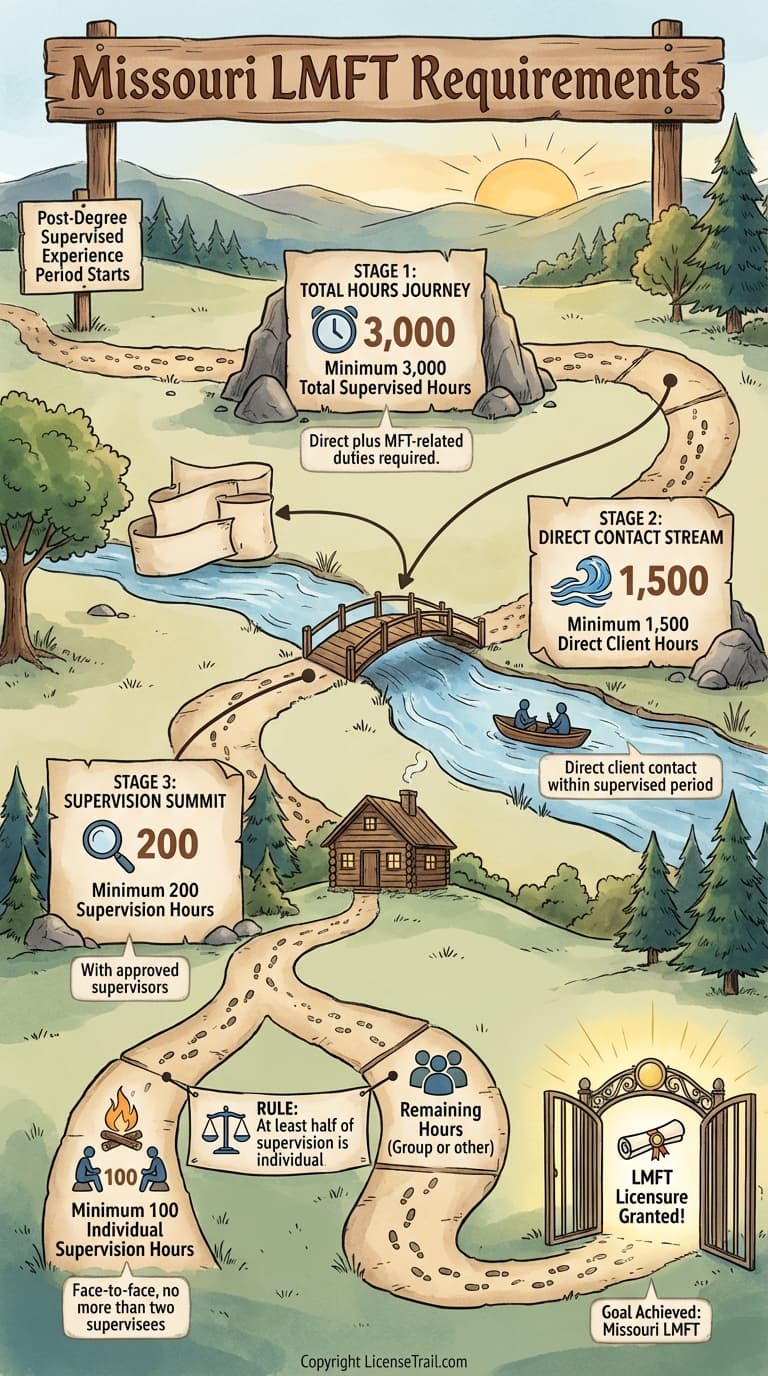
- Postgrad hours (Master’s route): 3,000 total supervised hours, incl. 1,500 direct client contact (face-to-face).
- Postgrad hours (Doctoral/Specialist or +30 post-master credits): typically 1,500 total hours incl. 750 direct client contact.
- Timeframe/minimum activity: Master’s 24–60 months; Doctoral/+30 12–24 months; each counted month needs ≥15 supervised hours.
- Supervision requirement: ≥200 hours face-to-face supervision, incl. ≥100 hours individual; cadence 1 hr/week or 2 hrs/2 weeks; group counts with limits; secure real-time electronic allowed.
- Exam: Pass AMFTRB Examination in Marital and Family Therapy; scores sent directly to the committee.
- LMFT application: Submit application + fee, official transcripts, supervised-experience verification, AMFTRB scores, and fingerprint-based state/FBI background check (plus statutory eligibility: age 18+, legal status, no disqualifying history).
License Details
Procedures
Becoming a Licensed Marital and Family Therapist (LMFT) in Missouri involves a specific sequence of education, supervised clinical work, examination, and formal application with the State Committee of Marital and Family Therapists (under the Missouri Department of Commerce and Insurance). The committee regulates two pre‑licensure designations—Provisional Licensed Marital and Family Therapist (PLMFT) and Supervised Marital and Family Therapist (S‑MFT)—and the full LMFT license. (aamft.org)
Below is a step‑by‑step outline of what Missouri requires, with emphasis on the types and amounts of hours, and the board’s own terminology.
1. Educational foundation
Missouri first requires a qualifying graduate degree and specific coursework.
Degree requirement
You must hold a graduate degree (master’s, specialist, or doctorate) with:
- A major in marriage and family therapy, or
- An “equivalent graduate course of study in a mental health discipline” from a regionally accredited institution acceptable to the U.S. Department of Education. (regulations.justia.com)
Degrees from COAMFTE‑accredited MFT programs or CACREP‑accredited marriage, couple, and family counseling programs are automatically considered to meet Missouri’s education standard. (regulations.justia.com)
If your program is not COAMFTE/CACREP‑accredited, it must include at least 45 semester hours (or 60 quarter hours) in the field and cover all of Missouri’s required core content areas (theoretical foundations; practice of MFT; human development and family studies; ethics and professional studies; research methods; practicum; and diagnostic systems). (regulations.justia.com)
2. Registering for supervision and pre‑licensure status (PLMFT or S‑MFT)
Post‑degree supervised experience must be earned under registered supervision approved by the State Committee. The committee uses two designations for people working toward full LMFT licensure:
- Provisional Licensed Marital and Family Therapist (PLMFT)
- Supervised Marital and Family Therapist (S‑MFT)
You must file a registration of supervision (or change‑of‑supervision form), pay the supervision fee, and submit transcripts and a background check for your supervised clinical experience to count. (law.cornell.edu)
Missouri explicitly requires that PLMFTs and S‑MFTs:
- Work under the “full order, control, oversight, and guidance” of the registered supervisor.
- Not engage in independent or private practice outside the approved supervision setting.
- Use the titles PLMFT or “provisional licensed marital and family therapist” when provisionally licensed, and S‑MFT or “supervised marital and family therapist” when supervised but not provisionally licensed. (law.cornell.edu)
3. Post‑graduate supervised clinical experience: master’s‑level route
Missouri’s rules define the structure of supervised experience in detail. For most applicants (master’s‑level), the widely used summary—based on state board information compiled by national organizations—is:
- Total supervised experience: 3,000 hours post‑degree.
- Of these, at least 1,500 hours must be direct client contact in marriage and family therapy. (aamft.org)
Missouri regulations then define how those hours must be organized and what counts.
3.1 Direct client contact hours
The State Committee requires:
- At least 1,500 hours of “supervised experience in marital and family therapy direct client contact.” (law.cornell.edu)
The rule further defines direct client contact as “face‑to‑face interaction between the client and [the] PLMFT or S‑MFT.” (law.cornell.edu)
In practice, these are your therapy sessions (individual, couple, or family), conducted in person or via secure, real‑time audio‑video if approved as “electronic” face‑to‑face supervision/contact.
3.2 Time frame and monthly minimum
Your supervised experience must occur within:
- No less than 24 calendar months and no more than 60 calendar months (2–5 years). (law.cornell.edu)
To have a month count toward this requirement, the PLMFT or S‑MFT:
- Must obtain at least 15 hours of supervised experience within that calendar month (these are client‑contact + related supervised activities). (law.cornell.edu)
3.3 Supervision hours and structure
Missouri is also very specific about supervision itself. Acceptable supervision must include:
- Frequency:
- A minimum of two hours every two weeks or one hour every week of face‑to‑face supervision with the registered supervisor. (law.cornell.edu)
- Total amount:
- At least 200 hours of supervision, of which at least 100 hours must be “individual face‑to‑face supervision.” (law.cornell.edu)
The committee defines these supervision formats:
- Individual face‑to‑face supervision is a minimum of 50 continuous minutes with no more than two PLMFTs or S‑MFTs present. (law.cornell.edu)
- Group supervision may include 3–6 PLMFTs or S‑MFTs (or a mix), and is also counted in continuous 100‑minute blocks when two hours are required. (law.cornell.edu)
Supervision can be conducted via secure, real‑time electronic methods if both parties ensure audio‑visual interaction and HIPAA‑appropriate privacy and data protection. (law.cornell.edu)
Putting the master’s‑level route together (typical interpretation)
Based on the State Committee’s regulations and published summaries:
- 3,000 total hours of supervised post‑degree work experience, of which:
- 1,500 hours are direct client contact (as defined above),
- The remaining 1,500 hours are other supervised professional activities (documentation, consultation, training, etc.),
- With at least 200 hours of face‑to‑face supervision, at least 100 individual and the remainder individual or group, at a rate of 1 hour/week or 2 hours every 2 weeks. (aamft.org)
4. Doctoral/specialist or 30‑hour post‑master pathway
For applicants who have:
- A specialist or doctoral degree in MFT or a mental health discipline, or
- At least 30 semester hours of post‑master graduate coursework in MFT or a mental health discipline that meets Missouri’s standards,
the supervised experience requirement is smaller but structured similarly.
Missouri regulations specify:
- At least 750 hours of supervised experience in marital and family therapy direct client contact, to be completed in no less than 12 months and no more than 24 months, with the same minimum of 15 hours of supervised experience per month rule. (law.cornell.edu)
National and board‑derived summaries interpret this as:
- 1,500 total supervised hours, including 750 direct client contact hours, plus supervision meeting the same frequency/structure requirements described above. (aamft.org)
5. Examination requirement
Before you can be licensed as an LMFT, Missouri requires you to pass the national licensing exam:
- Officially called the “Examination in Marital and Family Therapy” developed by the Association of Marital and Family Therapy Regulatory Boards (AMFTRB). (regulations.justia.com)
Your official exam scores must be sent directly to the State Committee as part of your LMFT application file. (regulations.justia.com)
6. Applying for the LMFT license
Once education, supervised experience, and examination are complete, you apply to the State Committee for LMFT licensure.
A complete LMFT application file must include: (regulations.justia.com)
- Completed LMFT application form (on committee‑approved forms).
- Application fee.
- Official graduate transcripts sent directly from your institution(s).
- Documentation of post‑degree supervised experience that complies with 20 CSR 2233‑2.020 (this typically includes verification forms from your registered supervisor[s]).
- Official scores from the AMFTRB Examination in Marital and Family Therapy.
- Criminal background check with fingerprints submitted through the Missouri State Highway Patrol’s approved vendor, covering both state and FBI records.
By statute, you must also:
- Be at least 18 years old.
- Be a U.S. citizen or legal resident alien.
- Have the required 24 months of postgraduate supervised clinical experience (which the regulations operationalize as the 1,500‑direct‑hour/3,000‑total structure described above).
- Not have disqualifying criminal history as defined in Missouri law. (law.justia.com)
7. Snapshot: Hour and supervision requirements at a glance
Master’s‑level (most common route)
- Total supervised post‑degree experience: 3,000 hours. (aamft.org)
- Direct client contact: Minimum 1,500 hours of “marital and family therapy direct client contact” (face‑to‑face interaction with clients). (law.cornell.edu)
- Supervision: At least 200 hours total face‑to‑face supervision, at least 100 hours individual, delivered at 1 hr/week or 2 hrs every 2 weeks. (law.cornell.edu)
- Time frame: Accumulated in 24–60 months, with at least 15 hours of supervised experience per calendar month for that month to count. (law.cornell.edu)
Doctoral/specialist or 30‑hour post‑master route
- Total supervised experience: 1,500 hours. (aamft.org)
- Direct client contact: Minimum 750 hours of direct client contact, under the same definition. (law.cornell.edu)
- Supervision: Same structure as above (face‑to‑face, 200 hours with at least 100 individual, weekly/bi‑weekly frequency). (law.cornell.edu)
- Time frame: Completed in 12–24 months, with at least 15 supervised hours per month. (law.cornell.edu)
Taken together, these requirements reflect the Missouri State Committee’s emphasis on substantial “direct client contact” under clearly structured, intensive supervision before granting the LMFT license.
Track your LMFT hours with confidence
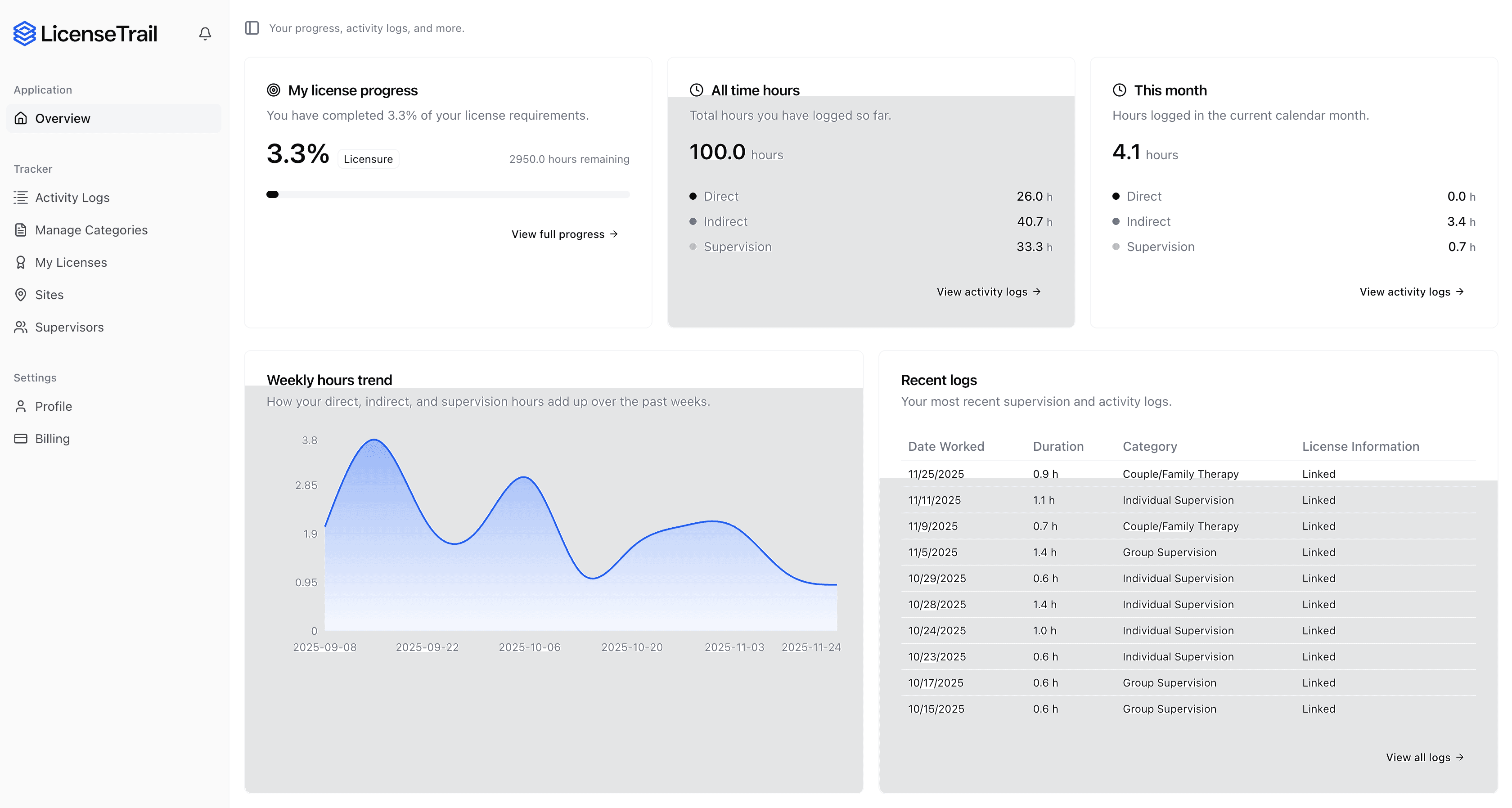
License Trail checks your direct, indirect, and supervision hours against Missouri LMFT requirements continuously and flags mismatches before you submit.
 Start Tracking for Free
No credit card required · Free plan available
Is your spreadsheet hiding Missouri LMFT risks?
Stop guessing if your categories match Missouri State Committee of Marital and Family Therapists requirements. License Trail checks your direct, indirect, and supervision hours continuously and flags mismatches before you submit.
Import or log
Bring your spreadsheet or start fresh
Upload your existing tracking spreadsheet and we'll map every hour into the right Missouri State Committee of Marital and Family Therapists categories automatically.
Verify against Missouri
Catch mismatches before the board does
License Trail checks your direct, indirect, and supervision hours against Missouri LMFT requirements continuously.
Export board-ready
One-click clean reports
Generate professional, board-ready reports for supervision meetings and Missouri State Committee of Marital and Family Therapists submissions in seconds.
No credit card required · Free plan available