
Missouri LPC Requirements: Hours, Exams & Step-by-Step Guide
Stop guessing if your categories match Missouri requirements. License Trail checks your direct, indirect, and supervision hours against LPC requirements continuously and flags mismatches before you submit.
No credit card required · Free plan available
Quick Requirements Overview
- Degree: Master’s/specialist/doctoral with a major in counseling from a regionally accredited institution; core content areas required
- Credit hours: 48 sem hrs (enrolled before 8/28/2023) or 60 sem hrs (enrolled on/after 8/28/2023)
- Practicum/Internship: 600 clock hours incl. 240 face-to-face counseling (telehealth allowed if HIPAA-compliant)
- Diagnosis coursework: 3 graduate semester hours in diagnostic systems/diagnosis (in-degree or post-master’s)
- Supervised practice registration: Post-degree hours must be committee-approved under an LPC/psychologist/psychiatrist; typically via CIT/PLPC
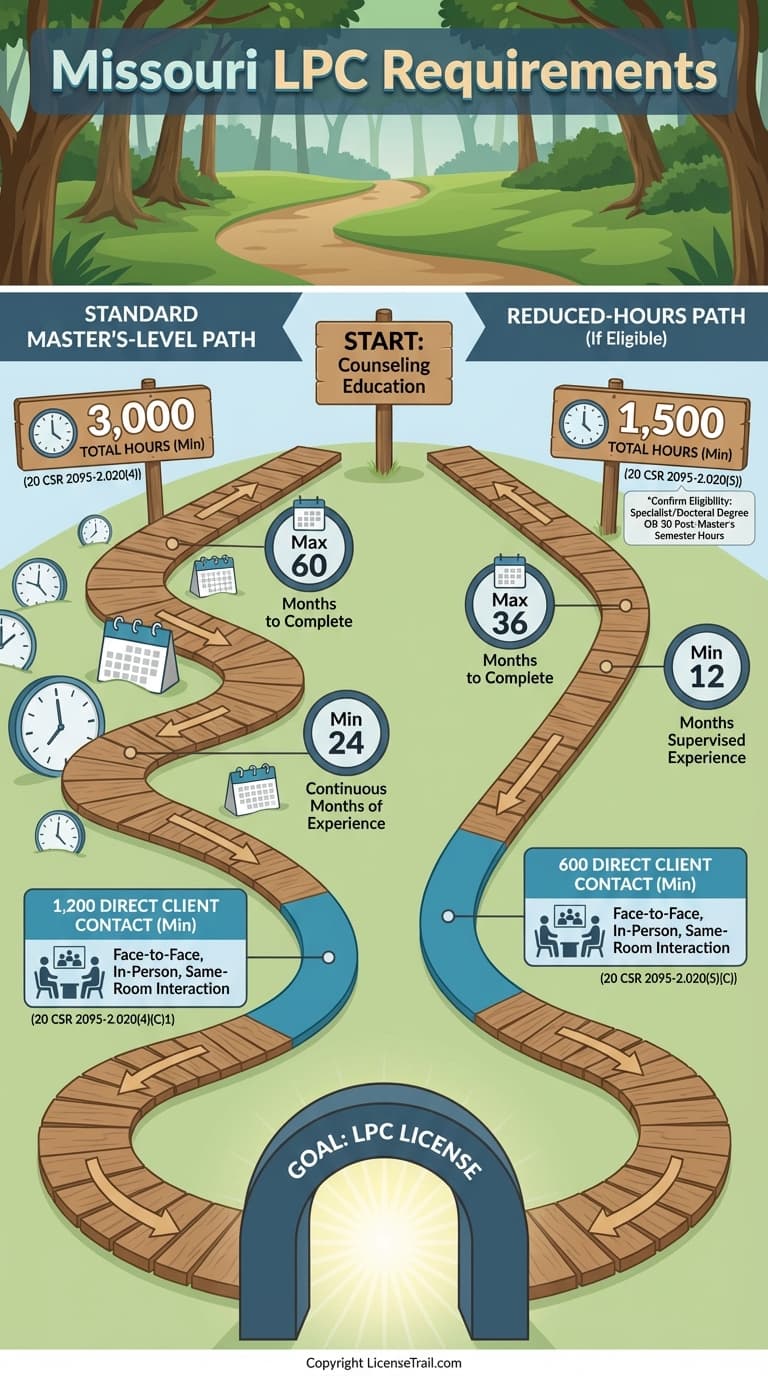
- Post-degree hours (Master’s path): 3,000 total within 60 months; 24 months (avg 15 hrs/week); 1,200 direct client contact
- Supervision & setting rules: 1 hr/week face-to-face supervision (individual at least 2 wks/month; group allowed up to 2 wks/month, max 3); no private practice; fees paid to supervisor/org
- Other LPC requirements: Pass NCE + MO jurisprudence exam; 2 hrs suicide prevention training; fingerprinting/background check (repeat if >2 years)
License Details
Procedures
Missouri licenses professional counselors through the Committee for Professional Counselors in the Department of Commerce and Insurance. To become a Licensed Professional Counselor (LPC) in Missouri, you move through three broad stages: (1) education, (2) supervised post‑degree practice as a Counselor-in-Training (CIT) and/or Provisional Licensed Professional Counselor (PLPC), and (3) full LPC licensure after completing exams and hours.
Below is an organized walkthrough with the state’s own terminology and hour requirements.
1. Educational requirements
Missouri’s education rule is 20 CSR 2095‑2.010, “Educational Requirements.” It requires a graduate degree with a major in counseling at the master’s, specialist, or doctoral level from a regionally accredited institution (“acceptable educational institution”). (regulations.justia.com)
Key points:
- The degree must be in counseling (or another qualifying mental health discipline under the rule) and “consist of a course of study with a major in counseling.” (regulations.justia.com)
- The program must include specific core areas (counseling theory, human development, social and cultural diversity, helping relationships, group counseling, career development, appraisal, research, practicum/internship, professional orientation/ethics, diagnosis). (regulations.justia.com)
- Practicum/internship must include at least 600 clock hours, with at least 240 hours of face‑to‑face counseling, which may include HIPAA‑compliant telehealth. (regulations.justia.com)
Credit-hour minimums:
- If enrolled before August 28, 2023: at least 48 semester hours (or 72 quarter hours) for a master’s with a major in counseling. (regulations.justia.com)
- If enrolled on or after August 28, 2023: at least 60 semester hours (or 90 quarter hours). (regulations.justia.com)
Statute §337.510 also requires at least 3 graduate-level semester hours in diagnostic systems/diagnosis of mental and emotional disorders, which may be in-degree or as post‑master’s graduate coursework. (law.justia.com)
2. Entering supervised practice: CIT / PLPC
Before you can count post‑degree experience toward licensure, Missouri requires that your supervised counseling experience be registered with and approved by the committee. The regulations refer to this as “acceptable supervised counseling experience.” (law.cornell.edu)
- You typically apply as a Counselor‑in‑Training (CIT) or Provisional Licensed Professional Counselor (PLPC).
- Supervision must be from a licensed professional counselor, licensed psychologist, or psychiatrist whose license is active (not provisional, expired, temporary, retired, probated, or suspended). (law.cornell.edu)
- The supervised experience must begin after the qualifying graduate degree is conferred (post‑degree hours). (law.cornell.edu)
The Missouri Counseling Association’s application guidance mirrors the board’s rules: applicants may become a CIT, accumulate supervision hours, pass the NCE, and eventually move to LPC. (mocounselingassociation.org)
3. Post‑degree supervised counseling experience: hours and structure
Missouri uses the specific phrase “supervised counseling experience” and defines the numbers and composition in 20 CSR 2095‑2.020. The totals depend on whether your highest qualifying degree is master’s versus specialist or doctoral.
A. If you qualify based on a master’s degree
Under 20 CSR 2095‑2.020(4), an applicant approved for supervision or provisional licensure based upon a master’s degree must obtain, within no more than 60 calendar months:
-
Total supervised hours
- “A minimum of three thousand (3,000) total hours of supervised counseling experience.” (law.cornell.edu)
-
Minimum time span
- “A minimum of twenty‑four (24) calendar months of continuous supervised counseling experience.” (law.cornell.edu)
- You must average at least 15 hours of supervised counseling experience per week. If you can’t maintain that, you must notify the committee in writing and they decide if the hours are acceptable. (law.cornell.edu)
-
Direct client contact requirement
- Of the 3,000 hours, at least 1,200 hours must be direct client contact. (law.cornell.edu)
- “Direct client contact” is specifically defined as face‑to‑face interaction between the client/patient or group and the counselor‑in‑training or PLPC in the same room. (law.cornell.edu)
The Missouri Counseling Association summarizes this for LPC as: a “minimum total of 3000 hours (minimum of 1200 of those hours are direct client) AND 24 months of counseling directly under a Missouri Approved Supervisor or approved hours from another state.” (mocounselingassociation.org)
B. If you qualify based on a specialist or doctoral degree, or 30 post‑master’s hours
For an applicant whose supervision is approved based on a specialist or doctoral degree in counseling or another approved mental health discipline, or based on thirty (30) hours of post‑master’s coursework in such a discipline, 20 CSR 2095‑2.020(5) requires, within no more than 36 calendar months: (regulations.justia.com)
-
Total supervised hours
- “A minimum of fifteen hundred (1,500) hours of supervised counseling experience.” (regulations.justia.com)
-
Minimum time span
- “A minimum of twelve (12) calendar months of supervised counseling experience,” averaging at least 15 hours per week, with the same requirement to explain in writing if that average cannot be met. (regulations.justia.com)
-
Direct client contact requirement
- At least 600 hours of the supervised counseling experience must be direct client contact. (regulations.justia.com)
4. Nature of supervised experience and work setting rules
The supervised counseling experience must fall within the scope of practice of professional counseling as defined in §337.500(6)–(7) RSMo and the regulations. (law.cornell.edu)
Key practice‑setting rules in 20 CSR 2095‑2.020: (law.cornell.edu)
- The counselor‑in‑training or PLPC, and the registered supervisor, must be employed at the same counseling setting or affiliated to the setting by contract.
- A CIT or PLPC may not operate a private practice.
- A CIT/PLPC may work in a licensee’s private practice, but must work under the “order, control, oversight, and guidance” of the registered supervisor.
- Payment for counseling services provided by a CIT or PLPC must be made to the supervisor or the employing/affiliated organization, not to the CIT/PLPC directly.
Documentation and title use: (law.cornell.edu)
- Treatment records must list the CIT/PLPC’s name and credentials, plus the registered supervisor’s name and license number.
- Acceptable acronyms: “CIT” (Counselor‑in‑Training) and “PLPC” (Provisional Licensed Professional Counselor). No other acronyms are allowed for these roles.
Advertising: a CIT or PLPC cannot engage in marketing/advertising without including the registered supervisor’s name and license number. (law.cornell.edu)
5. Supervision requirements (frequency and format)
Missouri sets specific requirements for how supervision itself is delivered: (law.cornell.edu)
- A CIT or PLPC must receive at least one hour of face‑to‑face supervision per week from the registered supervisor.
- At least two weeks per month must be one hour per week of individual face‑to‑face supervision with the registered supervisor.
- Up to two weeks per month may be satisfied with one hour per week of group face‑to‑face supervision, facilitated by the registered supervisor, with no more than three CITs/PLPCs in the group.
- If more than three supervisees/professionals are present, the time may count toward the total 3,000 (or 1,500) supervised hours, but does not count as the required weekly face‑to‑face supervision hour.
- Electronic communication (phone/Internet) can only count if it is simultaneously visually and verbally interactive (e.g., secure video with audio), meeting the regulation’s standard for face‑to‑face interaction.
All face‑to‑face supervision hours are included in the total supervised experience hours (i.e., they are part of the 3,000 or 1,500 hours, not in addition). (law.cornell.edu)
6. Examinations
Missouri currently requires two main exams for LPC:
-
National Counselor Examination (NCE)
- Applicants must pass the NCE, and NBCC must send results directly to the Committee for Professional Counselors. (mocounselingassociation.org)
-
Missouri Professional Counselors Jurisprudence Exam
- This is a Missouri‑specific exam covering statutes and regulations; applicants must complete and pass it before full LPC licensure. (mocounselingassociation.org)
The statute also requires that, “upon examination,” the applicant demonstrate knowledge of professional techniques and applications, research, and professional affairs and ethics. (law.justia.com)
7. Suicide prevention training
The Committee enforces a specific suicide‑prevention training requirement:
- Applicants for LPC must complete 2 hours of suicide prevention training.
- The Committee notes that, after January 1, 2019, applicants for initial licensure must maintain documentation of compliance; the two hours may come from the graduate program or self‑study, as long as it meets the board’s standard. (pr.mo.gov)
The Missouri Counseling Association explicitly lists “Completed 2 hours of suicide prevention training” as a requirement when applying for LPC. (mocounselingassociation.org)
8. Background checks and character requirements
Missouri requires:
- A criminal background check/fingerprinting at the time of applying for CIT/PLPC and again for LPC if more than 2 years have passed since the previous check. (mocounselingassociation.org)
- The board also evaluates whether the applicant is of good moral character and fit to practice, per the general licensing statute (this is standard across Missouri professions).
You’ll use the registration number and process specified by the board for the check; current guidance lists a specific registration code and portal (subject to change, so always verify on the board’s website). (mocounselingassociation.org)
9. Applying for full LPC licensure
Once all supervised experience, training, and exams are completed, you apply to transition from CIT/PLPC to LPC.
Typical LPC application components (per board and Missouri Counseling Association guidance): (mocounselingassociation.org)
-
Verification of supervised counseling experience
- Supervisor completes the “Verification for Post Degree Supervision” form documenting:
- Total supervised hours (3,000 or 1,500 depending on your pathway).
- Direct client contact hours (1,200 or 600).
- Duration in months and average weekly hours.
- Supervisor completes the “Verification for Post Degree Supervision” form documenting:
-
Experience timeline
- Must show you met:
- Master’s pathway: 3,000 hours, including 1,200 direct client contact, over at least 24 months, within no more than 60 months. (law.cornell.edu)
- Specialist/Doctoral or 30‑post‑master’s pathway: 1,500 hours, including 600 direct client contact, over at least 12 months, within no more than 36 months. (regulations.justia.com)
- Must show you met:
-
Proof of education
- Official transcripts showing the qualifying degree, core coursework, practicum/internship, and required diagnostic coursework. (regulations.justia.com)
-
Exam documentation
- Official NCE score report sent directly to the Committee.
- Proof of passing the Missouri jurisprudence exam. (mocounselingassociation.org)
-
Suicide prevention training documentation
- Certificates or documentation showing completion of at least 2 hours of approved suicide prevention training. (pr.mo.gov)
-
Background check results
- Current (or recent within 2 years) state‑approved background check/fingerprinting results. (mocounselingassociation.org)
-
Application form and fee
- Completion of the LPC application form provided by the Committee for Professional Counselors.
- Current guidance lists a $100 application fee for LPC, payable to the Missouri Committee for Professional Counselors (check the board website for any fee updates). (mocounselingassociation.org)
10. Summary of hour requirements in Missouri wording
Using Missouri’s own structure and terminology:
-
For most master’s‑level applicants:
- 3,000 total hours of supervised counseling experience, obtained within no more than 60 months.
- At least 24 months of continuous supervised counseling experience, averaging at least 15 hours per week.
- At least 1,200 hours of direct client contact, defined as face‑to‑face interaction with the client or group in the same room. (law.cornell.edu)
-
For those qualifying via specialist or doctoral degree (or 30 post‑master’s hours):
- 1,500 total hours of supervised counseling experience, within no more than 36 months.
- At least 12 months of supervised counseling experience, averaging at least 15 hours per week.
- At least 600 hours of direct client contact. (regulations.justia.com)
In all cases, the supervised experience must be approved by the Committee, under a qualifying supervisor, in an appropriate counseling setting, with weekly face‑to‑face supervision as defined in 20 CSR 2095‑2.020. (law.cornell.edu)
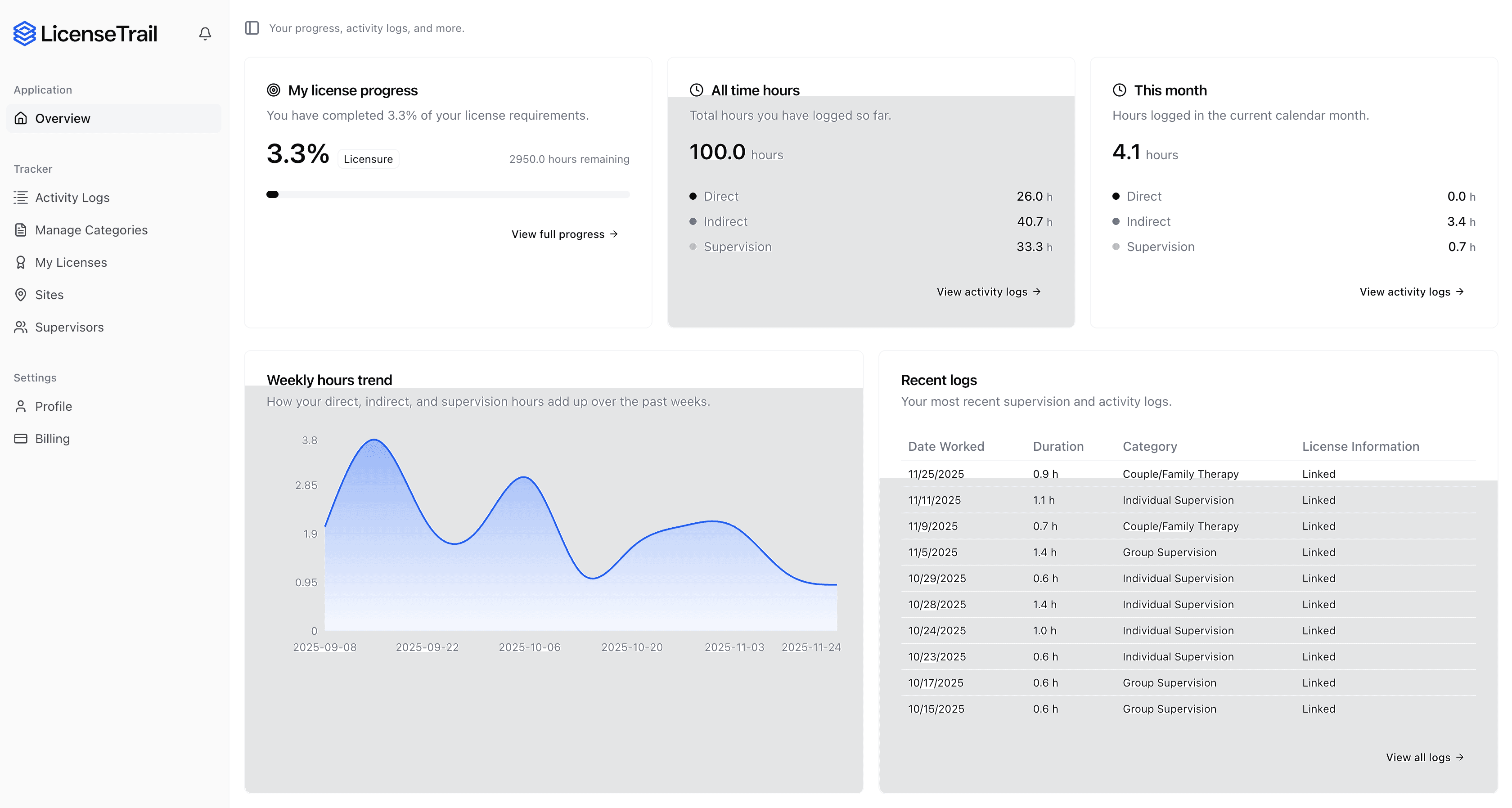
Track your LPC hours with confidence
License Trail checks your direct, indirect, and supervision hours against Missouri LPC requirements continuously and flags mismatches before you submit.
 Start Tracking for Free
No credit card required · Free plan available
Is your spreadsheet hiding Missouri LPC risks?
Stop guessing if your categories match Missouri Committee for Professional Counselors requirements. License Trail checks your direct, indirect, and supervision hours continuously and flags mismatches before you submit.
Import or log
Bring your spreadsheet or start fresh
Upload your existing tracking spreadsheet and we'll map every hour into the right Missouri Committee for Professional Counselors categories automatically.
Verify against Missouri
Catch mismatches before the board does
License Trail checks your direct, indirect, and supervision hours against Missouri LPC requirements continuously.
Export board-ready
One-click clean reports
Generate professional, board-ready reports for supervision meetings and Missouri Committee for Professional Counselors submissions in seconds.
No credit card required · Free plan available