
Missouri LP Requirements: Hours, Exams & Step-by-Step Guide
Stop guessing if your categories match Missouri requirements. License Trail checks your direct, indirect, and supervision hours against LP requirements continuously and flags mismatches before you submit.
No credit card required · Free plan available
Quick Requirements Overview
- Doctoral degree in psychology from a recognized institution; APA/CPA/PCSAS-accredited (or equivalent per §337.025/20 CSR 2235-2.005).
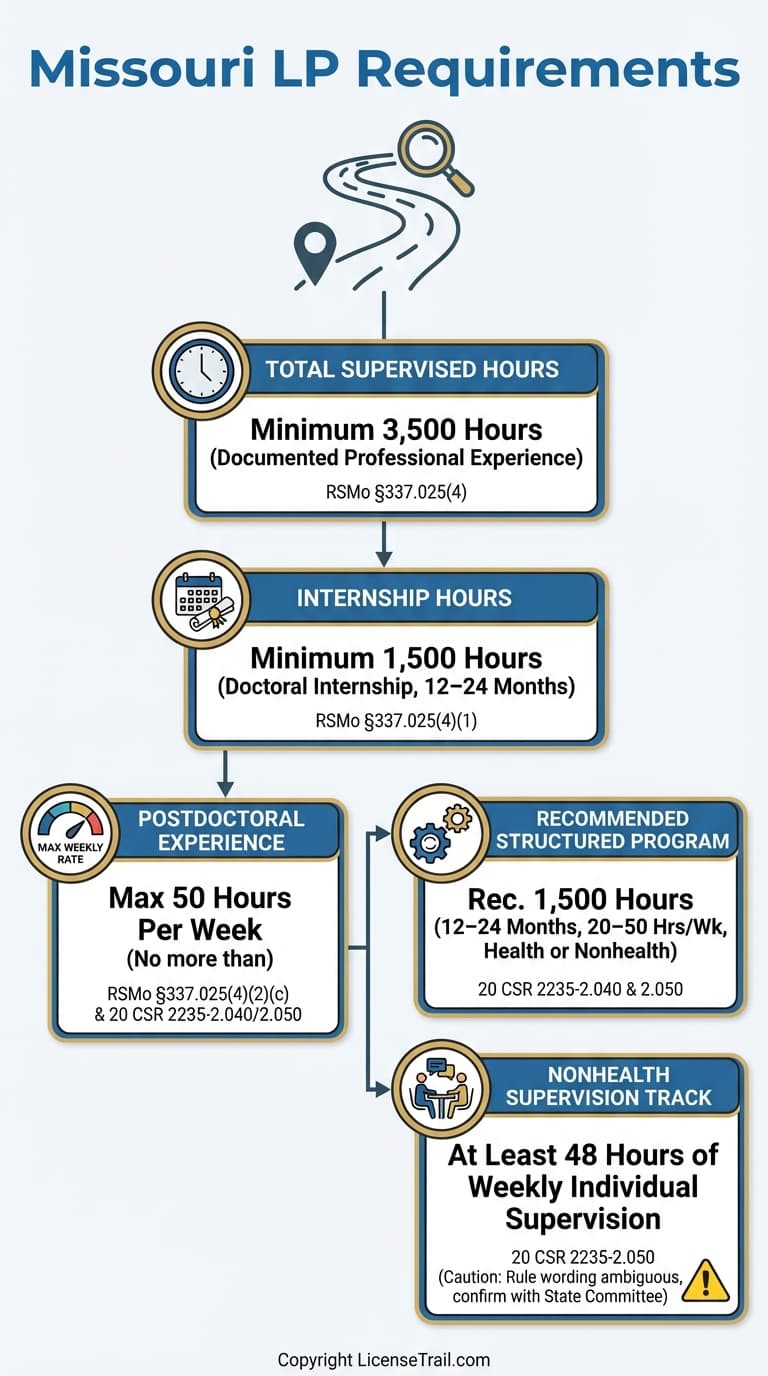
- Supervised experience minimum 3,500 hours total (§337.025.4).
- Internship: at least 1,500 hours, completed in 12–24 months.
- Additional supervised experience: at least 2,000 hours; may include preinternship/predoctoral postinternship, up to 750 extra internship hours, and/or postdoctoral hours.
- Rules require ≥1,500 postdoctoral hours in 12–24 months, 20–50 hrs/week, in organized training (health: 20 CSR 2235-2.040; nonhealth: 20 CSR 2235-2.050).
- Postdoc content/supervision: ≥10 hrs/week direct client contact, ≥5 hrs/week professional learning, and ≥1 hr/week face-to-face individual supervision (group doesn’t count); supervisor must be qualified, not related, and limited supervisee load.
- Provisional LP available after doctorate to practice while completing postdoc hours/exams (per §337.010 definitions).
- Exams: EPPP, MO jurisprudence (≥70%), and oral exam; EPPP + jurisprudence required before oral (20 CSR 2235-2.060).
License Details
Procedures
Becoming a Licensed Psychologist (LP) in Missouri is governed by both statute (Chapter 337, RSMo) and rules of the State Committee of Psychologists (Title 20 CSR 2235). For new applicants, the governing statute is §337.025, which sets doctoral-level education and experience requirements.(codes.findlaw.com)
Below is a step‑by‑step overview, with special attention to how many hours are required, what types of hours count, and how Missouri’s rules describe them.
1. Who this pathway applies to
Missouri uses §337.025 RSMo to define education and experience requirements for initial licensure as a psychologist for:
- Anyone who did not begin a primarily psychological graduate program on or before August 28, 1990, and
- Anyone matriculated after that date in a program designed to train professional psychologists.(codes.findlaw.com)
In practice, this covers almost all current applicants seeking an LP in 2025.
2. Educational requirement: doctoral degree in psychology
You must submit evidence that you have:
- A doctoral degree in psychology from a “recognized educational institution.”(codes.findlaw.com)
Missouri statute defines accepted doctoral programs in two broad ways:
- Accredited/recognized programs – A program accredited or provisionally accredited by APA, CPA, or PCSAS that includes supervised practicum/internship training appropriate to practice.(codes.findlaw.com)
- Non‑accredited but equivalent programs – Programs that meet specific content requirements (biological, cognitive‑affective, social bases of behavior; individual differences; research methods, etc.) and include appropriate supervised training, as set out in §337.025.3.(codes.findlaw.com)
The Committee’s rules in 20 CSR 2235‑2.005 further detail what counts as acceptable coursework and program structure (e.g., minimum credit hours, residency, dissertation), but the core idea is: a doctoral program in psychology that meets statutory and regulatory standards.
3. Key supervised experience concepts in Missouri law
Missouri uses a specific vocabulary for supervised hours. §337.010 defines:(law.justia.com)
- “Preinternship” – Any supervised hours acquired as a student in a doctoral program before internship, including supervised practicum.
- “Internship” – Supervised hours in a formal internship (12–24 months) after all doctoral coursework is completed, but before the degree is awarded. Internship is part of completing the doctorate.
- “Predoctoral postinternship” – Supervised hours after internship but before the doctoral degree is conferred.
- “Postdoctoral experiences” – Supervised clinical activities after the doctoral degree is completed. A person “shall not be licensed until” these additional supervised hours are satisfied.
All of these can contribute to the supervised experience required for licensure, but they are not interchangeable in any proportion—Missouri law sets minimums and structure.
4. Total supervised experience required: structure and hour counts
4.1 Statutory minimum: 3,500 hours total
Under §337.025.4, “acceptable supervised professional experience” must be verified by your academic training director or postdoctoral supervisor and must consist of:(law.justia.com)
-
Internship: at least 1,500 hours
- A “minimum of fifteen hundred hours of experience in a successfully completed internship” completed over 12–24 months.
-
Additional supervised experience: at least 2,000 hours, made up of any combination of:
- Preinternship and predoctoral postinternship hours (after at least the first year of doctoral training, or after a master’s in psychology within the doctoral program).
- Up to 750 additional internship hours beyond the core 1,500 hours in the same internship.
- Postdoctoral professional experience, completed within no more than 24 consecutive months, at no more than 50 hours per week, and involving delivery of psychological services relevant to your intended practice area.
So, by statute, the minimum supervised experience is:
- 1,500 internship hours
- 2,000 additional supervised hours
- Total minimum: 3,500 supervised hours
4.2 Board rules: minimum 1,500 hours of postdoctoral supervised experience
The regulations adopted by the State Committee of Psychologists then define what “postdoctoral supervised professional experience” must look like under §337.025.
There are two parallel rules, depending on whether your practice is in health services or not:
- 20 CSR 2235‑2.040 – For delivery of psychological health services
- 20 CSR 2235‑2.050 – For delivery of nonhealth psychological services
Both rules require:
- Postdoctoral supervised professional experience shall consist of a minimum of 1,500 hours of professional experience in the delivery of psychological (health) services, obtained in no fewer than 12 and no more than 24 months, at 20–50 hours per week.(law.cornell.edu)
In other words, the Committee’s rules make at least 1,500 of your 2,000 “additional” hours postdoctoral, even though the statute allows those 2,000 hours to be any combination of pre‑, intra‑, and postdoctoral experience.
Practical takeaway for a standard applicant today
For someone following the usual contemporary route in Missouri:
- Internship:
- 1,500 supervised hours minimum (12–24 months).
- Postdoctoral supervised experience:
- At least 1,500 hours in 12–24 months, 20–50 hours/week, in an approved organized training program.
- Remaining 500+ hours (to reach 3,500 total):
- Typically met with preinternship practicum, predoctoral postinternship hours, and/or internship hours beyond the core 1,500, as allowed by §337.025.4(2).(law.justia.com)
5. What “counts” within postdoctoral supervised professional experience
The Board’s rules are very specific about the nature of those 1,500 postdoctoral hours.
5.1 Time and structure
For health service providers (20 CSR 2235‑2.040):
- Minimum 1,500 hours of professional experience providing psychological health services.
- Must be completed in 12–24 months at 20–50 hours per week.
- Must occur in a postgraduate organized training program that is:
- APA‑accredited or provisionally accredited or
- A member of APPIC or
- Documented by the training program as meeting APA/APPIC standards or
- Substantially equivalent to those standards or
- A program that:
- Provides direct training and experience in delivery of psychological health services, with at least 10 hours/week of direct client contact,
- Employs or affiliates supervisors on‑site,
- Includes at least 5 hours per week of “professional learning experiences” (e.g., treatment team meetings, case conferences, didactics, research, teaching), as detailed in the rule.(law.cornell.edu)
For nonhealth delivery (20 CSR 2235‑2.050), the structure is similar but focused on “psychological services” rather than “psychological health services,” and the rule likewise requires 1,500 hours under defined program and supervision conditions.(regulations.justia.com)
5.2 Supervision requirements
Missouri emphasizes close, individual supervision:
- The supervisee’s activities must be under the supervisor’s “order, control, and full professional responsibility.”(law.cornell.edu)
- Supervision must include:
- At least one hour per week of face‑to‑face individual supervision when the supervisor is serving as clinical supervisor.
- Group supervision is not accepted as satisfying these required hours.(law.cornell.edu)
- Supervisors must:
- Be licensed psychologists (for health services, the primary supervisor must be a health service provider or meet those requirements).(law.cornell.edu)
- Not be related to the supervisee (spouse, parent, child, sibling, etc.).
- Supervise no more than four postdegree supervisees at one time, unless granted a variance.(law.cornell.edu)
- Certify to the Committee that the supervisee completed the supervised experience as required, using Committee attestation forms.(law.cornell.edu)
5.3 Representation during supervised experience
Board rules require that while accumulating postdoctoral supervised professional experience:(law.cornell.edu)
- You must present yourself to clients in a manner consistent with the definitions in 20 CSR 2235‑1.015 (e.g., as a psychological resident or provisionally licensed psychologist, not as an independent psychologist).
- Your name must not appear in directories as independently providing psychological services.
- Your professional correspondence must list the primary supervising psychologist’s name and license number.
6. Provisional licensure while you complete postdoctoral hours
Missouri law defines a “provisional licensed psychologist” as someone who:(law.justia.com)
- Holds a doctoral degree in psychology as defined in §337.025, and
- Meets all requirements to be licensed except:
- Passing the licensing examinations (EPPP, jurisprudence, oral), and
- Completing the required period of postdegree supervised experience.
Most new graduates in Missouri obtain this provisional license to lawfully deliver services while logging their postdoctoral supervised professional experience under an approved supervision agreement.
7. Examination requirements for full LP licensure
Once educational and supervised experience requirements are met (or concurrently, if on a provisional license), applicants must pass three examinations specified in 20 CSR 2235‑2.060 (Licensure by Examination):(law.cornell.edu)
- EPPP (Examination for Professional Practice in Psychology) – National objective exam; passing is defined by the exam developer’s current minimum passing score.
- Missouri Jurisprudence Examination – Written exam on Missouri law, regulations, ethics, and professional affairs relevant to psychology; passing requires at least 70% correct.
- Oral Examination – Conducted by the Committee, focusing on ethics, professional practice, and any subject matter relevant to safe practice of psychology.
You must pass the EPPP and jurisprudence exam before being allowed to take or complete the oral exam.
8. Putting it together: a concise pathway summary
For a typical contemporary applicant seeking LP licensure in Missouri under §337.025:
- Complete a qualifying doctoral program in psychology, with appropriate practicum and a formal 12–24‑month internship.(codes.findlaw.com)
- Accrue supervised professional experience that meets all of the following:
- Internship: At least 1,500 hours in a successfully completed, program‑approved internship.
- Additional supervised experience: At least 2,000 hours total, including:
- At least 1,500 hours of postdoctoral supervised professional experience, completed in 12–24 months at 20–50 hours/week in an organized training program meeting 20 CSR 2235‑2.040 (health) or 2.050 (nonhealth), and
- Up to 500 hours (or more, if you exceed minimums) from preinternship and/or predoctoral postinternship experience, and/or additional internship hours (up to 750 beyond the core 1,500).(law.justia.com)
- All supervised experience must be properly supervised, documented, and attested to on Committee forms.
- Hold a provisional license, if needed, while you complete postdoctoral supervised hours and/or exams.(law.justia.com)
- Pass all three required examinations – EPPP, Missouri jurisprudence exam, and oral exam, as defined in 20 CSR 2235‑2.060.(law.cornell.edu)
- Apply for full LP licensure with the State Committee of Psychologists, including official documentation of your doctoral degree, supervised hours broken down by category, and exam scores.
This combination of statutory requirements (particularly 1,500 internship hours + 2,000 additional supervised hours) and Committee rules (especially the 1,500‑hour postdoctoral supervised experience requirement) defines the hour structure and terminology for becoming a Licensed Psychologist in Missouri.
Track your LP hours with confidence
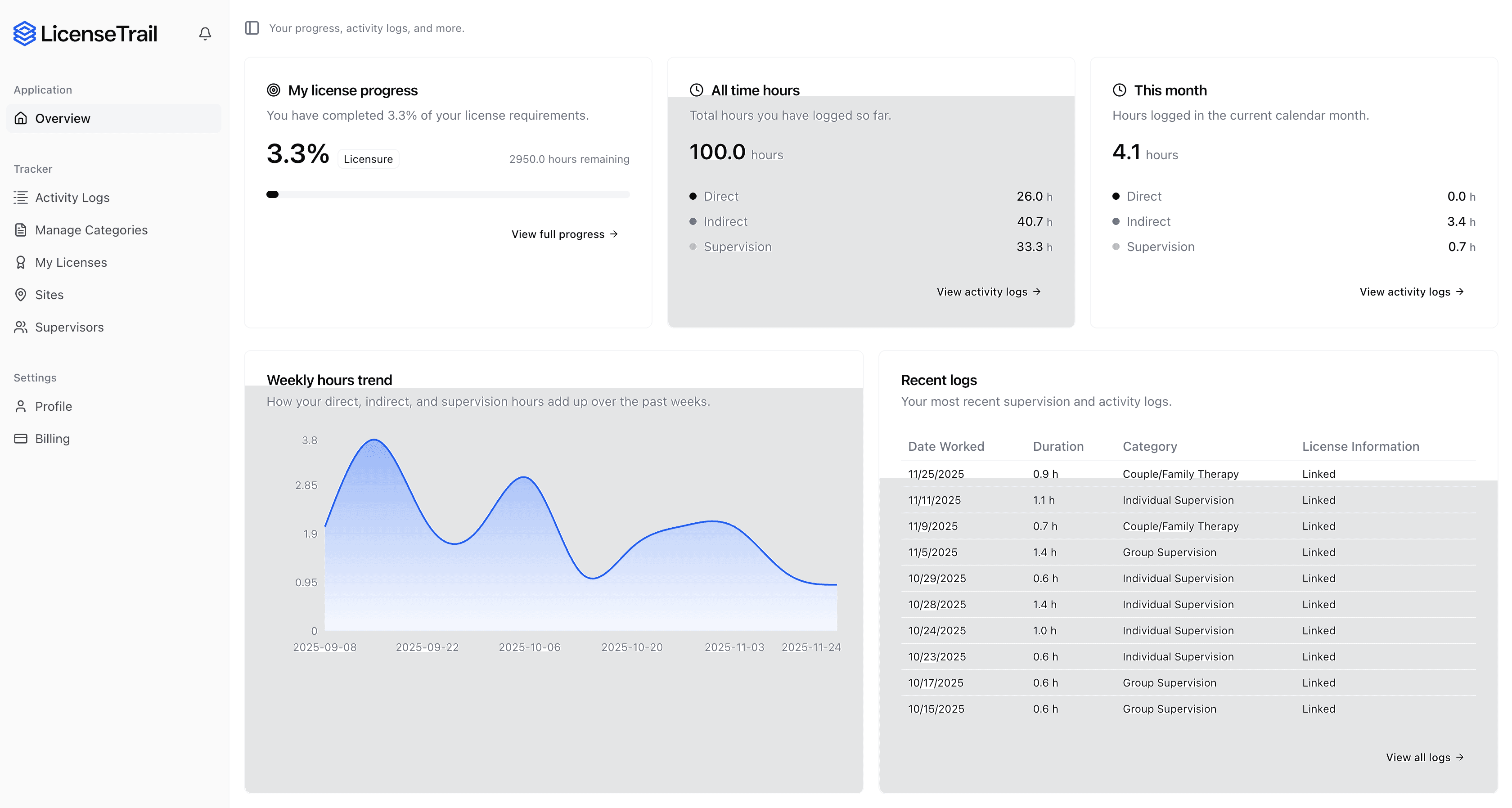
License Trail checks your direct, indirect, and supervision hours against Missouri LP requirements continuously and flags mismatches before you submit.
 Start Tracking for Free
No credit card required · Free plan available
Is your spreadsheet hiding Missouri LP risks?
Stop guessing if your categories match Missouri State Committee of Psychologists requirements. License Trail checks your direct, indirect, and supervision hours continuously and flags mismatches before you submit.
Import or log
Bring your spreadsheet or start fresh
Upload your existing tracking spreadsheet and we'll map every hour into the right Missouri State Committee of Psychologists categories automatically.
Verify against Missouri
Catch mismatches before the board does
License Trail checks your direct, indirect, and supervision hours against Missouri LP requirements continuously.
Export board-ready
One-click clean reports
Generate professional, board-ready reports for supervision meetings and Missouri State Committee of Psychologists submissions in seconds.
No credit card required · Free plan available